Independent Australian and global macro analysis

Wednesday, October 16, 2024

Preview: Labour Force Survey — September

Australia's monthly labour force survey for September is due for release this morning (11:30am AEDT). Resilient labour market conditions to the economic slowdown of the past year or so and elevated inflation continue to underpin the RBA's hawkish narrative as central banks offshore have moved into easing cycles. Although tightness in the labour market has eased, employment has continued to rise solidly and the unemployment rate remains at low levels. Today's report is expected to broadly reaffirm those dynamics.  

August recap: Employment continued to defy expectations  

Employment continued to increase with a 47.5k gain coming through in August, the 5th consecutive upside surprise on expectations. These gains in employment have been driven predominantly by the full time segment; however, in August part time employment (50.6k) accounted for all of the headline increase as full time employment eased (-3.1k). 


With the participation rate holding at a record high (67.1%), the increase in employment in August broadly absorbed the number of workers either entering or returning to the labour force. As a result, the unemployment rate printed at an unchanged 4.2%. Despite the broader underemployment rate lifting from 6.3% to 6.5%, the ABS reported total underutilisation in the labour force remained at 10.6%.  


Hours worked expanded by 0.4% in the month, matching the increase seen in July. Annual growth in hours worked lifted to 1.7%, well down from a 3.2% pace a year earlier. This has been the most responsive part of the labour market to the slowdown in economic growth. 


September preview: Employment expected to moderate; upside risk to unemployment

The main risk going into today's report looks to be an uptick in the unemployment rate should the strong run of employment gains falter. In September, a relatively modest increase in employment of around 23k is expected, with estimates ranging from a low of 10k to 45k on the high side. The expected figure is around where consensus has landed over recent months, which as noted above employment has outperformed in each of the past 5 reports. 

Despite that trend, there may be more confidence from the market in seeing a moderation in employment this time given the relatively modest rises in September in 2022 (19.7k) and 2023 (11.9k). If employment were to moderate as markets anticipate there is upside risk to the consensus forecast for the unemployment rate to hold steady at 4.2% (range: 4.1% to 4.3%) due to record high participation delivering large inflows of workers into the labour force. 

Friday, October 11, 2024

Macro (Re)view (11/10) | US dollar continues to advance

Growth and rate differentials continue to underpin broad-based support for the US dollar. The hawkish repricing of rate cut expectations in the US sees the 2-year treasury yield trading around 4%, at levels last seen in August before the Fed commenced its easing cycle with a 50bps cut. Next week, the ECB is expected to cut by 25bps, increasing the frequency of easing from the quarterly moves the governing council has made so far. Other highlights next week include employment data in the UK (Tue) and Australia (Thu), UK CPI (Wed) and US retail sales (Thu).   


It looks increasingly likely that the Fed's 50bps rate cut will be a one-off move, with the FOMC expected to downsift to more conventional 25bps increments as it moves through its easing cycle. The minutes from the September meeting reported that a 'substantial majority' of FOMC members supported a larger rate cut to start the easing cycle in the US, the move described as a 'recalibration of the stance of monetary policy' with the focus pivoting from returning inflation to target to concerns over the employment side of the dual mandate. However, the qualification that the 50bps cut should not be viewed as a signal of economic weakness or in the pace of easing going forward is consistent with what markets have heard from Fed officials since the September meeting, suggesting that 25bps rate cuts will be the play from here. 

Adding weight to this view is the incoming data, an upside CPI print in September coming on the back of last week's very strong payrolls report. Headline CPI came in at 0.2%m/m to 2.4%yr, down from 2.5% but above the 2.3% consensus while the core rate ticked up from 3.2% to 3.3%yr (vs 3.2% expected). In light of last week's significant upside surprise in payroll employment in September, markets were not dented too significantly by a notable rise in initial jobless claims (+23k to 258k) that was likely impacted by hurricanes.  

The minutes of the RBA's September meeting aligned with Governor Bullock's messaging on decision day that the Board does not have rate cuts on its radar nor is it concerned about policy divergence with many of its central bank peers now lowering rates. A lack of material developments in the run-up to the September meeting meant that it had been a straightforward call for the Board to leave the cash rate on hold (4.35%), while the accompanying guidance that rates would remain 'sufficiently restrictive' until more progress in made on lowering inflation toward its 2-3% target band was left intact. 

Of most interest in the minutes was the Board's discussion around the various scenarios that could influence the path for rates. A 'significant' weakening in economic growth or in the labour market is seen to be the most likely trigger for the Board to move into its easing cycle, while it would also act if inflation slowed more rapidly than forecast. Regarding the latter, the key for the Board will be how slower headline inflation driven by things such as government rebates on energy bills and lower fuel prices feeds through to underlying inflation. 

Alternatively, restrictive policy could be required for longer if household spending responds to the improvement in real incomes and underpins stronger labour market conditions and higher inflation than anticipated. Other factors that could require a more extended period of restrictive policy were the persistence of supply constraints or if post-pandemic productivity growth does not rebound as expected.

Turning to the key domestic data from the week, household support from the Stage 3 tax cuts and energy rebates appear to be gaining traction as consumer sentiment tracked by the Westpac-Melbourne Institute Index surged more than 6% in October as pessimsim around personal finances and the economy eased. Sentiment still remains very weak but this was at least a positive sign. In the NAB Business Survey, both confidence and conditions improved amongst firms in September while price pressures showed signs of easing.

Friday, October 4, 2024

Macro (Re)view (4/10) | US labour market shows renewed strength

It was another volatile week across asset classes with renewed geopolitical risk from the Middle East, a hawkish repricing of the Fed's easing cycle and concerns around fiscal deficits in Europe all in the mix. China continued to rally on the back of last week's stimulus announcements prior to closing for the golden holiday period. Rate differentials are seemingly back in favour of the US dollar; strong labour market data and comments Fed Chair Powell support a more gradual pace of rate cuts in the US, contrasting with ECB officials expressing concerns over headwinds to growth and Governor Bailey at the BoE hinting at hiking more aggressively. 


Renewed strength in the US labour market has reduced the risk of a hard landing in the near term, driving a hawkish repricing of the Fed curve. The expectation is that the Fed will now downshift to 25bps rate cuts following the initial 50bps move, while the extent of rate cuts priced through the cycle has pulled back by around 50bps from a week ago. After job openings surprised to the upside at 8mn in August early in the week, payrolls data came in hot leading into Friday's US session. 

Nonfarm payrolls surged by 254k in September, well above the 150k figure expected as revisions added back 72k to payrolls over the prior two months, reversing the trend of negative revisions. Arguably, the greater surprise came via the fall in the headline unemployment rate from 4.2% to 4.1% (vs 4.2%), a low since June, with the broader underemployment rate also declining from 7.9% to 7.7%. This retightening of the labour market came with participation holding at an unchanged 62.7% for the 3rd month in succession. An uptick in average hourly earnings growth to 4%yr (from 3.9%) rounded out the report. 

In the euro area, markets anticipate a more dovish ECB going forward as inflation continues to cool and concerns over the growth outlook are rising. Headline inflation slowed to 1.8%yr in September, down from 2.2% and the core rate eased from 2.8% to 2.7%yr, both outcomes in line with expectations. ECB President Lagarde told the EU Parliament this week that disinflation was accelerating while the economic recovery in the bloc was facing headwinds. Similarly, the ECB's Schnabel said a sustainable return to 2% inflation was 'becoming more likely' and that it could not ignore risks to economic growth.     

Upbeat Australian retail sales data combined with robust housing market conditions suggest the RBA will continue to hold off the start of its easing cycle. A solid 0.7% rise in national retail sales in August exceeded expectations and lifted annual growth to 3.1%, its fastest pace since May 2023 (reviewed here). A warm finish to the winter and spending in the lead-up to Father's Day underpinned an uplift in discretionary sales (0.8%) that drove the headline increase. The Stage 3 tax cuts, effective from July 1, may also have provided some support. 

With the effects of rapid population growth continuing to be felt in housing markets across Australia, CoreLogic clocked the national median housing price at $807k in September, a gain of 1% for the quarter and 6.7% over the year. Alongside rising housing prices, lending commitments extended their upswing with a further 1% gain coming through in August (reviewed here). At $30.4bn, commitments stand 31.5% above their cycle low in early 2023. Meanwhile, housing credit growth in August was running at a 5% annual pace. Staying with the housing theme, volatility in the higher-density segment saw dwelling approvals pulling back in August (-6.1%) from a sizeable gain in July (reviewed here). Lastly, the nation's trade surplus printed at $5.6bn in August (reviewed here), unchanged from the prior month around offsetting movements in exports (-0.2%) and imports (-0.2%). 

Thursday, October 3, 2024

Australian housing finance extends in August

Australian housing finance commitments have continued to rise seeing a 1% gain in August (in line with consensus) to be up for the 7th month in succession. Lending to both major segments advanced: owner-occupiers 0.7% and investors 1.4%. Supply-demand dynamics are pushing up housing prices - higher interest rates notwithstanding - as a significant volume of homes remains tied up in the construction pipeline. This is driving increased lending and the associated credit growth.  


The suite of indicators released this week have underscored the strength of housing markets across the nation, despite the effects of higher interest rates. CoreLogic reported a 1% rise in the national median housing price over the most recent quarter to $807k, up 6.7% on a year ago. Housing credit growth has expanded alongside this at a 5%yr pace to August according to the RBA. Today's data from the ABS showed a further 1% rise in lending commitments to $30.4bn in August. Commitments are now 31.5% above the cycle low in January 2023, up 23% over the past 12 months.  


Commitments to owner-occupiers saw a 0.7% rise ($18.7bn) in the latest month. Although lending to upgraders (existing home buyers) increased (0.5%), underlying loan volumes declined (-1.1%) - pointing to the impact of rising housing prices. Meanwhile, construction-related lending was down 0.6% month-on-month, with loan volumes also soft (-0.5%). The first home buyer segment saw lending drop 0.4% on the prior month on a 1.5% decline in the number of loans written. 


Investor lending is pressing record highs following a 1.4% rise in August to $11.7bn, now only a touch below the previous peak ($11.8bn) in January 2022. Lending to the segment troughed early last year ($7.8bn) but has since surged as rising rents amid very low vacancy rates and increasing housing prices have encouraged investors.  

Wednesday, October 2, 2024

Australia's trade surplus steady at $5.6bn in August

Broadly offsetting movements in exports and imports held Australia's monthly trade surplus at $5.6bn in August, essentially in line with expectations ($5.5bn). The lower surpluses seen in recent months reflect exports retracing due to lower commodity prices and import spending remaining resilient.  


The trade surplus in August ($5.6bn) was unchanged from the prior month after July's surplus was revised down from $6bn in today's report. Although off its recent lows, the monthly surplus has seen significant compression over the past 18 months on lower commodity prices and elevated import spending. 


Exports declined for the first time since April softening by 0.2% in August to $43.2bn, down 7.4% over the year. Falls in rural goods (-3.9%) and non-monetary gold (-3.4%) weighed on exports; however, that was largely offset by a lift in non-rural goods (0.8%) on the back of higher coal exports (7.3%). Other major commodities were soft: iron ore -0.5% and LNG -1.8%.   


Imports declined for the third month running with a 0.2% fall coming through in August. However, imports remain elevated ($37.6bn) and are up on 12 months ago (3.4%). The decline in the latest month was driven entirely by consumption goods (-4.2%) led by a fall in vehicle imports (-7.5%). By contrast, capital goods (1.6%) and intermediate goods (1.8%) advanced in August, the latter driven by higher fuel prices.   

Tuesday, October 1, 2024

Australian dwelling approvals retrace in August

Australian dwelling approvals fell more than expected in August (-6.1%), retracing from a large rise in the prior month (11%). The volatility remains in the higher-density segment while detached approvals continued to lift posting their 7th consecutive monthly gain. Overall, higher interest rates and headwinds in the construction sector continue to weigh on dwelling approvals. 


August's 5.5% fall saw national dwelling approvals come in just below 14k, down from July's total of 14.9k - the highest level since May last year. Approvals have bounced around in recent months on volatility in the higher-density (or unit) segment, the August result continuing a sequence of sharp swings: May +5.9%, June -6.3% and July +11%. Smoothing the volatility, approvals for the 3 months to August averaged 14.1k, remaining in the low range of the past couple of years as higher interest rates and capacity pressures have impacted the home building sector. 


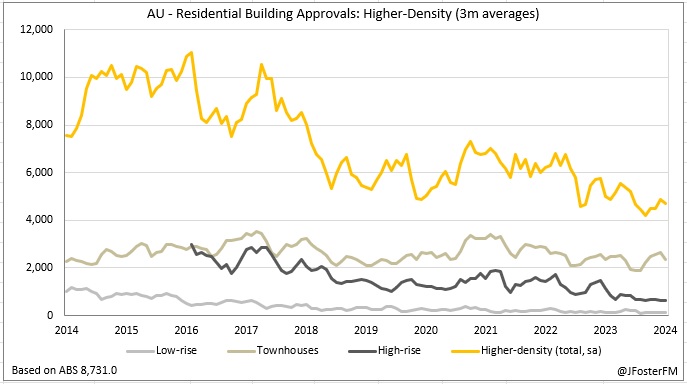
In the higher-density segment, approvals fell by 17.5% in August after a 34.6% surge in July. 3-month approvals to August averaged 4.7k, only slightly above cycle lows. Weakness continues to be most evident in high-rise units.  
 

Detached approvals climbed to their highest level in almost 2 years (9.5k) on the back of a further 0.6% rise in August, the 7th consecutive increase to be up 8.1% across the past 12 months. However, approvals in August are still down by a little more than a third on their earlier cycle peak in 2021.   


Alteration approvals - in value terms - continue to trend higher rising 1.4% to $1.1bn in August. Higher construction costs and robust demand have seen these approvals increase by almost 10% over the past year.

Monday, September 30, 2024

Australian retail sales rise 0.7% in August

Australian retail sales surprised on the upside of expectations posting a 0.7% lift in August (vs 0.4% forecast), the strongest gain since the start of the year. The ABS pointed to a warm finish to the winter and the early timing of Father's Day as the contributing factors. Although households remain under pressure from the cost of living and higher interest rates, sales increased by 3.1% across the year, the fastest pace since May 2023.   


Retail sales rose by 0.7% in August following a soft result in July (0.1%). This was the strongest gain for monthly sales since January. Over the 3 months to August, retail sales averaged a 0.4% increase, a modest pace but an improvement on the momentum in recent times. 


In the latest month, discretionary spending (0.8%) played a key role in the rise in the headline figure. Meanwhile, food sales (0.6%) were also solid. The ABS noted in today's release that unusually warm weather pulled Spring spending forward, boosting categories such as clothing and footwear (1.5%), liquor (2.8%), recreational goods (2.4%) and cafes and restaurants (1.0%). Spending in August was also supported by the timing of Father's Day, which fell on September 1. 


Spending growth was strong across most states in August. Gains of 0.7-0.9% were seen in New South Wales, Victoria, Queensland and Tasmania, but South Australia (0.3%) and Western Australia (0.4%) underperformed. Annual growth in the two largest states (NSW and Vic) is running in the 2-3% range, up from the lows earlier in the year but still subdued. 

Friday, September 27, 2024

Macro (Re)view (27/9) | RBA resists global easing cycle

A raft of stimulus measures from the authorities to support economic growth in China rocketed equity markets in the mainland and HK this week, a tailwind to other parts of Asia and Europe as well. In other policy-related developments, the Swiss National Bank cut rates; however, the RBA remained on the sidelines. Key labour market data in the US is out next week including September nonfarm payrolls and job openings for August, while Fed Chair Powell is also due to speak.  


A firmly on-hold RBA gave markets no sense at this week's meeting that it is concerned about policy divergence as central banks offshore continue to cut rates (reviewed here). The cash rate was maintained at 4.35%, a level unchanged back to November last year. Unlike in August, a hike was not considered on this occasion, but as Governor Bullock noted in the press conference strong labour market conditions - moderating job vacancies notwithstanding - mean near-term cuts remain off the table. In its decision statement, the Board retained the message that it needed to 'remain vigilant to upside risks to inflation' and that policy would stay 'sufficiently restrictive' until it gains greater confidence that inflation is on track to return to the 2-3% target 'sustainably'. 

The word 'sustainably' was added into the statement to emphasise the Board's focus on underlying inflation just as government rebates for household electricity bills are lowering headline inflation. Monthly data for August reported a fall in 12-month CPI from 3.5% to 2.7%, a 3-year low (reviewed here). Federal and state government rebates drove a 14.6% fall in electricity prices in the latest month following a 6.4% decline in July. Governor Bullock's press conference was prior to this release but it was made clear that the Board would not be cutting in response to falling inflation driven by these dynamics. That said the gauges of underlying inflation also softened in August to 3.1% (CPI ex-volatile items and travel) and 3.4% (trimmed mean), so this is at least progress in the right direction. In other news from the RBA, its half-yearly Financial Stability Review identified that households are weathering the effects from higher interest rates, but this would be at risk in the event of a sharper slowdown in the economy or if rates remained higher for a more extended period.   

In the US, Fed officials spoke after last week's decision to frontload the start of the easing cycle with a 50bps cut. The likes of Bostic, Goolsbee and Kashkari highlighted the need to dial back the tightness of monetary policy to guard against risks to the labour market. On inflation, the PCE price index softened from 2.5% to 2.2% at an annual rate in August, though the core index - the Fed's preferred measure - ticked up from 2.6% to 2.7%. For the core rate, however, the rise in the annual pace belies softer readings in recent months - the 3-month and 6-month annualised rates are at 2.1% and 2.4% respectively. It is this trend that saw the Fed pivot its focus away from inflation to the employment side of its mandate.      

Increasing risk of a hard landing in the euro area saw markets move to almost fully price in an October rate cut from the ECB. Economic activity contracted in September according to the latest flash PMI reading at 48.9 from 51.0 in August. While some of this decline can be attributed to a post-Olympics slowdown, cooling price pressures suggest the weakness runs deeper. The report noted that selling prices have fallen below a level consistent with the ECB's 2% inflation target, with services inflation slowing and goods prices falling. This was backed up by weaker-than-expected inflation reads in France (1.2%) and Spain (2.4%) ahead of figures for the euro area next week. 

Wednesday, September 25, 2024

Australian CPI 2.7% in August

Headline inflation in Australia slowed to a 3-year low in August as government rebates lowered household electricity bills. CPI on the monthly indicator fell from 3.5%yr in July to 2.7%yr in August, in line with expectations. The RBA made it clear at yesterday's meeting (see here) that it would not be moving to cut on these numbers, highlighting its focus on underlying inflation. There was at least some encouraging news here, with the underlying inflation gauges moving closer to the top of the RBA's 2-3% target band.


Markets had been anticipating a sharp fall in headline inflation in August and today's report did not disappoint. Prices fell 0.2% in the latest month, creating a base effect that saw 12-month inflation decline from 3.5% to 2.7% - a low back to August 2021. The main factor behind prices falling in August was Commonwealth and state government rebates driving a 14.6% decline in electricity prices. This was after a 6.4% fall in July during the early stages of the rebates. The ABS reported that without the rebates, electricity prices would have risen by 0.9% in July and 0.1% in August. 


Petrol prices continued to decline in August, another key factor behind the fall in inflation in August. Across the past year, petrol prices nationally are down by 7.6% - a vastly different situation to 12 months ago when prices had risen at a 13.9% pace. 


Although volatile items drove headline inflation lower, the underlying CPI measures also softened in August. CPI ex-volatile items and holiday travel slowed from 3.7% to 3.1% at an annual rate, and the trimmed mean eased from 3.8% to 3.4% - both measures at lows since early 2022. While welcomed, progress on lowering underlying inflation has been slow in 2024, a key reason for the RBA holding back from cutting rates as many of its peers offshore are doing.  


Key components in Australia's CPI basket that have contributed to sticky inflation are rents (6.8%), new home building costs (5.1%), insurance (6.2%) and health (5.3%). Progress will be needed across these areas to see the RBA moving into its easing cycle.    

Tuesday, September 24, 2024

RBA steady in September

The RBA left its key policy rates on hold at today's meeting (cash rate 4.35% and exchange settlement rate 4.25%). Inflation dynamics in Australia mean the RBA will be away slowly in cutting rates, now not likely to occur before February 2025 at the earliest. An RBA that will stay on the sidelines as the global easing cycle continues points to added support for the Australian dollar, something that Governor Bullock said today would be welcome from an inflationary perspective.  


Today's decision to remain on hold came across as having been straightforward for the Board. Key data since the August meeting did not surprise - Q2 GDP growth came in weak (1%Y/Y) and the labour market remained robust with solid employment gains and low unemployment (4.2%) - warranting little reason for a policy change. In the post-meeting press conference, Governor Bullock reiterated that rate cuts weren't on the radar for the Board, but neither did it consider a hike today - a mildly dovish tilt from August where a 25bps hike was discussed. This may explain the 11bps decline in the Australian 3-year bond yield to 3.45% in today's trade. 

The Board's decision statement repeated the same key themes that were highlighted at the previous meeting: inflation is proving persistent; the outlook is uncertain; and returning inflation to the 2-3% target band remains the priority. Continuing to assess that there is excess demand in the economy, the statement reaffirmed that the Board is 'vigilant to upside risks to inflation'. Accordingly, the guidance that policy needs to remain 'sufficiently restrictive' until the Board is assured inflation is on track to return to target is still intact. Moreover, Governor Bullock said that inflation needs to return to target 'sustainably'. CPI data for August tomorrow will likely show a sharp fall in headline inflation to 2.7%yr as energy rebates and other cost-of-living support measures kick in. However, the statement noted the Board's focus is on underlying inflation, which is not forecast to approach the midpoint of the band until 2026.   

Developments today have reaffirmed that the RBA is at a clear divergence from its central bank peers that have cut rates across the US, Europe, UK, Canada and New Zealand. Governor Bullock said this situation reflected several factors including that the RBA didn't raise rates by as much as other central banks; the domestic labour market has been more resilient than in other countries; and that disinflationary progress in Australia has been slower. As a result, the Board is content to preside over a policy divergence that will widen into year-end as other major central banks continue to cut rates. The next RBA meeting is on 4-5 November.   

Monday, September 23, 2024

Preview: RBA September Meeting

The monetary policy cycle in Australia is yet to turn and the RBA is likely to again push back on prospects for near-term rate cuts as it leaves the cash rate on hold (4.35%) at today's meeting in Sydney. Still awaiting greater control over inflation while also seeing a labour market that remains robust, the RBA is one of only 3 central banks in the G10 FX space not cutting rates. The global easing cycle has ramped up with the Federal Reserve delivering a frontloaded 50bps cut in the US last week, but the RBA is set to remain on the sidelines into year-end. 


Strong debate going into the previous meeting in August over whether the RBA would hike or hold was settled by the RBA maintaining the cash rate at 4.35%. Although a hike was considered, the Board concluded that holding rates struck a better balance at this stage of the cycle in terms of managing the risks to both sides of its mandate for inflation and employment. Recall that the strategy the RBA has said it is pursuing is to bring inflation down to the 2-3% target range with employment continuing to increase. With the cash rate having now been on hold since last November, the RBA has a good sense of the effects of its monetary tightening - GDP growth is weak (1%Y/Y in Q2) and tightness in the labour market has eased - but Governor Bullock has said repeatedly that slow progress on inflation means that rate cuts are out of the question. 

Accordingly, the key themes at today's meeting are likely to remain on the same lines as in August. Expect the Board to reaffirm that it needs to 'remain vigilant to upside risks to inflation' and that it will keep monetary policy 'sufficiently restrictive' until greater confidence that inflation is on track to return to the target range is gained. This continued focus on inflation comes with the recent labour market data backing up the RBA's assessment that conditions remain tight relative to full employment. Strength in employment has kept the unemployment rate low at 4.2% amid record high labour force participation (67.1%). 

On the markets, there is scope for a hawkish repricing today on further RBA pushback. In alignment with the declines in global bond yields as central banks offshore have moved to cut rates, the key 3-year Australian bond yield has fallen significantly over the past couple of months to trade around 75bps through the cash rate. That is probably enough of a discount given the RBA has made it clear they will be patient in moving into their easing cycle. This could provide additional support to the Australian dollar, which according to the RBA's trade-weighted index has lifted by more than 2.5% since the August meeting. 

Friday, September 20, 2024

Macro (Re)view (20/9) | Fed commences easing cycle

Markets repriced after a line-ball decision between a 25 or 50bps rate cut from the Fed went the way of a more frontloaded start to the easing cycle in the US. Equities ended the week higher and the US dollar declined against most majors excluding the Yen as the Bank of Japan left rates unchanged. With the easing cycle underway, the initial move has been a steeper treasury curve led by the long end. The 2-year segment ended the week essentially flat, with the Fed's signalling of a substantial amount of policy easing ahead playing catch-up to markets. 


Fed goes big to start easing cycle  

A frontloaded start to the Fed's easing cycle with a 50bps rate cut to 4.75-5.0% signals the FOMC's intent to avoid falling behind the curve with a soft landing for the US economy on the line. Backed by sufficient confidence that inflation is on track to return to target, addressing rising risks to the labour market is now the focus for the FOMC. This week's decision formalised this policy pivot, communicated intially at the recent Jackson Hole Symposium. At the post-meeting press conference, Chair Powell said these were the first steps in a recalibration of monetary policy away from restrictive settings to a more neutral level for interest rates. 

The nuance in the press conference revolved around Chair Powell making the case that starting the easing cycle with a larger 50bps cut instead of a conventional 25bps move did not mean alarm bells were ringing at the Fed. However, FOMC members are on the same page that a material easing cycle will be needed for a soft landing not be be derailed. The updated set of economic projections has kept the outlook for economic growth at 2% across the forecast horizon, but that is conditioned on a more aggressive easing cycle than previously anticipated. An additional 50bps of cuts is seen by year-end to 4.4%, down from 5.1% previously. This is then followed by 100bps of cuts in 2025, taking the Fed funds rate to 3.4% compared to 4.1% projected in June before rates eventually fall further in 2026 (2.9%).

This dovish reassessment of the rates outlook was in response to an uplift in forecasts for the unemployment rate, with risks seen to the upside. Unemployment is now expected to reach 4.4% later this year (from 4.0% previously) and hold at that level through 2025 (from 4.2%). Due to the cooling labour market, the inflation forecasts for both headline and core PCE prices were trimmed to 2.3% and 2.6% respectively this year and 2.1% and 2.2% in 2025, highlighting how the balance of risks has swung in the US.  

BoE holds rates steady  

This week's Bank of England meeting was largely a non-event for markets as rates were left unchanged at 5.0% in an 8-1 decision from the Monetary Policy Committee (MPC). Meanwhile, the MPC announced a target of £100bn for balance sheet reduction over the next 12 months, a continuation of the status quo.  

After commencing its easing cycle only last month, the MPC's decision statement noted that it is taking a 'gradual approach to removing policy restraint'. Notably, there remains caution around easing too quickly given that inflation risks have not yet been contained, particularly in relation to services prices. Depending on how economic conditions and the labour market evolves, there is a range of scenarios the MPC is looking at in terms of how long restrictive rates will be required. As set out in the August Monetary Policy Report, the MPC's baseline outlook is that lower inflation will filter through to price- and wage-setting processes, allowing for rates to be reduced over the next couple of years.  

Strong Australian labour market to keep the RBA on hold   

Another solid update on the Australian labour market should keep the RBA quiet at next week's meeting, with rates to stay on hold around its pushback to near-term rate cuts. Employment exceeded expectations for the 5th month in succession rising by 47.5k in August (vs 26k forecast), now up by more than 300k in 2024 (reviewed here). The resilience of employment to slower economic growth helped the unemployment rate print at an unchanged 4.2% as labour force participation remained at a record high of 67.1%. Overall, the report was consistent with the RBA's view that the labour market is seeing some rebalancing but still remains strong. This will likely keep the RBA's focus on the inflation side of its mandate at next week's meeting. 

Thursday, September 19, 2024

Australian employment 47.5k in August; unemployment rate 4.2%

Australian employment surpassed expectations for the 5th month on end in August rising by 47.5k against the 26k consensus. The national unemployment rate held at 4.2% with labour force participation remaining at record highs (67.1%). The continuation of resilient labour market conditions should see the RBA retain its place as a hawkish outlier to its G10 peers in actively pushing back against near-term rate cuts. 

By the numbers | August
  • Employment increased (on net) by 47.5k (full time -3.1k, part time 50.6k) in August, above the consensus forecast for 26k. However, downward revisions lowered employment by 14.9k over June and July. 
  • Australia's unemployment rate was unchanged at 4.2% (as expected), but the broader underemployment rate lifted from 6.3% to 6.5%. Labour force underutilisation remained at 10.6%, little changed over recent months. 
  • Labour force participation held at record highs printing at 67.1%. 
  • Hours worked were up 0.4% in the month - matching their gain in July - to be up by 1.7% over the year.


The details | August

Employment continued its run of strong gains rising by a further 47.5k in August to by up by a little more than 310k year to date. Notwithstanding a series of downward revisions to prior months, this is still a considerable increase amid the slowdown in economic growth. Additionally, more than 3/4 of the increase in employment in 2024 has been driven by full time employment, putting the modest decline in August (-3.1k) in context. Part time employment (50.6k) saw its strongest rise in 12 months to drive the headline outcome in August. To highlight the strength of the momentum in the labour market, employment gains averaged 47.7k for the 3 months to August - its fastest since May last year, an annualised pace of more than 4%.  


With the participation rate remaining steady at record highs (67.1%), August's rise in employment was strong enough to hold the unemployment rate at 4.2%. The unemployment rate is up from cycle lows of 3.5% but remains at low levels - as does underemployment (6.5%) and total underutilisation (10.6%). 


A 0.4% rise in hours worked came through in August, its 3rd consecutive monthly rise. Despite the decline in full time employment, hours worked by that segment still advanced by 0.2%. Meanwhile, part time hours were up 1.6% - its strongest rise since November 2022 - outpacing the lift in employment (1.1%). Base effects saw annual growth in hours worked accelerate from 0.5% to 1.7%. A considerable divergence remains in place between annual growth in hours worked in the full time (1.0%) and part time segments (5.0%) - a sign of adjustment in the labour market to weaker demand conditions. 


In summary | August 

The August report was consistent with the continuation of robust labour market conditions, remaining resilient to slower economic growth. As highlighted in a recent speech by RBA Assistant Governor Hunter, labour market conditions are assessed as tight relative to full employment. There is nothing in today's report to change that view, meaning the RBA's focus will likely remain on the inflation side of its mandate, pushing back on the prospect of a rate cut into year-end.