Independent Australian and global macro analysis

Wednesday, November 18, 2020

Australian employment +178.8k in October; unemployment rate 7.0%

After stalling in September, Australia's labour market regained momentum in its recovery from the Covid-19 pandemic in the month of October boosted by the anticipation of reopening in Victoria ahead of the easing of restrictions. Employment surged higher and hours worked also lifted sharply, while participation in the labour force is now close to where it was pre-pandemic. 

Labour Force Survey — October | By the numbers
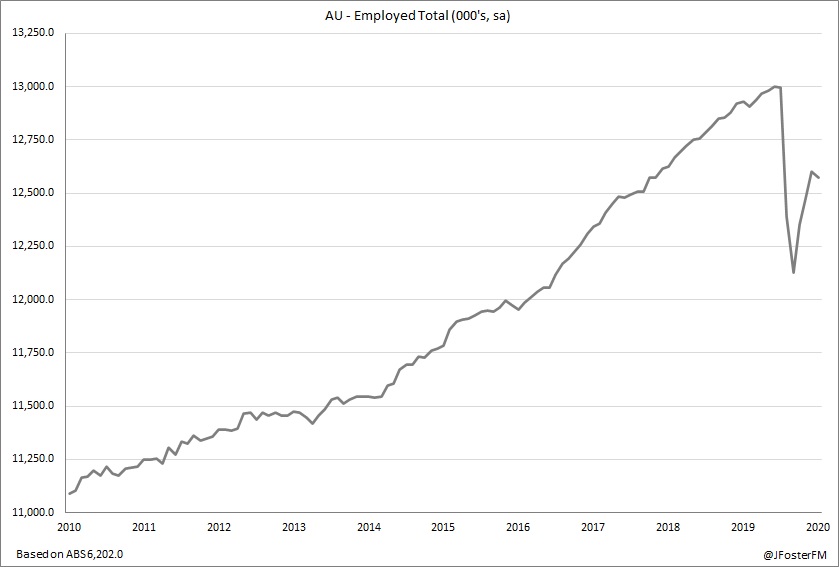
  • Employment (on net) came in very strong rising by 178.8k in the month to defy market expectations for a fall of 27.5k. September's initially reported fall of -29.5k was revised to a larger decline of -42.5k. 
  • The national unemployment rate lifted by 0.08ppt to 7.0%, though the median estimate was for a larger rise to 7.2%. 
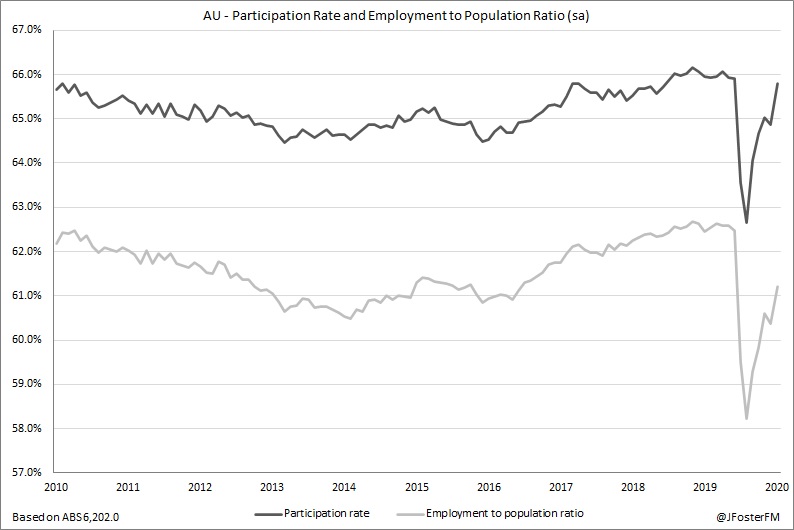
  • Australia's participation rate surged higher by 0.95ppt to 65.8%, whereas it was forecast to hold at 64.8%.   
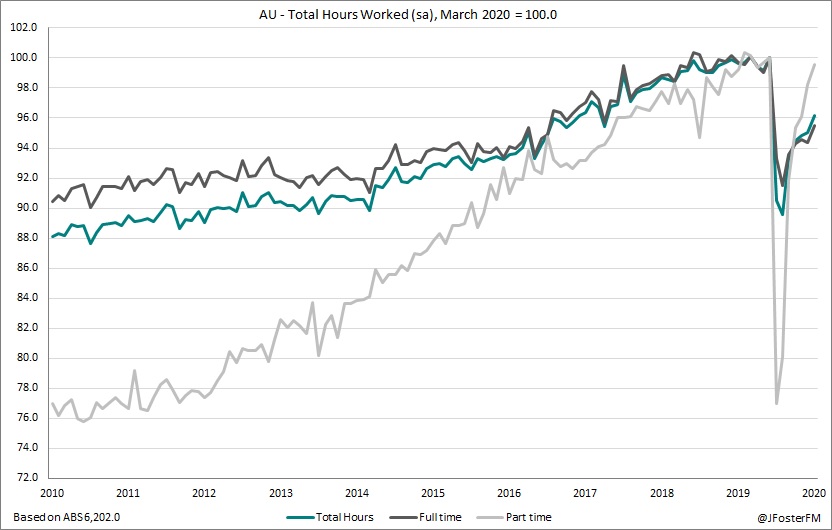
  • Total hours worked accelerated by 1.2% over the month to 1.711bn hours coming off a broadly flat outcome in September (0.2% revised from 0.5%) to pare the pace of decline through the year to -3.4% from -4.9%.  


Labour Force Survey — October | The details

Certainly, today's report came as a major surprise. After a soft report in September that indicated the national recovery in the labour market was losing momentum with Victoria in shutdown mode and signs that the initial reopening surge could be fading in some of the other states, October's report blitzed even the most optimistic forecasts. The explanation behind today's strong report appears to be that businesses in Victoria anticipated the reopening and planned accordingly before restrictions had been meaningfully eased, which did not occur until the period between the back end of October into early November and this falls outside the reference period for this survey. Total employment surged by 178.8k and consisted of a 97.0k rise in full-time employment and an 81.8k lift in the part-time segment. Victoria contributed 81.6k jobs to the national figure, which more than recovered the 76.7k jobs that were lost over the preceding two months. However, employment nationally is still 1.7% below its pre-pandemic baseline, while Victoria significantly lags at 4.1% below baseline reflecting the impact of its recovery being derailed by the second shutdown.   


With Victoria coming back online, hours worked were boosted sharply higher. Total hours worked increased by 1.2% in the month, with gains in both full-time (1.2%) and part-time hours (1.4%). Notably, part-time hours are broadly back to their pre-shutdown level, whereas full-time hours are still sharply below where they were in March. Total hours are down 3.8% on their pre-pandemic level, which is much more than where the fall in employment currently sits (-1.7%).  


This next chart shows the evolution in hours worked across the states since the onset of the pandemic. In October, hours worked surged in Victoria (+5.6%m/m) off a low base, while Queensland lifted (+2.2%) to be above baseline, and Tasmania (+0.9%) also advanced. The other states softened, with New South Wales -1.7%, South Australia -0.4%, and Western Australia -0.5%.  


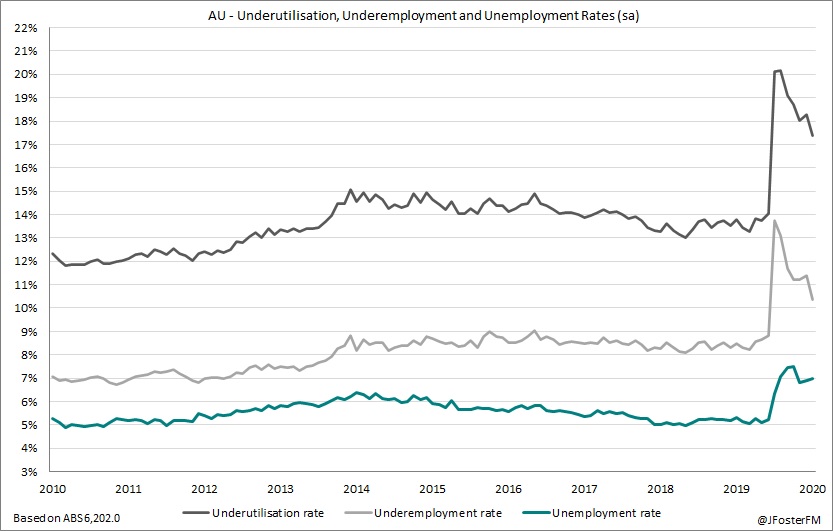
With total hours much higher in October, levels of spare capacity in the labour market were reduced. The rate of underemployment (counting those employed but wanting more hours) fell from 11.4% to 10.4% and underutilisation (including both the unemployed and underemployed) declined from 18.3% to 17.4%. Both are still extremely elevated, but the direction of travel is encouraging. But, despite the big rise in employment and strength in hours work, the unemployment rate moved higher in the month rising from 6.9% to 7.0%, which reflects the impact of a very large rise in participation from 64.8% to 65.8%. In particular, participation in Victoria surged by 2ppts to around 65% due to the anticipation of reopening.  


Overall, the national participation rate is now just about back to where it was before the pandemic hit. But with spare capacity elevated and with the share of Australians in work as a percentage of the population still a long way off its pre-pandemic level, this highlights just how important it is to keep employment growth rolling and justifies the recent policy actions by both the RBA and Federal Government.   


Labour Force Survey — October | Insights

There were plenty of encouraging signs in today's report as the anticipation of reopening in Victoria saw the recovery in the national labour market regain momentum after stalling in September. However, there is still a long way to go in the recovery in terms of restoring employment and more so hours worked, and with participation already back to around pre-pandemic levels that process is likely to take a while yet. 

Preview: Labour Force Survey, October

Australia's latest monthly update on the labour market for October is due to be published by the ABS at 11:30am (AEDT) this morning. Progress in the national labour market recovery was set back by the impact of the shutdown in Victoria as employment declined by 29.5k in September and the unemployment rate increased to 6.9%, and more weakness is expected to be reported in today's release.

As it stands | Labour Force Survey

In September, employment (on net) fell by 29.5k, though this was smaller than the 40.0k declined that markets had expected. In Victoria, a further 35.5k jobs were lost as the shutdown in the state continued following on from the loss of 37.7k jobs in August. The outcomes across the other states were generally muted, but Queensland outperformed as employment there lifted by 32.2k. Overall, September's outcome constituted a loss of momentum in the recovery in employment. From its earlier trough of 6.7% below its pre-pandemic level, the decline in total employment had been pared back to a 3.0% fall by August, but September's outcome unwound some of this progress to a 3.3% decline. 


Australia's unemployment rate lifted to 6.9% from 6.8%, though a larger increase to 7.0% was expected last month. The lift in unemployment was accompanied by an easing in the participation rate from 64.9% to 64.8%. Given the weakness in employment and the disruption in Victoria from the shutdown, total hours worked surprised somewhat in firming by 0.5% in the month, but the level is still some 5.1% weaker than its pre-pandemic baseline. For a full review of September's report see here.  


Market Expectations | Labour Force Survey

The consensus expectation is that the labour market recovery will have lost further momentum in October as Victoria remained in shutdown. Employment is forecast to fall by 27.5k on the median estimate between a wide range of forecasts from -60.0k to +30.0k. This follows recent weakness in the high-frequency ABS payrolls data (chart below), though this series has not always been the most accurate guide to the labour force survey. The national unemployment rate is expected to deteriorate from 6.9% to 7.1%, but again there is a large spread in the range of estimates (6.7% to 7.4%).  


What to watch | Labour Force Survey

After the fall in September, the headline employment will be closely watched. Consecutive monthly declines would raise some concern that the recovery in employment was stalling and that the loss of momentum is more broadly based than just in Victoria as the payrolls data have been suggesting. Another factor to consider that could have implications for today's report is that in late September the Federal Government's JobKeeper (wage subsidy) policy was tapered and eligibility for the scheme was tightened, and this could have potentially prompted some further adjustments in the labour market. With a lot going on beneath the surface, it remains important to follow the hours worked measure. 

Tuesday, November 17, 2020

Australian Q3 Wage Price Index 0.1%; 1.4%yr

The pace of Australian wages growth slowed to new record lows in the September quarter reflecting the full effects of the pandemic on the labour market. A further slowing in wages growth occurred in both the private and public sectors in response to wage freezes and deferrals of earlier agreed increases, as well as temporary cuts in some cases. 

Wage Price Index — Q3 | By the numbers
  • The headline WPI (total hourly rates of pay ex-bonuses) slowed by more than expected to 0.07%q/q in Q3 (consensus was 0.2%) from a 0.22%q/q pace in the June quarter. 
  • Annual growth decelerated from 1.82% to 1.36%, again coming in weaker than the consensus estimate (1.5%). 


Wage Price Index — Q3 | The details 

The WPI is a gauge of wage inflation that measures changes in hourly rates of pay for a fixed group of jobs that is typically affected by changes in minimum wage settings, variations in awards, enterprise and workplace agreements and individual contracts. According to the ABS's detailed analysis, enterprise agreements were the most prominent driver of wages growth in the quarter. The ABS reported that the weak quarterly outcome was affected by the deferral of increases under enterprise agreements, fewer end of financial year review for individuals, and the phasing in of the most recent minimum wage increase.      

Total wages growth stepped lower again in the September quarter to new record lows in the quarterly (0.07%) and annual paces (1.36%). In the June quarter, public sector wages only softened modestly (from 0.59% to 0.51%), but a more pronounced slowdown occurred in Q3 to 0.22%, reflecting the impact of deferrals and freezes by several governments. Annual growth in public sector wages slowed from 2.07% to a record low of 1.77%. Private sector wages were steady on the quarter at the very weak pace of 0.08% — this after the sharp slowdown in Q2 from 0.53%q/q to 0.08%q/q — as the pace over the year was dragged down from 1.68% to 1.21%, also a record low. The RBA has recently reported that its liaison program found that a rising share of firms had responded to the pandemic by implementing wage freezes with many more planning on doing so over the year ahead. This has had a significant impact on private sector wages growth in particular. On top of this is the significant level of spare capacity available after the upheaval that occurred in the labour market as the economy was placed into shutdown.


Wages growth was already very subdued before the pandemic emerged and it has since fallen sharply from there. The slowdown has been broadly based across the economy in a range of industries, but the deceleration has been most pronounced in services-related industries that have been hit hard by the restrictions on activity. To highlight the point, wages growth in the accommodation and food services industry was running a little above 2%Y/Y as of a year ago but is now currently just rising at 0.46%Y/Y. Meanwhile, wages growth in professional services has reduced to 0.76%Y/Y from 2.5% over the period, with this reflecting the impact of wage freezes and according to the RBA's liaison program temporary wage cuts in some cases. There are two industries which have seen wages growth pick up from its pace a year ago and this has occurred in education and training (2.41% from 2.09%) and finance and insurance (2.39% from 2.13%). Remarkably, wages growth is now sub 1% in annual terms in 7 of the 18 measured industries and emphasises the extent of the dislocation that has occurred in the labour market and the process of adjustment underway as displaced workers move between industries for new opportunities.     


A summary of the state details is shown in the table, below. Private sector wages growth was better in the September quarter rebounding in New South Wales (0.6% from 0.0% in Q2), Queensland (0.6% from -0.2%) and Tasmania (0.5% from -0.1%) and lifting more modestly in the other states. But, almost everywhere you look, annual private sector wages growth in annual terms has slowed to record lows (see chart, below). It was a mixed picture across the states in the public sector in Q3 with the quarterly pace slowing in Victoria (0.2% from 0.6%), South Australia (0.5% from 0.9%) and Tasmania (0.5% from 1.2%), but rising in the others; New South Wales (0.4% from 0.1%), Queensland (0.6% from 0.4%) and Western Australia (0.4% from 0.1%).   


Wage Price Index — Q3 | Insights

Today's report shows this is likely to be an economy where wages growth will be struggling to get to even pre-pandemic levels for some time. Indeed, that is the scenario the RBA's is expecting, with its current forecasts showing wages growth only improving to 1.75% by the end of 2022. Significant policy support from both the fiscal and monetary authorities will continue to be left in place until the labour market is able to cast aside the legacies of this pandemic. 

Preview: Wage Price Index - Q3

Australia's Wage Price Index for the September quarter is scheduled for release by the ABS at 11:30am (AEDT) today. The shock to the economy from the Covid-19 pandemic has had significant implications for wages growth with a large share of firms responding by implementing wage freezes and some introducing temporary cuts, while deferrals of earlier agreed increases have been common in the public sector. In addition, the upheaval in the labour market caused by the pandemic and the measures implemented to contain it have driven spare capacity to very elevated levels placing downward pressure on wages growth. 

As it stands | Wage Price Index

The Wage Price Index (WPI) weakened to its slowest pace on record in the June quarter at 0.2%q/q and 1.8%Y/Y; this from Q1's outcomes of 0.5%q/q and 2.2%Y/Y. The impact of the pandemic shock on wages was initially felt much more in the private sector than in the public sector. Private sector wages growth pulled back to a 0.1% pace in Q2 from 0.5% in the previous quarter, reducing the annual pace to 1.7% from 2.2%. Public sector wages growth was unchanged in Q2 (0.6%), but the pace over the year eased to 2.1% from 2.4% on a base effect. A full review of Q2's date is available here.


As an illustration of the extent to which wages growth has pulled back across the economy, the chart below compares the annual pace of wages growth in each industry to Q2 2020 with Q2 2019. The sharpest slowdowns have come in professional and other services, with these industries likely to have been impacted by wage freezes and temporary cuts as the pandemic hit.   
 

Market expectations | Wage Price Index

The consensus estimate according to Bloomberg is for the quarterly WPI outcome to come in at a 0.2% pace, with the range of estimates between 0.1% to 0.4%. If met, this would result in annual wages growth slowing even further to 1.5% from 1.8%.  

What to watch | Wage Price Index

According to the recent RBA Statement on Monetary Policy, the central bank's liaison with industry reported a rising prevalence of firms within the program that had either or were planning on implementing wage freezes in the year ahead (see chart below). This will mainly show up in the private sector WPI. Meanwhile, we can expect public sector wages growth to slow this quarter reflecting the impact of wage deferrals and freezes, in particular affecting Commonwealth and Queensland Government workers.  

Source: RBA November Statement on Monetary Policy

Monday, November 16, 2020

ABS Household Impacts of Covid-19 Survey - October

The ABS's latest Household Impacts of Covid-19 Survey for the month of October was released earlier today. This issue focused on travel intentions, attitudes towards testing for Covid-19 and personal stressors the pandemic has brought on, with responses taken between October 16-26 from around 1,400 households.

Ahead of the summer months, the survey gauged travel plans of Australian households. Overall, 46% of respondents said they intended to travel for holidays between November 2020 and February 2021. In a world without Covid-19, the survey reports this figure would be at 77%. For respondents that planned on travelling in the months ahead, this was more likely than usual to be either within their own state or to another state. International travel plans remain severely affected by the overseas travel ban.  

Source: ABS

Internally within Australia, several states continue to have border restrictions in place and this has been a key plank in the state authorities' containment strategy. Today's survey showed that a significant degree of pent-up demand has accumulated as a result, and many Australians are ready and willing to holiday interstate within 1-6 months of state borders being opened up. There is a strong aversion to overseas travel such that on these findings, it would take up to 12 months after the international borders had been opened before offshore travel intentions would begin to overtake domestic travel options. Meanwhile, around 1 in 4 respondents did not have any intention of traveling overseas; around twice the level of those that did not intend on travelling interstate.  

Source: ABS

In a clear sign that the message from the public health authorities around the importance of Covid-19 testing has set in, 52.5% of respondents said they would "definitely" obtain a test if they had mild symptoms of respiratory illness, which rises 85.2% in the situation that those symptoms were severe. 

Source: ABS

Together with a strong attitude towards testing is a culture of ongoing precautionary behaviour. Social distancing is still being adhered to, though not to quite the same extent as earlier in the pandemic. 

Source: ABS
  
Victoria is now seeing the benefits of its extended shutdown after a second wave of the virus, with no new cases being recorded over the past couple of weeks or so, even after restrictions have been eased significantly. But, as today's survey showed (see charts, below), the shutdown was a very tough period for Victorians across many aspects of life, though the negative impacts on wellbeing should now be dissipating under eased restrictions.  

Source: ABS

Based on the survey's findings, the Victorian shutdown appeared to have a more pronounced impact on females than males, particularly in terms of the feeling of loneliness. 

Source: ABS

This survey for October also provided the latest read on the frequency of household activity. As can be seen below, the activities that saw the largest pick up in the month of October were; patronage at bars and restaurants (+6.3ppts), visits to public parks or recreation areas (+5.2ppts) and going shopping (+4.4ppts), though all still remain comfortably below their pre-pandemic levels. The prevalence of working from home, using public transport and exercising/playing sport was little changed over the month. 


Lastly, in terms of financial arrangements, this survey reported that 14% of respondents had either deferred or reduced their mortgage payments due to difficulties that arose in response to the pandemic. A smaller share of respondents (8%) had deferred or reduced rental payments, while only 1 in 20 needed similar assistance to meet a bill or rate payment. According to this survey, 12% of respondents had applied for early access to their superannuation with almost all (97%) of those requests being granted. The most common uses of these funds were reported to be paying household bills and purchasing household supplies.  

Friday, November 13, 2020

Macro (Re)view (13/11) | Future optimism vs near-term risks

With encouraging news arriving this week on the development and likelihood of Covid-19 vaccines becoming available, markets took this as a green light to rotate from defensive positioning into the more cyclical areas that would benefit from a broader reopening of economies worldwide. However, according to the reports, the widespread availability of any potential vaccines is still not a likely scenario until well into 2021. And in the meantime virus cases are rising sharply in the US, while much of Europe and the UK have already returned to stricter restrictions after an earlier acceleration of infections. This tension between the hope of vaccines enabling broader and sustainable reopenings down the track against the near-term damage the virus is inflicting is what markets and policymakers have been contemplating this week. Markets have taken the optimistic view by looking past the immediate risks, but policymakers from the world's major central banks have been much more cautious in their assessments. At this week's ECB Forum on Central Banking, the key message from the heads of the European Central Bank, Federal Reserve and Bank of England in a panel discussion was that the re-escalation of the virus posed a major risk to the path of the economic recovery and that the prospect of vaccines would not diminish the need for more policy support. 

Just last week, the BoE announced further monetary easing and the Fed expressed a willingness to add more accommodation to assist the recovery in the US, while the ECB's Governing Council at their most recent meeting made their intent clear by declaring it will "recalibrate its instruments" to updated economic forecasts in December. As ECB President Christine Lagarde highlighted in a speech at this week's Forum, the key for policymakers is building a bridge to the time when vaccines are available and this clearly involves an enhanced response by the central bank, which was likely to be focused on adjustments to its Pandemic Emergency Purchase Programme and TLTROs (term funding for the banking sector). On this week's data from Europe, the second estimate of GDP for the September quarter saw only minor revisions with the reopening effort leading to a 12.6% rebound from Q2's immense 11.8% contraction, albeit with GDP still heavily below its pre-pandemic level by 4.4%. Considering the reintroduction of containment measures, a more timely assessment of the situation came from the industrial production update, which after surging in the immediate period since the reopening has now stalled. A 0.4% fall in September came after modest growth in August (0.6%), while output still remains around 5.9% below its pre-pandemic level. In the UK, after contracting at its fastest pace on record in Q2 (-19.8%q/q), economic activity posted its fastest pace of expansion in a single quarter as the reopening saw GDP rebound by 15.5% in Q3. But that still left GDP around 10% below its pre-pandemic level. Meanwhile, the monthly estimates showed a loss of momentum in the pace of activity as the quarter progressed, with GDP slowing to a 1.1%m/m rise in September; this after increases of  2.2% in August and 6.3% in July.

In the US, concerns are rising over the escalation in virus cases but so far there has been a patchwork response from the states around the reinstatement of restrictions. The most notable response has come in the city of Chicago (population òf around 8.8 million) where the authorities will implement a stay-at-home advisory from Monday (16/11), signaling the effective return to shutdown. In spite of the virus situation, there may be some resistance to a similar approach in other jurisdictions in the US as earlier fiscal measures that supported incomes have now lapsed and attempts by Congress to agree to a new package have been falling short. The effects of this latest resurgence in the virus are yet to show in the data in a material fashion, but the concerns are clearly there with Fed Chair Jerome Powell noting a moderation in the pace of the economic recovery at last week's FOMC meeting. In a light week for data in the US, inflation came in softer than expected in October with headline CPI slowing to 1.2% annual pace from 1.4%, while core CPI (excludes volatile food and energy prices) eased from 1.7% to 1.6% in annual terms. The other development of note offshore this week came across the Tasman where the Reserve Bank of New Zealand provided more support to the economic recovery through the announcement of its Funding for Lending Programme that will commence in December providing cheap liquidity to the banking sector. 

— — —  

Turning to Australia, the latest consumer and business survey were this week's focus. Consumer sentiment according to the Westpac-Melbourne Institute Index advanced by a further 2.6% in November to extend its recent stellar run after gains of 18.0% in September and 11.9% in October. Remarkably, this has driven the index to a reading of 107.7 to be at its highest level in 7 years (see chart of the week, below). Westpac's Chief Economist Bill Evans attributed the latest result to the widespread easing of restrictions in Victoria, while last week's decision by the RBA to ease monetary policy further and its pledge to keep rates on hold for an extended period was also a factor. The effect of the reopening in Victoria was a significant contributor to an 8.4% lift in expectations for economic conditions over the next 12 months, with the sub-index now standing 12.4% higher than the level that prevailed a year ago. While expectations for the 5-year outlook were relatively flat in November (0.5%) they are sharply elevated over the year (22.4%), continuing to suggest that consumers see better times ahead once the effects of the pandemic dissipate. The report's other key aspect was the continuation of optimism towards the housing market; the 'time to buy a dwelling' index up another 8% in the month to a 7-year high, while house price expectations lifted by 12%, albeit to a level that has not yet returned to where it was pre-pandemic.  

Chart of the week 


Improving confidence was also the main theme out of the NAB's Business Survey for October. The business confidence index advanced by 9 points to a reading of +5 to be at its highest level since mid-2019. Driving the improvement here was an outsized lift in confidence by firms in Victoria as light at the end of the shutdown tunnel emerged. However, the conditions component was little changed at a +1 reading from 0 in the month prior and conveyed a much more nuanced analysis of the situation, with industries such as retail, wholesalers, and transport faring well but construction and personal services being hit hard. The key point to note from the underlying detail was the disparity between improving trading (+8) and profitability (+4) but weakening employment (-5), suggesting that demand across the economy will need to strengthen materially to shift the outlook in the labour market to a more optimistic path. On this front, the forward-looking components for demand from forward orders and capacity utilisation both remained weak in November.   

Friday, November 6, 2020

Macro (Re)view (6/11) | More support comes as uncertainty increases

The focus domestically this week was on the Reserve Bank of Australia for its latest policy meeting and updated economic forecasts. As had been widely expected, the meeting decision statement from Governor Philip Lowe delivered a significant easing in the Board's monetary policy stance with the targets on the cash rate and 3-year bond yield, and the rate on the Term Funding Facility, lowered by 15 basis points from 0.25% to 0.1%, though of greater importance was the announcement of a separate quantitive easing (QE) program of Commonwealth and state government bond purchases with a target envelope of $100bn over the next 6 months (see here). Governor Lowe said the announcements were made to "support job creation and the recovery of the Australian economy from the pandemic". 

That recovery was described by the RBA in its quarterly Statement on Monetary Policy (SoMP) as one that is likely to be "bumpy and uneven, and highly sensitive to further virus outbreaks". Under the Bank's baseline outlook, in which there are no significant virus-related setbacks, the contraction in domestic economic activity is now expected to be smaller at -4% Y/Y to Q4 2020 compared to -6.0% in the August SoMP. The recovery in 2021 leads to a stronger growth profile through the first half at 6%Y/Y to Q2 (from 4%Y/Y) with household consumption rebounding sharply and the drag from residential construction dissipating, before the pace eases back to an unchanged 5%Y/Y to Q4, which only then sees GDP being restored back to its pre-pandemic level. Meanwhile, the forecast for GDP growth of 4% in 2022 was retained. A more constructive view now attends the labour market outlook — the unemployment rate is now forecast to peak at a lower level of 8% by the end of the year compared to 10% previously — but progress from there is slow taking until the end of 2022 to retrace to 6%. As such, with "significant spare capacity" persisting, underlying inflation is held to a low and steady trajectory improving from 1% by the end of 2020 to 1.5% by Q4 2022. Given this outlook, the possibility of further stimulus over the next couple of years will never be too far away. The SoMP confirmed that should that be needed, the Board's marginal tool will be QE, where it could potentially adjust the size, timing and pace of purchases for example. The Board reiterated its resistance to lowering rates any further, judging that it "continues to view a negative policy rate as extraordinarily unlikely".

Domestic data releases were mostly constructive across the week. Nowhere was this more evident than in the housing market which is gaining momentum on the back of the reopening and stimulus measures, though working in the other direction is the headwind to demand from low population growth in response to the international border closure. Building approvals advanced by much more than expected with a 15.4% rise in September as house approvals elevated by 11.1% in response to the tailwind from the HomeBuilder scheme (see here). Meanwhile, borrower-accepted housing finance commitments continue to surge in the post-reopening period with a 5.9% lift in September taking the cumulative increase in the value of lending approvals to 38% since May (see chat, below). Activity from owner-occupiers (41%), and in particular first home buyers (43%) with the support of low rates and state government incentives, has been very strong over the period (see here). If sustained, this is likely to see house prices pushing up and there was an early sign this was already taking place as CoreLogic's home value index of capital city property prices showed its first month-on-month rise (0.2%) since April. Meanwhile, retail sales slowed for a second straight month with a 1.1% decline in September, though the level of turnover remains elevated over the year (5.6%) and on its pre-pandemic baseline (5.0%) from February (see here). Importantly for GDP growth prospects, retail volumes rebounded strongly in the September quarter with a 6.5% rise coming through to more than reverse the shutdown-driven 3.5% contraction in Q2. Weighing on what should be a return to GDP growth in Q3 will be a sizeable pullback from net exports, though September's trade data came against the recent run of play as a lift in exports (3.9%m/m) combined with an unwind in imports (-5.9%m/m) to drive the trade surplus up to $5.6bn (see here).

Chart of the week


— — —

Looking offshore where the US election was the focus for markets to the virtual exclusion of all other developments. With a tighter race in the count ensuing than had been indicated by the polls and prospects for the consensus view in the markets for a 'blue wave' scenario (Biden Presidency and Democrat-controlled Congress) looking less likely some clear themes emerged; a much flatter US yield curve, strongly bid equity markets and US dollar weakness. With prospects for a large fiscal stimulus package seemingly reduced on the basis of likely gridlock in Congress, the general sentiment was that the US economic recovery might now be less robust than could have been the case, leaving it to the Federal Reserve to again increase its policy response to the pandemic. While it left its existing settings unchanged at this week's meeting, the decision statement from the Federal Reserve's FOMC reiterated its preparedness to provide that additional support "if risks emerge that could impede the attainment of the Committee's goals". In the post-meeting press conference, FOMC Chair Jerome Powell highlighted that after a strong rebound in economic activity in Q3 there were signs emerging that the momentum was moderating and the outlook remained uncertain; this as virus cases in the US lifted to a daily high for the pandemic at 121.9k on Thursday according to John Hopkins University data. Consistent with signs of moderation, the key ISM services survey eased to a reading of 56.6 in October (vs 57.4 expected) from 57.8, pointing to a slower pace of expansion in the sector. However, it should be noted the manufacturing sector vastly outperformed with a lift to 59.3 in October (consensus was 55.8) from 55.4 led by an acceleration in the new orders component. 

Currently, the Fed's asset purchases are calibrated to expand by at least $120bn/mth ($80bn Treasuries/$40bn of Mortgage-Backed Securities), though Chair Powell said this configuration would come under consideration as the FOMC contemplates how it can best support the economy through its ongoing recovery. In a positive development, the latest update on the US labour market came in on the upside of expectations as employment on nonfarm payrolls advanced by 638k in October against 600k expected. More importantly, the unemployment rate was lowered by 1ppt to 6.9% (vs 7.6% expected), a result strengthened by the fact that it came alongside a lift in labour force participation to 61.7% from 61.4%. Whether the recovery in the US labour market can be sustained against the virus headwinds through the winter is up for debate, though if the progress falters expect the Fed to be inclined to increase stimulus.   

Moving over to the UK where, with the second wave shutdown taking effect this week, there were significant policy announcements coming from both the monetary and fiscal authorities in a ramp-up of support to the economy. Firstly, the Bank of England's Monetary Policy Committee announced an increase in its QE purchases of an additional £150bn of UK Government bonds, taking the total target to £895bn (which includes £20bn of corporate bonds). The meeting minutes outlined that this decision to increase QE was taken so the impact of the shutdown "was not amplified by a tightening in monetary conditions that could slow the return of inflation to the target". As it stands currently, total BoE asset purchases are at £717bn having been accelerated by £272bn since the emergence of the pandemic. 

Meanwhile, the BoE's latest Monetary Policy Report highlighted the considerable degree of uncertainty weighing on the economic outlook due to the resurgence of the virus overlayed with the complexities of the UK's withdrawal from the EU. In terms of the outlook, in response to the return to shutdown, the expected contraction in GDP in 2020 has deepened to -11% from -9.5% previous, while the 2021 rebound was downgraded to 7.25% from 9.0%. Overall, under the BoE's baseline scenario, the recovery will take until early 2022 for GDP to be restored to its pre-pandemic level. Meanwhile, the UK Government announced an extension of its wage subsidy scheme as well as boosting support for self-employed workers through the northern winter to the end of March 2021. At this stage, the shutdown in England is slated to run until early December. 

There has also been a broad-based return to shutdowns in Europe after a second wave surge of infections and the impact of this has already been seen in the data. Activity in the euro area economy stalled in October at a reading of 50.0 according to the IHS Markit Composite PMI, though this conceals a services sector that was contracting at a sharp pace (46.9) as restrictions were tightened. Providing some offset was the region's export sector, reflected by an elevation in manufacturing activity (54.8) to its fastest pace in 27 months. The implications for the economic outlook were highlighted in the European Commission's Autumn forecasts, with GDP growth to contract by 7.8% in 2020, and although this was less pessimistic than earlier expected (-8.7%), the pace of rebound in 2021 is now anticipated to be noticeably slower at 4.2% from 6.2% previously. 

Wednesday, November 4, 2020

Australia's trade surplus rises to $5.6bn in September

Australia's trade surplus came in more elevated than expected in September at $5.6bn from $2.6bn in the month prior. Exports advanced after recent weakness while import spending pulled back after a reopening-inspired boost. For the September quarter, net exports are likely to subtract notably from GDP growth, unwinding a positive contribution in Q2.

International Trade — September | By the numbers
  • Australia's trade surplus increased by $3.013bn in September to $5.63bn to come in well above the median estimate of $3.7bn. August's surplus was revised lower to $2.618bn from $2.643bn.  
  • Export earnings lifted by 3.9%m/m to $33.737bn after falling in each of the two preceding months (-4.5% in July and -4.1% in August), moderating the annual decline to -19.7% from -22.5%. 
  • Imports halted a run of 3 straight monthly gains with a 5.9% fall in September to $28.108bn. This deepened the annual decline to -22.3% from -15.0%. 


International Trade — September | The details

September's trade surplus surprised to the upside of estimates coming in at $5.63bn, though it had declined sharply in July (-$3.5bn to $4.4bn) and then in August (-$1.7bn to $2.6bn). As a result, the trade surplus over Q3 was much lower at $12.6bn than in the previous quarter ($22.7bn), representing a decline of 44.5% (before seasonal adjustments are factored in). For the quarter, imports were up 3.6% on the reopening rebound while exports declined by 6.6%. 


Export details for September were broadly positive but were skewed towards volatile non-monetary gold. Earnings from goods and services exported were up 3.9% (or $1.265bn) in the month, with non-monetary gold the driving factor at 71.7%m/m (or $0.989bn). Non-rural goods lifted by 0.9% ($0.209bn), led by metal ores and minerals (includes iron ore) ($0.192bn). Rural goods were a touch softer (-1.6% or -$0.05bn) on weakness in meat. Services exports increased by 2.3% (or $0.117bn) with inbound travel surprising with a lift of 4% amid the international border closure. 


Turning to imports, aggregate expenditure declined by 5.9% in September (or -$1.747bn) to $28.108bn on broad-based weakness. Intermediate goods (those used within production) pulled back by 6.6% (-$0.629bn), with a decline in oil prices the driving factor. Consumption goods fell 3.9% (-$0.358bn) with clothing, footwear and textiles the main contributor. Meanwhile, capital goods were weaker for a second straight month in falling by 3.3% (-$0.199bn) after a 6.8% slide in August, though this was after a reopening surge of 18.1% in July. Services imports were also softer this month easing by 1.6% and remain severely affected by the overseas travel ban.     


International Trade — September | Insights

After today's update, net exports look likely to be a notable drag on Q3 GDP growth. However, this would be an unwind from the 1ppt contribution that net exports made in Q2 when the economy contracted by a historic 7.0%q/q. The result for imports in Q3 is a positive development in that it reflects improving domestic demand conditions post the reopening. In a sign that domestic demand conditions in Australia are faring relatively better during this initial recovery phase than in many other countries, the value of goods imported lifted by 4.4% in the quarter whereas goods exported contracted by 6.2%q/q. 

Tuesday, November 3, 2020

Australian retail sales -1.1% in September; Q3 volumes +6.5%

Momentum in Australian retail sales softened for a second straight month as a 1.1% decline in turnover came through in September, though its level remains comfortably elevated on where it was pre-pandemic. Retail volumes rebounded sharply over the September quarter to more than recover Q2's shutdown-induced decline.

Retail Sales — September  | By the numbers 

  • Nominal retail turnover declined by 1.1% for the month of September to $29.158bn, an upside result on the preliminary and market estimates of -1.5%, coming after a 4% fall in August. In annual terms, turnover growth slowed to a 5.6% pace from 7.1%. 

  • Retail volumes (nominal sales adjusted for inflation) surged over Q3 due to the reopening, rising by 6.5%q/q to come in above the median estimate of 6.0%, and this more than fully recovered Q2's shutdown-induced contraction of -3.5%. Annual growth in volumes lifted to 4.2% from -2.1%. Retail prices firmed by 0.5% in Q3 to be up by 3.8% through the year.


Retail Sales — September | The details

Momentum in Australian retail sales softened for a second consecutive month, with September's 1.1% decline following a 4% fall in August. The slowdown has been accentuated by Victoria's second shutdown, though turnover has softened across the other states over the past couple of months with earlier pent-up demand moderating, as shown in the chart, below. 


Details from turnover in September point to signs of this moderation in pent-up demand with sales ex-basic food (as a proxy for discretionary spending) declining by 0.8%m/m after a 6.7% fall in August. The slowdown has been most pronounced in household goods (-3.6% in September and -6.0% in August) and clothing and footwear (-1.1% in September and -10.5% in August). However, there will be some reversal of these declines in October and November as Victoria opens up again.    


It should be noted that even with the declines in August and September, retail sales are still running at a very elevated level, currently around 5% above their pre-pandemic level from February and this has been supported by significant fiscal and monetary stimulus as well as the boost generated by simply reopening again from the shutdown.


With the retail sector severely affected by the national shutdown, volumes had declined by 3.5% in Q2 (-2.1%Y/Y). The reopening and stimulus measures paved the way for a very strong return to trade in Q3 with volumes surging up by 6.5% (4.2%Y/Y), which more than made up for the decline in the previous quarter. Benefitting most from the reopening dynamics were clothing and footwear (36%q/q) and cafes and restaurants (28.1%q/q), though both remain lower over the year. Household goods surged in Q2 due to the impact of the shutdown (up 14.7%) but demand then steadied on the reopening (-0.2% in Q3).       


The breadth of the rebound can be seen in this next chart, where the declines in volumes in Q2 were made to look small by the increases that occurred in most states in the September quarter. The only exception to this is in Victoria, which suffered back to back quarterly declines as the state was shuttered again after a second wave of the virus.  


Retail prices continued to advance in Q3 but at a much more sedate pace of 0.5% compared to the previous two quarters. The key factor here has been in the food category, likely because discounting practices at the supermarkets have returned after it was largely shelved due to the intense period of demand that occured when households were stockpiling in preparation for the shutdown. The same would apply to the 'other' category as it includes items such as sanitisers, toiletry goods and pharmaceuticals. Household goods prices have risen sharply on strong demand for furniture to facilitate working and learning from home and for home entertainment equipment. Interestingly, cafe and restaurant prices fell in Q3, possibly as a result of competitive pressures in an attempt to entice customers back.    


Retail Sales — September | Insights

Taking today's outcome on retail volumes for Q3 on face value, household consumption is likely to have rebound sharply in the September quarter and that should underpin a return to GDP growth, albeit moderated by the impact of the shutdown in Victoria. It does appear that the momentum in retail spending is softening but Victoria's reopening is still to come and significant stimulus is still working its way through the economy. Another factor supportive of retail demand going forward is the housing market with activity going from strength to strength since the reopening (see here). Consumer consumer has also been on a tear lately on the back of the pandemic coming under control and that should be supportive of consumption generally, though that needs to be balnaced by a labour market that is still facing a long road to recovery.