Independent Australian and global macro analysis

Thursday, October 8, 2020

Australian housing finance accelerates in August

The value of Australian borrower-accepted housing finance commitments increased at their fastest pace in a single month on record with a 12.6% lift coming through in August in response to recent policy stimulus measures such as the RBA's Term Funding Facility that has helped lower borrowing costs as well as government initiatives to assist the housing market.  

Housing Finance — August | By the numbers
  • Housing finance commitments ($ value, ex-refinancing) advanced by 12.6% in August to $21.288bn (median forecast was for a 1.9% lift) after an 8.8% gain in the month prior. Annual growth increased from 11.7% to a 6½-year high at 19.3%.  
  • Owner-occupier commitments posted a second consecutive record increase for a single month in lifting by 13.6% to $16.276bn (prior 10.7%), elevating growth through the year to 29.2% from 18.5%.  
  • Refinancing commitments to owner-occupiers declined by 7.4% in August (+26.3%yr) to $7.262bn as they continue to come down from the May 2020 peak of around $10bn.  
  • Investor commitments posted their sharpest monthly increase in 4 years rising by 9.3%m/m to $5.013bn (prior 3.5%), though the level is -4.6% compared to a year earlier.   


Housing Finance — August | The details 

Activity in Australia's housing market is being buoyed up by a range of stimulus measures as the economy looks to recover from the pandemic shock. Notably, the RBA's Term Funding Facility that provides low-cost liquidity to the banks fixed for 3 years has helped to lower mortgage rates further, while government initiatives have been rolled out to assist first home buyers and through the HomeBuilder scheme that offers grants of $25k to put towards building a new home (up to a value of $750k) or renovate an existing one (for contracts between $150-$750k where the pre-renovated valued is <$1.5m).

The value of commitments made to the owner-occupier segment in August lifted to its highest level on record at $16.3bn. In terms of where these loans are going through, approvals to purchase existing properties have soared since the reopening of the economy in May to be up by 33.5% over the period, which includes a 9.0% lift in August. Construction-related approvals (either for a new build or to purchase a newly completed home) soared by 17% in August following a 7.1% gain in July as the HomeBuilder scheme opened up. 


First home buyer activity continues to accelerate with this segment of the market clearly benefiting from the range of stimulus measures in the market at present. Since May, the rebound has been very strong with lending commitments (ex-refinancing) advancing by around 35% and approvals by around 33%. 


The next table summarises the latest movements in lending commitments across the states in August. The general theme was that there was strong growth coming through from both owner-occupiers and investors nationwide in the month.   


Lending commitments made to owner-occupiers have well and truly gone past their pre-shutdown levels in every state.  


It is a different story in the investor segment where commitments in most states have not quite recovered to the pre-shutdown levels, though given the current momentum that is likely not far away from being achieved.  


Housing Finance — August | Insights

The rebound in housing market activity since the mid-May reopening of the Australian economy has been sharp, supported by a range of fiscal and monetary policy stimulus measures. The owner-occupier segment has driven this rebound, with first home buyers featuring prominently, though the investor segment that was initially slower to respond is now seeing the momentum build.  

Wednesday, October 7, 2020

In review: Australian Federal Budget 2020/21

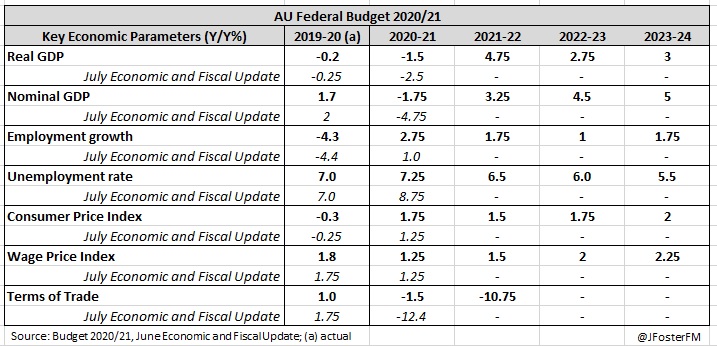
Australia's Federal Budget for 2020/21 extends the response from the nation's fiscal authorities to the COVID-19 pandemic, providing a further $41.4bn of new measures in the current financial year since the July Economic and Fiscal Update, with the focus around providing incentives for firms to hire and invest and boosting household income through the earlier introduction of personal income tax cuts. The Government's economic support measures now total $257bn (13% of GDP) over the forward estimates, with around $145bn of this front-loaded into 2020/21. 

Federal Budget 2020/21 | Budget Position

The budget deficit for 2020/21 is projected to be wider than earlier expected at $213.7bn (11% of GDP) compared to the $184.5bn (9.7% of GDP) estimate in the July Economic and Fiscal Update. The profile of the deficit is projected to narrow over the out-years to $112bn in 2021/22, $87.9bn in 2022/23 and to $66.9bn in 2023/24.    


The deterioration in the budget position reflects the focus of the Government to provide the economy with emergency support as it deals with the most severe crisis it has faced in the post-war period. For 2020/21, policy decisions taken by the Government since December are estimated to provide support to the effect of $159.8bn. Within this figure, Budget 2020/21 contains $41.4bn of additional measures following on from the $118.4bn of announcements already reflected in the Treasurer's July update. The nature of the Government's response switches in 2021/22 through a hand-off from the payments side of its budget as temporary support programs (JobKeeper and enhanced JobSeeker payments) are withdrawn to the revenue side as economic activity rebounds in response to earlier stimulus and a further easing of restrictions, while the role of automatic stabilisers through the tax system and safety nets will remain prevalent for some years beyond this, which is highlighted by the size of the parameter changes (see table above) over the remainder of the forward estimates period. 

The forecast profile for the budget deficit results in Government net debt expanding from its pre-pandemic level of 19.2% of GDP to a forecast 36.1% of GDP by 2020/21 aligning with the full scale of the fiscal response. A declining profile in the deficit onwards from 2021/22 sees growth in net debt moderate to 43.8% of GDP by 2023/24. The interest cost on this debt has lowered in response to the downward shift in global bond yields as central banks cut policy rates aggressively and expanded asset purchases following the onset of the pandemic. Net interest payments are forecast at 0.7% of GDP in 2020/21 and 2021/22 and 0.6% of GDP over the period out to 2023/24. The AOFM has since indicated in their Issuance Program statement that total issuance for 2020/21 is estimated at around $240bn, with around $117bn of this already completed. 


Federal Budget 2020/21 | Payments and Receipts 

Government payments as a share of GDP are forecast to surge to a peak of 34.8% in 2020/21, which compares with a pre-pandemic long-run average of around 25%. The level then declines over the out-years to 26.9% of GDP in 2023/24, reflecting the withdrawal of the temporary support programs.      

Receipts as a share of GDP before the pandemic were at 24.9% but the shock to the economy caused by its onset and the measures to contain the virus sees the Government's revenues roll over and maintain a downward trajectory through to 2021/22 at 22.5% of GDP. This is eventually forecast to begin turning higher from 2022/23, well past the time when the level of Australian GDP has recovered its pandemic-induced decline.  


Federal Budget 2020/21 | Policy Measures 

The major policy initiatives included in Budget 2020/21 are summarised in the table, below, with the focus on measures that are targeted towards incentivising firms to hire and invest, while bringing forward tax relief to households.  

On the payments side, the largest item is the extension to the JobKeeper scheme through to the end of March 2021 that costs $15.6bn. The Government's JobMaker plan includes an incentive for businesses to hire young workers as the demographic hardest hit by the upheaval in the labour market. A hiring credit of between $100-$200 a week will be available to employers who take on previously unemployed young workers (aged between 16-35) payable for 12 months for new jobs (minimum 20 hours/wk) created over the period up to 6 October next year. Additionally, there is an expansion of the existing wage subsidy scheme for new apprentices and trainees. Infrastructure is also a key focus with $6.7bn in funding available to the states and territories over the next 4 years to roll out new projects on an accelerated basis. More support payments will be forthcoming, with pensioners and other welfare recipients to receive two additional payments of $250.

Receipts measures are focused on boosting business investment and providing tax relief. On business investment, firms with turnover of up to $5bn (covering 99% of businesses) will be able to fully write-off the cost of depreciable assets (with no limit on the value of the asset) in the year of installation through to June 2022. This is expected to support around $200bn of investment, costing the Budget $26.7bn over the forward estimates. Firms will also be allowed to temporarily carry-back losses incurred over the period up to 2021/22 to offset tax paid since 2018/19. This will generate an estimated $31.6bn of tax refunds for firms that will become available as they lodge their tax returns in either 2020/21 or 2021/22. As was widely expected, the Government has elected to bring forward the stage 2 personal income tax cuts from its scheduled July 2022 start date to apply retrospectively from July 2020. This sees the lower threshold of the 32.5% band rise from $37k to $45k, while the lower band for the 37% threshold lifts from $90k to $120k. Meanwhile, the low- and middle-income tax offset (that was due to be removed at the commencement of the stage 2 tax cuts) will continue in 2020/21 providing tax relief of up to $1.08k for individuals and $2.16k for couples/families. The combined effect of these tax changes is estimated to lift household income by $12.5bn in 2020/21.  


Federal Budget 2020/21 | Economic Outlook 

The Government's near-term outlook for the domestic economy has been upgraded since July's update. The expected contraction in GDP growth in 2020/21 has been reduced from -2.5% to -1.5%, which largely reflects a stronger starting point following positive signs in the recovery towards the end of the first half of this year. It is, however, a time of significant adjustment as net overseas migration as a long-running support of economic growth falls away contracting by 72k in 2020/21 due to the impact of the international travel restrictions. On the assumption that Victoria's shutdown eases in line with its roadmap for reopening, conditions across all states and territories are seen to converge allowing most of the current border restrictions to be rolled back by the end of this year, except for a delayed easing in Western Australia. 

Assisted by improving dynamics offshore as the recovery in the global economy gains traction - China notably advancing by 8% next year - a rebound of 4.75% in Australian GDP is projected to come through in 2020/21. The major assumptions around the virus here are that a national vaccine program is available by the end of 2021 and that outbreaks remain localised and contained. As to the detail of this rebound, it is very much led by domestic demand. Household consumption growth swings from -1.5% in 2020/21 to 7% in 2021/22 assisted by stimulus measures and an improving labour market, while business investment turns from a 9.5% drag in 2020/21 to growth of 6% in 2021/22 in response to the asset write-off expansion and loss carry-backs announced in this budget. Despite weaker population growth dynamics, residential construction activity is also forecast to pick in 2021/22 rising by 7% on the back of measures such as the HomeBuilder scheme and monetary stimulus from an 11% fall in 2020/21. The Australian economy is then assumed to normalise from 2022/23 onwards with GDP growth advancing at an around trend pace.  

With the focus of this budget being on repairing the labour market, the peak in the unemployment rate is expected to be 8% in Q4 of this year ahead of improving over the forward estimates period to reflect the projected growth profile of the economy. This improvement is only expected to be gradual with the unemployment rate expected to take until mid-2022 to ease to 6.5% and decline modestly thereafter. The labour market faces headwinds from the tapering of income support measures ahead of the March 2021 end date for JobKeeper and more Australians returning to the labour force as restrictions are eased further.      


Federal Budget 2020/21 | Summary 

The Federal Government's 2020/21 Budget extends on earlier policy announcements to provide significant fiscal support following the COVID-19 shock. The focus is around providing incentives for businesses to hire and invest and in boosting household incomes by bringing previously legislated tax cuts through 2 years earlier than planned. The Budget made no changes to the proposed end dates for the JobKeeper policy (March 28, 2021) and enhanced JobSeeker payments (31 December 2020), though these programs are highly dependent on how the economy evolves and the Government has previously shown a willingness to make adjustments as necessary. A clear risk is that these measures, after recently being tapered, do not get extended and if that were to be the case, that would likely have implications for the pace of the recovery. For the economic outlook more generally, the key factor remains the path of the virus. Maintaining effective testing and track and trace measures are key to containing outbreaks that would otherwise restrict the ability of the economy to reopen further. 

Link to Budget 2020/21 here

Tuesday, October 6, 2020

RBA maintains policy stance

As expected, the RBA Board left its monetary policy stance unchanged (cash rate and 3-year AGS targets at 0.25%, Term Funding Facility rate at 0.25%) at today's October policy meeting, but the door has been left open for more support in the near term. The clearest indication of this in today's decision statement from Governor Philip Lowe was the line that; "The Board continues to consider how additional monetary easing could support jobs as the economy opens up further". Coming hours before the delivery of the Federal Budget for 2020-21, Governor Lowe noted the importance of both the fiscal and monetary levers working together given the economic outlook and labour market conditions. 

A key feature in today's statement was the emphasis given to the level of accommodation already being provided by current settings. On the Term Funding Facility, it was noted that in addition to the $81bn in initial drawings, the banking sector will have access to a further $120bn in cheap 3-year liquidity following the expansion announced at the September meeting. Together with its purchases of Commonwealth Government bonds (currently at $63bn), the yield on 3-year maturities was noted to have fallen below the target "to around 18 basis points as markets price in some probability of further monetary policy easing". Comments on the domestic currency were limited to; "The Australian dollar remains just a little below its peak of the past couple of years". This comes after a decline of around 3% in US dollar and trade-weighted terms since the September meeting. 

On economic conditions, following the 7% contraction in output in Q2, the recovery was starting to take place, albeit restrained due to the reversal of Victoria's reopening. As a result, the governor's expectation is that the economic recovery is "likely to be bumpy and uneven and it will be some time before the level of output returns to its end 2019 level". In the labour market, the good news is that a lower peak in the unemployment rate is now anticipated from the 10% level earlier expected, though it will still be highly elevated. Indeed, reducing the level of unemployment was seen by the Board as "an important national priority". These assessments come ahead of next month's quarterly statement from the Bank that will include a full set of updated forecasts.

For further guidance on policy, markets can now look forward to October 15 where Governor Lowe is scheduled to deliver a speech at 8:45am (AEDT).   

Monday, October 5, 2020

Australia's trade surplus narrows to a 2-year low

The surplus on Australia's monthly trade account narrowed to a near 2-year low in August coming in well below expectations. The result was, however, impacted by volatility in non-monetary gold exports as the import side lifted for a third straight month.   

International Trade — August | By the numbers

  • Australia's trade surplus narrowed by $2.009bn in August to $2.643bn its lowest since October 2018 — against the median estimate of $5.05bn (July was revised to $4.652bn from $4.607bn).  
  • Export earnings declined by 4.2%m/m to $32.638bn to extend the fall in annual terms slightly to -21.9% from -21.3%. 
  • Import spending lifted by 2.0% in August to $29.996bn, reducing the pace of decline through the year to -14.6% from -16.9%. 


International Trade — August | The details

There continues to be elevated volatility in monthly trade flows during this COVID period. In August, the nation's trade surplus declined sharply by $2.0bn following the $2.9bn fall in July. This coming shortly after a $6.7bn surge in March to a record high of $10.5bn. 

On the export side, earnings declined by 4.2% in the month (-$1.4bn) to $32.638bn, which is its lowest level since November 2017. The main influence was in non-monetary gold with a 61.8% fall (-$2.2bn) coming through, with volatility in this category often elevated from one month to the next. Non-rural goods lifted by 2.6% ($0.57bn) to $22.7bn supported by the commodities (metal ores +3% and coal +9%), while rural goods advanced by 12.4% ($0.37bn) to $3.3bn. Services exports, hard hit by the travel restrictions on inbound tourism, continue to ease falling by a further 2.4% (-$0.14bn) to $5.2bn — its lowest level since November 2013. 


Turning to imports, spending lifted for a third straight month rising by 2.0% ($0.58bn) to a touch short of $30bn as firms look to build up inventories again and domestic demand improves following the reopening of the economy back in mid-May. Consumption goods advanced by a further 6.3% to $9.3bn (with vehicles +36%m/m) and intermediate goods by another 3.4% to $9.7bn. Over the past 3 months, consumption goods have rebounded by almost 22% and intermediate goods by 6.5%. Capital goods have been volatile of late, falling by 6.9% in August, but they too have rebounded coming out of the shutdown rising by 7.6% over the past 3 months. Services imports, affected by the overseas travel ban, were little changed in August firming by 1.2% to $3.7bn.    


International Trade — August | Insights

The sharp fall in the trade surplus in August was affected by the volatility in non-monetary gold exports. As China's economy continues to gather momentum, demand for domestic resources will support the export sector. The rebound evident in imports is a positive development in that it reflects that activity and demand in Australia is coming back again after the reopening.   

Preview: RBA October meeting

Today's RBA Board meeting takes place just hours before Treasurer Josh Frydenberg hands down the Federal Budget for 2020-21. The consensus call in the market is that the decision statement from Governor Lowe (due 2:30pm AEDT) will confirm an unchanged stance in policy settings from the Board, though the option of further easing remains firmly on the table. 

A recent speech from Deputy Governor Guy Debelle noted; "Given the outlook for inflation and employment is not consistent with the Bank's objectives over the period ahead, the Board continues to assess other policy options". The most likely of the options under consideration appears to be a reduction in the Bank's rates structure, including the targets for the cash rate and 3-year AGS yield and Term Funding Facility (TFF), which are all currently at 0.25%. Under existing arrangements, banks' surplus exchange settlement (ES) balances held at the RBA earn 0.1%, so there is room to cut rates further by up to 15 basis points. Such a move would then likely involve a lowering of the rate applied to ES balances. Other options are being considered, including additional bond-buying at the long-end of the curve, foreign exchange intervention and negative rates, though each for their own reasons they shape as unlikely at this stage as discussed by recently by both Dr Lowe and Dr Debelle. 

As the situation currently stands, the effective cash rate is sitting a little above 0.1%, yields on 3-year Commonwealth bonds trade slightly below the 0.25% target and almost all of the $84bn in initial allowances under the TFF was taken up by the banks ahead of the 30 September deadline, while an expansion to the program was announced at the previous Board meeting. The recent decline in the level of the Australian dollar over the inter-meeting period (around -3% in USD and trade-weighted terms) is sure to have come as a welcome development for the Board. With the RBA clearly of the view that fiscal policy is more likely to be effective than further monetary easing, it is likely the Board will wait for the Federal Budget to be handed down first and assess the implications for its outlook thereafter.  

Friday, October 2, 2020

Macro (Re)view (2/10) | Australian Federal Budget in focus

Attention in Australia has turned towards next week's Federal Budget that will be handed down by Treasurer Josh Frydenberg on Tuesday evening. The deficit for 2019/20 will be announced at $85.3bn (4.3% of GDP), while the deficit for 2020/21 that was forecast in the Government's July economic and fiscal update to come in at $184.5bn (9.7% of GDP) will take a sizeable downgrade to well in excess of $200bn, with the budget position to deteriorate following the reversal of the reopening of the Victorian economy and additional support measures that are expected to be announced. It has been widely touted that the focus of this Budget will centre on the bringing forward of personal income tax cuts that were scheduled to commence in mid-2022 to be made retrospective from mid-2020, while other initiatives likely to feature are around the path forward for the key income support measures of JobSeeker and JobKeeper, infrastructure spending and business investment. A support package of around $1.5bn for the nation's manufacturing sector will be forthcoming as discussed by Prime Minister Scott Morrison in an address to the National Press Club this week. Reform is also likely to feature given the Government's recent focus on skills and training and industrial relations to support a labour market still very much in recovery mode after it was upended by the measures enacted to contain the pandemic. Next Tuesday will also coincide with the RBA's monthly policy meeting. Whereas market pricing for additional easing by the Board had firmed last week, that has largely been unwound over recent days with no change to existing settings (0.25% target on the cash rate and 3-year AGS and 0.25% on TFF funding) likely to be the decision.

On this week's domestic data flow, retail sales pulled back by 4.0% for the month in August (7.1%yr) as the impact of the Victorian shutdown saw turnover in the state fall heavily by 12.6% (see here). However, spending on a combined basis excluding Victoria was soft falling by 1.3% in the month and with discretionary spending pulling back sharply, this appears to line up with the weakness in consumer confidence that occurred in August. This negative impact on confidence appears to have moderated in September, though the Federal Government's income support measures were tapered towards month's end. Building approvals softened broadly as expected in August easing back by 1.6% coming after a 12.2% surge in July that reflected reopening dynamics (see here). A 12.9% decline in unit approvals more than offset a further advance in house approvals of 4.6% after recording an 8.1% lift in the month prior (see chart of the week, below). Approvals for residential alteration work increased by 7.0% to $748m, taking the value of work approved over the past 3 months to $2.2bn. The key factor here, and in the upturn in house approvals, has been the Government's HomeBuilder scheme and with the policy clearly gaining traction in the market, some form of extension beyond its end of year cut-off date could be announced in next week's Budget. Remaining with the housing theme, capital city property prices according to CoreLogic's Home Value Index declined for a 5th straight month in September, albeit at a moderated pace of -0.2% (4.9%yr), reflecting the impact of a 0.9% fall in Melbourne and a 0.3% softening in the Sydney market. Sales volumes have improved markedly since the shutdown and this has contributed to housing credit growth staying resilient at 3.2% through the year to August against the sharp slowdown in private sector credit growth (2.2%yr) over recent months in line with the weakness in the economy. 

Chart of the week

— — 

To offshore developments where momentum in the lead up to the US election was derailed by the news of the confirmed virus cases of President Trump and the First Lady, leading to increased uncertainty over the path forward in the campaign and the outlook for policy in the near term with both sides of the House still yet to agree to terms on next fiscal stimulus package. On economic developments, some of the gloss of the recovery in the US labour market since the reopening was dulled by a softer-than-expected nonfarm payrolls report in September as employment lifted by 661k against the median estimate for a rise of 859k. While upward revisions saw a further 145k jobs added over July and August, the employment outcome in September was by a considerable margin the slowest outturn in this recovery phase going back to May, possibly raising concerns over its sustainability given the risks that lie ahead. An upside surprise came through on the unemployment rate which fell to 7.9% (vs 8.2% expected) from 8.4%, though this did come alongside a decline in the participation rate of 0.3ppt to 61.4%, while the level of underemployment also continues to decline coming in at 12.8% and has improved by 10ppts over the past 5 months. In other key data points from the US this week, personal spending moderated to a 1.0% lift in August from a 1.5% pace in July, though this was stronger than the median estimate for a 0.8% rise, while in annual terms the rate of decline eased to -1.9% from -2.6%. The ongoing recovery in consumption spending continued despite a sharper-than-expected fall in personal income of -2.7% in August (4.7%yr), which contributed to a decline in the saving rate from 17.7% to 14.1%. Meanwhile, the ISM manufacturing index for September eased to a reading of 55.4 from 56.0 in the month prior. The result pointed to a moderately softer pace of expansion in the sector as growth in the new orders (-7.4pts) and production (-2.3pts) components slowed.

Over in Europe, the annual ECB and Its Watchers conference took place during the week with the highlight being the speech by ECB President Christine Lagarde that outlined some of the key considerations that are the focus of the bank's currently-underway strategic review. Findings from the review are still expected to be up to 12 months away, but it was discussed that the ECB could potentially move to a make-up strategy on inflation to compensate for the lengthy period in which measured CPI has fallen short of the Governing Council's single mandate of below, but close to, 2%. While the ECB currently targets headline inflation, President Lagarde raised the idea that it could shift to focusing on core inflation with underlying measures described as being "more responsive to economic slack" and less affected by volatility. Certainly, short-term factors, such as the reductions in Germany's value added tax rates as a pandemic response measure to support the economy there, are currently weighing on inflation dynamics in the euro area. On Friday, the flash estimate of headline CPI in the euro area declined 0.1ppt to -0.3% through the year to September, while core inflation slowed further to a record low of 0.2%Y/Y. As such, ECB Vice-President Luis de Guindos in an interview with MNI pointed out that base effects would see the pace of inflation rebound, but on current projections, this would still be well below target at 1.0% next year and 1.3% in 2022. Meanwhile, Brexit discussions between the UK and the EU made some progress this week; however, the statement from the EU's chief negotiator Michel Barnier highlighted there remained "persistent serious divergences" between the sides, notably the rules and enforcement mechanisms that will apply to its trading relationship. Lastly, coming in a week of increased uncertainty, a speech from the Bank of England's Chief Economist Andy Haldane gained attention in which he cautioned against over emphasising risks to the outlook at the exclusion of the positive developments that have occurred in the recovery so far. 

Thursday, October 1, 2020

Australian retail sales -4% in August

The upswing in Australian retail spending coming out of the national shutdown was paused in August as the reopening in Victoria went into reverse following a second wave of virus infections and this had spillover effects on confidence across the rest of the nation. However, even after falling by 4% in August, the level of retail turnover is still 6% higher than prior to the onset of the pandemic, boosted by fiscal and monetary stimulus, early access to superannuation, loan and rent deferrals, and shifts in consumption patterns away from services and into goods due to ongoing activity restrictions.  

Retail Sales — August | By the numbers 

  • Retail turnover (nominal) declined by 4.0% in August to $29.481bn, slightly less severe than the preliminary and market estimate of -4.2%. Turnover advanced by 3.2% in July that coincided with the second of two $750 Economic Support Payments from the Federal Government to eligible Australians.
  • Annual growth in retail turnover slowed from a 20-year high 12.0% to 7.1% in August. 


Retail Sales — August | The details  

For the first time since the national shutdown, monthly retail sales declined with a 4% fall in August. Though it lost a bit of momentum on this result, the upswing since the reopening remains well and truly intact with the level of retail spending in August around 6% higher than prevailed immediately before the pandemic emerged. The main factor that contributed to the decline in August was the impact of the shutdown in Victoria that accounted for $0.93bn of the $1.22bn fall in the national figure of $29.48bn. 


Spending in Victoria declined by 12.6% in August to $6.47bn. Even incorporating the 2.1% decline in July, the impact of this second lockdown has been much less severe than the 21.1% fall (-$1.65bn) that came through in the state back in April following the implementation of the national shutdown. Excluding Victoria, turnover on a combined basis across the other states and territories fell by 1.3% in August and given that consumer confidence weakened sharply in that month (-9.6% according to the Westpac-Melbourne Institue's index), this would seem to suggest that the level of precautionary behaviour increased. 


The composition of spending in August saw broad-based weakness coming through across the categories, particularly in non-food sales (-6.7%), which as a proxy for discretionary demand would support the notion of precautionary behaviour picking up following the Victorian situation. 


Furthermore, with Victorians unable to access the shops in person and health-related concerns evident elsewhere in the nation, online spending lifted strongly in August (7.0%) following on from a robust increase in July (6.3%). Combined with the fall in total retail turnover in August, spending through online channels as a share of total spending accelerated to be at a near-record high of 11.0% from just below 10% over June and July. The record figure of 11.1% occurred in April during the national shutdown. 


The following chart shows how the level of spending across each of the major categories is tracking from a February (pre-pandemic) baseline. As its stands after August, 3 categories are below baseline; cafes and restaurants (-18.7%), department stores (-6.7%) and clothing and footwear (-4.9%). Last month, cafes and restaurants were the only category below the level from February. Online has been the major beneficiary of the impacts on shopping behaviour following the onset of the pandemic rising to almost 68% above its February 2020 level.   


Retail Sales — August | Insights

As expected, retail spending fell sharply in August due mainly to the reversal of Victoria's reopening. This had spillover effects on confidence across the other states and territories as indicated by the declines in spending outside of Victoria, weaker discretionary spending and the elevated result from online turnover. Nevertheless, the upswing in retail spending since the Australian economy started to reopen from mid-May remains intact boosted by fiscal and monetary stimulus, the early access to superannuation accounts and other measures such as loan and rent deferrals have also helped to drive the recovery so far.  

Tuesday, September 29, 2020

Australian dwelling approvals -1.6% in August

Australian dwelling approvals softened broadly as expected in August after rebounding by 12.2% in July that reflected the reopening of the domestic economy. House approvals posted another strong result to be at their highest level since early 2019 but approvals for units remain very weak. 

Building Approvals — August | By the numbers

  • Dwelling approvals (seasonally adjusted for the private and public sectors) eased slightly in August by -1.6% to 13,691 after rebounding by 12.2% in the month of July, with the median estimate looking for a larger decline of 2.0% in today's report. Annual growth in approvals pulled back to be near-flat at 0.6% from 6.9%.  
  • Unit approvals declined by 12.9%m/m to 4,290 after a 20.3% surge in the month prior. As a result, the pace through the year swung to -18.1% from +9.1%.
  • House approvals firmed by 4.6% to 9,402 following on from an 8.1% boost in July. This is its highest level since January 2019. In annual terms, house approvals are up by 12.3%.


Building Approvals — August | The details 

August's report contained mixed details as house approvals lifted for the second straight month coming out of the shutdown but this was more than offset by a fall in unit approvals. The underlying detail (which is not seasonally adjusted) suggested that the weakness in unit approvals in August was concentrated in both the low rise and high rise segments.


Approvals for alteration work to residential properties is now becoming quite elevated in response to the Federal Government's HomeBuilder scheme that offers grants of $25k to put towards a substantial renovation (contract value between $150k-$750k) for contracts entered into between 4 June and 31 December 2020. Approvals of this type lifted by a further 7% in August to $784.3m, with $2.2bn of work having been approved over the past 3 months (see chart, below). Note HomeBuilder also applies to new builds (provided the value of the house does not exceed $750k), so this could also be a factor in driving house approvals higher of late. Non-residential approvals, which are very volatile month to month, look to be improving out of the shutdown with around $12.1bn in approvals going through over the past 3 months.   


Building Approvals — August | Insights 

As expected, approvals softened in August after rebounding sharply in July. The effects of the Government's HomeBuilder scheme are clearly evident in the alterations component of today's report, which is a positive outcome amid a highly uncertain outlook for residential construction given the prevailing weak economic conditions post the initial COVID shock and border restrictions slowing population growth.  

Friday, September 25, 2020

Macro (Re)view (25/9) | Risks starting to rise

Support for the next phase of the economic recovery has quickly become the main focus in Australia, with both Westpac and NAB now expecting further easing in monetary policy from as early as next month. This has seen rates pricing in the OIS market declining by a few basis points to 0.1% on a 1-month outlook; undoubtedly this was also a factor in the depreciation of the Australian dollar this week, albeit amid a notable move higher in the US dollar. These moves came after a speech by Reserve Bank of Australia Deputy Governor Guy Debelle in which he highlighted that with the outlook for both inflation and employment "not consistent with the Bank's objectives over the period ahead, the Board continues to assess other policy options". With the Federal Budget due to be handed down on the evening of October 6, the same day as the next RBA Board meeting, the assessment from some quarters is that sentiment could be boosted by deploying both the fiscal and monetary levers simultaneously in a similar episode to the coordinated measures announced by the RBA and the Treasury back in March.

As to policy options, the deputy governor reiterated the earlier communication from the RBA that it could consider; 1) additional bond purchases, more targeted at the longer end of the curve, 2) intervene in the foreign exchange market, 3) further reduce rates to a still-positive nominal level, and 4) turn to negative rates. With the RBA assessing the Australian dollar as broadly in line with its fair value, the effectiveness of foreign exchange intervention was seen as unclear, while it remains much the same for negative rates. Whether the Board ultimately decides to move in October or not, if a further easing in the monetary policy stance is required a rate cut appears to be the most likely option and this would apply to the cash rate, 3-year Commonwealth bond yield target and Term Funding Facility (TFF) rate, which all currently stand at 0.25%. Under current arrangements, with banks' surplus exchange settlement balances held at the RBA earning 0.1%, there is potentially 15 basis points of scope available to cut rates and still remain positive. The other notable points from the speech were around the RBA's actions to enhance the supply of credit to the real economy and to lower borrowing costs. Here, the deputy governor outlined that the Bank's balance sheet had been expanded by $130bn since February to $300bn currently, which mostly reflects the impact of its bond purchases in support of its 3-year yield target and the take-up from the TFF. Initial allowance drawings under the TFF now stand at $78.7bn (see chart of the week, below), leaving another $5.3bn available to be taken up by the banking sector before the end of the month, with the access window for supplementary ($57bn) and additional allowances ($67.7bn currently) then opening up from October 1.

Chart of the week

On the fiscal front, Federal Treasurer Josh Frydenberg announced that the budget deficit for 2019/20 has been finalised at $85.3bn (4.3% of GDP) and in the July Economic and Fiscal update has been projected to widen to $184.5bn (9.7% of GDP) in 2020/21. Meanwhile, the Treasurer on Friday announced a proposal to roll back the nation's responsible lending laws in an effort to loosen credit standards and support credit flow to aid the economic recovery. Data domestically was light this week but was generally soft. August's preliminary estimate of retail sales declined by 4.2%, with the shutdown in Victoria (-12.6%) accentuating broader weakness across the rest of the nation (-1.5%). The high frequency employment data continued to point to a stabilisation in the recovery in the labour market as the payrolls index eased to 95.5 to be around its level from June. Some better news came from Australia's flash PMI for September that lifted from 49.4 to 50.5 (readings > 50 indicate expansion), indicating that the slowdown in economic activity in August that was driven by the reversal of Victoria's reopening was fading.

— — 

To offshore developments where there was a decidedly risk-off tone in market sentiment over the past week. Among the concerns were perceptions that the timing of additional fiscal stimulus in the US would be delayed, rising virus cases in Europe and the UK leading to containment measures being reinstated, and signs that the initial rebound in activity from the reopening effort was beginning to stall. This was reflected in the week's price action as equity markets in Europe slumped, strength went into the US dollar and long-end Treasuries were bid.    

An unnerving resurgence in the virus over recent weeks in Europe has clearly weighed on both economic activity and sentiment. The euro area flash PMI for September slowed to a 3-month low at 50.9 from 51.9 in August as the service sector fell back into contractionary territory (47.6 from 50.5) for the first time since shutdowns started to be wound back. In contrast, output in the manufacturing sector advanced to a 31-month high at a reading of 56.8 from 55.6 with the bright spot coming in Germany where output lifted at its strongest pace since early 2018. On the consumer, though sentiment improved marginally in rising by 0.9% in September, at a level of -13.9 it remains well below its long-run average (-11.1) and is vulnerable to rolling over if restrictions are progressively tightened over the northern hemisphere winter. Over in the UK, Prime Minister Boris Johnson this week announced a range of new pandemic measures that he indicated could remain in place for up to 6 months. With the Government's furlough scheme due to conclude at the end of October, Chancellor Rishi Sunak unveiled the slimmed-down job support scheme that will partially subsidise the wages of workers who have lost hours from November 1 onwards for a period of 6 months. With the threat of the virus re-emerging, conditions in the UK economy have started to start to lose momentum as September's flash PMI eased back to 55.7 from its 72-month high of 59.1 in August. This was driven mostly back a pullback in the services sector to 55.1 from 58.8, though the manufacturing sector also softened in the month to a reading of 54.3.

Dominating developments in the US have been the seemingly fading prospects for the next fiscal stimulus package to be passed before November's presidential election. However, Speaker of the House Nancy Pelosi and Treasury Secretary Steven Mnuchin to some extent pushed back against this narrative by expressing a willingness for both sides to come back to the negotiating table. There is much riding on more fiscal stimulus, not only from a markets perspective but also in keeping momentum in the economic recovery going, a point emphasised by Federal Reserve Chair Jerome Powell at this week's testimony before Senate Banking Committee. For now, the recovery remains robust with September's flash PMI coming in little changed at 54.4 from 54.6 in August, but as seen in Europe it is vulnerable to fraying if the path of the virus takes a turn for the worse. While the services sector saw activity slow slightly to a reading of 54.6 (from 55.0), manufacturing output advanced to a 20-month high at 53.5 driven by an increase in production and new orders. The key question now for markets now is whether the momentum in the recovery carries over into the December quarter with election, policy, and virus uncertainty in play.      

Friday, September 18, 2020

Macro (Re)view (18/9) | Australian employment continues to recover

Domestically this week, the August labour force report showed the recovery in Australian employment extended to a third consecutive month, albeit coming against a deterioration in conditions in Victoria as the state was placed back into shutdown. Whereas the narrative pre-release was around gauging the extent to which the situation in Victoria would impact the broader labour market, as had been indicated by recent high frequency data points, the good news was that the result surprised even the most optimistic forecasts as employment increased by 111k against a median estimate that was positioned for a decline of 35k (reviewed here). Adding to the 347k increase in employment that occurred through the initial reopening effort in June-July, just over half (53%) of the 871.6k jobs that were lost when the pandemic hit have now been returned to the economy. Understandably, the Victorian shutdown had a notable impact on the labor market there, though not to the severity as occurred when the pandemic emerged initially, with the loss of 42.4k jobs.      

Notwithstanding the headline employment result, with the shutdown coming back in Victoria, this weighed on the broader recovery in the Australian labour market. This was seen by the stalling in hours worked in August (0.1%) at the national level as a 4.8% decline in Victoria offset a 1.8% lift across the other states. Back in June, hours worked rebounded by 4.2% before lifting by another 1.3% in July. Those gains had reduced the decline in the level of hours worked on pre-pandemic times from a trough of -10.4% to -5.5%, but that progress stalled in August (-5.4%). 

Chart of the week


Another area where the Victorian disruption was evident was in the level of workforce participation, which lifted by only 0.1ppt to 64.8%, whereas it had risen by a combined 2ppts over June-July. Weighing on the lift in the participation rate nationally was Victoria (-0.6ppt) as well as a surprising fall in Queensland (-0.5ppt). With headline employment rising sharply and with this muted increase in participation, there was a reversal of the recent rise in the national unemployment rate as it fell to 6.8% from 7.5% against an expected lift to 7.7%. However, given the underlying dynamics outlined, headline unemployment remains an imprecise gauge in the circumstances. More importantly, not least for policymakers, spare capacity in this labour market remains very elevated with underemployment at 11.2% and 18% on the rate of underutilisation.

Certainly from the perspective of the RBA, the message from the Board in the September meeting minutes was that it will be leaving in place a significant degree of policy support to help the economy through what are very difficult and uncertain times. These latest meeting minutes explained that this elevated level of uncertainty around the economic outlook had justified the Board's decision to announce an expansion in the Term Funding Facility, which will provide the banking system with access to additional funding of around $57bn between October and June 2021, with the window for drawing down intial allowances ($84bn) due to close at the end of the current month, while the deadline for accessing additional allowances that become available from October 1 (currently around $68bn) was pushed out by 3 months to the end of June 2021. The minutes also provided insights around the Bank's bond-buying activity, noting that it had to contributed to the effective functioning of these key markets "alongside a significant increase in issuance" from government authorities and reiterated its commitment to step in with more purchases in support of its yield target (0.25% on 3-year AGS) and in the event of similar episodes of the turmoil seen earlier in the year when liquidity in global bond markets seized up. With the RBA backstopping the government and semi-government bond markets, the Board reasoned that the public sector was well placed to use their balance sheets to expand fiscal policy measures. 

— — 

Over in the US, the latest meeting of the Federal Reserve's FOMC made no changes to its policy stance, as expected, as the Committee's updated economic projections indicated its ultra-accommodative settings were likely to remain in place for years to come. After a persistent undershoot on its inflation goal (2%), the Fed's recent regime shift to average inflation targeting will now see the Committee aiming to lift inflation "moderately above 2 percent for some time", to secure longer-run inflation expectations at its targeted level of 2%. Market participants, in search of details as to the specifics on how this will be carried out, were largely left to keep looking by a Fed reluctant to make firm commitments given the uncertainties around the path the pandemic and its effects on the economy and future fiscal support plans. Committee Chair Jerome Powell outlined in his opening statement at the post-meeting press conference that by pledging to leave rates on hold (0-0.25%) until its maximum employment and inflation goals have been achieved and by continuing its asset purchases "at least at the current pace" ($80bn/mth of Treasuries and $40bn/mth of mortgage-backed securities) these actions would best support the economic recovery at the present juncture. Regarding the path of that recovery, the median projections based on the individual views of Committee members pointed to a less severe contraction in economic growth in 2020 (-3.7%) than previously expected (-6.5%) but a slower and more protracted rebound over the following years; 4% in 2021 (from 5.0%) and 3% in 2022 (from 3.5%). Meanwhile, with rates going nowhere, unemployment was expected to take until 2023 to get down to 4%, while the inflation outlook was only seen reaching 2% by the end of the forecast period. It is also worth highlighting that Chair Powell said that for these prospects to be attainable more fiscal support would likely be needed. In terms of the data in the US this week, the outturns were in line with the recent pullback in Citigroup Economic Surprise Index as retail sales disappointed with a 0.6% lift month-on-month in August against +1.0% forecast (control group sales declined 0.1% vs +0.3%), while industrial production was also softer than expected in rising by 0.4% in August (vs +1.0%) and housing starts (-5.1%m/m) and building permits (-0.9%m/m) rolled over after very strong increases in July. 

Across the Atlantic, the Bank of England's Monetary Policy Committee (MPC) maintained existing settings at this week's meeting, with the Bank rate at 0.1% and the target for asset purchases at £745bn (currently standing at $684bn). The main change coming from the MPC was in the meeting minutes that elevated the prospect of negative interest rate policy from an option merely not being dismissed to now coming under increasing consideration, with the MPC having recently been briefed by BoE staff on possible plans for implementation ahead of discussions between the Bank and regulators later in the year. On economic conditions, the MPC assessed that the recovery was occurring gradually, with monetary and fiscal support helping to bolster household spending, though its durability was uncertain given that sentiment remained weak and the labour market was still being held up the government's furlough (wage subsidy) scheme. Data this week underscored this point through a modest uptick in the unemployment rate from 3.9% to 4.1% in July, though the BoE forecasts it to rise to 7.5% by the end of the year with the furlough scheme scheduled to be wound up at the end of October. On inflation, the MPC noted that the decline in headline annual CPI in August to 0.2% from 1.0% reflected a range of temporary government initiatives to support the economy, though it was unlikely to pick up materially over the coming months with wages growth and rents soft. Staying with the inflation theme, euro area CPI was this week confirmed to have declined by 0.2% through the year to August, while core CPI slowed to 0.4%Y/Y from 1.2% in July with a key influence behind this being a temporary VAT cut in Germany. Lastly, in Asia, the Bank of Japan's Policy Board left its monetary settings on hold at this week's meeting, maintaining the line that it would "not hesitate to take additional easing measures", as new prime minister-elect Yoshihide Suga vowed to continue of the regime established by his predecessor of pro-growth policies and structural reforms.