Independent Australian and global macro analysis

Friday, July 2, 2021

Macro (Re)view (2/7) | Recoveries and setbacks

The spread of the Delta variant of Covid-19 cases that led to the lockdown in Sydney broadened out to lockdowns in several other major Australian cities over the past week, some of which are now easing. Caseloads nationally averaged 34 per day over the 7 days to June 30, but with only around 6% of the population fully vaccinated, the public health authorities have mandated tighter restrictions to curb transmissions. In looking ahead, the plan agreed by National Cabinet on Friday proposes for precautions and restrictions to become less stringent as vaccination rates rise. Throughout the pandemic, snap lockdowns have not derailed the recovery as activity typically rebounds very quickly on reopening, though the sheer size of the Sydney economy means that the lockdown there has the potential to weigh more substantially at the national level the longer it is required to be kept in place. It should be noted that official forecasts (including by Treasury and the RBA) factor in the impact of lockdowns, conditioned on outbreaks being small and the period of hard restrictions short. Thus it appears unlikely the situation will alter the course for next week's crucial RBA meeting. But with the Board widely expected to remove some of its accommodative policy by not extending the duration of its 3-year yield target past the April 2024 bond, it will clearly want to find the right tone on Tuesday. The main message from the RBA since the previous meeting has been the transition in the economy from recovery to expansion, but as this latest setback highlights, progress is not always smooth. An expansion in the RBA's bond purchase program is also expected, which is likely to include more flexibility with regard to the pace of purchases as underlying economic conditions evolve.     

Data releases through the week remained strong, supportive of the momentum the economy was running with prior to these recent virus setbacks. The housing market remains a case in point, with robust conditions continuing as policy stimulus drives buyer demand while stock available on the supply side remains tight. Nationally, house prices according to CoreLogic's monthly index showed another elevated gain rising by 1.9% in June, albeit softening from the 2.2% rise in May. This lifted annual growth in house prices to their fastest pace since April 2004 at 13.5%. While growth in house prices remains strong, there were some signs of cooling in certain markets and segments. Prices in Perth (0.2%mth) and Darwin (0.8%mth) were much slower than in the other capitals, while price growth in the high end of capital city markets (top 25% of house prices) decelerated by more than in the middle and lower tiers, easing by 1.2ppts to 8.0% for the 3-months to June. Meanwhile, the spread in the outperformance of regional markets (17.7%yr) to capital city markets (12.4%) remains, but it is tighter than earlier in the pandemic. While demand has been supported by a range of stimulus measures, CoreLogic highlighted the effect tight supply was playing in the current price upswing. The group estimates there were around 126k new listings that came onto the market for the 3-months to June, but this was outpaced by sales transactions of around 167k over the period. With sales exceeding supply a persistent trend year to date, CoreLogic noted that the level of advertised stock was currently sitting 25% below its 5-year average. 

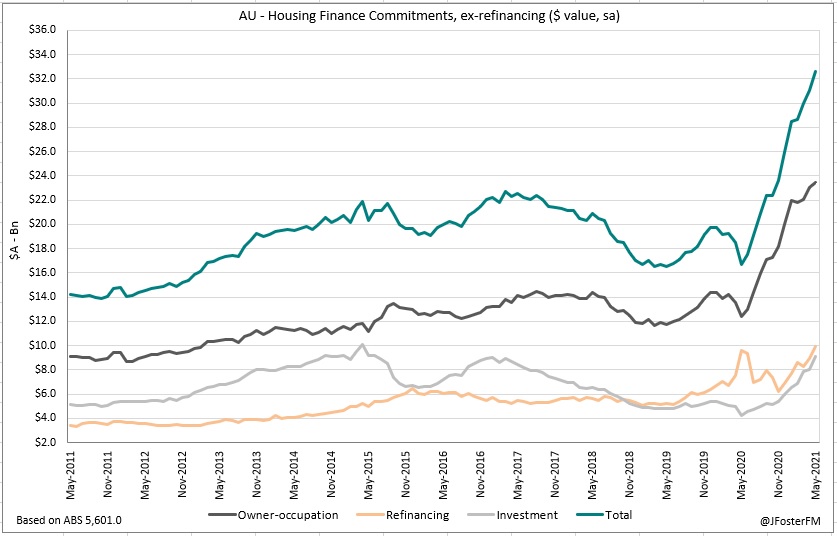
On the demand side, May's housing finance update reported a stronger-than-expected rise in commitments of 4.9%, taking growth over the reopening period to 95.4% above the trough during the national lockdown 12 months earlier. Increasingly evident is the strength in investor commitments, which surged by 13.3% in May to a near 6-year high, compared to a 1.9%m/m rise from owner-occupiers. The investor segment has had a more delayed rebound than owner-occupiers, but their presence is increasing the longer the upswing in house prices extends and as first home buyer activity moderates following the expiry of the HomeBuilder scheme (discussed in detail here). The last piece to this is the impulse the rebound has given to housing credit growth, which in annual terms has lifted from a pre-pandemic pace of 3.1% to 4.8% in May. Over the period, annual credit growth to owner-occupiers has risen from 4.9% to 6.6% and from 0.1% to 1.6% in the investor segment.  

News on the labour market extended the optimism coming out of May's very strong employment report. Job vacancies tracked by the ABS have surged to record highs rising by 23.4% for the 3-months to May at 362.5k to be 57.4% higher than pre-COVID levels (see chart below). Clearly, the demand for labour is strong and the good news is that it is broad-based in sectors across the economy, with vacancies relative to pre-COVID levels up 84% in household services, 63% in the good-related sector and 27% higher in business services. While this an encouraging sign for the outlook for employment growth and should lower unemployment further, it was covered in last week's review that 27% of businesses were finding suitable labour difficult to come by due to a lack of applicants, skills mismatches or because of the travel restrictions. Also this week, Australia's trade surplus widened in May, missing expectations but still coming in at an elevated $9.7bn (reviewed here). Exports advanced by 6.1%mth, with iron ore and rural exports reaching record highs, outpacing a 2.9%mth lift in imports.

Chart of the week 

— — 

Dominating the focus for offshore markets all week was Friday's US labour market update for June. While the report contained some strong elements, it did little to suggest that the "substantial further progress" the Federal Reserve wants to see in the recovery was near to being achieved. Employment on non-farm payrolls increased by 850k in June to outperform the median estimate for a 720k rise, while revisions to the prior two months added on a net 15k. This brought total employment to 145.8m, which is still around 6.8m below its pre-pandemic level. On the disappointing side was a slight uptick in the unemployment rate from 5.8% to 5.9% (vs 5.6% expected), while there was no change in the level of labour supply as the participation rate held steady at 61.6%, remaining well short of its level just north of 63% before the pandemic swept through. Overall, the US labour market is still very much in recovery mode with much happening beneath the surface. Employment continues to rise — June's 850k lift was the strongest outcome in a single month since last August — as vaccinations allow a wider reopening, though there are still significant hurdles in the way of people returning to work given the much lower level of participation. Another highlight in the US this week was the strong read on manufacturing conditions in June's ISM survey. Sector-wide activity levels softened slightly from 61.2 to 60.6 but are still at a highly expansionary level as the reopening continues to drive strong demand across a wide range of industries. As capacity struggles to meet this demand, bottlenecks through the supply chain remain evident. Higher prices have been the result with a further lift of 4.1ppts coming through in June taking the sub-index to its highest level since 1979. Another feature was that delivery times from suppliers became more lengthy, deteriorating by 3.7ppts in the month.     

In Europe this week, the dovish messaging from key ECB officials continued as the latest inflation data came in close to expectations. CPI inflation in June was a touch ahead of consensus on the monthly pace at 0.3%, though the annual rate eased from 2.0% to 1.9%. But this includes the boost from the rebound in global energy prices (12.5%yr). Excluding this and other more volatile prices, core CPI is up only 0.9% over the year. Though inflation is set to rise further, the ECB expects this will prove transitory, allowing its very accommodative policy settings to remain in place. This currently includes asset purchases under its PEPP program running at an accelerated pace, reaching their fastest weekly net pace (for the week to June 25) since the depths of the pandemic at 24.3bn. In the UK, the Bank of England is also taking a similar view to the inflation outlook to that of the Fed and ECB, with Governor Andrew Bailey outlining in a speech this week that it is important that the MPC does not overact to temporarily strong growth and inflation rates by prematurely tightening policy as the recovery progresses. However, Governor Bailey also noted that the Bank needed to be alert to signs that indicate higher prices could be more persistent such as high savings driving consumer spending by more than expected, wage rises emanating from a tight labour supply, and inflation expectations drifting above the MPC's target. For the time being, the recovery in the UK still has a long way to go after the return to lockdown set back real GDP by 1.6% over Q1, leaving economic output 8.8% below its pre-COVID level.


Thursday, July 1, 2021

Australian housing finance rises 4.9% in May

Australian housing finance commitments came in stronger than expected in May rising by 4.9% on the back of accelerating activity from the investor segment. Activity from owner-occupiers remains at elevated levels, though it is a nuanced picture in this segment between upgraders and first home buyers, with the latter seeing a reduction in stimulus from the end of the HomeBuilder scheme and house prices now sharply higher than at the time of the reopening a year ago. 

Housing Finance — May | By the numbers
  • Housing finance commitments ($ value, ex-refinancing) lifted by a stronger-than-expected 4.9% for the month in May to $32.6bn compared to the median estimate for a 1.8% rise. Annual growth accelerated from 68.2% to 95.4%, noting that the base period dates back to last year's trough amid the national lockdown and before many of the stimulus measures had been announced. 
  • Owner-occupier commitments increased by 1.9% in the month to $23.4bn to be up 88.4% over the year. 
  • Refinancing by owner-occupiers jumped 11%m/m to $9.9bn (2.7%yr). 
  • Investor commitments surged 13.3% in May $9.1bn (116%yr), reaching its highest level since June 2015. 


Housing Finance — May | The details 

Housing finance commitments have continued their reopening-driven upswing with a further 4.9% lift coming through in May. In the reopening period, monthly growth in commitments has averaged 5.8% and there has only been one decline over this stretch, with that being October's very small contraction (-0.1%). With significant stimulus measures introduced to support the housing market, including further cuts to official interest rates, the HomeBuilder scheme and state government incentives for first home buyers, housing commitments have risen from a national lockdown low of $16.7bn to $32.6bn as of May 2021, equating to growth of 95.4%. 


Through the first two-thirds of the reopening period, owner-occupiers were driving the upswing with the stimulus measures being targeted at that segment, in particular first home buyers. With some of these measures now having wound down and with house prices having risen sharply, the driver of the cycle has pivoted to the investor segment. An improvement in conditions in many capital city rental markets is another key factor to highlight here. 


In the owner-occupier segment, activity from 'upgraders' is continuing to rise (+3.6%mth, 95.4%yr) though commitments to first home buyers have plateaued (+2.5%mth), albeit at a very high level (+81.8%yr). Higher house prices leading to affordability concerns is likely to now be weighing on first home buyer activity. 


The other factor behind the pivot from owner-occupiers to investors as the driver of the cycle is the expiry of the HomeBuilder scheme to new applicants at the end of March. Construction-related commitments (for new builds and to purchase newly built homes) made to owner-occupiers have rolled over from a peak of $5.7bn in February to $4.7bn in May. Loans for new construction have driven this, falling from $4.2bn to $3.1bn over the period. 


The owner-occupier approvals data (by the number of commitments made rather than the value) reflect the themes discussed above. Construction-related approvals are now in decline, reflecting the unwinding of the 'frontloading' effect from the HomeBuilder scheme, while first home buyer approvals are coming down from their peak. However, set against this is the ongoing rise in approvals to 'upgraders', with higher house prices, strong household balance sheet and low rates enabling this group to remain very active in the market.  


A summation of developments across the states is provided in the table below. Comparing the annual growth rates confirms the trend occurring at the national level, with investors taking over the running from owner-occupiers and, by extension, first home buyers.  


As can be seen from this next chart, owner-occupier commitments are still at very high levels in all states. However, in recent months, the pace of increase has slowed in New South Wales and Victoria, while commitments have stopped rising in Queensland, Western Australia and South Australia. 


Investor commitments are now accelerating, reflecting this segment's more delayed pick-up in this cycle, which appears to have needed an improvement in market fundamentals and for some of the incentives to owner-occupiers to have reduced.  


Housing Finance — May | Insights

Today's report remained consistent with a very strong housing market, though it appears that as this cycle has progressed, investors are having an increasing influence with commitments in May reaching their highest level in nearly 6 years. Activity from owner-occupiers is still very strong, in particular from upgraders, but first home buyer activity is likely past its peak for this cycle with the HomeBuilder scheme having expired to new applicants and after the sharp rise in house prices over the past 12 months.  

Wednesday, June 30, 2021

Australia's trade surplus widens to $9.7bn in May

Australia's trade surplus for May came in below expectations at $9.68bn, though this was still the nation's third-highest monthly surplus on record. Growth in export earnings lifted as both iron ore and total rural exports hit record highs. Imports have continued to advance, reflecting the robust momentum in the economic recovery. 

International Trade — May | By the numbers
  • Australia's monthly trade surplus increased by $1.52bn to $9.68bn in May, though this was short of the median estimate for $10.5bn. April's surplus was revised up to $8.16bn from $8.03bn reported initially. 
  • Export earnings advanced by 6.1%m/m to $42.23bn (prior +3.3%m/m). With sizeable declines from the initial stages of the pandemic remaining in the 12-month calculation, annual growth accelerated to 23.1% from 8.2%.  
  • Import spending lifted 2.9% for the month to $32.55bn, reversing the 2.7% fall in the month prior. As with exports, base effects sent annual growth higher to 17.7% from 8.0%. 


International Trade — May | The details

Growth in export earnings increased pace in May rising by 6.6% following a 3.3% uplift in April. This brought export credits in May to $42.23bn, its highest level since September 2019. Earnings from both goods (6.3%) and services (4.7%) exports advanced in the month. The increase in the former was driven by a 6.6% rise from non-rural goods, reflecting metal ores and minerals (mainly iron ore) exports rising to record highs at $18bn, equating to 42.6% of total exports in May. Detailed data from the ABS indicated that the increase was supported by both higher iron ore prices and a rebound in volumes after falling in April. 


The rural sector has been a major success story for the Australian economy in its recovery from the pandemic shock following drought-breaking rain early last year. Exports from the sector hit a record high in May ($4.5bn) to be up 31% on a year earlier and 53% above the recent trough in July last year. This has been driven by a surge in cereal grain production, with exports up 168% over the year. Exports of wool (102%yr) and other rural goods (17%) have also rebounded strongly. 


Non-monetary gold exports lifted by a modest 2.3% for the category in May to $1.82bn. Services exports remain significantly lower than prior to the pandemic due to the border closure, though they lifted by 4.7% in May. 


Turning to imports, total expenditure increased by 2.9% to $32.55bn in May, broadly in line with pre-pandemic levels. Imports have rebounded by 17.7% from the depths of the lockdowns last year, reflecting the reopening-driven boost to domestic demand conditions. All categories have contributed to this upswing. Consumption goods lifted by 1% in May to be 28% higher over the year and around 18% above pre-pandemic levels. Notably, imports of passenger vehicles have soared over the past year (139%). 


Capital goods advanced another 3.2% for the month, taking annual growth to 17.2%. The rebound in economic conditions, strong business sentiment, tax incentives and accommodative financing conditions have boosted spending on equipment and industrial machinery (22.6%yr). Intermediate goods posted a modest 0.5% rise in the month but are sharply higher over the year (17.7%). This broadly reflects the very strong conditions in surveys of manufacturing activity both in Australia and globally, which was a shift driven by the pandemic through spending patterns rotating away from services into goods. Lastly, services imports were up 4.6% for the month and 15.5% for the year, but this is from a very low base due to spending being crunched by the travel restrictions.   


International Trade — May | Insights

The trade surplus for May widened out to $9.68bn, making this the third-highest monthly surplus on record. Export earnings have accelerated on the back of elevated iron ore prices, currently trading above US$200/t on global exchanges despite the US dollar proving stronger than many had anticipated in 2021. This, together with the rebound in the rural sector, is boosting national income. Spending on imports continues to rebound in line with the robust recovery in the domestic economy and has recovered to pre-pandemic levels.    

Friday, June 25, 2021

Macro (Re)view (25/6) | Views from all sides

Market themes continue to develop around prospects for policy normalisation in the US following the hawkish interpretation taken away from last week's Federal Reserve meeting. A host of public appearances by FOMC members this week provided a range of differing perspectives on the matter. On the dovish side is Committee Chair Jerome Powell who in a Testimony appearance this week reiterated to lawmakers that high inflation readings would likely prove transitory, easing as the supply-side constraints evident in the reopening process abate. Also leaning dovish is New York Fed President John Williams who expects high inflation to roll over towards the Committee's 2% target next year and hold around that pace in 2023. More hawkish comments in calling for rate hikes in 2022 on the basis that high inflation could persist came from the likes of St. Louis Fed President James Bullard, the Atlanta Fed's Raphael Bostic and President of the Dallas Fed Robert Kaplan. On asset purchases, both Bostic and Kaplan thought that the progress in the recovery meant that the timeline for tapering could be brought forward. Meanwhile, several other Committee members, including current voters Bowman, Daly and Barkin, also spoke publically this week but did not put forward predictions around the timing for liftoff. The Fed's preferred measure of inflation continued to lift rising to 3.4%Y/Y in May from 3.1%, matching the median estimate. Meanwhile, personal income (-2.0%m/m) and spending (0.0%m/m) continued to unwind after the stimulus payments earlier in the year. For the second consecutive month, services spending (0.7%m/m) outperformed goods spending (-1.3%), but a return back towards their pre-pandemic shares of spending still remains a long way off.   

Switching to Europe where, as covered last week, officials from the European Central Bank continued to press the need for policy to remain very accommodative to guard against the risk of financing conditions tightening and potentially weighing on the recovery. ECB President Christine Lagarde told the European Parliament this week that the economy was expected to rebound sharply over the second half of the year and that while inflation would likely rise further, it was mainly the result of temporary factors from reopenings and supply-side constraints. Strong preliminary PMI readings for June reflected the optimism around the near-term outlook in the euro area, with activity on the composite index (59.2) rising at its fastest pace in 15 years, driven by a rebounding services sector with restrictions easing. Households also sense the optimism as the EU's consumer confidence indicator lifted further in June to sit close to record highs. In the UK, the Bank of England left all policy settings unchanged, maintaining rates at 0.1% and asset purchases at £895 at this week's meeting. The Monetary Policy Committee gave a relatively upbeat assessment of conditions in noting that the UK economy was on track to return to pre-pandemic levels of output before the turn of the year and that as the rebound occurred, a period of excess demand was expected leading to inflation temporarily spiking above the 2% target. The strong outlook will continue to see markets speculating on when rate hikes might come across the MPC's radar, though any hint of this was avoided in this week's statement.      

— — 

Turning to developments in Australia where the pandemic is starting to cause problems again through increased caseloads in New South Wales leading to a localised lockdown in Sydney and the reintroduction of internal border controls. But at the same time, Victoria continues to reopen from its recent lockdown and capacity restrictions in Queensland are being rolled back further. High-frequency data on consumer confidence will likely fall sharply on the back of these COVID concerns when it is reported next Tuesday given that it will be coming off a 1.3% rise for the week through to 19-20 June that was largely attributed to May's strong labour market update (see here), while the readings in Sydney (5.2%wk/wk) and for the rest of the state (2.8%wk/wk) had shown more elevated gains over the period. May's advanced estimate of retail sales showed the impact of the early stages of Victoria's lockdown as spending in the state fell by 1.5%m/m around a familiar stay-at-home composition with basic food up sharply (4.0%m/m) as discretionary categories all declined. But despite the fall in Victoria, offsetting gains of 1.5% came through in Queensland and Western Australia, which resulted in national turnover increasing very slightly (0.1%) on the month prior. This left monthly retail sales 7.4% higher than a year earlier, with the level at $31.1bn remaining sharply above their pre-pandemic trajectory. 

Also highlighting the impact of the disruption to activity from the Victorian lockdown was the 0.9% fall in the ABS's national payroll jobs index for the fortnight to 5 June. Unsurprisingly, payroll jobs showed the sharpest decline in Victoria (-2.1%), though the readings across the other states had also been soft. However, there remained positive signs for the strength in labour market conditions continuing as internet-advertised job vacancies reported by the government lifted by a further 1.9% in May to be at their highest level (as a per cent of the labour force) since 2011 at around 1.8%. While the strong rebound in the economy helps to explain the acceleration in labour demand, there are also other factors that are contributing to elevated vacancies. Insights into this were provided in the ABS's latest business survey for June in which 27% of firms reported encountering difficulties finding suitable labour for their requirements. For firms in this situation, the top 3 reasons cited behind the difficulties included a lack of applicants (74%), skills or qualifications mismatches (66%), and the impact of the border closures (32%). Of late, there has been speculation of an acceleration in wages growth given the strength in the labour market. But that seems more likely to be more of a micro than a macro story. Higher wages might go some way to encouraging more applicants to industries that need labour, but it seems unlikely to be the response from firms if they perceive that the required skills either aren't available in the first instance or, secondary to that, if suitable labour can't be easily accessed. Consider also that while broad measures of conditions in the labour market continue to strengthen, employment in many industries is still recovering from the COVID crisis and is yet to return to pre-pandemic levels more than a year on from the national lockdown (see chart below). With the recovery still having some way to go, a broad-based uplift in wages appears an unlikely scenario. 
        
Chart of the week 

As noted by the RBA's Assistant Governor Luci Ellis in a speech this week, accommodative monetary policy settings will remain appropriate for as long as spare capacity in the economy persists. Somewhat pushing back against the notion of pre-emptive tightening was the interesting observation that with the pandemic leading to many structural adjustments in the economy, this process can be made smoother if policy settings continue to support robust demand conditions. Ellis outlined that if the economic recovery can be sustained into a durable expansion, workers will be able to more easily shift between industries and businesses will be able to more readily adapt their operating models. 

Friday, June 18, 2021

Macro (Re)view (18/6) | Recovery strength prompts hawkish tilt

Headlining Australian developments this week was a very strong labour market update for May. Employment for the month soared past all estimates in rising by 115.2k (consensus was 30.0k), confirming that the weak outcome in April (-30.7k) was more than likely related to seasonality around the Easter and school holiday period than the expiry of the JobKeeper wage subsidy (full review here). Consistent with this, participation near fully rebounded from a sharp fall backing up to around record highs at 66.2%. But such was the strength in employment, the national unemployment rate was crunched lower falling from 5.5% to 5.1% (vs 5.5% expected) to now sit slightly below where it was at the time the pandemic emerged and a vast improvement on the mid-2020 peak of 7.5% (see chart below). With many Australians returning from holidays, total hours worked rebounded by 1.4% for the month, more than recovering the decline in April and rising to be 2.9% above pre-pandemic levels. This, combined with the weighting towards full-time employment in May (97.5k to 17.7k in part-time), helped soak up more of the spare capacity in the labour market. Underemployment fell to its lowest since 2013 at 7.4% and underutilisation is now at an 8-year low at 12.5%. COVID-related setbacks seem a much greater risk to the recovery than the expiry of JobKeeper at this stage and further progress is still needed given that the economy is still far from full employment.  

Chart of the week

Certainly, this was the message from this week's RBA communications, which emphasised that very accommodative monetary policy settings will still be required for some time. The composition this will take is up for some recalibration at the July meeting, with the Board to make decisions around the 3-year yield target and quantitative easing (QE) program. On the former, the June minutes noted that the decision on whether the target bond for the policy would be rolled forward into the next maturity would be based on an assessment of prospects for inflation returning to target "some time in 2024". This fits with the Board's forward guidance for the conditions for rate hikes being unlikely to materialise "until 2024 at the earliest". Previously, I had expected that for the RBA to be confident in achieving its goals, it would fully commit to its forward guidance by extending the yield target through much of 2024. But it appears the Board may be of the view that current settings targeting the April 2024 bond can get the job done. Indeed, RBA Governor Philip Lowe provided more nuance in a speech this week that outlined how the economy was now in a transitional phase still in recovery mode but moving towards expansion. On the yield target decision, Governor Lowe said that the Board had been working through various scenarios and in some of these cases, the economic conditions forecast would justify hiking rates in 2024. Governor Lowe also outlined that when it comes to the way forward with its QE program, the Board was considering lots of options. This leaves markets to drive the discussion in coming weeks over which way it might go. Potential options include maintaining existing parameters, opting for a tapered approach or shifting to a more flexible program where the assessment of economic conditions would dictate the pace of purchases. Ending QE when the second tranche of $100bn of bond-buys is completed in September has already been ruled out by the Board. 

— — — 

Offshore, the focus was almost exclusively on the latest meeting by the US Federal Reserve's policy-setting FOMC. While the Committee left rates (0-0.25%) and QE purchases ($120bn/mth) unchanged, as expected, the markets came away with a significantly more hawkish narrative than anticipated going into the meeting. Expectations were that the median forecast on the dot plot would shift just enough to bring forward the timing of the first rate hike from 2024 to 2023. However, the updated set of Committee members' projections now shows 50 bps of rate hikes as the median estimate for 2023. Highlighting the shift in expectations across the FOMC, there are now 13 of the 18 members forecasting at least one rate hike for 2023 compared to a total of 7 when projections were last submitted in March. But the more pressing issue is the implications for QE and the timing of the tapering discussion with Fed Chair Jerome Powell saying that it talked about talking about it at this week's meeting. The interesting aspect to this more hawkish shift is that it has come despite the forecasts maintaining the central view that high inflation readings will prove transitory. Unsurprisingly, the median estimate for core PCE inflation this year was revised sharply higher from 2.2% to 3.0%, but the forecasts then have it slowing back to 2.1% next year (from 2.0%) as supply-side bottlenecks abate and to then hold at that pace in 2023 (unchanged from 2.1%). But it appears there is now more uncertainty around inflation following this profile and the Committee clearly sees the risks are to the upside of its expectations. In the post-meeting press conference Chair Powell highlighted that the price pressures currently evident with the economy reopening "...could turn out to be higher and more persistent than we expect". As to the other key forecasts, GDP growth was upgraded to 7.0% this year from 6.5% maintaining an above-trend profile in 2022 and 2023, while unemployment is seen falling to 4.5% by year's end and lowering to 3.5% in 2023.

Over in Europe, maintaining the message from last week's policy meeting, there is no sign of the ECB taking on a hawkish leaning. ECB Chief Economist Philip Lane noted during a Bloomberg TV interview this week that its guidance to run purchases in its pandemic bond program at a higher pace remained appropriate but that it had the flexibility to make adjustments to ensure that favorable financing conditions are preserved over the summer. While euro area inflation strengthened a little further in May rising from 1.6% to 2.0%yr on the headline measure and from 0.7% to 1.0%yr on the core rate, the ECB's Lane spoke to the expected transitory nature of its recent rise by highlighting the high level of spare capacity in the labour market and absence of upward pressure on wages. Staying with the inflation theme, UK CPI printed above expectations in May at 2.1%yr on headline and 2.1%yr for the core measure. The uplift in inflation is being driven by base effects, with prices being compared back to the depths of the lockdowns last year, but there were also elements pointing to reopening dynamics through rises in May for clothing and footwear, recreational goods and restaurants and hotels.   

Wednesday, June 16, 2021

Australian employment 115.2k in May; Unemployment rate 5.1%

Australian labour market conditions have rebounded very strongly in May after a temporary pause in the prior month during the Easter and school holiday period. Employment surged ahead of all expectations printing at a gain of 115.2k in the month, while the unemployment rate fell sharply from 5.5% to 5.1% to be marginally lower than pre-pandemic levels.  

Labour Force Survey — May | By the numbers

  • Employment (on net) increased by 115.2k in May to soar past the median estimate for a 30.0k rise. The decline in April was revised very slightly to -30.7k from -30.6k.
  • National unemployment fell to 5.1% from 5.5% to vastly outperform the consensus estimate for it to hold at that level.  
  • Labour force participation rebounded from a material fall in April, lifting to 66.2% from 65.9%.
  • Hours worked surged up 1.4% for the month to 1.81bn hours (13.0%yr), recovering (and then some) the 0.7% decline in April. 


Labour Force Survey — May | The details

Employment surprised markets by falling in April and was largely attributed to seasonal effects from Easter and school holidays through the reference period. There were, however, some questions as to whether the expiry of the JobKeeper wage subsidy had also contributed. It may well have, but the 115.2k surge in employment in May suggests that the greater risk going forward is from COVID outbreaks given the lockdown in Victoria and the very recent emergence of community cases in New South Wales. Full-time employment, which lifted by 33.5k in April, surged by 97.5k to drive the headline increase. Part-time employment only lifted by 17.7k in May after it had plunged by 64.2k in April.


Overall, total employment stands 1.0% higher than at the start of the pandemic, with the full-time segment (+1.1%) now a little higher compared with the rebound in part-time employment (0.7%). 


With job vacancies at very high levels, today's survey indicates that supply is meeting that demand. The participation rate bounced back from a sharp fall in April to be around record-high levels at 66.2%. Meanwhile, the employment to population ratio (share of the population aged 15 and over in work) is around the highest levels in the nation's history. 


Strong growth in employment is driving down spare capacity in the labour market. Employment at 115.2k in May easily outpaced growth in the labour force (62.2k), resulting in unemployment falling to 701.1k be around where it was at the start of the pandemic. The measured unemployment rate, now at 5.1%, is a little below the 5.3% level from March of last year and this is down from the pandemic peak of 7.5% in July. Underemployment fell from 7.8% to 7.4% and underutilisation declined 0.7ppt to 12.5%, with both measures now at their lowest in more than 7 years.

   
Growth in hours worked picked up in May, rising by 1.4%m/m, as the disruptions associated with holidays cleared. This was driven by a 1.6% lift in full-time hours as part-time hours rose modestly (0.3%). Overall, total hours worked are a strong 2.9% above their pre-pandemic level: a pace that well exceeds the recovery in employment. The JobKeeper wage subsidy did its job by sparing employment from the depths of decline suffered by hours worked when the restrictions came in and now in this reopening economy, hours worked are expanding in line with the rebound in activity. Those working zero hours due to economic reasons were at a low level in May (58.2k) and in a further positive development from a productivity perspective, average monthly hours were well clear (+1.9%) of pre-pandemic levels.   


Turning to the states, gains in employment were concentrated in the largest states rising by 75.2k in New South Wales, 32.3k in Queensland and a 29.8k lift in Victoria. Employment in all states is higher than pre-pandemic, with the strongest recovery occurring in Queensland. Particularly with the wage subsidy now expired, the return to lockdown in Victoria in June will impact that state but it could also have spillover effects in the other states given the declines seen in recent measures of sentiment. 


Labour Force Survey — May | Insights

A much stronger-than-expected report today across the key measures of employment, unemployment and hours worked. The strength of the economic recovery is supporting the transitional period in the labour market with the JobKeeper wage subsidy now expired. Forward-looking indicators of labour demand point to further strength in employment, though there are risks here associated with COVID outbreaks with vaccination rates still at low levels. While unemployment is now slightly below its pre-pandemic levels, there is still considerable room for it to decline further, with most estimates of full employment around 4-4.5%.  

Preview: Labour Force Survey — May

Australia's labour force survey for May is scheduled for release by the ABS at 11:30am (AEST) this morning. Progress in the recovery was disrupted by the Easter and school holiday period as employment declined by 30.6k in April and hours worked fell sharply. Conditions are expected to have rebounded in May with job vacancies remaining elevated, though the recent expiry of JobKeeper appears to be having a noticeable impact in some of the industries that relied more heavily on the wage subsidy.  

As it stands | Labour Force Survey

Employment contracted by a net 30.6k in April for its first monthly decline since September. Markets had expected employment to slow to a rise of 20.0k in anticipation of some effect from the expiry of the JobKeeper wage subsidy. In the event, seasonality due to Easter and school holidays coinciding with the reference period of the survey look to have been a key factor behind the weak outcome. 


Part-time employment saw its weakest month since the national lockdown falling by 64.4k in April. This was partially offset by a 33.8k rise in full-time employment. After April's net 30.6k fall, total employment was 0.4% above its pre-pandemic level. Both part-time (0.5%) and full-time employment (0.3%) had recovered to be a little higher their levels prior to the onset of COVID.


A material decline in labour force participation from 66.3% to 66.0% appeared consistent with seasonal effects. With the decline in participation (-64.2k) being larger than the fall in employment (-30.6k), the unemployment rate was lowered from 5.7% to 5.5% (vs 5.6% expected), though it remains above its pre-pandemic level of 5.3%. Underutilisation in the labour force also declined in the month (13.3% from 13.7%) as did the underemployment rate (7.8% from 8.0%), with both measures below pre-pandemic levels.


Associated with the Easter and school holiday period was a sizeable 0.7% fall in hours worked in April. The ABS reported that a very large number of workers (around 3.462m) either worked fewer hours than usual or zero hours in April due to holidays, annual leave or other entitlements. This was a similar number to April 2018 when Easter last fell within the reference period of the survey. Those working zero hours due to economic reasons was little changed in April (58.9k), pointing to muted initial impact from the expiry of JobKeeper. 


Market Expectations | Labour Force Survey

With the holiday period out of the way, employment is forecast 
to rebound by 30.0k in May, with the range of estimates sitting between -19.0k and 45.0k. However, there continues to be uncertainty around the expiry of JobKeeper given that the transitional effects are likely to take some time to play out. Highlighting the point, the ABS's high-frequency payrolls data shows that there have been varying outcomes in the industries that had the largest take-up of the wage subsidy since its expiry. Meanwhile, headline unemployment is expected to remain steady at 5.5% (range: 5.4% to 5.7%), though much is going to depend on whether there is a rebound in participation in May.    


What to watch | Labour Force Survey

The key question ahead of today's release is whether April's weakness is confirmed as temporary due to Easter holidays or if another soft print comes through that would point the impact of the JobKeeper expiry. A rebound in conditions appears more likely, though on the other hand, the ABS payrolls index is only up slightly over the month, so there are risks on either side of consensus expectations on the employment number.  

Monday, June 14, 2021

Australian property prices surge 5.4% in Q1

Australian capital city property prices surged up at a near-record pace in the March quarter rising by 5.4% according to the ABS's series released this morning. With policy stimulus continuing to drive activity, price growth has stepped up sharply from the rises recorded in the previous two quarters (0.8% in Q3 and 3.0% in Q4) after the onset of the pandemic and associated restrictions drove a 1.8% fall in the June quarter.


There was an acceleration in price growth in all capital city markets in the March quarter as detached house prices (6.4%q/q) continued to rise at a much faster pace than for units (2.7%). Shifts emerging since the onset of the pandemic are contributing to this through a preference towards detached housing in lower-density suburban areas as well as policy stimulus measures that have been more directed towards boosting activity in the owner-occupier segment, particularly first home buyers, rather than investors.


Prices in the Sydney market advanced by 6.1% for the quarter, recording their sharpest increase in nearly 6 years. Detached house prices surged by 8.0%q/q compared to a modest 2.6% rise for units. Overall, this leaves Sydney prices 8.0% higher than a year earlier, with the ABS reporting that the mean price in the city lifted through the $1m level; a first for any Australian capital city. Matching Sydney's 6.1% increase was the Hobart market where prices stand 10.2% above their year-ago level. Prices in Canberra lifted by 5.6% in Q1 to be up 10.9% through the year. Unlike the other capitals that saw larger falls as the pandemic emerged, its effect was modest in Hobart where prices only fell 0.4% in Q2 last year and prices in Canberra still lifted (0.8%). However, both of these markets are still experiencing a sharp acceleration.  


Next strongest was the Perth market where prices lifted by 5.2% for Q1. Additional state government incentives have been available there for first home buyers, reflected by house prices rising at their fastest quarterly pace (5.5%) in more than 11 years. Melbourne prices stepped up to a 5.1% rise in Q1 from a 3.4% lift in the previous quarter. Annual growth in Melbourne is running at the slowest pace of all capital city markets (5.9%) reflecting a more delayed pick-up due to the extended lockdowns in the state last year. In the top end, Darwin recorded a 4.7% quarterly rise; its strongest since Q4 in 2009. Prices in both the Brisbane and Adelaide markets were up by 4.0% for Q1, with both also up 7.5% through the year. The annual pace of uplift is the strongest it has been for either market since 2010. The main difference is a more pronounced outperformance in house prices relative to unit prices in Brisbane compared with Adelaide. Brisbane house prices advanced 4.6% in Q1 (8.3%Y/Y) compared to a 1.9% rise for units (4.0%Y/Y), whereas in Adelaide house prices were only a little stronger (4.3%) than for units (3.2%) in Q1 and for the year: houses 7.8% to units 6.3%.  

Higher frequency data complied by CoreLogic has reported that the price gains may have topped out in March, though the pace of increase has still been strong in rising by 1.8% in April and then 2.3% in May on a combined capital city basis. Overall, the near-term momentum very much resides with the weight of stimulus measures, though with this has come rising concern over affordability, with last week's Westpac-Melbourne Institute Consumer Sentiment Survey reporting that attitudes towards purchasing a dwelling have turned pessimistic for the first time since April last year. There are also other headwinds for prices but these are longer-term in nature from low population growth with the international borders closed and potential oversupply should much of the record high level detached dwelling approvals be constructed.      

Friday, June 11, 2021

Macro (Re)view (11/6) | Bonds back transitory inflation narrative

Key risk events for markets came late in the week via the latest inflation data from the US and the European Central Bank's policy meeting. With the two occurring concurrently, it was not surprising that the former would take most of the attention given the importance of the inflation narrative in the markets, though there were some points of interest arising from the latter. In May, headline inflation in the US overshot expectations in rising by 0.6%m/m to drive the annual pace up to its highest since 2008 at 5.0% (vs 4.7% exp), while inflation on the core rate (ex-food and energy) saw a 0.7% uplift on the month elevating the year-over-year change to its fastest in nearly 30 years at 3.8% (vs 3.5% exp) (see chart below). Though surprising on the upside of consensus, markets largely shrugged the release off in a sign that there is now more alignment with the thesis that global central banks have been putting forward for high inflation readings to prove transitory. Emphasising the point was the move south of 1.5% on US 10-year Treasury yields this week to their lowest since March, which was driven by a rollover in breakeven inflation rates from their May peaks. True that demand for fixed income is very strong (highlighted by this week's US 10-year auction) underpinned by central bank purchase programs, but May's inflation data contained elements pointing to the well-documented supply-side issues that have become evident as economies have reopened. 

Chart of the week 

About one-third of the rise in headline inflation can be attributed to surging prices for used cars and trucks (7.3%m/m) due to the global semi-conductor shortage and bottlenecks through the supply chain that have constrained the availability of new vehicles. Base effects are also a significant factor driving the uplift in inflation: energy costs in a reopening economy stand 28.5% higher than a year earlier when activity was grinding towards a halt with the lockdowns in place, while gasoline prices are up more than 56% over the period. Shifts in demand patterns due to the pandemic through the rotation away from services into goods at a time of extraordinary stimulus to support spending also help to explain inflation trends. Inflation in durable goods has soared to 10.3%Y/Y (highest since 1980) on these effects, though inflation in services, which tends to be more stable and accounts for a much larger share of the CPI (around 62%), has only just returned to its pre-pandemic pace up 3.1%Y/Y. As consumption patterns rebalance on the back of the continuation of the vaccine rollout and wider reopening, it seems likely to think that this disparity will dissipate and inflation will slow.   

Over at the ECB, the decision statement from this week's meeting was nearly identical to that from April as all monetary policy settings were left unchanged. This confirmed that bond-buys under the Pandemic Emergency Purchase Programme (PEPP) would be maintained at their "significantly higher pace than during the early months of the year". Of most significance was that the discussion around tapering will not be taking place until the recovery is back on track after it was derailed by a resurgence in the virus, with the reintroduction of lockdowns leading to a contraction in real GDP of 0.6% in Q4 followed by a further 0.3% fall in the most recent quarter. Progress in the vaccine rollout promises to deliver a strong rebound over the summer based on the signals from the soft indicators (PMIs, mobility and sentiment) and indeed this has been factored into the latest ECB staff macroeconomic projections in which the outlook for GDP growth was upgraded this year (4.6% from 4.0%) and next (4.7% from 4.1%). Adding to the sense of optimism, in the post-meeting press conference, President Christine Lagarde said that the risks around the growth outlook had improved to be "broadly balanced" as opposed to being on the "downside" previously. Upward revisions to the inflation profile rounded out a more upbeat assessment from the ECB with an uplift in the forecast for 2021 to 1.9% from 1.5%, before expected transitory price rises fade in 2022 as the pace slides back to 1.5% (was 1.3% previously). A Reuters article citing ECB sources reported that 3 members had argued at the meeting that the stronger growth and inflation outlook warranted a tapering of PEPP purchases, but the core of the Governing Council remains focused on preserving the current very accommodative financing conditions as the economy opens up again.  

In Australia, consumer and business surveys were in focus. Consumer sentiment on the Westpac-Melbourne Institute survey responded to the Victorian lockdown with 5.2% fall in June, taking the index back to its level at the start of the year but still at a strong reading of 107.2. While sentiment fell more sharply in Victoria, it also declined noticeably in several of the other states with the return of virus-related concerns. The broader effects on confidence are an important area to watch given that the recent National Accounts reported that the rebound in household spending slowed across the states in Q1. Also of note, unemployment expectations have come off their best level in a decade after lifting sharply in the month. Whether or not this has much to do with the expiry of the JobKeeper wage subsidy should become clearer in next week's labour market data with seasonal effects from the Easter holiday period out of the way. The May NAB Business Survey was largely taken before Victoria's lockdown and conveyed another robust snapshot of conditions. Business confidence was a little softer at a +20 reading but still very elevated, while business conditions lifted to a new survey high at +37 as all 3 sub-components reset record levels achieved in the prior month (trading +47, profitability +40 and employment +25). But arguably of more importance to the durability of this recovery is that the forward-looking indicators continue to hold up. Both forward orders (+26) and capex (+24) are at record highs, providing optimism that the strength in equipment investment over the last two quarters has further to run, especially since the recent Federal Budget extended the generous asset write-off provisions for another 12 months through mid-2023.