Independent Australian and global macro analysis

Wednesday, July 17, 2019

Australian employment slows in June

The Australian labour market added a softer-than-expected 500 jobs on a net basis in June, while the headline unemployment rate remained at 5.2% for the third consecutive month. The most encouraging aspect of today's report was a decline in the broader measures of spare capacity, retracing increases from the previous two months. 

Labour Force Survey — June | By the numbers
  • Employment increased by a net 500 in seasonally adjusted terms; well below the median forecast for a rise of 9,000. May's initially reported increase of 42,300 was revised up to 45,300.  
  • The national unemployment rate was unchanged at 5.2%, in line with the consensus forecast. 
  • The underemployment rate fell from 8.6% to 8.2%, while the underutilisation rate improved from 13.7% to 13.4%.
  • The participation rate remained at its record high achieved in the previous month at 66.0%, whereas it had been anticipated to ease to 65.9%.
  • Aggregate hours worked were flat in the month at 1.77bn hours, stabilising after declines in April and May, as annual growth fell from 2.1% to 1.6%.


Labour Force Survey — June | The details 

As highlighted in our preview, employment was expected to moderate in June, in part because statistical volatility looked to have helped drive the very strong gains seen in April and May, and that was not expected to be repeated on this occasion. That expectation was broadly vindicated, though the moderation occurred at a more rapid pace. The net increase of 500 jobs was the weakest outturn since July last year and was split between a 21,100 rise from full-time work and a 20,600 fall in part-time positions. These outcomes saw the annual pace of total employment growth slow from 2.9% to 2.4%, with full-time easing from 3.1% to 2.9% and the more volatile part-time segment halving from 2.4% to 1.2%. 


For Q2, net employment lifted by 87,700, its strongest quarterly gain in a year, while the annual pace of employment growth was in line with where it was at the end of the March quarter.   

  
At two decimal places, the unemployment rate lifted from 5.19% to 5.24%. That occurred because the net increase in employment of 500 fell well short of meeting the addition of around 7,000 new entrants into the workforce. 

Notwithstanding, the underutilisation rate (including the unemployed and those workers who want and are able to work more hours) fell from 13.75% to 13.43%, while the underemployment rate (those employed who want and are able to work more hours) declined from 8.55% to 8.19%. The underemployment rate is a critical measure the Reserve Bank of Australia looks at to determine the level of spare capacity in the labour market, as it highlighted in its July meeting minutes that were released earlier this week.   

These improvements in underutilisation reference a better outcome from hours worked on this occasion. Following back-to-back declines, aggregate hours worked steadied in June at 1.77bn hours, though the annual pace (which is volatile) fell from 2.1% to 1.6%. After adjusting for the modest increase to employment, average hours worked per employee remained at 137.8 hours. This followed declines of 0.5% in April and 0.7% in May. However, the through-the-year pace was unchanged at -0.7%. 

   
Turning to the state details, there was little positive news to report given that only one state, Western Australia, saw its unemployment rate decline. The details for June were (change across Q2 in brackets); New South Wales held at 4.6% (+0.2ppt), Victoria +0.2ppt to 4.8% (+0.2ppt), Queensland +0.3ppt to 6.5% (+0.4ppt), South Australia +0.2ppt to 5.9% (steady), Western Australia -0.4ppt to 5.8% (-0.2ppt), and Tasmania +0.4ppt to 6.8% (+0.1ppt). 


The next chart shows the net employment outcomes from each state on a monthly (lower bars), quarterly (middle bars) and annual (upper bars) basis. 

Labour Force Survey — June | Insights

Employment moderated sharply in June, but that followed very strong outcomes in April and May. Overall, Q2 was fairly robust in terms of employment growth at 87, 700 and was a notable improvement on Q1's total of 67,400. For some time, though, the forward-looking indicators for labour demand in private surveys and advertisements have indicated that employment growth is likely to slow. To support employment growth against those headwinds, the RBA delivered consecutive rate cuts in June and July. The minutes from July's meeting confirmed that the Board would continue its close focus on the labour market, in which the key indicators are the unemployment and underemployment rates and wages growth, and is prepared to deliver further easing "if needed".   

Preview: Labour Force Survey -- June

Australia's latest labour market update is due to be released by the ABS at 11:30am AEST today. The survey will cover the month of June, coinciding with the first of two 25 basis point rate cuts announced by the Reserve Bank of Australia in response to an accumulation of excess capacity in the labour market. 

As it stands Labour Force Survey 

For the third consecutive month employment surprised to the upside of market expectations, with May's report showing a net increase of 42,300 jobs that accelerated past the median forecast for a rise of 16,000. April's outturn was equally impressive rising by 43,100 compared to the consensus call of 15,000. Employment growth continues to strengthen, with the annual pace rising to 2.9% in May; up from 2.6% in the previous month and 2.2% at the end of 2018. In response, workforce participation has been lifting in kind and reached a new record high of 66.0% in May. 

Thus, the unemployment rate held at 5.2% in May, disappointing an expected fall to 5.1%, while underemployment drifted from 8.5% to 8.6% and underutilisation remained at 13.7%. As was the case in April, strong participation and employment outcomes were unable to generate a rise in aggregate hours worked; falling by 0.3%, while a base effect saw the annual pace lift to 2.1%. For a full review of May's report see here   


Market expectations Labour Force Survey 

Employment is expected to moderate in June, with the median forecast situated at +9,000 between a range from -10,000 to +24,000. Absent revisions to previous months, the unemployment rate is expected to hold at 5.2% for the third straight month, though there are some estimates for a decline to 5.1%.


What to watch Labour Force Survey

With little change expected in the unemployment rate, the focus will turn to employment growth. Expectations are set low ahead of today's release; the forecast 
for 9,000 jobs to be added into the economy in June is the lowest consensus call from economists since December 2017 and is well below the 15,000 to 20,000 range usually predicted. The shift down in expectations can be explained by two factors. 

Firstly, statistical volatility may help to explain the very strong employment outcomes from April and May -- the incoming sample group on both occasions had an employment to population ratio that was higher than the group they were replacing and above that for the overall sample. Meanwhile, the same characteristic was held by the group that concluded its involvement in the survey in May. Thus, economists have seemed to have concluded that, on balance, employment is likely to moderate due to the high benchmark the new incoming group would have to exceed to help drive another spike in jobs growth.

Secondly, the call is likely some recognition of the recent softening seen in the forward-looking indicators of labour demand, notably job vacancies and employment intentions from private surveys.     

Friday, July 12, 2019

Macro (Re)view (12/7) | Fed to cut in July; Australian sentiment weakens

The US Federal Reserve is almost certain to announce its first interest rate cut since the global financial crisis at the FOMC's upcoming meeting later this month in response to an increasingly uncertain economic outlook. The minutes from the Committee's June meeting released this week highlighted notable caution around their overall constructive outlook for the US economy prompted by the recent escalation in trade tensions and slowing activity from abroad, with the key implication that "...many (members) judged that additional policy accommodation would be warranted if they continued to weigh on the economic outlook". 

Fed Chair Jerome Powell extended on this point during his semiannual testimony to the Congress this week by highlighting that since the June meeting "it appears that uncertainties around trade tensions and concerns about the strength of the global economy continue to weigh on the US economic outlook". Thus it was of no surprise to see that markets have a 25 basis point rate cut fully priced in for July, while they have also been giving genuine consideration to the idea that a 50 basis point cut was a possibility again after it had seemingly been taken off the table following last Friday's strong non-farm payrolls data. Those more aggressive expectations were moderated slightly in response to Thursday's US CPI data, with core inflation stronger than expected at 2.1% over the year to June (shown as our chart of the week, below), which could support a rise in the FOMC's preferred measure of inflation, the core PCE index, towards its 2% target.   

Chart of the week

From a domestic standpoint, the Committee's main concern appears to be around the outlook for business investment, with Chair Powell highlighting that measures of confidence had weakened of late in consequence to the elevated uncertainty from trade tensions and slowing economic activity in major export markets. A July rate cut would be intended to assuage those concerns given that conditions in the household sector appear to have rebounded in Q2 with strength in the labour market supporting a lift in consumption spending. As we highlighted in our review on the 28/6 (see here), while US GDP growth was strong in Q1 at an annualised 3.1% pace that was underpinned by solid contributions from net exports and inventories; components that are not typically indicative of underlying momentum in activity. Household consumption and business investment are the areas that will determine the growth trajectory over the medium to long term, with the latter now mired by an uncertain outlook. 

Over to Europe where the Account of the European Central Bank's June policy meeting was released this week. The overall tone was in line with comments from ECB President Mario Draghi late last month that the Governing Council, like their US counterparts, have become increasingly alert to the downside risks to their economic and inflation outlooks from persistent uncertainty relating to trade and geopolitical factors and "... needed to be ready and prepared to ease the monetary policy stance further by adjusting all of its instruments, as appropriate". The overall expectation of the Governing Council is that these uncertainties will remain persistent and thus require them to consider all of their options including adjusting the timing of forward guidance for interest rate increases, resuming quantitive easing and potentially taking the benchmark deposit rate further into negative territory. More clarity on the path the ECB will take should be available in two weeks' time following the Governing Council's policy meeting at its Frankfurt headquarters. 

— — 

Consumer and business surveys were the main focus in Australian this week. The Westpac-Melbourne Institute's Index of Consumer Sentiment posted a surprisingly steep 4.1% fall to a near 2-year low reading of 96.5 in July. The fall into outright pessimism occurred despite the survey being conducted last week (1-5 July) that coincided with news of the Reserve Bank of Australia (RBA) lowering its benchmark interest rate by 25 basis points to 1.0% and the federal government's tax relief measures being cleared by the parliament. This survey has shown interesting results of late; sentiment increased notably in April in response to the federal government's 2019/20 Budget, while it declined in June following the RBA's first rate cut since mid-2016, though GDP growth figures for Q1 that were released in that week confirmed a sharp slowing in momentum.

July's decline in sentiment was centred on a deterioration in the economic outlook, both over the near and longer terms. The sub-index tracking expectations over the next 12 months plunged by 12.3% in the month and by 17.4% from a year earlier to hit a 4-year low. The outlook over the next 5 years also weakened by 6.7% in the month to be down by 12.2% over the year.  A weakening outlook for the domestic economy is weighing on consumers' views towards family finances over the next 12 months, which declined by 8% in the month to fall into the pessimistic range, while concerns around the labour market saw unemployment expectations rise by 5.8% in July to now sit above its long-run average for the first time in 2 years. 

Sentiment towards the housing market has clearly been buoyed by the RBA's back-to-back rate cuts, with the index measuring 'time to buy a dwelling' lifting by 5.4% to its highest level in 4½ years at a reading of 123.2, while house price expectations continue to surge; rising by a further 8.9% this month to 119.4 after a 22.7% acceleration in June but still remains suppressed relative to the long-run average level of 125. These developments are yet to be reflected in the housing finance data, with May's update released this week showing another soft outturn (see our review here). 

Also this week, the NAB's Business Survey for June confirmed that momentum in the private sector continues to slow and remains broad-based across the industries. Business confidence retraced most of its post-election rise after declining from +7 to a below-average reading of +2. Firms reported a marginal improvement in operating conditions from +1 to +3, though as has been the case over recent months the index continues to languish below its long-run average. However, in contrast to concerns highlighted by consumers, firms reported a solid gain in the employment index indicating that that the national unemployment rate was likely to remain contained over the coming months. Meanwhile, the leading indicators pointed to a soft outlook given weakness in forward orders and a slowing trend in capacity utilisation.


Thursday, July 11, 2019

Australian housing finance softens in May

Australian housing finance softened in May, both in terms of approvals to owner-occupiers and lending commitments. Today's data largely pre-dated the Coalition government being retained in the recent federal election and the consecutive interest rate cuts announced by the Reserve Bank of Australia in June and July. 

Housing Finance — May | By the numbers
  • Housing finance approvals to owner-occupiers (excluding refinancing) eased by 0.1% to 30,820 -- an upside surprise relative to the median expectation for a 1.0% fall (prior rev: -0.9% from -1.1%). Approvals declined by 15.0% year-on-year, accelerating from a 13.5% fall over the year to April.
  • The total value of housing finance commitments (excluding refinancing) fell by 2.4% in the month to $A16.5bn (prior rev: 0.0% from +0.2%), with the annual decline steepening to -20.9% from -17.6%. 

Housing Finance — May | The details 

Lending commitments declined by 2.4% in aggregate excluding refinancing in May to $16.5bn, with the owner-occupier segment falling by 2.7% to $12.2bn (-18.1%Y/Y) and investor lending sliding by 1.7% to $4.3bn (-27.8%Y/Y). Refinancing commitments lifted by 0.5% in the month (-8.4%Y/Y), with increases for both owner-occupiers (+0.5%m/m, -7.0%Y/Y) and investors (+0.4%m/m, -11.6%Y/Y). Lending for alterations to existing properties in the owner-occupier segment declined by 1.6% for the month to $269.6m, which saw the annual pace slow from -11.8% to -14.6%. 


Total loan approvals to owner-occupiers were almost flat in May (-0.1%), though the decline over the year extended to -15.0% from -13.5%. Approvals to purchase existing dwellings pulled back by 0.8% (-16.0%Y/Y). Construction-related approvals were up by 2.3% in the month (-11.7%Y/Y), which was centred around a 3.5% rise for loans to fund new construction (-4.6%Y/Y), as approvals to purchase newly constructed dwellings eased by 0.6% (-25.8%Y/Y). The ABS does not produce approval estimates for the investor segment. 


The state details across all borrower types in May are broken down in the table, below. 


Despite mixed results in May, the chart (below) confirms that approvals across the nation remain on a downward trajectory, driven largely by New South Wales, Victoria, and Queensland.  


Moreover, the downturn in investor activity showed no sign of slowing in May's release. 


Housing Finance — May | Insights 

This series remains pre-dated by the recent federal election outcome, the RBA's June and July rate cuts, as well as the decision by regulator APRA to ease its guidance around lending criteria applied by the banks. More timely indicators in the form of price and auction clearance data suggest some early signs of stabilisation in the Sydney and Melbourne markets, though volumes remain low.

Friday, July 5, 2019

Macro (Re)view (5/7) | RBA cuts to 1.0%; markets call for easier policy

As anticipated, the Reserve Bank of Australia (RBA) cut the cash rate by 25 basis points to a new record low of 1.0% at its July Board meeting this week. The decision followed up June's 25 basis point cut and was again based on supporting employment growth to bolster confidence in inflation returning back to the target range. Lowering spare capacity in the labour market is the Board's key focus given the national unemployment rate at 5.2% is sitting well above the 4.5% level it now considers to be consistent with 'full employment' (see our review of July's meeting here). 

During a speech following the rate cut decision, Governor Lowe left open the possibility for further rate cuts by noting "the Board is prepared to adjust interest rates again if needed", though he once again called for additional support from fiscal stimulus and structural policies. To that end, news from Canberra this week would have come as a welcome development, with the federal government's income tax relief package passing through both houses. The three-stage plan commences immediately, highlighted by a doubling of the low and-middle-income tax offset to $1,080 for incomes between $48,000 to $90,000 applied to the previous financial year. Stages 2 (occurring in mid-2022) and 3 (in mid-2024) will have a lagged introduction, ultimately working towards flattening the nation's tax system so that an estimated 94% of taxpayers will face a top marginal rate no higher than 30%.

The RBA's rate cuts and the immediate tax relief measures look to be well-timed given that retail sales data for May showed that spending lifted by just 0.1% in the month following a 0.1% decline in April, while the annual pace slowed to its lowest since the start of 2018 at 2.4% (see our review here). Another positive is that surging iron ore prices are continuing to generate a strong tailwind for the government's tax receipts, with the nation's trade surplus hitting a new record high in May at $5.75bn thus providing the scope for further fiscal stimulus to be announced (see here).

In the housing market, data from CoreLogic showed that price declines continue to slow, with the national median easing by just 0.2% in June to be down by 6.9% over the year (see here). Notably, prices in Sydney (+0.1%) and Melbourne (+0.2%) posted their first monthly increases since peaking in July and November of 2017 respectively, though there were declines for most other capitals. Overall, conditions in the nation's housing market remain soft, though sentiment appears to have improved somewhat following the federal election outcome and the RBA's rate cuts. The announcement from banking regulator on Friday that it will remove its guidance for banks to apply a minimum interest rate of 7.0% (most had used 7.25%) within loan serviceability assessments, now allowing a buffer of at least 2.5% over the prevailing interest rate to be used also shapes as a key development (see here). Notwithstanding, the outlook for residential construction activity continues to remain weak with dwelling approvals down by around 20% over the year to May (see here). 

— — 

Developments from offshore this week were highlighted by the G20 Summit in Osaka, where US President Trump and China's President Xi called a truce to their recent escalation in trade and technology tensions. In a best-case outcome for markets, the US and China agreed to re-start negotiations that had stalled since May, while President Trump pledged to suspend implementing a new tariff on a $300bn tranche of Chinese imports as well as scaling back restrictions placed on tech firm Huawei. These outcomes helped to set up a strong week for risk assets, though plunging yields were arguably a more significant factor as markets continued to price in aggressive policy easing from central banks across the globe over the next 12 months in response to growth and inflationary concerns, as shown in our chart of the week, below.

Chart of the week

In the US, Federal Reserve rate cut expectations were tempered somewhat by Friday's employment data for June, which showed that non-farm payrolls lifted by a stronger-than-expected 224,000 in the month compared to the median forecast for a rise of 160,000. Meanwhile, the unemployment rate lifted against expectations from 3.6% to 3.7%, though that was accompanied by a rise in workforce participation from 62.8% to 62.9%. Growth in average hourly earnings on a through-the-year basis remained at 3.1%, which disappointed expectations for a rise to 3.2%. Overall, the report was strong enough to see markets dial back expectations for a 50 basis point rate cut by the FOMC on July 31, though they remain priced for a 25 basis point cut on the view that easier policy is required given the headwinds to the growth outlook from trade uncertainty and slowing business investment.

Over in Europe, the main development was that a meeting of the European Council nominated IMF Managing Director Christine Lagarde to replace outgoing European Central Bank (ECB) President Mario Draghi when his term expires on 31 October, though is subject to approval from the European Parliament. The markets interpreted this as a dovish move considering that the alternative, Bundesbank President Jens Weidmann, has been a noted hawk on the ECB's Governing Council. In the UK, Bank of England Governor Carney highlighted in a speech that while the labour market conditions are tight and inflation is at target, risks from global trade tensions and a no-deal Brexit were increasing.   


Thursday, July 4, 2019

Australian retail sales rise 0.1% in May

Australian retail spending ticked a fraction higher in May to reverse a decline in the previous month. Sales growth in annual terms continues to slow after printing at its weakest pace since the start of 2018. 

Retail Sales — May | By the numbers
  • Turnover growth increased by 0.1% in May to $A27.343bn, which underwhelmed expectations for a 0.2% lift. Spending declined by 0.1% in April.
  • The annual pace of retail sales slowed to 2.4% from 2.8% over the year to April. 


Retail Sales — May | The details

May's report showed contrasting detail. Turnover in food retail (around 40% of total retail spending) declined by 0.3% in the month and was the main weight on the headline growth figure of 0.1%. Removing the impact of the food category, retail spending lifted by 0.4% in the month. In through the year terms, total turnover growth at 2.4% continues to outpace sales ex-food at 1.8%.

Taking a closer look at the discretionary categories; household goods lifted by 0.5% (-0.8%Y/Y), 'other' retail (sporting goods, pharmaceuticals and newspapers etc) gained 0.6% (+4.4%Y/Y) and cafes and restaurants increased by 0.7% (+4.2%Y/Y). These rises were moderated by declines from clothing and footwear -0.2% (+1.1%Y/Y) and department stores -0.4% (-1.4%Y/Y). 


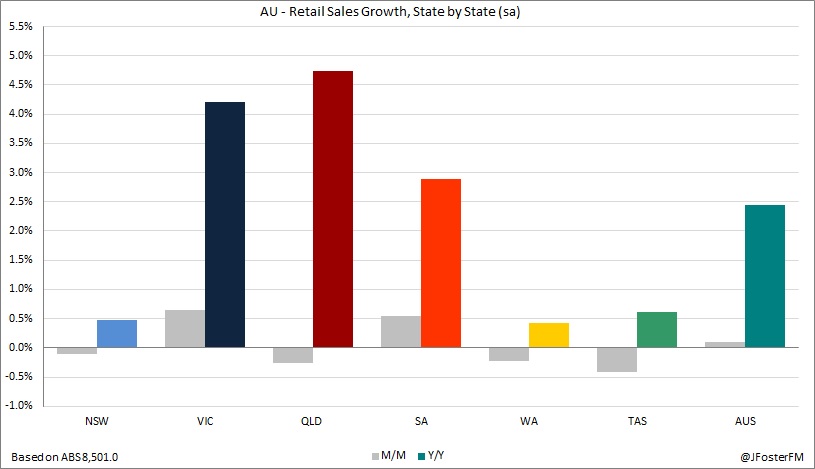
On a state basis, the clear standout is the weakening that has occurred in New South Wales -- spending in the nation's most populous state declined by 0.1% in May and the annual pace has fallen to its lowest since early 2012 at 0.5%. Conditions have also slowed in Victoria over the past 6-9 months but are holding up overall. May's increase of 0.6% more than offset last month's 0.4% decline, while the annual pace lifted from 3.7% to a still modest 4.2%.


The outturns from the other states were mostly weak with declines in Queensland -0.3% (+4.7%Y/Y), Western Australia -0.2% (+0.4%Y/Y) and Tasmania -0.4% (+0.6%Y/Y). However, South Australia posted a rise of 0.5% in May to be up by 2.9% over the year. 


The chart, below, highlights that national retail sales growth over the past year has been held up by Victoria, Queensland and South Australia, with those states cumulatively accounting for around 53% of nationwide spending. However, the slowing in New South Wales (around 32% on national sales) has been a strong headwind for the sector. 


Sales through online channels on a national basis lifted by 10.7% in May according to the ABS' latest estimates following a 2.1% fall in April. As a percentage of total retail spending, the online space accounted for 6.2% of May's turnover compared with 5.6% from a year earlier. 


Retail Sales — May | Insights 

Conditions in Australia's retail sector continue to slow, driven largely by a weakening in New South Wales in response to the downturn in the state's residential property market and ongoing low wages growth. Furthermore, weakness persists for retailers in household goods and department stores indicating the impact from lower transaction volumes in the housing market. So far in Q2, nominal spending growth is little more than flat. The impact of the RBA's June and July rate cuts and the federal government's increases to the low and-middle-income tax offsets are positives for the consumer spending outlook for the second half.

Wednesday, July 3, 2019

Australian dwelling approvals rise by 0.7% in May

Australian dwelling approvals lifted unexpectedly in May posting their first monthly gain since February. Compared to a year earlier, approvals remain down by around 20% amid a notable slowdown in the residential construction cycle.  

Building Approvals — May | By the numbers

  • Total dwelling approvals (private and public sectors) lifted by 0.7% in May to 14,436 (seasonally adjusted) compared to the median forecast for a flat outcome (0.0%). Approvals in April were revised to show a 3.4% decline compared to the initially reported 4.7% fall. 
  • Through the year, dwelling approvals are down by 19.6% (prior rev: -23.4%)
  • Unit approvals increased by 2.1% in the month to 5,885 to be down by 27.6% over the year (prior rev: -5.8%m/m, -26.2%Y/Y)  
  • House approvals eased by 0.2% to 8,551 to slow the annual decline to -13.0% (prior rev: -1.7%m/m,  -21.3%Y/Y) 


  • On a trend basis, total dwelling approvals declined by 0.5% in May and by 20.9% over the year. House approvals fell by 1.4%m/m and -17.0%Y/Y, though unit approvals lifted by 0.7%m/m to be down by 25.6%Y/Y.  


Building Approvals — May | The details 

May's update showed mixed detail with softness in house approvals and an increase from units. Taking a broader view, the granular detail (not seasonally adjusted) suggests that momentum for house and townhouse approvals continues to ease, though there may be some tentative signs of stabilisation emerging from the high-rise segment.


The state-level data was volatile in May but mostly weak. Approvals remain heavily lower over the year across the nation as shown in the table, below. 


The value of approvals for the alteration of existing residential property lifted by 1.0% in the month to $712.1m but is down by 3.0% over the year. Non-residential approvals slipped by 6.7% to $3.78bn, which slowed growth through the year from 17.5% to 5.3%. 

    
Building Approvals — May | Insights 

May's report was stronger than anticipated, though this series is typically volatile from month to month. There may be some early indications of stabilisation in unit approvals, but house approvals continue to lose momentum. Markets will have noted the recent improvement in the timely housing market data from auction clearances and prices, though it will take much more that than to have any impact on the residential construction outlook. In that sense, the RBA's June and July rate cuts are a clear positive as is the removal of uncertainty around changes to tax policy following the recent federal election outcome.  

Australia's trade surplus reaches a record high in May

Australia's monthly trade surplus outpaced market expectations by lifting to a new record high in May, reflecting the tailwind from surging export commodity prices. As noted by Reserve Bank of Australia Governor Philip Lowe during a speech on Tuesday night (see here), a rising terms of trade and an expected lift in resources sector investment are factors supporting the domestic economic outlook.

International Trade — May | By the numbers
  • The trade surplus accelerated by $925m in May to a new record high of $A5.745bn, which easily surpassed the median forecast for a $5.3bn surplus. April's trade surplus was revised down from $4.871bn to $4.82bn.   
  • Export earnings incresed by 3.6% in the month (+$1.442bn) to $A41.585bn to be 16.4% higher over the year (prior rev: +1.6%m/m, +16.4%Y/Y) 
  • Spending on imports lifted by 1.5% in May (+$515m) to $A35.839bn, though the annual pace slowed to 2.5% (prior rev: +2.3%m/m, +4.6%Y/Y)


International Trade — May | The details 

Export earnings were up by a robust 3.6% in May (or $1.442bn in AUD terms) to stand 16.4% higher than a year earlier. The key factor has been surging commodity prices, in particular for iron ore, with the tailwind persisting into the second half of the year. In May, earnings from non-rural goods exported lifted by 5.0% in the month (+$1.316bn). That was predominantly due to a 13.0% increase ($1.304bn) from metal ores and minerals (iron ore), with strength in both prices and volumes according to ABS estimates. Coal exports lifted by 3.0% (or $175m) in the month. Earnings growth from the other export categories was contained in May; rural goods +1.1% ($46m), non-monetary gold +1.3% ($22m), while services lifted by 0.7% ($58m).   

   
On the imports side, expenditure increased by 1.5% ($515m) in May, which followed a 2.3% rise in the previous month. Annual growth, however, moderated from 4.6% to 2.5%. Underpinning the aggregate increase, capital goods expenditure lifted by another 5.3% ($348m) following a rise of a similar magnitude in April. Intermediate goods increased by 0.6% ($66m), while consumption goods declined by 0.8% (-$73m). Services imports lifted by 1.3% ($107m) driven by transport and maintenance services.


International Trade — May | Insights

Surging commodity prices will continue to bolster the nation's terms of trade in Q2, following a 3.1% rise in the March quarter. The boost to national income will help to support the domestic economy through an expected increase in resources sector investment over the 2019/20 financial year, and potentially expanded fiscal stimulus and infrastructure investment from the federal government. 

Tuesday, July 2, 2019

RBA cuts the cash rate by 25bps to 1.0%

The Reserve Bank of Australia Board followed up June's rate cut with a further cut of 25 basis points at its July meeting held in Darwin today lowering the official cash rate to a new record low 1.0%. This decision had largely been discounted in market pricing and was the consensus expectation of economists according to official surveys.


As was the case at June's meeting, today's statement from Governor Lowe outlined that the decision to cut "will support employment growth and provide greater confidence that inflation will be consistent with the medium-term target" (see here). During a speech on June 20 (see here), the Governor discussed the factors that had led the Bank to conclude that the labour market was operating with spare capacity and could sustain faster employment growth and a lower unemployment rate. 

In today's statement, the Governor noted that "employment growth has continued to be strong" and also that "labour force participation is at a record level, the vacancy rate remains high and there are reports of skills shortages in some areas". Notwithstanding those remarks, there had "been little inroad into the spare capacity in the labour market recently, with the unemployment rate having risen slightly to 5.2%". In addition, while acknowledging a recent uptick, the pace of wages growth "remains low". The overall assessment, therefore, was that "these labour market outcomes suggest that the Australian economy can sustain lower rates of unemployment and underemployment".

Commentary on inflation was broadly unchanged, with pricing pressures subdued but anticipated to lift in the near term due to higher petrol prices. Core inflation is forecast to return to the 2% lower bound in 2020, though that will clearly be dependent on labour market developments and in particular the extent to which spare capacity can be reduced. 

The Governor highlighted that the economic outlook remains reasonably constructive with output growth anticipated to return to trend, though the key risk domestically pertains to household consumption given it has been constrained "by a protracted period of low income growth and declining housing prices". Notably, developments in the global economy were also in focus by highlighting that "persistent downside risks" and "subdued inflation" had prompted markets to price in expectations for major central banks (US, Europe and Japan) to ease policy rates. 

In the concluding paragraph, the Governor highlighted the importance of a lower cash in helping to bring about faster progress in reducing spare capacity and shoring up the inflation outlook. The possibility of further easing was left open with the line that "the Board will continue to monitor developments in the labour market closely and adjust monetary policy if needed to support sustainable growth in the economy and the achievement of the inflation target over time". 

--- --- ---

Following today's meeting, Governor Lowe provided further insights in a speech on Tuesday night (see here). The comments reiterated the message that the rate cuts from June and July were as a response to lowering spare capacity in the labour market, rather than a deterioration in the economic outlook. 

In fact, the Governor highlighted that the Bank's domestic outlook was bolstered by very low interest rates, a rising terms of trade, an exchange rate that has depreciated over the past 2 years and an expected lift in household income growth. However, developments from abroad following the recent escalation in US-China trade tensions and subsequent expectations for easing from other major central banks have clearly been noted by the RBA, with the Governor noting that "this is quite a different world from the one we were facing earlier in the year".

There was a sense from the Governor's speech that with the Board having cut rates by a total of 50 basis points in June and July it will now wait for incoming data to assess the impact of those decisions. Once again, the Governor pressed the case for additional support from government through fiscal policy and structural reform. In concluding, given the uncertainties both domestically and from abroad, Governor Lowe highlighted that "the Board is prepared to adjust interest rates again if needed to get us closer to full employment and achieve the inflation target".   

Monday, July 1, 2019

Preview: RBA July meeting

The Reserve Bank of Australia (RBA) Board visits Darwin — the nation's northernmost capital — for its July policy meeting today. Financial markets and economists are, on balance, anticipating Governor Lowe to announce a follow-up to June's rate cut with an additional 25 basis points of easing at 2:30PM (AEST) lowering the cash rate to 1.0%. 


The Board's decision to cut by 25 basis points to 1.25% in June was taken "to support employment growth and provide greater confidence that inflation will be consistent with the medium-term target". The key shift from the Bank is that it now views 'full employment' to be consistent with an unemployment rate of 4.5% compared to its historical estimate of 5.0%. This was highlighted in speeches from Governor Lowe and Assistant Governor Ellis. Recall that the Bank has a mandate to target inflation between 2-3% and full employment.

In the period since June's meeting, the minutes showed that the Board retains a firm easing bias by noting "members agreed that it was more likely than not that a further easing in monetary policy would be appropriate in the period ahead". This was extended upon by Governor Lowe during his speech on June 20 The Labour Market and Spare Capacity by noting: "It is not unrealistic to expect a further reduction in the cash rate as the Board seeks to wind back spare capacity in the economy and deliver inflation outcomes in line with the medium-term target". 

Perhaps adding support for the case to cut today, the Governor outlined early last week at the ANU's Crawford Australian Leadership Forum (link here) that in the global context where central banks in the US, Europe and Japan are expected to ease policy rates over the next 12 months in response to growth and inflationary concerns, the stimulatory impact from further cash rate cuts through exchange rate depreciation would be constrained. Certainly, the outlook for global growth remains a key risk for the RBA given that the weekend's G20 Summit was unable to provide any clear resolution in US-China trade tensions.   

From a domestic standpoint, key data over the past month have been soft. GDP growth slowed to a 1.8% annual pace in Q1 to be around 1ppt below trend (see here), while the national unemployment rate held at 5.2% in May (see here). It is therefore likely that the Bank will downgrade its growth and inflation forecasts in next month's quarterly Statement on Monetary Policy. Given its existing forecasts are based on a cash rate at 1.0%, there seems little justification in waiting until August to cut, particularly considering the Governor's comments around exchange rate depreciation from last week. Note also that at 7:30PM (AEST) the Governor is scheduled to deliver a speech where further explanation could be provided in the event that a cut is announced. This was the approach used by the RBA following June's rate cut decision.  

All considered, expect to see the cash rate cut by 25 basis points to 1.0% today. For reference, markets are around 70% priced for a rate cut, which is also the call from 18 of 26 economists surveyed by Bloomberg Australia.