Independent Australian and global macro analysis

Wednesday, July 5, 2023

Australia's trade surplus widens to $11.8bn in May

Australia's trade surplus widened to $11.8bn in May, partially rebounding from a sharp narrowing in April. Export earnings advanced and remained at elevated levels, while imports are holding up amid headwinds to household spending from rising interest rates and cost-of-living pressures.   

International Trade — May | By the numbers
  • Australia's trade surplus widened by $1.3bn to $11.8bn in May, higher than the expected figure ($10.9bn). April's trade surplus was revised to $10.5bn from $11.2bn. 
  • A 4.4% rise saw exports come in at $57.8bn, rebounding partially from a 6.4% fall in April. Export earnings are 1.8% lower than 12 months ago.   
  • Imports advanced 2.5% to $46bn, up for the third month in succession and are 3.4% higher over the year.  


International Trade — May | The details

The value of Australia's exports lifted by 4.4% in May, outpacing a 2.5% rise in import spending. That saw the nation's trade surplus increase from $10.5bn in April to $11.8bn in May. This partially reverses a sharp ($4.5bn) narrowing in the trade surplus in April ($10.5bn). As a result, the trade surplus remains in elevated territory, though May's figure was slightly below the 12-month average ($12.3bn). 


The balance on goods trade was in surplus to the order of $11.7bn in May, while services trade in exports and imports remained in balance ($0.05bn). 


Exports earnings increased on the back of a 5% rise in goods trade, with the services component also advancing (1.4%). The rise in goods exports was supported by rural (5%) and non-rural goods (1.9%) as well as volatile non-monetary gold (77.1%). Increases in some of the major resources (coal 1.6%, other mineral fuels 3.4%, and metals 15.8%) supported non-rural goods (though iron ore fell by 1.9%). Rural goods have come off record highs but remain elevated.    


A 3.1% rise in goods spending lifted imports to a 2.5% rise in May; services imports were flat. Consumption goods (7.7%) were the key factor as new vehicle imports surged to a new record high rising through $4bn in the month. Intermediate goods were modestly higher in May (0.5%), while capital goods declined (-2.5%). 


International Trade — May | Insights

The trade surplus remained elevated in May, with exports supported by the major resources. Imports are holding up despite headwinds to domestic demand, highlighted by record spending on vehicles.  

Tuesday, July 4, 2023

RBA on hold at 4.1%

The RBA left the cash rate on hold at 4.1% (and the ES rate at 4%) at today's meeting but has not shut the door on further rate increases. The Board was unmoved today following rate increases at the May and June meetings, decisions that were described as "finely balanced". As was the case in April, the Board elected to take stock of developments cautious of the risk of overtightening into an uncertain economic outlook.


Back in April, the Board left rates on hold only for it to then hike rates in May and June after judging that the risk of inflation staying above the 2-3% target band for longer had increased. Today's statement from Governor Philip Lowe used a similar justification to the April hold, highlighting that the decision gives the Board additional time to weigh up the lagged effects of rate hikes on the one hand with economic conditions on the other. In considering this balance, the Board is not yet settled in its view of whether interest rates are appropriately calibrated.

Despite not hiking today, the statement points out that the risks to an outlook of more persistent inflation from price and wage settings and the strength in the labour market are still on the radar. That said, there is recognition that a "substantial slowing" in household spending is weighing on the domestic economy and the outlook is for below-average growth offshore. Amid that backdrop, Governor Lowe said that the path to returning inflation to the target band while keeping the economy growing remained a ''narrow one''. '

All in all, today's meeting came across as the Board taking a more cautious view after it went in a more hawkish direction in May and June. The guidance that further monetary policy tightening '''may be required'' argues against extrapolating today's decision to a more extended pause, but rates in Australia are closing in on their peak. The emphasis for the Board remains on the data in determining how much further rates may rise.  

Monday, July 3, 2023

Preview: RBA July meeting

Today's RBA meeting shapes as another finely balanced decision for the Board between leaving the cash rate on hold at 4.1% or hiking rates by 25bps. After pausing its tightening cycle in April, upside risks to inflation prompted a hawkish turn from the Board that caught markets offside as 25bps rate hikes were delivered in May and June. Markets interpreted a deceleration in Australia's monthly inflation indicator in May as increasing the chance of the Board leaving rates on hold, but a 25bps hike seems the more likely outcome today.   


Since its meeting last month, the RBA's messaging has been consistent around the theme of acting with monetary policy to ensure inflation falls back to the 2-3% target ''within a reasonable timeframe'', projected currently to be in 2025. Recent speeches from Governor Lowe and Deputy Governor Bullock have highlighted that risks to achieving that objective have increased given developments it has observed in services inflation, wage and price settings and in housing prices. The rate hikes in May and June were justified as helping to address those risks, but there has been no indication from the RBA that rates have peaked. That view is informed by the Board retaining the guidance that "some further tightening of monetary policy may be required..." in light of the incoming data. 

Key recent data points look consistent with the Board hiking rates further today. A fall in headline inflation in the monthly indicator to 5.6% in May (13-month low) will be welcomed; however, a hawkish Board will probably put more weight on the measure excluding volatile fuel and holiday travel prices, which was more elevated at 6.4% and only a tick lower than April's reading (6.5%). Labour market conditions, meanwhile, remain very robust with employment surging to a 75.9k rise in May that saw the unemployment rate decline to 3.6%, around historic lows. Those developments, I think, will persuade the Board into another 25bps hike. 

Australian housing finance posts sharp rise in May

Australian housing finance commitments posted their sharpest rise since late-2021 with a 4.8% rise coming through in May. Although the RBA's tightening cycle remains in train and its full effects are yet to hit, housing finance continues to move off the lows reached earlier in the year. Fundamental factors in the housing market appear to be taking over from interest rates as the main impulse to housing prices.     

Housing Finance — May | By the numbers
  • Housing finance commitments (ex-refinancing) saw their strongest increase in 18 months rising by 4.8% in May to $24.9bn (-20.5%yr).  
  • Commitments to owner-occupiers advanced by 4%m/m to $16.4bn (-20.2%yr). 
  • Investor commitments increased by 6.2% - their strongest rise in 24 months - to come in at $8.5bn (-20.9%yr).  


Housing Finance — May | The details 

For the second time in the past three months, housing finance commitments rose in value by more than 4%. This comes after a run of 13 consecutive monthly declines to February-23 amid an aggressive RBA rate hiking cycle. Increased commitments follow housing prices starting to turn higher, with tight fundamentals in the housing market appearing to dominate rising interest rates.     


Owner-occupier commitments are starting to gain momentum after sustaining a peak-to-trough slide of 33.5% between April-21 to February-23. The 4% gain in May came on the back of widespread gains across upgraders (4.2%), construction-related (4.3%) and first home buyers (5.5%). The only area of weakness was alterations (-5.0%). 


Investor commitments worked up to a 6.1% rise in May after a largely flat outcome in April (-0.2%) following on from March's 3.8% increase. The high point came in February-22 before 12 consecutive declines brought investor commitments to a trough of $7.7bn, a fall of 32.4% over the period. 


Refinancing remains around record-high levels against the backdrop of the RBA's rate hiking cycle. Owner-occupier refinancing rose through $14bn for the second time in the past 3 months, while refinancing by investors was $6.8bn in May. 


Housing Finance — May | Insights

May's report reflects the upturn in housing prices that has recently emerged. CoreLogic reports that since flooring in February, housing prices nationally have risen by a little more than 3%. That comes after a peak-to-trough decline of around 10% that commenced just before the first hike in the RBA's tightening cycle. Despite tighter financing conditions, supply/demand pressures appear to be driving housing prices higher. 

Sunday, July 2, 2023

Australian dwelling approvals rebound in May

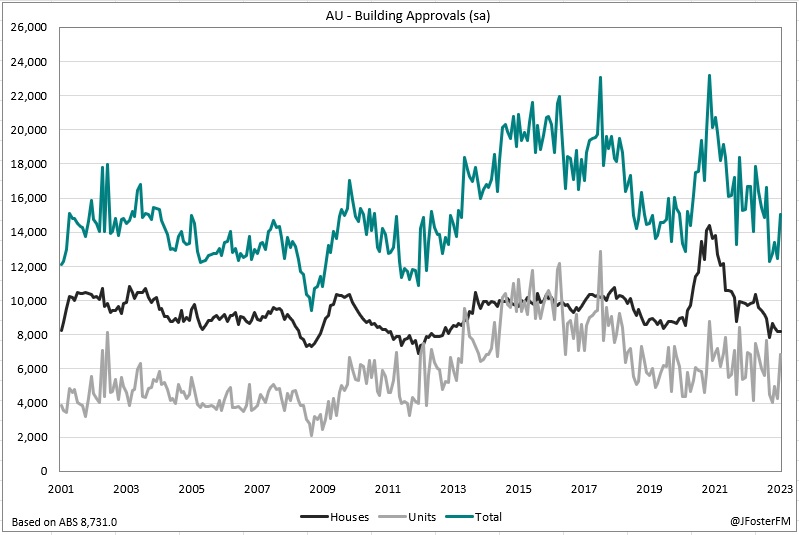
Australian dwelling approvals lifted sharply in May but remained well down from their cycle highs. Volatility around the Easter holiday period may have been a factor in the rise in monthly approvals, which came largely from the higher-density segment.   

Building Approvals — May | By the numbers
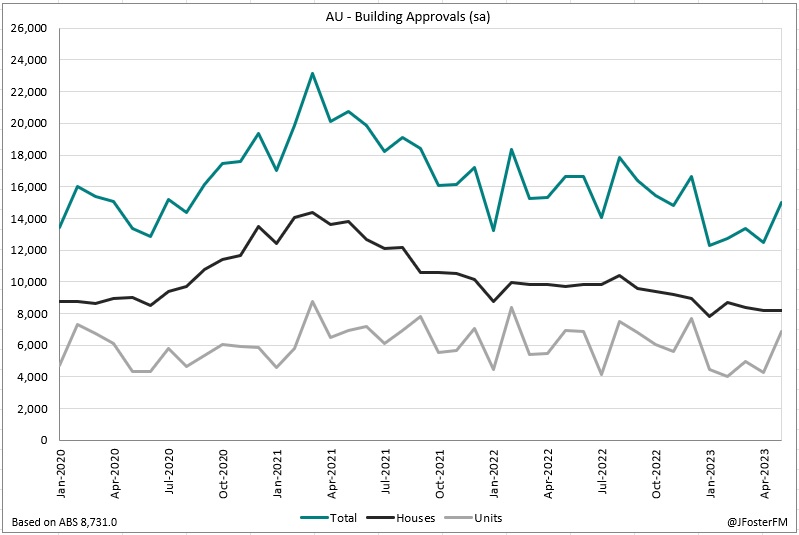
  • Dwelling approvals (seasonally adjusted) jumped by 20.6% in May (vs 3% exp) to 15,032, rising from levels around 11-year lows in recent months. Approvals were still 9.8% lower than a year earlier.   
  • House approvals inched 0.3% higher to 8,193, a decline of 15.6% over the year.  
  • Unit approvals spiked by 59.3% to 6,839, narrowing the fall in annual terms to 1.7% from 22%.  


Building Approvals — May | The details  

Dwelling approvals lifted from cycle lows in May, potentially reflecting a backlog of approvals held over from April during the Easter holiday period. The nearly 21% rise in May lifted monthly approvals to their highest since December-22; however, that still left approvals down 35.1% on their cycle high from March-21.  

The higher-density segment (59.3%) accounted almost entirely for the increase in approvals in May and mainly in Sydney (NSW), while house approvals saw a modest rise (0.3%). From their respective peaks, house approvals (-43.1%) have seen a much larger decline than units (-21.9%).  


Smoothing the elevated volatility on a 3-month average basis, approvals remain around decade lows. 


The value of alteration approvals remains at high levels, partly on the back of ongoing demand but also cost increases for labour and materials. With housing prices starting to turn higher again, this may keep alteration activity supported.   


Building Approvals — May | Insights    

Headwinds from an earlier fall in housing prices, rising interest rates, margin pressures faced by builders and the withdrawal of construction subsidies have seen dwelling approvals decline to very low levels. As this has unfolded, a rapid post-Covid rise in population is putting pressure on the nation's housing stock, seemingly the main factor behind housing prices starting to rise again.

Friday, June 30, 2023

Macro (Re)view (30/6) | Equities close out strong first half

A panel of the world's major central bank chiefs at the ECB's Sintra forum made clear that the focus remains on hiking rates to more restrictive levels given the risk of prolonged high inflation. The inflation dynamics in the US, euro area, and UK each have their own characteristics but the commonality is that underlying inflation rates are high and progress in returning it to central banks' targets has been slow. There has been little change in this narrative in 2023. While this has led to more inverted yield curves as recessionary risks have increased there has been a sustained rise in equities, coming through headwinds that include the banking turmoil in the US and Switzerland and a fading reopening in China. At the halfway point of the year (see below) US markets are up around 15-30%, European majors are 15% higher; Asia has been more mixed but the Japanese market has been a standout globally rising 27% through the first half.  


Australian inflation slows; RBA still likely to hike 

Markets were encouraged by a notable deceleration in Australia's headline inflation rate from 6.8% to 5.6% in May, assessing that this increases the chance of an RBA pause at next week's meeting. Slowing inflation was driven mainly by falling fuel and holiday travel prices, both considered to be volatile items in the CPI basket. Looking ahead to next week, a hawkish RBA that has been highlighting upside risks to the inflation outlook seems likely to give more weight to the elevated underlying inflation measures in the May report. The trimmed mean gauge came in at 6.1%, down from 6.7% in April but still far too high for the Board, while the CPI ex-volatile items and holiday travel measure printed at 6.4% from 6.5% previously. 


Household spending and the labour market - two other key areas of focus for the RBA - showed ongoing resilience in the data to hand through the week, pointing to a 25bps rate hike on Tuesday. Retail sales accelerated by 0.7% in May, the strongest outturn since the start of the year. The rise was driven by discretionary-related spending (sales ex-food lifted 0.9%) supported by dining out and end-of-financial-year sales (see here). Despite numerous headwinds including from higher interest rates and cost-of-living pressure, spending is holding up better than may have been expected, with the labour market a key support. Job vacancies declined by 2% for the 3 months to May to be 10% below their peak a year earlier; however, labour demand still remains very strong. Total vacancies in Australia came in a 431.6k, equivalent to a historically elevated share of the labour force at around 3%. 


US inflation easing but still elevated 

The disinflationary process in the US continued in May with the headline PCE deflator falling from 4.4% to 3.8%, a low going back to April 2021. Underlying inflation, which remains harder for the Fed to shake, ticked down from 4.7% to 4.6%. That said, markets were buoyed by the underlying measure that excludes housing costs (considered a more accurate guide of where inflation is headed) which softened from 4.4% to 3.9%. That particular measure is considered monitored by the Fed and if the trend lower remains in place, the need to hike rates further becomes a more nuanced discussion.    


That comes as household demand - while still resilient - appears to have lost much of its momentum. Real consumption lifted solidly by 1% in the first quarter, but this has been followed since by a 0.2% rise in April and a flat outcome in May. A softer impulse from consumption supports an outlook for easing inflation. 

ECB Sintra wrap-up  

Inflation and the response to it was (unsurprisingly) the theme of the ECB's Sinta Forum. In her opening remarks, ECB President Christine Lagarde said that the series of shocks that caused inflation to surge quickly risked taking longer to unwind. While headline inflation is coming down declining from 6.1% to 5.5% in June, the core rate has yet to decelerate and ticked up slightly from 5.3% to 5.4%, the latter the main focus of the ECB. 


The main risk the ECB sees to persistent inflation is from rising unit labour costs. While the ECB expected stronger wages growth in response to a tight labour market and as catch-up to past high inflation, it is concerned that this is occurring against the backdrop of weak productivity growth. To avert a more sustained period of wages following prices, President Lagarde maintained the message that rates would rise further. The key questions the Governing Council were now pondering are the appropriate level rates needed to reach and the length of time they would need to remain there. 

Wednesday, June 28, 2023

Australian retail sales rise 0.7% in May

Australian retail sales accelerated by 0.7% in May posting their strongest rise since the start of the year. Discretionary categories drove the rise in spending amid strong demand for dining out and discounting associated with end-of-financial-year sales. Despite numerous headwinds and weak sentiment, spending by Australian households is displaying resilience. 


Headline retail sales lifted by 0.7% in May, with discretionary sales (total sales ex-basic food) rising at a slightly stronger pace of 0.9%. These were the strongest outturns for both categories since January. The ABS identified an early start to end of financial year sales and events such as Mother's Day and Click Frenzy promotions as key factors behind the acceleration in spending in May.  


Across the categories, the strongest rises were in restaurants and cafes (1.4%) and other retailing (2.2%), the latter boosted by online sales and spending at florists and for cosmetics and pharmaceuticals. Household goods (0.6%) saw their first rise since January. Weakness in discretionary spending was evident in clothing and footwear (-0.6%) and department stores (-0.5%). Food sales lifted by 0.3%.   


As highlighted above, there were several factors supporting retail spending in May, this coming amid the backdrop of a very strong labour market and rapid population growth. Inflationary effects also remain a factor in boosting nominal sales; goods-related inflation in Australia is slowing but the process is taking longer than seen overseas. Overall, declines in sales volumes over the past two quarters (-0.3% in Q4 and -0.6% in Q1) show that retail demand has softened; however, household consumption in services has held up and is appearing resilient. 

Friday, June 23, 2023

Macro (Re)view (23/6) | Rally setback by renewed hawkishness

The upbeat sentiment that has fuelled equity markets of late dissipated this week amid renewed central bank hawkishness. Both the Bank of England and Norges Bank surprised markets with larger rate hikes than were expected, while the Swiss National Bank hiked by 25bps and signalled the prospect of more tightening ahead. These factors boosted the US dollar and led to more inverted yield curves.   


BoE accelerates tightening 

The BoE surprised markets with a larger rate hike than expected at this week's meeting. The Monetary Policy Committee (MPC) voted 7-2 to hike rates by 50bps to 5%, the pace of tightening accelerating from 25bps increases at the previous two meetings. As noted last week, renewed strength in wages growth meant a rate hike was assured, but it was a hot inflation report on the eve of the meeting that prompted the MPC to act more aggressively. Headline CPI inflation is in decline, though progress stalled in May printing at 8.7%yr (vs 8.4% exp); however, a rise in core inflation from 6.8% to 7.1%yr (vs 6.8% exp) marked a new high and clearly shocked the MPC. 


External shocks, namely Covid and the war in Ukraine, initially led to a surge in UK inflation, but increasingly the drivers are turning to domestic factors with businesses raising prices to protect margins and households receiving higher wages for the cost of living. The MPC is concerned that the changing nature of inflation risks prolonging elevated price increases. Services inflation, which is the key focus for the MPC, pushed up from 6.9% to 7.4% to be running at its highest since the early 1990s. The MPC retained its guidance that developments consistent with persistent inflation pressures would see rates hike further. Markets anticipate the MPC will hike rates to a peak of 6% by year-end. 

Fed remains on message... 

Federal Reserve Chair Jerome Powell told Congress that further rate hikes in the US are expected to be needed, consistent with the messaging at last week's FOMC meeting. Despite inflation having decelerated significantly, Chair Powell said there was still "a long way to go" on the path back to the 2% target. Last week's decision to leave rates on hold was taken to allow the FOMC to take on board more data, acknowledging that the full effects on the economy from 500bps of tightening remain in the pipeline. That approach also meant that there was now less emphasis on the pace at which rates were being hiked than earlier in the tightening cycle. 

... as does the ECB 

Coming out of last week's meeting, the ECB reiterated its determination to do more to return inflation to target. In a speech, ECB Executive Board member Isabel Schnabel said that given the risk of high inflation remaining persistent, it was prudent for monetary policy to "err on the side of doing too much rather than too little". Schnabel identified three sources of upside risk to the inflation outlook including: i) ongoing supply shocks, ii) lasting effects on productivity from these supply shocks, and iii) a greater resilience in demand conditions than anticipated.  

RBA adapting to inflation risks 

More insights into the RBA's latest rate hike came to hand in the June meeting minutes. The emergence of upside risks to the RBA's inflation outlook has meant that its hiking pause in April was short-lived. As was the case in May, the Board considered leaving rates on hold but ultimately elected to hike, a judgment it again said was "finely balanced". 

It was outlined that the risk of inflation staying higher for longer had increased. Specifically, the Board is wary that wage and price settings indexing to past inflation could become more widespread, while a more robust growth outlook, supported by rising housing prices in Australia and an improving global backdrop, could delay the process of returning inflation to the 2-3% target. 

The Board's other mandate, full employment, was discussed in a speech by RBA Deputy Governor Michele Bullock this week. Bullock's main argument was that full employment goes hand in hand with inflation at the target. While the RBA expects the labour market to soften on the back of higher rates, it remains of the view that there is a path to achieving a soft landing. 

Friday, June 16, 2023

Macro (Re)view (16/6) | More hawkish turns

Following the likes of the Reserve Bank of Australia and the Bank of Canada, the Federal Reserve and the European Central Bank increased the hawkish volume of their messaging on policy at their respective meeting this week. But this proved no match for the rally in global risk sentiment. The expectation is that further rate hikes will be required in the US and euro area as the risk of persistent inflation pressures remains present. Markets are unconvinced the Fed will hike again while they took the ECB's messaging in their stride. The Bank of Japan also met this week, leaving all settings unchanged. Attention shifts to the Bank of England's meeting next week, a 25bps hike considered a lock on the back of a strong labour market report and rising wages growth. Given the forward profile for UK rates is aggressive, with 4 additional hikes expected to a peak of 5.5%, it may be harder for the MPC to deliver a hawkish surprise.    


Fed hawkishness falls flat as inflation decelerates 

The Federal Reserve's FOMC delivered the 'skip' it had guided markets to expect at this week's meeting, the fed funds rate remaining steady in the 5-5.25% range. Cautioning against extrapolating this week's decision into a more extended pause, the FOMC raised its projection for the peak rate to 5.5-5.75%. However, markets are unconvinced an additional 50bps of rate hikes will be forthcoming given the disinflationary pulse working through the US economy. Headline CPI fell from 4.9% to 4% in May - its slowest since March-21 - and this was backed up by a continued easing in pipeline price pressures in producer (1.1%yr) and import prices (-5.9%yr). The core CPI softened to 5.3%yr but is still elevated and as Chair Jerome Powell highlighted in the post-meeting press conference, the FOMC has been frustrated by the slow pace of progress on this front. 


Speaking to this, FOMC members raised their outlook for the core PCE deflator - its preferred gauge of underlying inflation - from 3.6% to 3.9% this year; the projection for 2024 was left unchanged at 2.6%, with a return close to the target anticipated in 2025 at 2.2% (from 2.1%). Chair Powell also made the point that the FOMC continues to see that the balance of risks to its inflation outlook remain to the upside, justifying the expectation for a higher peak rate. This comes amid renewed confidence in the resilience of the economy; forecast GDP growth was upgraded from 0.4% to 1.0% in 2023, which lowered the outlook for the unemployment rate to 4.1% from 4.5% previously.

ECB recalibrates as inflation risks persist 

In addition to announcing a 25bps hike to its key rates this week, the ECB signalled rates were set to rise further in July, developments that were expected by markets. The depo rate now stands at 3.5%, up from -0.5% this time last year. Uncertainty remains over how close the ECB is to the peak rate. In the post-meeting press conference, ECB President Christine Lagarde said an outlook for higher inflation than previously expected meant that rates had yet to reach their destination, remaining short of a sufficiently restrictive level.   

ECB staff macroeconomic projections raised the inflation profile to 5.4% on a headline basis in 2023 (from 5.3%) and to 5.1% on the core rate (from 4.6%). Inflation is then anticipated to decline at a slower pace through the projection horizon, remaining firm to its 2% target come 2025: headline at 2.2% (from 2.1%) and core at 2.3% (from 2.2%). The drivers of inflation - previously caused by the shock to food and energy prices stemming from the war in Ukraine - are switching to labour cost pressures, which the ECB says carries upside risk to its outlook. That portends higher rates but at the cost of a more forceful headwind to the economy. Euro area growth has contracted slightly over the past couple of quarters, resulting in the ECB  lowering its growth outlook from 1% to 0.9% this year and to 1.5% from 1.6% in 2024. 

Australian labour market rebounds strongly 

A strong rebound in the Australian labour market from the slowdown over the Easter holiday period has put a hawkish and data-dependent RBA back in focus. Pricing for a July rate hike has pushed up to 50% from 25% as employment surged above expectations rising by 75.9k in May - its strongest increase in 11 months - after declining by 4k in April (full review here). Attesting to the strength of labour demand, the unemployment rate fell back from 3.7% to be close to its lowest since 1974 at 3.6%While this will keep the RBA alert to wage pressures, labour supply in Australia remains highly dynamic - as it was through the pandemic - with the participation rate rising to a new record high of 66.9%.


Surveys on households and businesses continued to report that confidence remains weak. For households, the Westpac-Melbourne Institute consumer sentiment index was broadly unchanged in June (-0.2%) but remains in deeply pessimistic territory, largely reflecting the impacts of cost-of-living pressures and rising interest rates. A weak confidence reading for businesses in the NAB survey (-4) appears driven by the expectation that conditions - while still above average for now despite softening in May (+8) - are set to weaken materially amid an outlook for economic growth to slow as consumers pull back.

Wednesday, June 14, 2023

Australian employment 75.9k in May; unemployment rate 3.6%

The Australian labour market regained its momentum from earlier in the year, rebounding strongly from a slowdown over the Easter holiday period. Employment posted its strongest increase in 11 months (75.9k), rising through 14 million for the first time. This drove a fall in the unemployment rate to 3.6%, remaining around cycle lows as the participation rate elevated to a new record high (66.9%). The report increases the chance of an RBA rate hike in July.        
    
Labour Force Survey — May | By the numbers
  • Employment surged by 75.9k (on net) in April, blitzing expectations for a rise of 17.5k. This follows a 4k decline in April (revised from -4.3k). 
  • National unemployment fell back to 3.6% (or 3.55%), reversing the increase to 3.7% in April. The broader underemployment rate was 0.3ppt higher at 6.4%, resulting in total underutilisation increasing from 9.8% to 10% (11-month high).  
  • Labour force participation rate hit a record high in May at 66.9%, more than rebounding from April's decline to 66.7%. The employment to population ratio (share of working-aged Australians in work) is also back at record highs after rising to 64.5%.  
  • Hours worked were 1.8% lower on the month following a 2.7% acceleration in April. Year to date, hours worked have risen by 2.8%. 


Labour Force Survey — May | The details

The Australian labour market has returned to the strong momentum seen in the first quarter of the year, confirming (as expected) the weak report in April was driven by seasonal effects around the Easter holiday period. Employment increased sharply by 75.9k in the month (full time 61.7k and part time 14.3k), its strongest rise in 11 months.  


Over the 3 months to May, employment averaged an increase of 47.6k per month, the pace annualising at a robust 4.2%. The momentum in employment softened into the end of last year, but it has since reaccelerated. Annual growth in employment is running at 3.4%, outpacing growth in the working-age population (2.7%).


Total employment in Australia rose through 14 million for the first time, an increase of more than one million from its level on the eve of the pandemic. The Australian economy has been a powerhouse for employment in its recovery and subsequent expansion from the Covid recession. Real GDP to the March quarter was 7.4% above its pre-pandemic level, an expansion that has generated a 7.9% increase in employment to May-23. 


Such was the strength of the employment outcome in May, the unemployment rate fell from 3.7% to 3.6% even as the participation rate lifted to a new record high at 66.9%. At this level, unemployment is around cycle lows and at its lowest levels since the mid 1970s. Meanwhile, rapid population growth post the pandemic has contributed to a larger labour force in Australia. The participation rate is 1.1ppts higher than in early 2020. 


Where there has been some easing in the labour market is in the underemployment rate (including unemployed people and employed people wanting additional hours), now 6.4% compared to the cycle low of 5.9% in late 2022. Alongside this, underutilisation has lifted to 10% from the low of 9.3% last October. But, overall, both measures remain low by historical standards. 


Hours worked pulled back in May (-1.8%) after the surprise increase in April (2.7%) when more than 5 million people were on annual leave over Easter. This month around 4 million people were back at work, but hours were reported to have fallen. Looking through the volatility, hours worked are up by 0.9% over the past two months.   


Total hours worked in May were up 2.8% since the start of the year and up 10% overall on the pre-pandemic level from March 2020. 


Labour Force Survey — May | Insights

There was good reason to be upbeat going into today's report given that the labour market had accelerated in the first quarter; the weak report in April came against the run of play and clearly looked to be related to the Easter holiday period. Given this and the RBA's recent hawkish turn, markets looked to be underpricing prospects for a July rate hike, assessed to be a 1 in 4 chance at yesterday's close. Expectations for a July hike will firm off the back of today's report. That said there are upcoming key events including a speech from RBA Deputy Governor Bullock (20/6) and the monthly CPI report for May (28/6) that will provide more of a guide.