Independent Australian and global macro analysis

Tuesday, August 24, 2021

Preview: Construction work done Q2

Today (11:30am AEST) sees the June quarter update of Australian construction activity published the ABS. Prior to the recent disruptions in the sector in certain states from pandemic restrictions, construction activity was building strong momentum. Activity increased at its fastest pace in 3½ years in Q1 and further strength is expected in Q2, led by the upswing in the residential construction cycle in response to stimulus measures and rising housing prices. Work done by the public sector is also expanding with state governments providing support to their economic recoveries.
    
As it stands Construction Work Done

In the March quarter, construction activity lifted by a stronger-than-expected 2.4%  its fastest quarterly increase since Q3 2017 (reviewed here). Growth through the year remained in contraction (-1.1%) but moderated from the previous quarter (-2.4%).  


Work done in the private sector advanced by 1.7% in Q1 after a broadly flat (0.3%) outturn in the previous quarter. Driving this was the surging residential segment, with activity rising at its sharpest pace in 6 years, up 5.1% in the quarter (3.8%Y/Y). The stimulus measures from the HomeBuilder grants, first home buyer incentives and low interest rates combined with the upswing in housing prices to lift new home building by 4.1% in Q1 (1.8%Y/Y) after Q4's 3.1% rise. Renovation work continued to soar, up 11.3% in the quarter following a 10.8% rebound over the second half of 2020. Moderating this strength was weakness in the non-residential sector (-5.6%qtr, -17.6%yr) with investment in retail and office projects remaining weak in response to the pandemic. Engineering work lifted modestly in Q1 (1.6%) as growth through the year firmed from 2.6% to 3.4%.  


In the public sector, activity increased by 4.3% in Q1 as it rebounded from a weak Q4 (-6.8%) but remained down on a year earlier (-1.0%). The gains were broadly based across engineering (3.1%) and building work (7.1%), supported by a lengthy pipeline of state and territory government projects. 


Market expectations Construction Work Done 

The median estimate is for construction activity to have advanced by 2.8% in the June quarter between a range of estimates from 0.8% to 5.0%. 

What to watch Construction Work Done

The focus remains on the upswing in the residential construction cycle. Stimulus from the HomeBuilder scheme and other measures drove detached house approvals to record highs, with the pipeline now being worked through. Alterations have also benefitted from policy stimulus, 
surging to their strongest level on record in Q1. More time being spent at home and robust conditions in the housing market have encouraged homeowners to make improvements.

Friday, August 20, 2021

Macro (Re)view (20/8) | Test of resilience

The pressures from the Delta variant were starting to show in July as the strong momentum in Australia's labour market stalled. Employment was more resilient than expected rising by 2.2k in the month against an anticipated decline of 43.1k, but lockdown restrictions had broadened out to cover around 60% of the population in early August (reviewed here). July's relatively flat employment outcome was the net result of a sizeable fall in New South Wales (-36.4k) as the Sydney lockdown intensified offset by rises in most other states, led by Victoria (16.0k) as it reopened from lockdown 4. With the Sydney lockdown prompting a large number of workers in NSW to leave the labour force, a weakened participation rate (66.0% from 66.2%) was the key driver in the decline in the measured unemployment rate, from 4.9% to 4.6% — its lowest since 2008. In NSW, a sharp 1ppt fall in participation to a 12-month low at 64.9% cut the unemployment rate from 5.1% to 4.5%, despite the contraction in employment. 

Given these crosscurrents, the cleanest read on labour market conditions comes from hours worked. It is here that the loss of momentum is clear with hours worked slowing to be just 0.7% above their pre-pandemic level compared to a peak of 2.9% in May (see chart below). In July, hours worked softened by 0.2% as a 7%m/m collapse in NSW was largely covered up by Victoria's reopening (9.7%m/m). But with lockdowns broadening out in August, hours worked are poised to fall well below pre-pandemic levels. While unemployment may have continued to fall, this has come alongside a rise in underutilisation in the labour market over June and July, highlighting the effects of lockdowns on economic activity. Since May, the underemployment rate has risen 0.9ppt to 8.3% and underutilisation is 0.4ppt higher at 12.9%.  

Chart of the week 

While momentum in the labour market has stalled, any thought that the earlier strength in the recovery may have seen wages growth starting to rise more meaningfully were dashed by another soft update of the Wage Price Index in the June quarter (reviewed here). Growth in the WPI eased to 0.4% in Q2 (vs 0.6% expected) from rises of 0.6% in the previous two quarters, and while the trajectory in annual growth remains higher as it continues to firm off its pandemic-induced fall to record lows last year, the pace is slow as it lifted from 1.5% to 1.7%. Beneath the surface, private and public sector wages are on divergent paths: wages in the private sector are on the improve, mainly because wage reviews postponed due to the pandemic are being revisited, but public sector wages have slowed to a new record low at 1.3%Y/Y under the weight of caps and freezes to limit expenditure growth. The private sector WPI lifted by 0.5%q/q while annual growth firmed from 1.4% to 1.9% but is still short of its pre-pandemic pace at around 2.1%. Highlighting that wage pressures are narrowly based, there are only 4 of the 18 surveyed industries where private sector wages growth is running above pre-pandemic rates and this is predominantly in services industries where specific skills have been harder for businesses to come across. Wages in construction (2.2%Y/Y) have risen above their pre-pandemic pace in response to the upswing in the residential sector.

In the minutes from the RBA's August meeting, while the Board reiterated that it opted not to delay the start of tapering its bond purchases (set down for September) in anticipation of a strong rebound once the current lockdowns ease and in recognition of the greater potency of fiscal support in the circumstances, it has not ruled out revisiting this stance. Indeed, the Board has signalled a preparedness to respond if the worsening pandemic situation leads to "a more significant setback" in the recovery. Arguably, this has unfolded since early August when there was a contraction of 'at least 1%' in Q3 GDP sitting in the Bank's forecasts  most market forecasts are in the order of a 2.5-3% fall in output. Meanwhile, the Board had discussed the downside risks to its expectations for the snapback in Q4 by noting the reopening from Delta could be "more gradual" than from previous lockdowns. That being said, the Board is clearly unsure of the marginal effect that delaying the taper would have, particularly when the more relevant window from a policy perspective 1-2 years ahead remains positive. Further to this, the minutes also noted that pricing in the rates market since the previous meeting had shifted slightly lower for 2023, indicating that tapering expectations had not been linked to a faster hiking cycle.

— — 

Growth concerns and weak sentiment have weighed on markets at home and offshore over the week, prompting strength in the US dollar while the US yield curve has continued its flattening trajectory. Both the Australian dollar and Australian government bond yields were crunched in the moves. At the centre of these concerns is the Delta variant, with downside risks to economic outlooks increasing and uncertainty rising. Case in point is in New Zealand where the emergence of a small number of virus cases saw a national lockdown imposed, in turn leading to the RBNZ abandoning what was expected to be the announcement of its first rate hike since 2014. Also contributing to the risk-off tone was soft activity data from China early in the week — retail sales, industrial production and fixed asset investment all slowed more sharply than expected in July — which came on the back of the collapse in US consumer sentiment (-13.5% in July) reported the previous Friday. Key to the slide in sentiment has been the uplift in caseloads as the Delta variant continues to spread. The minutes from the Federal Reserve's meeting late last month outlined that there was caution within the Committee around the near-term outlook as a result, noting the there was a risk that the Delta outbreak could "damp the economic recovery". Perhaps, there was some sign of this in the decline in US retail sales in July, which were down 1.1% in the month on a headline basis (vs -0.3% expected) and -1.0% (vs -0.2%) in the control group. 

The Fed minutes also backed up the recent messaging from many Committee members that the commencement of tapering is drawing near and could potentially start before the end of the year. Whether or not the rapidly evolving pandemic situation has since swayed the thinking within the Committee remains to be seen, though we have already heard from the Dallas Fed's Robert Kaplan — who has been calling for tapering to start in October — that he may have to adjust this view "somewhat" if the economy weakens. As the July minutes pointed out, developments in the labour market will be key to watch given that the inflation side of the Committee's mandate is currently being met. The very strong July non-farm payrolls report released after the recent Fed meeting suggested that progress toward its employment objectives was being made, but that will now need to hold up amid the headwinds from Delta. On tapering itself, several Committee members were keen to get across that it should be interpreted as providing stimulus "at a slower pace", rather than establishing a link with eventual rate hikes. Next week's speech from Fed Chair Jerome Powell at the annual Jackson Hole Symposium shapes as a key event in guiding markets towards its tapering plans.  

Wednesday, August 18, 2021

Australian employment 2.2k in July; Unemployment rate 4.6%

Australian employment held up better than expected in July rising by 2.2k, with the reference period of the survey coming ahead of the full severity of the Delta disruption. The national unemployment rate declined to a new post-GFC low, though this was driven by a weaker participation rate as a significant number of workers exited the labour force in New South Wales due to the lockdown in Sydney. Hours worked nationally recorded a modest fall in the month as the hit from Sydney lockdown was offset by the reopening from Melbourne's 4th lockdown.  

Labour Force Survey — July | By the numbers
  • Employment (on net) lifted by 2.2k compared to an expected fall of 43.1k as June's outcome was left unrevised at a gain of 29.1k.
  • Australia's unemployment rate fell from 4.9% to 4.6% — its lowest since December 2008 — against an expected uptick to 5.0%.   
  • Labour force participation weakened from 66.2% to 66.0%, driven by a significant fall in NSW of 1ppt to 64.9%.
  • Hours worked nationally were 0.2% lower in July, slowing growth over the year from 6.7% to 5.7%. The Sydney lockdown sent hours worked in NSW down by 7%m/m but was offset by Victoria (9.7%m/m) reopening from lockdown 4. 


Labour Force Survey — July | The details

Timing played a large role in the outcomes in today's report. As highlighted in the preview, during the reference period (4-17 July), Sydney was in lockdown but stay-at-home mandates were lifted early in the month in Brisbane, Perth and Darwin. Meanwhile, Victoria was between lockdowns 4 and 5. Thus the severity of the impact on the data from the Delta disruption will intensify from here. For July, employment was up by 2.2k leaving it at 1.2% above its pre-pandemic level. While employment fell sharply in NSW (-36.4k), this was offset by gains in most of the other states, led by the reopening in Victoria (16.0k). 


On a compositional basis, the recent surge in full-time employment cooled, falling by 4.2k in the month in the segment's weakest outturn since March. Employment in part-time lifted by 6.4k but this was after a 22.5k fall in June and the segment has seen only limited growth year to date, up just 13.9k compared to 273.4k in full time. 


Despite the small rise in employment, Australia's unemployment rate fell by 0.3ppt to 4.6% to be at its lowest since December 2008. The key factor was a decline in the level of participation, from 66.2% to 66.0%. This was driven by New South Wales where the Sydney lockdown led to participation in the state falling from 65.9% to 64.9%. In level terms, the labour force in New South Wales contracted by 63.6k but increases in most of the other states restricted the fall in the national labour force to -37.7k. Despite employment falling in New South Wales by 36.4k, the state's unemployment rate actually lowered from 5.1% to 4.5%, reflecting the larger drop in participation. 


As occurred last month, both underemployment (8.3%) and underutilisation (12.9%) increased as unemployment fell. This reflects the impact of the lockdowns on activity with mobility restrictions preventing many people from going to work.  


In June, total hours worked fell by 1.8% as Victoria was in lockdown (-8.4%). This month, hours worked nationally fell by 0.2% (5.7%yr) amid significant state volatility. Hours worked plunged in NSW (-7.0%) as Sydney's lockdown was extended, but this was offset by Victoria reopening from lockdown 4 (9.7%). 


Hours worked in Australia in July softened to be 0.7% above their pre-pandemic level and will fall well below that baseline in August when around 60% of the population was in lockdown.


Labour Force Survey — July | Insights

Today's report contained significant volatility but the overall theme is that momentum in the labour market stalled in July and is about to roll over. Since July's survey, Sydney's lockdown has broadened out to cover the entire state and restrictions have returned and tightened in Melbourne. Several other states have also been affected by lockdowns, but for short periods. The most optimistic angle that can be put forward is that the labour market is at least entering this period of disruption from a strong starting point. 

Preview: Labour Force Survey — July

Australia's labour force survey for July is due to be released by the ABS at 11:30am (AEST) this morning. Ahead of the recent outbreaks and associated lockdowns, labour market conditions were strong with employment rising well above pre-pandemic levels, participation around record highs and the unemployment rate at its lowest in more than 10 years. There is likely to be some loss of this momentum until the time when vaccination rates rise to levels that can support sustainable reopenings. While forward-looking indicators of labour demand have weakened lately, job vacancies remain at elevated levels, suggesting the outlook beyond the near-term headwinds is positive. 

As it stands | Labour Force Survey

Employment posted a stronger-than-expected rise of 29.9k in June to consolidate the 115.2k surge from May (reviewed here). This advanced total employment up to 13.154 million to be 1.2% above its pre-COVID level. 


The leadership continued to come from the full-time segment with employment rising by 51.6k in June, though this was moderated by a 22.5k fall in part-time employment. Weakness in the part-time segment was driven by New South Wales and Victoria, with the latter in a snap lockdown over the survey reference period. Through the June quarter, full-time employment increased by 182.6k to stand 1.7% higher than its pre-pandemic level. The part-time segment led in the initial phase of the recovery but employment has since leveled out to be around pre-pandemic levels.


With the participation rate unchanged in the month at 66.2%, the strength in employment drove the unemployment rate down further, falling from 5.1% to 4.9%  its lowest level in 10½ years. However, both underemployment (7.9% from 7.4%) and underutilisation (12.8% from 12.5%) increased in July reflecting the disruption from the Victorian lockdown.


Total hours worked contracted by 1.8% in June, slowing annual growth from 13.0% to 6.8%. The return to lockdown from late May led to hours worked in Victoria plunging by 8.4% in June, which was its steepest decline since the onset of the pandemic. Queensland also recorded a decline in hours worked in June (-1.1%) but all other states saw hours worked maintained or increased over the month.  


Market expectations | Labour Force Survey

Throughout the July reference period, Sydney was in lockdown while stay-at-home mandates in place in Brisbane, 
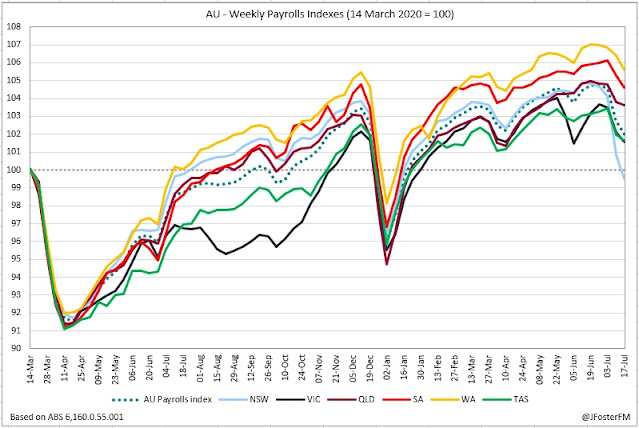
Perth and Darwin were lifted early in the month. Victoria entered its 5th lockdown towards the end of the reference period after reopening around 4 weeks earlier. The impact on the labour market from these disruptions has been reflected by the weakening in the ABS's payrolls data (chart below). For today's release, the median estimate is for employment to fall by 43k in July. However, as has been the case over the pandemic period, the effects of lockdowns have been more pronounced on hours worked rather than employment, with fiscal support measures attenuating the impact on the latter. The national unemployment rate is forecast to tick up slightly from 4.9% to 5.0% (range: 4.5% to 5.2%). Lockdown disruptions are likely to weigh on the participation rate, in turn limiting the extent to which unemployment might rise.


What to watch | Labour Force Survey

While a weak report is expected today, the full impact of the Delta disruption on the Australian economy will come through in August when around 60% of the population was in lockdown early in the month. The change in hours worked for July is the figure to watch today and will be used to help guide assessments on the hit to GDP in Q3. The participation rate is another area of interest given how responsive it has been to strong employment outcomes through the recovery. There is now likely to be some unwinding in the participation rate given the lockdowns and the pace at which it snaps back when reopenings occur will be a key factor to the strength of the rebound. 

Tuesday, August 17, 2021

Australian Q2 Wage Price Index 0.4%; 1.7%yr

Australia's Wage Price Index came in below estimates in the June quarter with annual growth at 1.7% still short of returning to its pre-pandemic pace. Growth in private sector wages is rebounding from record lows at a gradual pace, though public sector wages have slowed to a new series low, weighed by ongoing caps and freezes following the pandemic. 

Wage Price Index — Q2 | By the numbers
  • The headline WPI (total hourly rates of pay ex-bonuses) was softer than expected rising by 0.4% in the June quarter against the median estimate for a 0.6% rise. The WPI rose by 0.6% in each of the two previous quarters. 
  • Annual growth in the WPI firmed from 1.5% to 1.7% but was weaker than the 1.9% pace expected.
  • Private sector wages moderated slightly from the previous two quarters to a 0.5% rise in Q2, with the annual pace advancing from 1.4% to 1.9%. 
  • Growth in public sector wages held at a 0.4% pace in Q2, though the annual pace slowed from 1.5% to a new record low of 1.3%. 


Wage Price Index — Q2 | The details 

Australian wages growth firmed by a weaker-than-expected 0.4% in the June quarter, with the annual rate ticking up to 1.7% after hitting a record low (1.36%) in the September quarter of last year. The main theme in today's report was the divergence between wages growth in the private and public sectors. Prior to the current cycle of lockdowns, conditions were normalising somewhat with restrictions being rolled back, helping to support the strong economic recovery underway.

In that context, businesses were continuing to revisit wage reviews that had been put on hold due to the pandemic. As a result, wages growth in the private sector lifted further in Q2, albeit at a modest pace (0.5%) and slower than in the previous two quarters (0.6%). Annual growth in private sector wages lifted from 1.4% to 1.9%, in part boosted by base effects going back to the depths of the pandemic in 2020, though it has yet to return to its pre-pandemic pace just above 2%. In the public sector, wages growth lifted by 0.4% for a 3rd consecutive quarter, though the annual pace has slowed to a new record low of 1.3%, continuing to be weighed by the implementation of wage caps and freezes. 


In response to the economic recovery, there were signs that bonuses were returning in the private sector. Some of this would have been driven by sales commissions in an environment of robust household spending, though businesses may have also been using non-wage strategies to hold onto or recruit staff as they reopened and activity picked up, rather than lifting wages and adding to the cost base. The private sector WPI measure including bonuses had lifted by 0.6% and 0.4% in the final two quarters of 2020 before advancing by 0.8% in Q1 of this year. However, the pace slowed noticeably in Q2 back to 0.1%. In annual terms, growth was only modestly higher rising from 1.9% to 2.0%. 


The next chart shows wages growth for each industry in quarterly and annual terms, as well as their annual pace prior to the onset of the pandemic. For the June quarter, wages growth was strongest in rental, hiring and real estate services, reflecting robust housing market conditions. Overall, what the chart below highlights is the lack of wages pressure across the economy. There are only 3 industries where annual wages growth is exceeding its pre-pandemic pace: professional, scientific and technical services 2.5% vs 2.2%, other services 2.6% vs 2.1% and construction 2.2% to 1.8%. Consistent with this, the ABS noted in today's release that wage pressures are limited to only select areas where there are particular skill requirements. Wages growth remains very subdued either side of 1.5%Y/Y in an number of industries hardest hit by the pandemic including accommodation and food services, transport and retail trade, while the pace is even weaker in arts and recreation at 0.9%Y/Y.  


Turning to the states, the rebound in the WPI at the national level has not been broad based. Wages growth in New South Wales and Victoria continued to firm, rising from 1.5% to 1.8%Y/Y for both states. 


Wages are rising fastest in Tasmania at 2.2%Y/Y, while Queensland (1.7%) has been on a similar trajectory to New South Wales and Victoria. However, wages growth in South Australia and Western Australia is only fractionally above their pandemic lows. 


Wage Price Index — Q2 | Insights

Australian wages growth continues to rise from record lows associated with the pandemic but the uplift has been very gradual and has not been broad based across the economy. This is despite a very strong recovery in the labour market with the unemployment rate now lower than it was prior to the pandemic and employment having more than recovered from last year's significant falls. Labour demand remains very strong — take today's reading from the federal government on skilled vacancies for example that showed internet job advertisements were 46% higher than pre-pandemic levels despite a 3% decline in July due to the current lockdowns (chart below). Rates of wages growth around the 3% level though necessary by the RBA to hold inflation within its target band still seems a long way off. 

Preview: Wage Price Index Q2

The June quarter update of the Australian Wage Price Index is scheduled to be released by the ABS this morning (11:30am AEST). Measuring changes in hourly rates of pay for a fixed group of jobs, the Wage Price Index (WPI) is driven by minimum wage settings, changes in award rates, enterprise agreements and individual arrangments between employees and employers. Wages growth slowed to record lows last year as both the private and public sectors responded to the pandemic by delaying increases and implementing wage freezes. With these measures now unwinding, wages growth is recovering but the pace remains modest and is uneven across the economy.  

As it stands Wage Price Index

Going back to the March quarter, the WPI came in slightly ahead of consensus at 0.6%, matching pace with the outcome in the December quarter (reviewed here). The driving factors behind wages growth in Q1 were individual agreements and enterprise agreements as strength in underlying economic conditions allowed firms to revisit wage reviews that had been postponed. The decision by the Fair Work Commission to phase in the introduction of the minimum wage increase to help ease pressure on industries struggling with the pandemic continued. Annual growth in the WPI firmed from 1.4% to 1.5%.  


Wages growth in the private sector lifted by 0.6% in Q1 following on from the 0.7% rise in the previous quarter as the reversal of temporary wage cuts and freezes continued. The WPI measure including bonuses posted a stronger rise to be up by 0.8% in Q1, reflecting the contribution from sales commissions with consumer demand strong as well as non-wage strategies by firms to retain or attract staff. Annual growth in private sector wages was little changed around 1.4% but lifted from 1.2% to 1.9% for the measure including bonuses. For the public sector, wages growth was steady at a 0.4% quarterly pace, though the annual rate eased from 1.6% to 1.5% to a new record low.


The strongest rates of wages growth were in some of the industries hit hardest by the pandemic. This reflected the later phasing in of the 2019/20 minimum wage increase for these industries. Wages growth in accommodation and food services was 1.2% in the quarter, while wages in retail trade (0.6%) and other services (includes tourism) (0.7%) advanced over the period.    
 
Market expectations Wage Price Index

For the June quarter, the median estimate is for the WPI to rise by 0.6% between a tight range of estimates from 0.5% to 0.7%. Should the median estimate be realised, annual wages growth would rise from 1.5% to 1.9%, with the base period coinciding with the depths of the pandemic 12 months earlier. 

What to watch Wage Price Index

Insights from the recent RBA Statement on Monetary Policy suggested that many businesses were turning to non-wage increases such as bonuses and flexi-working arrangements to retain and hire new staff rather than lifting base wages, which would lock in a higher cost base. With job vacancies at highly elevated levels and many businesses reporting difficulties in finding staff, this is a key area to watch and will be reflected in the private sector WPI inclusive of bonuses measure. More generally, wages growth should continue to recover in line with the significant improvement in labour market conditions with the unemployment rate lower than prior to the pandemic, while employment levels have recovered their significant falls seen last year. However, the recent setbacks with the virus have raised uncertainty over the near-term trajectory. 

Friday, August 13, 2021

Macro (Re)view (13/8) | Sentiment hit by Delta

Household and business surveys released through the week reflected the deterioration in Australian economic conditions as broad-based lockdowns continue to restrict activity across much of the nation. Consumer sentiment tracked by Westpac and the Melbourne Institute fell by 4.4% in August to a reading of 104.1, taking the index to a 10-month low. The positives are that despite the Delta setback, sentiment is still in optimistic territory above the 100 line and it has shown much more resilience than during the depths of the pandemic when it collapsed to the 75-80 range. However, there has been a significant deterioration in the level of optimism by households over recent months, with the index falling by 12% from its peak in April. Following the recent outbreaks, the key factor influencing sentiment was vaccines. Sentiment amongst respondents who had received the vaccine (or planned to) was optimistic at 106.6 whereas it was outright pessimistic (95.9) for those who were not planning to receive it or were undecided about the vaccine. Local developments are also influential. Sentiment weakened in states affected by the lockdowns; New South Wales -4.1%, Victoria -10.8% and Queensland -4% but it strengthened in the 'open' states; Western Australia 4.1% and South Australia 9.1%.   

The deterioration in the pandemic situation has led to a significant re-rating of households' view of the economy. The 12-month outlook was downgraded by 8.3% driven by the states in lockdown. The ongoing Sydney lockdown has seen the economic outlook in New South Wales fall by more than 23% over the past 3 months. This has spilled over into the labour market, with the unemployment expectations index lifting by 13.7% in the month as households factored in a rise in job insecurity. The housing market is somewhat decoupled from these developments, with more than 70% of the respondents expecting house prices to rise further over the coming year. The acceleration in prices is weighing on buyer sentiment amongst owner-occupiers, though these dynamics are becoming increasingly more favourable for investors. While there are headwinds over the near term with lockdowns to remain prominent until vaccination rates are much nearer to the 70-80% range being targeted by the national cabinet, assessments of the economy further out remain solid. Economic conditions on a 5-year outlook moderated slightly in August (-1.2%) but are at a strong level overall and up by 30% on a year ago. 

For firms, the NAB Business Survey for July highlighted the rapid deterioration seen following the return to lockdowns. The business confidence measure turned negative for the first time since September plunging from +11 to -8, with falls recorded in all states. Business conditions weakened from +25 to +14 and while they remain above average, further declines are in prospect given the broadening and extension of lockdowns post the survey period. The sub-components were at elevated levels before the outbreaks but fell sharply on the month; trading from +32 to +12, profitability +25 to +6 and employment +18 to +10. The disruption to demand associated with the lockdown measures was reflected by the collapse in forward orders from +15 to -6, while capacity utilisation fell to a below-average level of 81.2%. Similar to households, the next few months will be difficult for many businesses until there is confidence that reopenings are imminent and that they can be sustained through higher vaccination rates.  

— — 

July's very strong US payrolls data and communications from Federal Reserve officials that the threshold for QE tapering is nearing have set the tone in markets offshore. However, there are rising concerns about the impact of the Delta variant, as highlighted by the 13.5% collapse in the University of Michigan consumer sentiment index in August. This saw the index breaking through the lows seen at the onset of the pandemic last year, weighed by a resurgence in caseloads and expectations for economic conditions to weaken. This has led to some tension in the bond market. From a closing low last week at around 1.2%, yields on 10-year maturities pushed as high as 1.36% this week — auctions for 3, 10, and 30-year maturities through the week may have been a contributing factor to the uplift — before pulling back sharply on Friday to 1.28% following the weak sentiment data. Over at the Federal Reserve this week, officials have generally been in favour of the tapering announcement coming soon. In support of a September announcement are the likes of the Dallas Fed's Rober Kaplan, the Atlanta Fed's Raphael Bostic and Boston Fed President Eric Rosengren. While refraining from nominating a start date, Esther George of the Kansas City Fed said this week that the time had come to "dial back the settings" on monetary stimulus, while the Richmond Fed's Thomas Barkin noted the FOMC was "closing in" on tapering. Further out, San Fransisco Fed President Mary Daly sees the tapering announcement coming "later this year or early next year".  

Perhaps just giving a little more space to the FOMC was the week's inflation report. Annual CPI steadied in July holding at a 5.4% pace while the core rate eased from 4.5% to 4.3%Y/Y. In a sign that inflation may have peaked, the easing of the acceleration was driven by a slowdown in price pressures for durables. Following surges of between 3-3.5% in each of the past 3 months, durables CPI pulled back to a 0.6% increase in July (see chart of the week). Prominent in this surge has been used cars and trucks, new vehicles and a range of household goods and appliances. With the pandemic still weighing on services consumption, spending on goods remains at highly elevated levels with stimulus measures and strong household balance sheets driving demand. Couple that with the shortages and supply chain constraints and the response has been an acceleration in prices. While these pressures might be starting to ease, stronger-than-expected print on producer prices (1%m/m, 7.8%Y/Y) suggests inflation will remain in the pipeline for a while yet. On the services side of the economy, CPI was a touch softer in July easing from a 3.2% annual pace to 3.0% and remains around pre-pandemic rates.    

Chart of the week

Over in the UK, the recovery looks to be back on track notwithstanding some near-term headwinds associated with the Delta variant. After contracting by 1.6% in Q1 weighed by lockdowns, GDP surged by 4.8% in Q2 as the economy reopened and consumption spending rebounded. This reduced the contraction in GDP relative to its pre-pandemic level to -4.4%. Last week, the Bank of England stuck to its forecast for GDP to return to its level from Q4 2019 by the end of the year, though output growth is expected to slow in the current quarter due to precautionary behaviour associated with the pandemic. 

Friday, August 6, 2021

Macro (Re)view (6/8) | Glass half full for the RBA

In spite of delta outbreaks and associated lockdowns that are expected to drive the Australian economy into contraction and stall the recovery, the RBA is confident that a strong rebound will follow when restrictions ease. This was the sanguine messaging from Australia's central bank this week as around 60% of the population was in lockdown. In its August quarterly Statement, the RBA outlined that GDP was anticipated to contract by at least 1% in Q3, with household spending and residential and non-residential construction to be hit hard. However, that estimate was made before Melbourne's latest lockdown, announced on Thursday. As a result, the labour market is expected to hand back some of the ground it has made in its recovery, with employment to fall and the unemployment rate to back up a bit from its current level of 4.9%, though a much larger impact is anticipated to be seen in hours worked. But as vaccinations rise, the experiences coming back from earlier lockdowns suggest to the RBA that the economy will rebound when restrictions ease, anticipated to be in the December quarter. This being said, there are clear downside risks given that lockdowns are to remain the main response to outbreaks until vaccination rates rise towards 70% under the national roadmap to reopening. Modeling from the Treasury released this week provided insight into the potential economic impacts going forward. 

Although the delta setback has knocked 0.75ppt off the 2021 growth forecast to 4.0%, the RBA sees this as a short-term disruption to the trajectory of the economy as it transitions from the recovery to the expansion phase. This was reinforced by the upgrade made to GDP growth for 2022, from 3.5% to 4.25%. With the forecasts recalibrated to a higher starting point due to the stronger-than-expected pace of the recovery up until the March quarter, GDP is now projected to end the forecast period in 2023 at a higher level than it anticipated in its previous Statement. Ending 2021 at 5%, the path for the unemployment rate was lowered from 4.5% to 4.25% in 2022 before making further progress to 4% in 2023. Meanwhile, for inflation, forecasts in both headline and underlying terms were lifted in 2021 — the former to 2.5% from 1.75% and the latter to 1.75% from 1.5% — though the pace subsequently eases such that it is in line with the 2% lower target in mid-2023, with wages growth only rising gradually over this period.  

All in all, with the outlook remaining relatively upbeat over this 2022-23 window the signal appears to be that the RBA is content with its policy settings. In spite of the delta setback and against market expectations, the decision by the Board at this week's meeting (reviewed here) to reaffirm the September start date for tapering its government bond purchases reflects this. RBA Governor Philip Lowe told the Parliament's economics committee on Friday that while the Board had the flexibility to dial up the pace of purchases later on if the economic outlook were to deteriorate more substantially, fiscal policy had recently been ramped up through relief payments to households and businesses and that was the more impactful policy response in the circumstances. It was reiterated to the committee that monetary policy will remain accommodative for a long time to come, with the governor noting that the Board did not expect to be raising rates until 2024.

Also of note this week was a range of data releases. Retail sales declined by 1.8% in June reflecting the impact of lockdowns in Melbourne and Sydney, though volumes lifted 0.8% for the quarter overall (see here). Conditions in the housing market remain strong — house prices nationally lifted by a further 1.6% in July (16.1%yr) according to CoreLogic — but policy stimulus is unwinding following the expiry of the HomeBuilder scheme. Reflecting this, housing finance commitments fell by 1.6% in June (see here) and dwelling approvals were down by 6.7% for the month (see here). Meanwhile, surging commodity prices elevated Australia's monthly trade surplus to a new record high at $10.5bn in June (see here).    

— — 

Offshore, expectations around the timing for the Federal Reserve tapering its asset purchases are shifting forward following comments from Vice Chair Richard Clarida and a very strong employment report across all key measures. In July, employment on non-farm payrolls surprised sharply to the upside of expectations coming in at 943k against 870k forecast, with the outturn bolstered by the addition of 119k jobs from revisions over the prior two months. While some caution is probably warranted given that it pre-dates much of the concern from delta, it reflects the strong momentum that the economy has built up with GDP now back above pre-pandemic levels. Employment has lagged significantly in the recovery and is still 5.7 million below its level prior to the onset of the crisis. In that context, the Fed has been reluctant to begin the process of removing policy support until there has been "substantial further progress" towards maximum employment. But as Vice Chair Clarida noted in a speech this week, officials of the FOMC are becoming more confident that the progress in the recovery is approaching this threshold  the July payrolls report undoubtedly in line with that view. As for rates, Vice Chair Clarida's assessment was that the economy is tracking towards being in a position for liftoff to start in 2023, and while that aligns with the median of FOMC members' individual projections (that sees 2 hikes that year), the comments were judged hawkish by markets. But, in the near term, there are still considerable issues in the labour market to work through. The sharp decline in unemployment from 5.9% to 5.4% and in the broader underemployment rate from 9.8% to 9.2% speaks to the strength in labour demand (see chart below), with both the manufacturing and services ISM surveys this week again highlighting issues businesses are having in filling vacancies. But the supply side remains constrained: participation moved a little higher in July to 61.7% but is well below its pre-pandemic level at around 63%. Hesitancy due to the virus, school closures, early retirements and ongoing support payments are cited by the Fed as key constraints and these will take some time to resolve. In the interim, wage pressures are evident with annual growth in average hourly earnings running at a 4% pace. 

Chart of the week

Across the Atlantic, the Bank of England signaled that asset purchases would run to the existing schedule through to December, though the process of reducing the size of the Bank's balance sheet is now expected to start sooner than previously guided. In an unchanged decision on monetary policy, the MPC will continue to press ahead with asset purchases, with the current £150bn tranche expected to be completed by around the end of the year. Mindful of the need to create headroom for future asset purchase programs to have similar firepower to previous versions of QE in the event of a crisis, the MPC sees benefit in lowering the stock of assets on its balance sheet as part of the next tightening cycle. Previously the BoE had indicated that this process would commence when its Bank Rate reached 1.5%. Currently, at 0.1%, Governor Andrew Bailey now says 0.5% is the appropriate level, provided the prevailing economic and market conditions allow it. Initially, the stock of asset purchases would roll off the balance sheet by not reinvesting maturing bonds, allowing the reduction to occur "at a gradual and predictable pace". The decline in the level of the Bank Rate to facilitate balance sheet tightening was attributed by Governor Bailey to negative rates being seen as part of the policy toolkit, as well as a judgment that the effect on financial conditions would be less pronounced than in the past. 

On the economy, the BoE's latest Monetary Policy Report conveyed an upbeat assessment of the outlook, with the effect of the pandemic expected to gradually dissipate. UK GDP is still expected to return to pre-pandemic levels by the end of the year, albeit around some near-term volatility from the delta variant. In Q2, GDP has been revised up to growth of 5.0% (from 4.25%), but it is then expected to ease back to 3% for Q3 due to voluntary precautions taken with caseloads high. Supported by accumulated household savings and the waning of the pandemic, very strong growth of 6% is projected for 2022 (up from 5.75%) before cooling in 2023 (1.5%). A key change in the BoE's outlook is that inflation pressures are now higher and more persistent in the short term, though this is still seen as a transitory dynamic. The peak in CPI was lifted from 2.5% to around 4% between Q4 2021 and Q1 2022, before slowing to 2.5% next year (from 2%) and again in 2023 to 2% (unchanged) to be in line with the MPC's target. As the MPC noted, this outlook would be consistent with "some modest tightening" of policy over the next couple of years, in line with market pricing.  

In Europe, the composite PMI reading for June was finalised at a highly expansionary reading of 60.2, indicating that the recovery is set to accelerate after getting back on track with a stronger-than-expected rise in GDP in Q2 of 2.0%. While delta outbreaks are a risk, businesses across a range of services industries reported strong demand conditions and they also remained optimistic with sentiment readings at high levels. Activity in the manufacturing sector was also expanding rapidly at a 62.8 reading, though the risk here is that momentum slows in response to constraints on the supply side in being able to meet elevated demand. Price pressures remain prevalent as a result and could also act as a speed bump. Lastly, euro area retail sales showed solid growth rising by a further 1.5% in June coming on the back of a 4.1% surge in the month prior as the shops started opening up more widely.