Independent Australian and global macro analysis

Wednesday, May 29, 2024

Australian Capex 1% in Q1; 2023/24 investment plans $181bn

Australian private sector capital expenditure increased by 1% in the March quarter, outperforming the 0.7% rise expected by markets. A strong rise in equipment investment (3.3%) drove capex higher through the first 3 months of 2024, providing a welcome boost to GDP estimates amid weak details around the consumer and the construction sector. Forward-looking investment plans were revised upwards in both the current financial year (to $181bn) and 2024/25 (to $155bn), the projected spend for the latter advancing to an 11-year high. 


Private sector capex - an indicator of business investment that feeds into GDP growth calculations - rose solidly by 1% in chain volume (or inflation-adjusted) terms in the March quarter. Year-ended growth slowed from 8.1% to 5.5% - capex spending was brought forward into the first half of last year ahead of the withdrawal of Covid-related tax incentives - so this is still a decent pace in that context. In the most recent quarter, equipment investment lifted by 3.3% to comfortably offset a 0.9% drag from spending on buildings and structures.   


Equipment investment in the non-mining sector lifted by 4.6%q/q - its strongest rise in 3 years - driving the overall increase in equipment spending. The ABS noted in today's release that this was supported by an expansion of investment in data centres by firms in the information media and telecommunications industries. Mining-related equipment investment declined 3.2%q/q. 


The details around buildings and structures investment included a 1.9% rise in the non-mining sector but a 5.2% fall in the mining sector. Overall, this netted out to a 0.9% decline for buildings and structures, an outcome against the recent strength in this component, largely consistent with the picture painted by yesterday's construction activity data (see here). 


Today's report contained firms' latest estimates of their capex plans in 2023/24 and 2024/25. For the current financial year, total investment was lifted to an expected spend (in nominal terms) of $181bn for estimate 6, an upgrade of 2.5% on the previous estimate from 3 months ago and tracking 11% higher on a year-to-year basis (relative to estimate 6 in 2022/23). 


Firms were also surveyed for their 2nd estimates of planned capex spending in 2024/25. The headline figure was $155bn, a 6.8% lift on estimate 1 from 3 months ago and 12.8% higher than estimate 2 for 2023/24. Inflationary effects are a factor in those upward revisions but this was nonetheless the highest estimate since 2013/14.   


Non-mining sector investment plans for 2024/25 increased by 6.8% (vs est 1) to $107bn, with upgrades coming through for both equipment (6.9% to $48bn) and buildings and structures (6.7% to $59bn). Meanwhile, mining sector plans advanced 7% to $48bn, with equipment spending projections rising 7.5% (to $13bn) and buildings and structures up 6.8% (to $35bn).   

Australian construction work done -2.9% in Q1

Australian construction activity declined sharply in the March quarter (-2.9%), defying expectations for a modest rise (0.5%). That result was attenuated somewhat an upward adjustment to activity in the previous quarter (revised from 0.7% to 1.8%); however, this was still a weak outcome from a key component of the economy that will feed into next week's growth figures for Q1. 


Construction activity went backwards in the first quarter of 2024 by 2.9% - the sharpest decline seen in almost 5 years. The result was driven by non-residential (-7%) and engineering work (-2.1%) rolling over from recent strength, while weakness in the residential sector (-1.2%) persisted. 


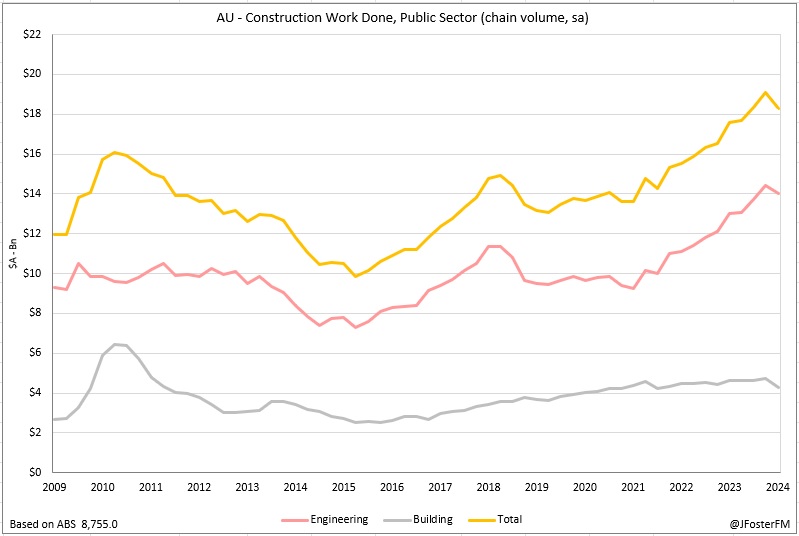
From a broader perspective, construction work done by the public sector - a major source of strength coming of out the pandemic on the back of a ramp up in infrastructure spending - unexpectedly fell (-4.3%), and private sector activity also declined (-2.4%). 


In the private sector, residential construction contracted by 1.1% in the March quarter to be down by 3% through the year. Activity in the segment is facing strong headwinds from labour and supply constraints - legacy issues from the pandemic - higher interest rates and affordability concerns. New home building declined by 0.8%q/q and by 1.7% over the year. Alterations (-2.7%q/q, -10.5%Y/Y) have retraced to late 2020 levels, pre the full weight of the Covid stimulus measures that supported this activity.  


Private non-residential work was down 6% for the quarter, albeit after an 8.9% surge in Q4. Activity in this segment remains at elevated levels nonetheless, supported by renewable energy and industrial projects. 


Engineering activity was down 2.1% overall in the quarter, slowing the increase over the year to 6.2% from 16.3%. The expansive pipeline of public infrastructure projects being undertaken by governments across the nation has boosted engineering activity across both the public (7.8%Y/Y) and private sectors (5%Y/Y). Public sector building work was reported to have contracted by a surprisingly large 9.2% in Q1, an outcome against its recent trend of rising activity. 

Tuesday, May 28, 2024

Australian CPI 3.6% in April

Australia's monthly CPI inflation indicator has surprised on the upside of expectations rising to 3.6% on a 12-month basis in April (vs 3.4% forecast) from 3.5% in March. The Australian dollar lifted before unwinding the move but a spike in the benchmark 3-year bond yield has held up post the release. Although consistent with RBA easing prospects in 2024 being priced out, construction activity data (also released today) provided another sign that next week's National Accounts will report a weak economic growth outcome in Q1, a factor that could see rate cuts being restored into the profile. 


Headline CPI rose by 0.1ppt for the second month in succession printing at 3.6% in April, its highest since last November (4.3%). Broadly speaking, today's report suggests that the disinflationary process lost momentum over recent months, not unlike what has been seen in the US. This was reflected in the 3-month change in the CPI (shown in the grey bars in the chart above) lifting to 1.6% in April, similar to the momentum seen in Q3 last year. Meanwhile, the gauges of underlying inflation were either steady or up slightly - the key trimmed mean measure a case in the latter category firming from 4% to 4.1%. 


Services prices - the component of inflation being watched most closely by the RBA - saw a small uptick to 4%yr from 3.9%, while goods prices were unchanged at 3.3%yr. Interestingly, however, the data suggests goods prices have been rising at a faster pace than services in recent months; the 3-month change in goods prices was 2.1% to April compared to 1.1% for services prices. The other point to highlight is that goods disinflation has been much more pronounced overseas than has been the case in Australia.  


Notable increases in goods prices in April came through in fruit and vegetables (from -1.2% to 3.5%yr) and clothing and footwear (0.3% to 2.4%yr). Despite fuel prices easing from 8.1% to 7.4%yr in April, this has been a strong contributor to the uplift in the momentum of inflation in early 2024 - as have electricity prices (4.2%yr in April) with government rebates rolling off. But the new rebate schemes that have been announced by governments at the federal and state levels will be deducting from the measured inflation rate through the back half of the year.  

Monday, May 27, 2024

Australian retail sales rise 0.1% in April

Australian retail sales increased by just 0.1% in April, underwhelming expectations for a modest rebound (0.2%) on the back of a weak print in March (-0.4%). A post-Easter moderation in households' spend on food and alcohol weighed down on the headline result as discretionary-related sales showed surprising strength. 


April sales ($35.7bn) were up very modestly on the prior month, the overall increase of 0.1% falling short of the expected figure (0.2%). The earlier timing of Easter in 2024 boosted food sales in March (0.8%), helping to attenuate weakness from households cutting back on discretionary-related (non-food) purchases (-1.2%) that left headline sales down 0.4% month-on-month. 

In April, this dynamic broadly reversed: food sales pulling back (-0.5%) and discretionary-related sales rebounding (0.6%). Around a volatile monthly profile, momentum in retail sales is soft rising by 1% through the first 4 months of the year; a result that could be described as weak in the context of the pace of population growth (around 2.5%). Inflationary effects are two-sided: on one hand, higher prices should weigh on spending as budgets become stretched but on the other, the higher prices being paid lift nominal sales.  


Looking further into spending across the categories in April, the overall rebound in discretionary-related sales was driven by 'other' retailing (1.6%) and household goods (0.7%) - categories that had each declined in February and March. In addition, spending at cafes and restaurants (0.3%) and department stores (0.1%) also lifted. By contrast, clothing and footwear sales continued to fall (-0.7%) following a much larger decline in March (-4.6%). Food sales declined 0.5% in April - statistically their largest month-on-month fall going back to February 2022 - though the pullback may be accentuated by seasonal volatility given the earlier timing of Easter. 


More volatility was evident in monthly sales in today's report, a common theme so far this year. But, overall, momentum in retail sales is soft (and weak in per capita terms), reflecting the pressures households are feeling from the higher cost of living and tighter monetary policy. This is the main dynamic that the National Accounts for Q1 should confirm next week, which appear likely to increase expectations for RBA easing in 2024. 

Friday, May 24, 2024

Macro (Re)view (24/5) | Australian dollar pares recent strength

A quiet calendar gave little directional impulse to markets this week. In equities, strong earnings results from tech giant Nvidia advanced the Nasdaq to new closing highs but this was unable to inspire indices in Europe and Asia. This week's hawkish RBNZ meeting caught markets offside as its revised cash rate track signaled an on-hold stance in restrictive territory until well into next year. Locally, the Australian dollar saw its sharpest weekly fall against the US dollar in 6 weeks. 


May's FOMC meeting minutes contained hawkish sentiments that, however dated by last week's improved CPI release, were able to move markets in a fairly quiet week in the US. There had been discussion around the uptick in the momentum of inflation since the turn of the year leading the FOMC to think that gaining "greater confidence" in the outlook for a return to 2% inflation would now take longer to achieve. Moreover, there was uncertainty expressed around the current extent of restrictiveness of monetary policy, with "various participants" willing to tighten further if "such an action became appropriate".    

What was seen as a line-ball decision between June and August for the first BoE rate cut has swung firmly to the latter as UK inflation slowed by less than expected in April. Headline CPI fell from 3.2% to 2.3%yr (vs 2.1% expected) - the decline driven by energy-related base effects - while a more marginal slowing was seen in the core rate from 4.2% to 3.9%yr (vs 3.6%). The positive is that headline inflation is now within striking distance of the BoE's 2% target, but on the other hand, annual price resets saw services inflation coming in at an elevated 5.9% (vs 5.5%) from 6% previously. By contrast, goods prices are now in deflation (-0.8%yr). 
 
Improving growth momentum in the euro area through early 2024 looks to have continued into the second quarter. Business activity according to May's flash PMI lifted to a reading of 52.3, a 12-month high. Faster growth in output, new orders, and employment supported the overall rise in activity from the prior month (51.7). Activity in the services sector (53.3) expanded for the fourth month in succession while the manufacturing gauge (49.6) improved to a 14-month high that indicates the downturn in the sector may be about to turn. Better growth and an uptick in wages growth in Q1 has clouded expectations for the extent of policy easing from the ECB past the June rate cut that it will almost certainly deliver. Negotiated wage growth lifted from 4.5% to 4.7% year-on-year to Q1, an upside surprise on expectations for a slowing to 4%Y/Y. This could be more noise than signal, with more timely measures of wages growth slowing since the start of the year. The driving factor behind the rise in negotiated wages was new wage agreements in Germany coming into effect that were playing catch up to high inflation. 

The minutes of the RBA's May meeting outlined what was a broad-ranging discussion on policy from the Board. Although much of the focus went to the consideration the Board gave to hiking rates, I think the most significant development was the insight that the Board judged its current strategy remained fit for purpose whereby it is aiming to gradually return inflation to target "within a reasonable timeframe". This approach seeks to balance in equal measure the risk of inflation expectations shifting up against a sharp increase in unemployment. The new forecasts published at the May meeting indicated to the Board that there was "a credible path" by which it could return inflation to target with employment continuing to rise. Overall, markets sense that the RBA is reluctant to hike further despite its neutral guidance that it is "not ruling anything in or out", a factor that may have weighed on the AUD this week.   

Friday, May 17, 2024

Macro (Re)view (17/5) | Risk takes the upper hand

US inflation data this week snapped its recent run of upside surprises and underpinned a positive tone for risk. Equity markets in the US advanced to new highs buoyed by the prospect of rate cuts from the Fed later this year, giving bearish momentum to the dollar. Amid that backdrop, the Australian dollar has rallied to its highest levels since January, outweighing renewed pricing for an RBA rate cut in 2024 on the back of this week's labour market and wages data. 


US data this week was seen as endorsing the Fed's dovish messaging at its recent FOMC meeting. Following the softer-than-expected increase of 175k in April's nonfarm payrolls report, signs of softening momentum in economic growth were taken from this week's inflation and retail sales data for April. Both headline and core inflation printed at 0.3% month-on-month (vs 0.4% headline and 0.3% core), as headline eased from 3.5% to 3.4%yr and core moved down to a 3-year low of 3.6% from 3.8%. These outcomes - while still too hot to appease the Fed - were interpreted favourbly in the context of the inflation data having come in above expectations through the early part of the year. Furthermore, markets were encouraged by better underlying detail: services inflation (0.4%m/m) posted its slowest rise so far this year - though the annual rate saw an uptick from 5.2% to 5.3% - as disinflation continued in goods prices at 0.3%yr from 0.6% previously. Signs of softer consumer demand were taken from retail sales growth stalling in April (vs 0.4%) as the key control group - viewed as a better gauge of underlying spending - was unexpectedly weak declining by 0.3%m/m (vs 0.1%). 

In Europe, several ECB officials continued to reaffirm a June rate cut is firmly on the cards. Beyond June, markets are pricing the ECB to cut on a quarterly profile, resulting in a total of 3 rate cuts by year-end. Inflation data for April was finalised at 2.4%yr on a headline basis with the core rate slightly firmer at 2.7%yr; unlike the US, disinflation in the euro area has continued steadily so far this year headline falling from 2.9% last December and core slowing from 3.4%. New forecasts published by the European Commission this week lowered its inflation outlook, anticipating an earlier return to the ECB's 2% target in 2025. Meanwhile, consistent with signs that GDP growth has started to pick up expanding by 0.3% in Q1, the Commission has retained its outlook for growth in 2024 to firm to 0.8% before strengthening to 1.4% in 2025.    

Australia's labour market data released this week tipped the profile for RBA rates pricing towards a cut as the next move, outweighing the impact of measures announced in the Federal Budget. My budget analysis focused on the competing pressures on the nation's finances. Revenue windfalls have swung the budget into surplus, giving the government headroom to provide cost-of-living support (built around personal tax cuts and energy bill relief) in the near term. But larger deficits are forecast in coming years, driven by the escalating cost of the delivery of key services. The budget measures have mainly been assessed through an inflationary lens, contributing a net $9.5bn of stimulus in 2024/25 at a time when the RBA doesn't see inflation back at target until mid-2026. However, the RBA's forecasts are yet to take full account of the situation. 

Employment rebounded from a decline in March to rise by a stronger-than-expected 38.5k in April, with the 3-month average (50.2k) reaching its strongest level since May last year. However, an uplift in the participation rate (66.7% from 66.6%) saw the unemployment rate increase to 4.1% from a revised 3.9%. My review of the report here concludes that the labour market remains robust but continues to rebalance from peak levels of tightness. Consistent with this situation, wages growth printed on the soft side of expectations in Q1 at 0.8%, with a softening in the year-end pace to 4.1% from 4.2% suggesting the peak may be in (reviewed here). 

Wednesday, May 15, 2024

Australian employment 38.5k in April; unemployment rate 4.1%

A stronger-than-expected rise in employment in April (38.5k) was unable to keep a lift in the unemployment rate at bay, increasing to a 3-month high of 4.1%. Momentum in employment remains strong but tightness in the labour market has eased, consistent with wages growth starting to lose heat. 

By the numbers | April
  • Employment increased by a net 38.5k in April, above the 20k consensus following a 5.9k fall in March (revised from -6.6k).  
  • The unemployment rate lifted to 4.1% (vs 3.9% expected) from a revised 3.9% in March (3.8% reported initially). 
  • Labour force participation increased from 66.6% to 66.7%, just below the record high of 67% from last November. 
  • Hours worked were unchanged month-on-month but are down 0.8% over the year. 


The details | April 

Employment rebounded from a weak March figure (-5.9k) rising by 38.5k in April (full time -6.1k and part time +44.6k). This outcome was near the top end of the range of forecasts (-10k to +45k), though conviction going into today's report given the timing of the survey coincided with Easter and school holiday periods. Although employment outcomes in recent months have been volatile, the underlying trend shows that employment has strengthened since the start of the year. In fact, employment for the 3 months to April averaged an increase of 50.2k per month - its strongest clip since May last year. 


Rising momentum in employment helped keep the unemployment rate below 4% over the past couple of months; however, in April it ticked back up to 4.1% - in line with its level from January. In addition, both the underemployment rate (6.5% to 6.6%) and the total underutilisation rate (10.3% to 10.7%) rose in April. These increases were driven by two factors 1) the labour force increased by 68.8k (reflected in the participation rate rising from 66.6% to 66.7%), which outpaced the net gain in employment (38.5k), and 2) hours worked in April were flat in month-on-month terms. Overall, these metrics on spare capacity in the labour market are still constructive, but they imply the level of tightness has eased over the past year or so - an assessment validated by the apparent peaking in wages growth reported yesterday.  


The broader dynamic that has been playing out is that employment growth has converged with growth in the working-age population - in RBA speak, labour demand has been coming into balance with labour supply.    


Monthly hours were reported flat in April, though it is probably best to take this with a grain of salt given the effect of Easter and school holidays. The ABS's seasonal adjustment processes are designed to mitigate such effects; however, the post-pandemic labour market is very different from the pre-pandemic one. For instance, the ABS noted the timing of Easter in 2024 closely aligned with 2018; back then, hours worked rose 1% month-on-month but were flat this year.


In summary | April

My takeaway from today's report is that it is unlikely to change the RBA's assessment of the labour market; that being that conditions have moved away from peak levels of tightness but are still robust overall. The headline increase to 4.1% unemployment was higher than expected; however, the ABS noted in today's release that more people than usual for this time of year were waiting to start new jobs. A similar effect in February (while more pronounced than in April) contributed to a very large rise in employment and a fall in the unemployment rate. Absent a shock, there is still good reason to be optimistic that the robust momentum in employment growth can be sustained and hold the unemployment rate around current levels.   

Preview: Labour Force Survey — April

Australia's Labour Force Survey for April is due at 11:30am (AEST) today. Seasonality has led to a run of volatile employment outcomes in recent months, and this could continue today with the April survey coinciding with the Easter holiday period. Amid this uncertainty, the consensus forecast is for employment to rebound by around 22k in the month but for the unemployment rate to lift to 3.9%. 

A recap: Volatility continued but employment lifted solidly in Q1 

Employment surprised to the downside in March falling by 6.6k against expectations for a modest 7.2k increase. This was another in a series of volatile employment outcomes over recent months coming off the back of a 117.6k surge in February. Amid the volatility, employment increased solidly over Q1 (122.3k), an average increase of 40.8k per month. 


The decline in employment in March saw the unemployment rate rise from 3.7% to 3.8%, with a larger increase kept at bay due to an easing in the participation rate (66.6% from 66.7%). Although the unemployment rate increased, the broader underemployment rate declined from 6.6% to 6.5%, leaving the total labour force underutilisation rate unchanged at 10.3% - remaining at its lowest since October last year.


Hours worked advanced by 0.9% in March but were flat over Q1. Over the past year, labour market conditions have remained resilient to the economic slowdown in Australia, but an adjustment has played out through slower growth in hours worked. The annual pace in hours worked has stepped down to a 1.7% pace from 6.5% a year ago. 


Seasonal volatility again a factor in April

The consensus estimate is for employment to rise by around 22k in April, with the band of estimates ranging from -10k to 45k. As that range suggests, there is little conviction over what the outcome will be. This is partly due to seasonal effects. The reference period for the April survey commenced on Easter Sunday and took in school holidays in a few states. Payrolls data published by the ABS last week showed a 0.6% decline in the employment index for the month to mid-April, highlighting the seasonal impact of the holiday period. How that translates to a seasonally adjusted figure for employment is the big question, one which cannot be answered with any certainty. A slight uptick in the unemployment rate to 3.9% is anticipated (range: 3.8% to 4%), based on the participation holding flat (66.6%). 
 

Tuesday, May 14, 2024

Australian Q1 Wage Price Index 0.8%; 4.1%yr

The sequential slowing in the pace of Australia's Wage Price Index (WPI) continued in the March quarter. Base wages moderated to a quarterly increase of 0.8%, below expectations (0.9%) and the slowest rise since Q1 2022. After rising alongside the economic recovery from the pandemic since the second half of 2020, annual wages growth has started to ease printing at 4.1% from 4.2% previously. Today's report is consistent with wages growth moderating in response to an easing in labour market conditions.  


The WPI - a measure of wage inflation in the Australian labour market - was 0.8% in the first quarter of 2024, slowing from 1% in the previous quarter and well down on the equal-record 1.2% increase seen in Q3 last year. This slowing has been driven by a moderation in the pace of wages growth tied to individual agreements, while the effect on wages growth from large legislated increases to the minimum wage and awards (determined by the Fair Work Commission) and new enterprise bargaining agreements (EBAs) mostly passed through in the previous two quarters. Today's report suggests annual wages growth (4.1%) is around its peaks - consistent with the forecasts in last night's Federal Budget and the RBA's May outlook. 


Private sector wages growth matched the outcomes of the headline index. The 0.8% increase in the most recent quarter was the slowest recorded in 2 years, while the annual rate (4.2% to 4.1%) dipped for the first time since the pandemic crisis. 


ABS analysis reported that just 12% of private sector jobs saw a pay increase in Q1. The average pay increase for these jobs was 4.4%, unchanged from the previous quarter but well below the 5.8% pace seen in Q3 last year.  


In the public sector, wages growth pulled back to 0.5% in the quarter following a very strong increase in Q4 (1%) that was linked to the implementation of new EBAs and other wage policies coming into effect. The annual pace declined sharply from 4.3% to 3.8% driven by a base effect relating to a very strong quarterly rise in Q1 2023 (1%) falling out of the calculation. 


Aggregating the latest estimates for wages growth across the industries tracked by the ABS suggests the pace has either levelled out or is starting to ease. Wages growth across industries in business services and in goods-related areas continued to move sideways in Q1. Meanwhile, wages growth in household services slowed. 

Preview: Wage Price Index Q1

Australia's Wage Price Index (WPI) for the March quarter is due to be published at 11:30am (AEST) today. Wages growth neared 15-year highs at the end of 2023 at an annual pace above 4%. There are signs that wages growth is around its peak for the cycle, with labour market conditions easing but still remaining tight overall. In today's report, wages growth is expected to remain around 4.2%. 

A recap: Wages growth continued to rise into year-end  

The WPI increased by 0.9% in the December quarter to an annual pace of 4.2%, a near 15-year high. After falling to cycle lows of 1.4% during the pandemic crisis, wages growth accelerated alongside the economic recovery as the labour market tightened and wage-setting processes adjusted to a high inflationary backdrop.  


Wages growth in the most recent quarter was driven by the public sector, which saw its fastest quarterly increase (1.3%) since 2009. This drove the annual pace from 3.5% to 4.3%, overtaking growth in private sector wages (4.2%) for the first time in this cycle. The catch-up in the public sector reflects new wage agreements progressively coming into effect, including in specific industries such as healthcare and education.     


There were signs in the Q4 report that wages growth may be around its peak, consistent with the level of tightness in the labour market having eased. Wages growth in the private sector tends to be more responsive to changes in underlying economic conditions, and wages growth in the sector appears to be stabilising. Additionally, wages growth for workers on individual agreements (most commonly used in the private sector) has softened slightly. However, new enterprise bargaining agreements (both in the private and public sector) are continuing to come into effect with a lag and so are expected to contribute further upward pressure on wages growth. Meanwhile, the bulk of the recently legislated increases to the minimum wage and awards determined by the Fair Work Commission have already flowed through to wages growth. 


Wages growth to remain firm in the March quarter

Expectations are that wages growth remained firm in the March quarter; the consensus estimate going into today's report is for a 0.9% quarter-on-quarter outcome (range: 0.8% to 1%), which would hold the annual pace around 4.2%. In last week's Statement on Monetary Policy, the RBA reaffirmed its view that wages growth is around its peaks for the cycle, highlighting wage developments for individual agreements as a sign of responsiveness to the easing in labour market conditions. This is also informed by the year-ahead view on wages growth reported by firms in the RBA's liaison program, with the pace anticipated to slow to around 3.5%.