Independent Australian and global macro analysis

Tuesday, November 15, 2022

Australian Q3 Wage Price Index 1.0%; 3.1%yr

Australian wages growth has lifted above a 3% annual pace for the first time since 2013, boosted in the September quarter by private sector wage reviews and increases to the national minimum wage and award rates. Labour costs have risen as the labour market has tightened coming out of the pandemic, but Australian inflation remains more driven by pandemic-related and global supply factors.  

Wage Price Index — Q3 | By the numbers
  • The headline WPI (total hourly rates of pay ex-bonuses) lifted by 1% in the September quarter, higher than the 0.9% rise expected and up from Q2's 0.8% increase. Annual wages growth advanced from 2.6% to 3.1%, a 9½-year high.  
  • Private sector WPI lifted by 1.2%q/q (prior: 0.8%), its fastest quarterly rise since Q2 2008, lifting to be 3.4% higher through the year (from 2.6%). 
  • Wages growth in the public sector was unchanged from the June quarter at 0.6%q/q and 2.4%Y/Y. 


Wage Price Index — Q3 | The details 

Wages growth in the Australian economy lifted by 1% in the September quarter - its fastest quarterly increase in more than a decade - to be running 3.1% higher over the year. The start of the new financial year triggered a large round of wage reviews in the private sector, while the increases announced by the Fair Work Commission to the national minimum wage and award rates in most industries also came into effect. 


In the private sector, wages growth accelerated by 1.2% in the quarter, elevating the annual pace to 3.4% - a near decade high. Outside of the Covid period, annual wage reviews in Australia typically take place in Q3 at the start of the financial year. Given the significant strength in the labour market and the high prevalence of jobs in the sector covered by individual agreements, annual wage reviews were the driving factor in the acceleration in wages growth in Q3. 


The ABS's analysis found that 46% of private sector jobs received pay increases in the September quarter - higher than the usual share at this time of the year, at around 40%. Pay increases to the jobs that received them averaged 4.3%; the last instance where the average increase was above 4% was back in 2012. The rising momentum in wages growth reflects the responsiveness of the private sector to the strength in underlying labour market conditions, which have continued to tighten post the recovery from the pandemic crisis. 


In addition to rising base wages, firms have also increasingly relied on bonus payments to retain and attract staff, or in the absence of that have offered one-off payments for the higher cost of living. Reflecting this, the private sector WPI inclusive of bonuses measure posted its strongest quarterly increase in 11 years (1.6%) to be up through 4% over the year. 


Public sector wages growth held steady for the third quarter running at 0.6%, leaving the annual pace firmly contained at 2.4%, in line with its pre-pandemic range. Wage policies of governments at the federal and state levels have sought to limit growth in labour costs through wage caps; however, these policies have increasingly come under review and have been recalibrated in response to the acceleration in inflation, which will take time to flow through to the data. 


From an industry perspective, wages growth in the goods-related and business services sectors is running at its strongest pace since 2012 at around 3.5%. Wages growth in household services is lagging at 2.8%, though some of the industries in this sector have yet to see the announced award rate increase come through, with the Fair Work Commission delaying the increase for pandemic-affected industries until Q4. 


In the goods-related sector, wages growth picked up sharply in the retail sector to be running at 4.2%Y/Y, boosted by the increases to award rates. Labour shortages have impacted many industries in the sector, pushing up wages growth in the construction (3.4%) industry in particular. 


For business services, wages growth has picked up across the sector to its fastest pace in around 10 years amid strong competition for labour. 


Wages growth has been less responsive in household services to the tightening in the labour market, in part because of its larger share of public sector jobs, in particular in health care and education. Also, as alluded to earlier, the award rate increase in the accommodation and food services industry has yet to fully come through. This sector does, however, have one industry where wages growth is running above 4%: rental, hiring and real estate, coming on the back of strong demand for those services.  


Wage Price Index — Q3 | Insights

Australian wages growth is running with a 3-handle for the first time since early 2013, responding to the tightening that has occured in the labour market following the recovery from the pandemic. High inflation has led to upward pressure on national settings for the minimum wage and awards also boosting wages growth, though households continue to face falling real incomes regardless. Today's outcome was a little stronger than expected but is broadly in line with RBA projections for wages growth. Overall, Australian inflation is in the main being driven by pandemic and global supply-related factors rather than domestic wage pressures. 

Preview: Wage Price Index Q3

Australia's Wage Price Index for the September quarter is due to be published by the ABS today at 11:30am (AEDT). Wages growth has gradually risen off the lows of the pandemic alongside the recovery and subsequent tightening in the labour market but is still unlikely to be at a pace that is contributing to inflation pressures in the economy. In today's report, wages growth will be boosted by increases to the national minimum wage and award rates. 
 
As it stands Wage Price Index

Aggregate wages growth continued to pick up rising by 0.7% in the June quarter to be up by 2.6% through the year. Wages growth floored at 1.4%Y/Y in the back half of 2020 but the strength of the recovery in the labour market has driven a rebound to now be running at its fastest since 2014, though that is a pace well below inflation in Australia (7.3%Y/Y). 


Wages growth in the private sector lifted by 0.7%q/q to 2.6% in year-ended terms - a little stronger than its pre-pandemic pace. A key development to emerge in the sector is the rising rate of wage increases. Only 14% of jobs received a pay rise in the quarter, but the average of those rises was 3.8% - its highest in a decade. Meanwhile, the WPI inclusive of bonuses measure lifted to 3.3%Y/Y, also a decade high indicating that firms' labour costs are rising due to factors other than increases in base wages.


In the public sector, wages growth is softer at 0.6%q/q and 2.4%Y/Y. This is largely because wage caps had been in place in the sector, though they have more recently been recalibrated in many states. 


The industries that are seeing the fastest pace of wages growth are in the goods-related and business services sectors. Construction (3.4%Y/Y) and manufacturing (3.1%Y/Y) are boosting the goods-related sector due to skills shortages. The average increase across business services industries was 2.8%Y/Y in Q2, reflecting strong competition for labour and increased churn from workers changing jobs. 

Market expectations Wage Price Index

The headline wage price index is tipped to rise by 0.9% in the September quarter between a range of estimates from 0.8% to 1.4%. That would lift the annual pace to 2.9%, which would be the fastest since Q1 2013 but still below the range the RBA estimates to be consistent with generating sustainable 2-3% inflation.  

What to watch Wage Price Index

The quarter-on-quarter figure for wages growth is the key number to watch. An increase of the magnitude expected in today's report (0.9%) hasn't been seen in over a decade, and there could be risk to the upside. The driving factors are the strength in the labour market where the unemployment rate is down at half-century lows, and from increases in the national minimum wage and award rates coming through. Back in June, the Fair Work Commission announced a 5.2% increase in the minimum wage and a 4.6% rise for award rates. Those increases came into effect from the start of the quarter, though for pandemic-affected industries the award rate increase is delayed until the start of Q4.

Friday, November 11, 2022

Macro (Re)view (11/11) | Turning point in US inflation

Price action following the latest US CPI report indicated markets have come to the view that the turning point is in with inflation now past its peak. Risk assets surged as terminal rate pricing in the Fed's policy rate pulled back below 5% and expectations firmed up for a slower pace of hikes starting in December. Substantive progress toward the reopening in China was another factor that boosted sentiment. Amid these developments, the US dollar fell very sharply by around 4% over the week. 


US CPI still high but takes a turn for the better   

The first downside surprise in US inflation since April has put a downshift in the pace of Fed rate hikes firmly on the table. Indications from the Fed's policy meeting last week were that the FOMC was leaning towards a 50bps hike in December following four consecutive 75bps increases, and October's CPI data has only firmed up that view. Although there is another CPI report due before the December meeting, it's probably not pivotal to the decision as the FOMC should be able to detect enough signals that the inflationary pulse is slowing.  

Headline CPI was 0.4%m/m in October, lowering the annual pace from 8.2% to 7.7% - its slowest since January. The core rate printed at 0.3%m/m and eased to 6.3%yr from 6.6% in September. Taking a 3-month average, headline CPI has slowed to 0.3% - down sharply since the middle of the year as gasoline prices have fallen - while the core rate is running around 0.5%, which is still elevated but the trajectory has softened.


From a compositional standpoint, services prices remain the main driver of inflation, mostly due to rising rents. Goods prices are now weighing on the inflation rate. During the pandemic, rising goods prices were the main reason inflation surged as consumption rotated away from services, leading to strong demand at a time when supply chains were severely hampered. Lower input prices, eased supply chain disruptions and weaker demand are now working to see goods-related inflation unwinding, which has further to play out. Services inflation is still rising driven by factors such as the earlier strength in the housing market, reopening effects pushing up prices for airfares, hotels and dining out, and businesses passing through higher prices they have faced, including for labour costs. 


Australian consumer sentiment falls further...  

A 6.8% plunge in November saw Australian consumer sentiment tracked by the Westpac-Melbourne Institute index fall to a new low for the cycle, broadly in line with its level at the outset of the pandemic. The renewed weakness appeared to be driven by a negative reaction to the recent federal budget, which kept new spending to a minimum to avoid adding to inflation pressures but left households without the sort of cost-of-living assistance they may have been expecting. The underlying details in the report showed consumers see the economic outlook developing in a similar fashion to the RBA and other forecasters, with a growth slowdown anticipated due to an expectation for further rate hikes and high inflation likely to pressure their finances. That has seen some of the optimism towards the labour market fade, though they remain broadly upbeat about that situation. Sentiment on the housing market became more negative in terms of the outlook for buying intentions and housing prices. 


... and businesses are less confident in the outlook  

For businesses, the latest NAB survey reported ongoing strength in conditions (+22) but seemingly with concern over the outlook as the confidence indicator weakened to a zero reading. There is broad-based strength in conditions with the trading, employment and profitability components all remaining elevated while forward orders are robust despite softening in the month. Inflation pressures held fairly steady at historically high rates. Confidence has slipped below average in response to a weakening global economic outlook and in the knowledge that RBA rate hikes will slow domestic demand. On the RBA, a speech from Deputy Governor Bullock reiterated that its more cautious path of tightening has come in response to the high level of uncertainty around the economic outlook and with rates having already risen significantly since May. 

UK economy contracts in Q3... 

The UK economy posted a 0.2% contraction in real GDP in the third quarter, which while affected by the additional bank holiday for Her Majesty's state funeral likely portends the start of the recession the Bank of England has been warning about. GDP fell just short of returning to its pre-pandemic level following the recovery and is now rolling over again. In Q3, the driving factor behind the contraction in growth was a 0.5% decline in household consumption, a clear sign that cost-of-living pressures are hitting demand. The ONS reported that consumer prices based on the household consumption deflator increased by 2.3% in Q3 and by 9.1% over the past year. A large contributor to high inflation in the UK has been the surge in the price of imports (21.2%Y/Y), most notably for goods and energy. 


... as the outlook in Europe deteriorates 

The European Commission published its Autumn economic forecasts in which it cut the growth outlook and revised its inflation projections higher. Faced with an energy crisis and a real income shock, the Commission expects the euro area economy to fall into recession by the end of the year, with growth of just 0.3% now expected in 2023, down from 1.5% previously. A rebound is anticipated to generate a 1.5% rise in GDP in 2024. The timing for the peak in inflation has been pushed out to the end of 2022, lifting to 8.5% at that stage. Inflation is expected to remain elevated at 6.1% next year and is only anticipated to be within sight of the ECB's target by the end of 2024 after slowing to 2.6%. On the ECB, the central bank this week took steps to support market functioning around the year-end period by raising its limit for securities lending against cash put up as collateral from 150bn to 250bn.

Friday, November 4, 2022

Macro (Re)view (4/11) | Focus on the destination

A week of recalibration in markets as central banks in the US, UK, Australia and others further afield gave their latest insights on the path ahead for their respective tightening cycles. The overall message has been to deemphasize the pace of hikes as the focus turns to the end destination for the level of interest rates. That destination is likely to be higher than previously expected in the US but lower in the UK. In response, US equities were under pressure as yields at the front end of the curve marched higher. 


Fed looks to change gears... 

The Federal Reserve's FOMC hiked by another 75bps this week elevating the policy rate target in the US to 3.75-4%. The Committee's decision statement opened the door to a slower pace of hikes, citing the accumulation of tightening and the lags in monetary policy transmission, but in the post-meeting press conference Chair Jerome Powell said it was now likely rates would need to be raised to a higher level to lower inflation to the 2% target. Whereas the hiking cycle has so far largely been focused on finding the appropriate speed to raise rates, Chair Powell said the FOMC's focus was now turning to the ultimate level rates need to get to and for how long rates will need to remain in a "sufficiently restrictive" zone. The FOMC's economic projections from September pointed to a terminal rate in the 4.5-4.75% range; market pricing post this week's meeting indicates the peak is expected to be around 5%. All in all, a step down to a 50bps hike looks likely at the December meeting. Although the October CPI data is a key event next week, Chair Powell said a step down wasn't contingent on a softer inflation outcome in that report. 


... as the US labour market remains solid 

Employment on nonfarm payrolls came in at 261k in October, beating expectations for 193k and revisions boosted the prior two months by a net 29k. The labour market only recently recovered to pre-pandemic levels of employment in August. There was a rise in the unemployment rate from 3.5% to 3.7% and in the broader underemployment measure from 6.7% to 6.8%, but both indicators are at historically low levels. The aspect of the labour market that continues to lag is the participation rate, which at 62.2% is still more than 1ppt lower than prior to the pandemic. Even in the prime age category (25-54yrs), and thus less impacted by retirements caused by the pandemic, participation is also lower at 82.7% from around 83% pre-Covid. A constrained supply side is contributing to average hourly earnings running at an elevated pace, though, at least from an inflation standpoint, the trajectory is slowing coming in at 4.7%yr.  


RBA turning more cautious   

The RBA hiked rates by 25bps for the second meeting in succession, lifting its main policy rate to 2.85% (reviewed here). The step down from a sequence of frontloaded hikes came last month and at a post-meeting speech, Governor Philip Lowe said a more conventional pace of tightening was appropriate given that rates had already risen "substantially" (now up 275bps since May); the effects of those hikes were yet to be felt, and to balance risks to the growth and inflation outlook in Australia. Those risks were highlighted in the Bank's quarterly Statement on Monetary Policy to be on the upside for inflation and to the downside for growth. 


Inflation is now forecast to reach a higher peak of 8% in Q4 and to come down more slowly thereafter, remaining above the top of the target band at 3.25% at the end of the forecast period in 2024. Meanwhile, forecast growth has been trimmed to 3% this year (from 3.25%) and to slow more sharply in 2023 and 2024 with output now expected to expand at 1.5% in both years, down from 1.75% previously. That set of outcomes defines the "even keel" the RBA is trying to keep the economy on while it sets about lowering inflation from its 30-year high. The other implication, though, is that given the outlook is highly uncertain, the RBA is turning increasingly cautious and mindful of the risk of overtightening monetary policy. The Board's guidance remains that it expects to raise rates further "over the period ahead" and while it is keeping its options open to scale the pace of hikes depending on the incoming data, it appears 25bps will be the standard incremental increase from here. 

---

Highlights in the data flow domestically this week were the continued weakness in the housing sector in response to the RBA's rate hiking cycle. Housing prices according to CoreLogic were down 1.2% nationally in October, their 6th consecutive monthly decline, while housing finance commitments fell sharply by 8.2% in September (see here). New dwelling approvals declined by 5.8% in September (see here). Consumer demand remains broadly resilient to headwinds from cost-of-living pressures and weak sentiment, though retail sales volumes slowed to a 0.2% rise in Q3 (see here). Lastly, the trade surplus rewidened to $12.4bn in September on the back of elevated export income from iron ore and LNG (see here). 


Mixed signals from the Bank of England

The Bank of England invoked its pledge to "act forcefully" against inflation pressures by stepping up the pace of its latest rate hike to 75bps while at the same time pushing back on market pricing for the peak level of rates. Seven of the 9 MPC members voted to hike by 75bps, that number rising from 3 members at the previous meeting in September where rates went up by 50bps. The meeting minutes detailed that the government's price cap on energy bills was the swing factor that tipped the majority to side with 75bps on this occassion, as it would boost demand and likely add to inflation pressures. 


This week's hike lifted Bank rate to 3.0%, which has risen by 290bps since December but is still some way short of the terminal rate priced into markets at around 5%. At the post-meeting press conference, Governor Andrew Bailey went to the unusual step of stating clearly that the MPC believed this pricing to be overdone, which followed similar comments from Deputy Governor Broadbent during a recent speech. The reason for that is because of the dire economic outlook the Bank published in its latest Monetary Policy Report, with the UK economy expected to enter a prolonged recession by the end of the year. To generate its forecasts, a standard assumption the Bank uses is that its policy rate will move in line with the market curve, in this case reaching a peak of 5.25%. Under that assumption, the forecast recession stretches into 2024, with inflation well below target by then and the economy operating with a large degree of excess supply. 

One of the other major uncertainties for the BoE is the path fiscal policy will now take under the new leadership of the government. The mini-budget announced under former PM Truss has been condemned, but the shape fiscal policy will now take won't be fully known until later in the month, and that could have significant implications for the growth and inflation outlook of the BoE. For now, the BoE's guidance is that further rate hikes "may be required", though Governor Bailey said that the 75bps hike delivered this week shouldn't be seen as the new normal.

Thursday, November 3, 2022

Australian retail sales 0.6% in September; Q3 volumes 0.2%

Australian retail sales continued to advance in September, though growth in underlying demand in the quarter saw its weakest outturn in a year. Retail prices rose sharply again, driven by food and discretionary categories. Household demand is rotating back to services from goods as the pandemic dissipates and is still broadly resilient to weak sentiment and cost-of-living pressures. 

Retail Sales — September | By the numbers 
  • National retail sales increased 0.6%m/m in September to $35.1bn, in line with the preliminary estimate that surprised to the upside of market expectations (0.4%) earlier in the week. 
  • The pace of 12-month retail sales eased from 19.2% to 17.9%, with the base period coinciding with the back end of the Delta wave lockdowns in 2021.   


  • Quarterly retail sales volumes slowed to a 0.2% rise in Q3, softer than expected (0.4%) and well down from Q2 (1.0%). 
  • Year-ended volume growth accelerated from 5.5% to 10% as the decline in Q3 last year (-3.9%) during the Delta lockdowns fell out of the calculation.
  • The retail price deflator lifted by 2% in the quarter to be up by 6.9% through the year. Prices advanced by 2.1% in the prior quarter.  


Retail Sales — September | The details  

Australian retail sales lifted by 0.6% over the month in September and by 2.3% for the quarter in total. Rising prices were a significant driver, contributing 2ppts to the quarterly increase in turnover. Relative to their pre-Covid levels from Q4 2019, nominal sales are 26.3% higher compared to a 12% increase in volumes. That 'wedge' highlights the extent of retail inflation the Covid period has caused. But, despite that, there hasn't yet been outright demand destruction, with retail volumes continuing to rise. 


In Q3, retail volume growth was weak rising by just 0.2%, slowing from gains of 1% in the past two quarters and a 7.5% reopening boost in the December quarter last year. In part, that slowdown has been driven by the rotation in spending from goods to services as the pandemic has dissipated. Categories supported by staying at home, notably household goods and food, are pulling down on retail demand, while categories boosted by people going out more, such as dining out and clothing and footwear, have been key drivers. In Q3, that discretionary-related demand did show signs of softening. That could be reflecting the maturing of pent-up demand, but cost-of-living pressures could also have been a factor.     


Retail volumes are well above pre-pandemic levels in all states. The rise in volumes over that period has been close to the national aggregate (12%) in New South Wales (11.5%) and Victoria (10.7%). Demand has been most elevated in Western Australia (16%) and Queensland (14.3%) but has been sub-par in South Australia (8.4%) and Tasmania (8%).   


The breakdown of the quarterly changes in retail prices over the past year are shown in the next chart. Unsurprisingly, prices in the food category have shown the most sustained rise, consistent with the CPI data. Higher input costs associated with transportation, production and from supply-related issues (such as the floods in New South Wales and Queensland) have been key factors. Household goods prices have risen due to strong demand amid constraints in global supply chains. The decline in clothing and footwear prices in Q3 was due to seasonal discounting. Meanwhile, prices at cafes and restaurants have escalated on the back of rising food prices, while labour costs are also likely to have contributed. But despite these rising prices, demand for dining out has been very strong. 


Retail Sales — September | Insights

A soft result for retail volumes which slowed sharply in Q3. Demand is moderating as the pandemic continues to dissipate, leading to a reduction in pent-up demand and more spending rotating to services, with offshore travel (not captured in the retail data) a major beneficiary. Cost-of-living pressures are likely to also be taking some of the heat out of retail demand. Spending on services drove household consumption growth in Q2 and that is likely to have been the case again in Q3.  

Wednesday, November 2, 2022

Australian trade surplus widens in September

Australia's trade surplus widened sharply in September to $12.4bn after narrowing to an average of $8.8bn over July and August. Export earnings accelerated on rises in commodity prices and an easing in weather-related disruptions while import spending slowed. The terms of trade came off its record high in Q3 and net exports are likely to subtract from September quarter GDP, unwinding much of their sizeable contribution to activity in the previous quarter. 

International Trade — September | By the numbers
  • Australia's trade surplus widened out to $12.4bn from $8.7bn (revised from $8.3bn), defying expectations for a broadly steady outcome ($8.8bn).   
  • Exports found renewed strength to rise by 7.0%m/m to $60.6bn, advancing by 39.9% over the year to sit just off record highs. Exports lifted by 2.7% (revised from 2.6%) in August.  
  • Imports slowed to a 0.4%m/m increase following strong rises in July (5%) and August (4.1%) but lifted to a new record high at $48.2bn (44.7%yr).


International Trade — September | The details

The nation's trade surplus narrowed sharply in July and into August due to a combination of lower commodity prices and disruptions to shipments weighing on exports, and strong rises in import spending. Those factors waned in September: shipment volumes for resources rebounded from weather-related disruptions and LNG prices surged driving up exports while a sharp fall in consumption spending held back imports. 

For the quarter, however, the trade surplus was lower, retracing by 31% to around $30bn. That occured as exports fell by 0.7% and imports surged by 9.4%. Those outcomes partly reflect a decline in the terms of trade, with export prices down by 3.6%q/q and import prices rising by 3%. This will impact the contribution to Q3 GDP growth from net exports, which is likely to unwind much of its large positive addition to growth in the June quarter of 1ppt.    


On the export side, the 7% lift in income in September was largely generated by rises in non-rural goods (8.5%) and rural goods (2.8%). Metal ores (8.7%) and other mineral fuels (inc LNG) (19.5%) drove non-rural goods. Surging prices and demand for Australian cereals and grain (6.6%m/m) amid the supply disruption caused by the Ukraine war have pushed up the value of those exports by more than 80% over the past year.  


The post-pandemic recovery in the services sector continues but has established strong momentum after the restrictions on inbound travel were lifted. Services spending expanded by 11.1% in the quarter. 


Import spending was relatively flat in September (0.4%) but strongly higher over the quarter (9.4%). In the month, consumption goods fell by 7.2% as both vehicle (-14.6%) and other goods (-12.9%) pulled back from strong rises in August. That weakness was offset by rises in capital (5.1%) and intermediate goods (2.9%). Capital goods were boosted by the arrival of aircraft and other goods. The rise in intermediate goods came overwhelming on the back of fuel imports (12.2%), which have surged by 141% over the past year due to elevated global oil prices. 

The services sector is seeing a rapid recovery from the pandemic, driven by strong demand for overseas travel by Australians. Tourism-related spending lifted 3.4% in September and 43.1% in the quarter. 


International Trade — September | Insights

Net exports are likely to unwind after contributing strongly to GDP growth in the June quarter. Although the terms of trade fell in the quarter, the dynamic is still a positive one for Australia. Elevated revenue generated by exports is shielding the economy from an income shock from higher goods and energy prices. It is also supporting the post-pandemic rotation in spending from goods to services.  

Australian dwelling approvals down 5.8% in September

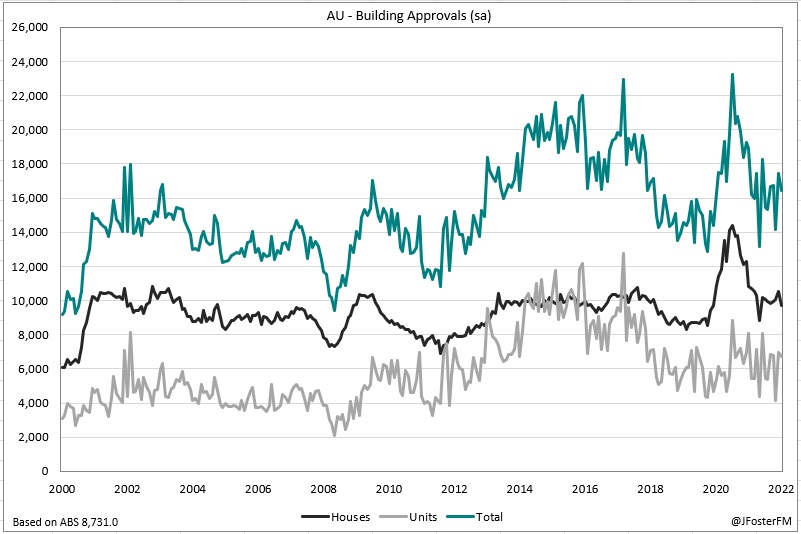
Australian dwelling approvals declined by almost 6% in September but were down only modestly during a volatile third quarter. The weakness in approvals in Q3 was driven by the higher-density segment as house approvals advanced. Further declines in approvals are likely as the construction sector responds to capacity and cost pressure, declining housing prices and rising interest rates. 

Building Approvals — September | By the numbers
  • Dwelling approvals (seasonally adjusted) declined by 5.8% in September to 16,455; markets anticipated a larger fall of 10% following August's 23.1% rebound (revised from 28.1%). 12-month approvals are tracking at -13%. 
  • House approvals saw their largest month-on-month fall since the start of the year down 7.5% to 9,721 (-10.4%yr), though that was after a strong rise in August (4.5% revised from 3.7%).
  • Unit approvals declined modestly by 3.1%m/m to 6,734 to be down by 16.6% over the year.  


Building Approvals — September | The details 

Building approvals have been highly volatile over recent months, ending up contracting by 1.9% over the September quarter. House approvals lifted strongly in July (1.1%) and August (4.5%) but then fell sharply in September (-7.5%), overall rising by 2% in Q3. This was a similar gain to that posted in Q2 at 2.2%. Approvals in the unit or higher-density segment swung from a large fall in July (-39.2%) to rebound strongly in August (68.8%) before moving lower again in September (-3.1%).This left unit approvals down by 6.3% in the quarter. 


The state estimates show house approvals advanced in Q3 in  New South Wales (2.1%), Victoria (3.9%) and South Australia (10.3%). As the chart, below, shows, approvals across the states are well down from their highs reached around the middle of 2021 after running up in response to the raft of Covid stimulus measures.


In the alterations segment, approvals showed no signs of slowing, pushing higher over the quarter (1.9%). That is partly driven by elevated materials and labour costs, but demand for alterations is clearly very strong and has held up long after the HomeBuilder subsidy wound down. 


Smoothing out the volatility, higher-density approvals have been running around the 6,000 level on a 3-month average for much of 2022. Townhouse approvals have been trending lower while high-rise approvals have been tracking at relatively low levels. 


In the non-residential space, the value of approvals declined by almost 12% in Q3, pulling back after gains of 5.2% in Q1 and 6.5% in Q2. Beneath the headline results, some encouraging signs have emerged. notably for commercial and education, health and reaction facilities. 


Building Approvals — September | Insights  

Building approvals have retraced from their stimulus-driven highs in 2021 and are settling towards more sustainable levels. That said, capacity and cost pressures in the construction sector, declining housing prices and rising interest rates shape as likely to drive approvals lower over the coming quarters.   

Tuesday, November 1, 2022

Australian housing finance falls 8.2% in September

Australian housing finance commitments contracted by 8.2% in September as owner-occupier lending posted a record fall and investor lending retraced further from its March peak. Housing market activity is weakening in response to the accelerated RBA rate hiking cycle, which continued yesterday with a further 25bps increase.   

Housing Finance — September | By the numbers
  • Housing finance commitments (ex-refinancing) were down 8.2% in September at $25.1bn on the back of a 2.7% decline in August; markets expected a fall of around 3%. Commitments have declined by 18.5% over the year.  
  • Owner-occupier commitments declined by 9.3%, the largest month-to-month fall since these records commenced in 2002, sliding to $16.8bn (-19.9%yr). 
  • Investor commitments contracted by 6%m/m to $8.3bn, down 15.3% over the year. 
  • Refinancing came off a record high in August after falling by 8.2% in September to $17.3bn, but the level is still 7.4% higher than a year ago. 


Housing Finance — September | The details 

Housing finance commitments were down for the fourth month running reflecting the sensitivity of housing market activity to the RBA's rate hiking cycle. Total commitments have retraced to levels last seen at the end of 2020 at around $25bn.  


Over the course of the third quarter, commitments fell by 15% making this the steepest quarter-to-quarter decline since 2008. Owner-occupier commitments fell by 12.9%q/q, contributing a little more than half of the decline in total commitments in the quarter. Investor commitments were down 19.1%q/q.  


In the owner-occupier segment, the weakness has been broad based coming across upgraders (-14.3%q/q), first home buyers (-12.9%q/q), the construction-related segment (-7.7%) and alterations (-12.8%q/q). Those declines are broadly in line with fewer loans being written to first home buyers (-11.7%q/q) and for construction-related purposes (-8.1%q/q). However, approvals to upgraders were down by 9.6%q/q compared to a much larger fall in commitments (-14.3%), the latter factoring in the effects of reduced loan sizes and declines in housing prices. 


Lending to the investor segment was $8.3bn in September, down almost 30% from the peak in March. In Q3, declines were of a similar magnitude in New South Wales -18.5%, Victoria -18.3% and Queensland -17.6%; Tasmania saw the largest fall (-21.3%) while the declines were relatively modest in South Australia (-8.3%) and Western Australia (-6.6%). 


Refinancing activity declined in September but remains at elevated levels. Competition amongst lenders in a rising interest rate environment has been a driving factor. Refiancing should remain at elevated levels as more fixed rate periods on mortages mature. 


Housing Finance — September | Insights

Housing market conditions continue to cool in response to the RBA's rate hiking cycle. Tighter financing conditions are leading to a reduction in lending activity and falls in housing prices, as reported by CoreLogic yesterday. From the inflation viewpoint, lending for construction-related purposes (including new builds and off the plan sales) has unwound to mid-2020 levels, prior to the introduction of construction subsidies. Although the number of homes is at a record high, commencents are declining and today's reports shows the flow of lending in now greatly reduced. Alongside additional rate hikes and further falls in housing prices, these factors point to a material easing in the inflationary pulse coming from new home building.  

RBA hikes by 25bps again in November

The RBA hiked its key rates by 25bps again following its downshift from a sequence of frontloaded 50bps hikes last month. The cash rate target is now at 2.85% and the Exchange Settlement rate (remuneration on bank deposits) moved up to 2.75%. Although the Board continues to expect further rate hikes will be required "over the period ahead", revised forecasts that project a higher peak in inflation and a lower growth outlook means the tone is turning more cautious with the RBA looking to find the right balance in the trade-off between growth and inflation that keeps the economy "on an even keel".   


In Governor Philip Lowe's decision statement, it was noted that rates had risen "materially" over the course of the tightening cycle. Rates have now risen by 275bps since May and the emphasis remained on the lags associated with the transmission of monetary policy, with the cumulative effect of the rate hikes yet to impact mortgage payments and household spending. 

In his remarks at the Board dinner, Governor Lowe made the key observation that it is now the level of rates rather than the size of the hike that is the more important consideration. Now that rates had moved "back to more normal levels", it is the Board's judgment that it is appropriate to hike at a slower (or more conventional) pace. Lowe later kept the option of larger hikes on the table, but a return to frontloaded hikes looks an unlikely scenario from here. Market pricing for the terminal rate has been scaled back to below 4% following today's decision.  

That is despite the RBA now expecting inflation to reach a higher peak of around 8% in Q4 (up from 7¾%) following last week's stronger-than-expected CPI report. Due to that revision, inflation is also expected to be higher in 2023, slowing to 4¾% from 4.3% previously. By the end of 2024, inflation is still expected to be above the top of the 2-3% target band at "a little above" 3% compared to 3% in the August forecasts. 

Forecast growth this year has been revised down from 3.2% to 3.0% ahead of a material slowdown to 1.5% in 2023 (from 1.8%) and 2024 (from 1.7%). Slower growth is projected due to a weaker global economy, the post-pandemic recovery in services fading and as higher rates impact household spending in Australia. Although the RBA sees the unemployment rate drifting up slightly as growth slows, the expectation for unemployment at 4% in 2024 is little changed. 

In general, the RBA is forecasting the labour market to remain strong over the next couple of years, in effect reflecting its base case for a soft landing for the Australian economy amid an aggressive tightening cycle to bring down inflation from a 30-year high. The Board continues to assess this path to be a "narrow one" and "clouded in uncertainty". Full details of the RBA's updated outlook will be available in Friday's quarterly Statement on Monetary Policy.