Independent Australian and global macro analysis

Wednesday, July 13, 2022

Australian employment 88.4k in June; unemployment falls to 3.5%

Surging employment lowered Australia's unemployment rate sharply to 3.5% in June to post at a new low dating back to 1974 as the participation rate increased to a new record high of 66.8%. Despite the disruptions to businesses caused by staff absences due to Omicron and the flu, hours worked still lifted strongly over the June quarter.    

Labour Force Survey — June | By the numbers
  • Employment surged above expectations rising by 88.4k in June (vs 30k expected), lifting from a 60.6k increase in May.
  • Australia's unemployment rate fell from 3.9% to 3.5% (vs 3.8% expected), its lowest since August 1974. Underemployment ticked up by 0.3ppt to 6.1%, leaving total labour force underutilisation steady at its 40-year low of 9.6%.  
  • The participation rate reset to a new record high, rising from 66.7% to 66.8%. The national employment to population ratio increased 0.3ppt to 64.4%, also a record.
  • Hours worked were flat in the month, held back by high staff absences, but were up sharply over Q2 (4.6%). 


Labour Force Survey — June | The details

Australia's unemployment rate has fallen to a new low for the cycle, declining sharply from 3.9% in May to 3.5% in June. This is its lowest level since August 1974 and compares to the peak of 7.5% it hit during the national lockdown in 2020.


Employment increased by a multiple of the expected outcome rising by 88.4k in June, increasing from the strong outcome in May (60.6k). Full time employment increased by a further 52.9k (now up by 359.9k over the first half of 2022) and continued to drive the headline rise in employment. Part time employment, however, increased by 35.5k, its strongest rise in 7 months (down 63.5k in 2022). 


Although employment slowed during March-April, the momentum has re-accelerated, consistent with the high level of job vacancies, increasing hours, and the underlying strength in the economy. These factors have supported the rotation to full time employment. For Q2 overall, employment lifted by more than 7%q/q to 153.5k. Employment is now 4.6% above pre-Covid levels. 


With employment surging, the participation rate has again reset to a new record high at 66.8%. Meanwhile, the share of the working-age population in work now stands at 64.4%, an increase of around 2ppts from pre-Covid levels.  


Hours worked came in flat in June, remaining at 4.9% above their pre-Covid level. This came after increases of 1.3% in April and 0.9% in May, resulting in a 4.6% surge in Q2 that will drive a strong Q2 GDP result. This is a highly impressive rebound from Q1 where total hours fell by 1%, impacted by the Omicron wave and the east coast floods. 


June's weakness in hours worked looks to have been held back by the continuing disruptions caused by staff absences due to Omicron and the flu and for caregiving reasons. Combined, these factors saw more than 1.1 million Australians working fewer hours than usual in June, a similar level to May. 


Driven by the flat outcome for hours worked in June, there was a slight uptick in the underemployment rate, from 5.7% to 6.1%, while underutilization in the labour force held steady at its 40-year low of 9.6%. 


Labour Force Survey — June | Insights

Australia's unemployment rate fell sharply to 3.5% as the participation rate lifted to a new record high. Employment has surged over May-June, defying assessments that hiring was slowing over March-April. The high level of job vacancies should continue to support a further tightening in the labour market. The strength of today's report has prompted calls for a larger rate hike from the RBA than the 50bps increase expected. However, I see the upcoming Q2 CPI report as more likely to be the catalyst for the RBA to step up the pace of its next increase. 

Preview: Labour Force Survey — June

Australia's Labour Force Survey for June is scheduled for release at 11:30am (AEST) today. Conditions in the labour market strengthened in May, with the unemployment rate close to a 50-year low as the participation rate increased to a record high. Employment re-accelerated after a recent slowdown and elevated levels of job vacancies indicate the momentum can continue. A strong report would further back calls for a third consecutive 50bps RBA rate hike in August. 

As it stands | Labour Force Survey

Conditions in the Australian labour market continued to strengthen in May. Employment increased by 60.6k in the month to come in well above the consensus estimate (25k), re-accelerating after slowing in April (4.4k). This kept the national unemployment rate at the 48-year low of 3.9% as the participation rate elevated to a record high at 66.7%. Underemployment fell from 6.1% to 5.7%, reducing total underutilisation in the labour force to its lowest in 40 years at 9.6%.


The strong labour market continues to drive full time employment, increasing by a further 69.4k in May, taking its rise since the turn of the year to above 300k. Part time employment was down by 8.7k in May, extending the decline to 99k year to date. Rising hours worked and very high levels of job vacancies have supported this rotation away from the part time segment to full time employment. 


Hours worked increased by 0.9% in May, rising to be almost 5% above pre-Covid levels. However, ongoing disruptions related to Omicron remained a headwind. The number of people away from work due to illness surpassed the previous peak in January, while caregiving-related absences also surged in the month. 


Market expectations | Labour Force Survey

The market expects a 30k rise in employment in June, with estimates ranging between -10k and +45k. Employment underperformed expectations between March and April with hiring slowing down due to the east coast floods and over the Easter holiday period. May's resurgent outcome (60.6k) brought the 3-month average to 30k, the expected figure today. With job vacancies as high as they are and hours worked sharply above pre-Covid levels, I see the risks as being to the upside for employment in June. Such an outcome would help generate the expected decline in the unemployment rate from 3.9% to 3.8% (range: 3.7% to 4%).      


What to watch | Labour Force Survey

All indications are that the labour market will tighten further through the back half of the year. Another strong report today would be consistent with that outlook and firm up expectations for another 50bps rate hike from the RBA in August. With these being the strongest labour market conditions in many years, wage pressures are building. I, therefore, continue to watch the participation rate closely, encouraged by the rise to a record high in May. This is a vastly different situation to many other countries where participation has fallen over the pandemic. I expect this to be one key that will prevent the degree of acceleration in wage pressures seen in the US and UK in particular.   

Friday, July 8, 2022

Macro (Re)view (8/7) | All not lost

A better week for risk sentiment as equities broadly reversed last week's declines. This was supported by strong US data that indicated recession fears have been overdone and gives the Fed the green light to hike by 75bps later this month. 


RBA hikes rates by a further 50bps 

The RBA met expectations by hiking its key interest rates by 50bps this week, taking the cash rate target to 1.35% and the Exchange Settlement rate to 1.25%. A detailed review of the July meeting is available here, but the key points in Governor Philip Lowe's statement related to keeping inflation expectations anchored between the 2-3% target with the strength of domestic demand putting pressure on the supply side of the economy. This focus looks consistent with another 50bps hike in August post the next CPI report, with that data likely to prompt the RBA to again raise its forecast for peak inflation later in the year (currently at 7%). 

While markets are priced for the RBA to keep hiking at every meeting through to the end of the year to bring the cash rate to around 3%, my estimate sits just above 2% which factors in the RBA pausing in September ahead of hiking at a slower pace later in the year. Recent comments from Governor Lowe have highlighted that the RBA's arrangement of monthly meetings allows for a graduated response to countering the risks to the inflation outlook, particularly noting the flexibility built into the inflation target, defined as a medium-term average of between 2-3%. Three successive 50bps hikes could be seen by the Board as finding the right balance between moving ahead of a rising inflation outlook without overdoing the scale of tightening in the near term. The Board noted it will be attentive to the outlook for inflation and in the labour market and also to developments in the global economy where prospects are increasingly uncertain. 

Record trade surplus headlined Australian data in May 

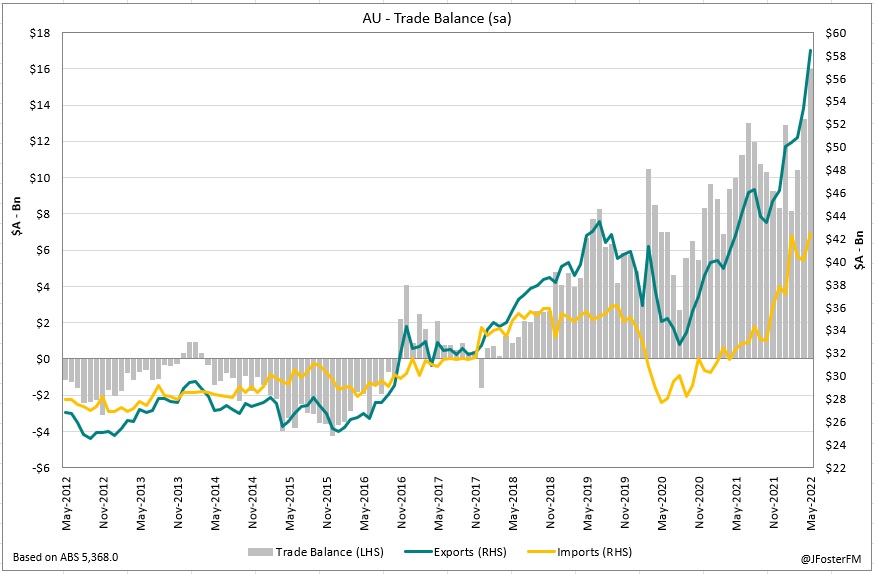
A surge in the trade surplus to a record high of $16bn was the standout data point this week (see here). The nation's trade surplus was already at elevated levels at the beginning of the year but has subsequently doubled on the back of the escalation in commodity prices following the Ukraine war. Housing data defied expectations for weak outcomes as new finance commitments lifted by 1.7%m/m (see here) and dwelling approvals posted a 9.9%m/m rise (see here). Meanwhile, ongoing strength in retail sales, up 0.9%m/m, underscored the resilience of spending to weak sentiment (see here).      


No let-up from the Fed...

The minutes from the Fed's meeting in mid-June made clear no let-up was in sight, putting a hike of "50 or 75 basis points" on the table for its meeting later this month as the FOMC signalled its intent to drive rates up into restrictive territory for economic activity. Markets are priced for a 75bps hike in July and comments from Governor Waller and St. Louis Fed President Bullard this week supported that assessment. The FOMC was also clear that the intent behind tighter monetary policy was to slow demand to be in closer alignment with a constrained supply side of the economy, an imbalance currently contributing to the high rate of inflation. 

... as the US labour market remains strong  

Markets took a strong labour market report for June as a green light for the Fed to hike by 75bps. Despite growth concerns in the US, the labour market continues to perform as nonfarm payrolls posted a 372k rise in the month, printing well above the consensus forecast of 268k. Employment increased by 1.1m over Q2, down from 1.6m in Q1 but still a very solid outcome. The unemployment rate held at 3.6% for the 4th month in succession, though the broader underemployment measure came in from 7.1% to 6.7%, a record low. The disappointment remains on the supply side with the participation rate ticking down from 62.3% to 62.2%, which is around 1ppt down on pre-pandemic levels. The constraint of lower participation as employment has recovered from the pandemic is reflected in the step-up in average hourly earnings growth to above 5%Y/Y compared to its pre-Covid pace that struggled to rise much higher than 3%Y/Y.   


BoE's Financial Stability Report highlighted risks from high inflation 
 
Although politics dominated the headlines in the UK, it was also a busy week at the Bank of England. The Bank's latest Financial Stability Report noted that a persistence of high inflation risked economic growth prospects, tighter financial conditions and increased volatility in markets. The key risks are around the war in Ukraine and in China from both its Covid response and in the deleveraging in the property sector. Noting that the economic outlook had "deteriorated materially", the Financial Policy Committee (FPC) judged that the banking sector was well placed to act as a support to UK households and businesses rather than amplify the shock in the event of a downturn. However, to enhance resilience, the FPC confirmed the rate for banks' countercyclical capital requirements would rise from 1% to 2%, effective from July next year. 

Also of note from the BoE this week was a speech by Chief Economist Huw Pill. In the speech, Pill said the Monetary Policy Committee's reaction function centred on preventing an upward rise in inflation expectations. There is concern that imported inflation could become more entrenched domestically if UK corporates try to offset the squeeze on profit margins through persistent price increases, a situation that would encourage workers to push for higher wages to compensate for the increased cost of living. Pill outlined that the MPC's policy guidance has been calibrated to give it a high degree of flexibility to either speed up or back off from tightening in light of the very uncertain outlook, characterised by crosscurrents from high inflation in the near term against the potential for disinflationary impulses to emerge further out.  

ECB weighs up 25bps and 50bps  

The key message taken from the account of the ECB's meeting in early June was that there had been support from some Governing Council members to commence hiking rates by more than the 25bps increase currently guided. Faced with a negative terms of trade shock caused by surging energy prices following the war in Ukraine and also being exposed to the spillover impacts from China's lockdowns, the rapidly deteriorating growth outlook has led to the view that the ECB's window to hike and move away from negative rates is closing. 

It is possible the ECB could up its first hike to 50bps later this month, but the question is whether enough members have seen something since June to shift the consensus. June's account revealed that the consensus for a 25bps hike was made on the basis of wanting to start with a modest increase and with longer-term inflation expectations still anchored at the 2% target. The further weakening in the euro to 20-year lows against the US dollar may constitute a material change that prompts a reassessment but for now, 25bps looks the way forward. 

Thursday, July 7, 2022

Australian trade surplus hits record high in May

Australia's trade surplus reset to a new record high in May as export earnings continued to surge on the back of strength in key commodities. Rising national income is helping to offset the economic impact of the escalation in global oil prices.

International Trade — May | By the numbers
  • Australia's trade surplus came in well above expectations in May ($10.8bn), widening out to $16bn from $13.2bn in April (revised from $10.5bn). 
  • Exports accelerated by 9.5% in the month to $58.4bn to be up by 38.1% over the year. This followed a sharply upgraded gain in April, revised to 5% from 1%.  
  • Imports posted a 5.8% rise to $42.4bn taking out the previous record high in April. Annual growth firmed from 27.4% to 31.4%.


International Trade — May | The details

Australia's position as a major commodity exporter has seen its monthly trade surplus elevating to $16bn in May, almost double its level from February prior to the Russian invasion of Ukraine. With the war driving a surge in commodity prices, the trade surplus has stepped sequentially higher over the period, lifting from $8.1bn to $10.4bn in March, then to $13.2bn in April and now $16bn in May. 


Monthly export earnings are close to pressing $60bn after surging by 9.5% in May alone, taking the overall increase since February to nearly 16%. Exports were driven by a 9% lift in non-rural goods in May, centred rises in the major commodities: coal 20.4%, LNG 11.8% and iron ore 2.8%. With May's surge coming on the back of large increases in the prior two months, coal overtook iron ore as the nation's highest value export, the last time this happened was back in 2009. ABS data suggested the strength was driven by a rebound in shipment volumes after falling in April. Non-monetary gold (71%m/m) also boosted monthly exports.


Rural goods lifted by another 3.6% in May to $5.6bn, a record high. Strong offshore demand, rising prices and favourable weather conditions have seen earnings from rural goods surge since mid-2020.    


The reopening of the international border earlier in the year is starting to see services exports (4.8%m/m) rise sustainably from their lows of the pandemic. 


Imports rebounded from soft outcomes in the prior two months lifting by 5.8% in May to $42.4bn. Increases were broad based but were led by intermediate goods (9%) as fuel imports continued to surge reflecting high oil prices, rising by 22.9% in the month to be up by 151% over the year. 


Pointing to the easing of some of the constraints holding up global supply chains, new vehicle imports lifted by 18.5%m/m and machinery and industrial equipment advanced by 6.5%m/m; the former driving consumption goods to a 5.4% rise in the month and the latter pushing up capital goods by 3.2%m/m. Services imports (4.1%m/m) remain on the recovery path following the easing of restrictions on offshore travel.  


International Trade — May | Insights

Surging commodity prices continue to drive widening Australian trade surpluses. The war in Ukraine and its spillover impact on commodity prices has been a positive terms of trade shock for Australia and other commodity exporting nations. Australia's terms of trade hit a record high in the March quarter and are very likely to reset that benchmark in the June quarter, providing a buffer against the surge in oil prices. However, despite these factors, the Australian dollar has weakened sharply against the US dollar in 2022 (down by around 6%) reflecting concerns over the global economic growth outlook and the aggressive rate hiking cycle from the Federal Reserve. 

Tuesday, July 5, 2022

RBA hikes cash rate by 50bps in July

The RBA hiked the cash rate target by 50bps to 1.35% at today's meeting, continuing the accelerated withdrawal of monetary policy support implemented during the pandemic. Today's decision followed the step up to a 50bps hike in June after the tightening cycle commenced in May with a 25bps increase. Meanwhile, the rate on Exchange Settlement balances was increased by 50bps to 1.25%. 


Governor Philip Lowe's decision statement reiterated many of the key themes from his recent speech and public appearances. Rising inflation in Australia is reflecting a combination of global factors and domestic capacity constraints with demand robust and the labour market strong. As described today, rates are rising to establish a "more sustainable balance" between spending and the supply capacity of the economy and to keep inflation expectations anchored in the 2-3% target range. Today's statement emphasised the strength of the labour market, highlighting the near 50-year low in the unemployment rate and underemployment that has fallen "significantly". The RBA forecasts the labour market to tighten further given the elevated level of job vacancies, leading wages growth to lift out of its subdued pace in the years prior to the pandemic as a result.

With the RBA recently upping its forecast for peak inflation to 7% towards the end of the year, it is accelerating the withdrawal of stimulatory monetary policy. The next meeting in August will be accompanied by a new set of economic forecasts and will come in the week after the Q2 CPI data. With that report to capture more of the pass-through to energy and food prices in particular associated with the war in Ukraine and the east coast floods in Australia earlier in the year, a further upward revision to the inflation outlook is likely. For that reason, I expect another 50bps rate hike in August. 

Governor Lowe noted the Board will be closely monitoring the crosscurrents for household spending amid the tightening cycle. High household savings, financial buffers and incomes underpinned by the strong labour market are supporting a resilience in spending as highlighted by today's retail sales data, though the Governor highlighted that budgets were under pressure from high inflation and rising interest rates, while housing prices were also on the decline in some markets. The other key factor is around global developments, with Governor Lowe describing the outlook as "clouded" due to the Ukraine war and China's Covid response. Real incomes are being squeezed due to high inflation and rising interest rates. 

The Board's forward guidance remained intact expecting to "...take further steps in the process of normalising monetary conditions in Australia over the months ahead". As mentioned, I anticipate a 50bps hike in August to take the cash rate to 1.85% but then see the Board pausing until later in the year giving it time to assess the effect of the tightening cycle on the domestic economy and to monitor the global situation. My forecast is for the cash rate to end 2022 at just above 2% compared to market pricing for around 3%.

Monday, July 4, 2022

Australian retail sales rise again in May

Australian retail sales posted another solid rise in May, remaining resilient to concerns relating to weak consumer sentiment. Headline sales were up 0.9% in the month but were outpaced by discretionary spending (1.1%), a key theme that has been evident year to date. 

Retail Sales — May | By the numbers 
  • National retail sales lifted by 0.9% in May, matching the initial estimate that was above expectations (0.4%), to come in at $34.2bn. Sales in April also advanced by 0.9%.  
  • 12-month retail sales lifted from 9.6% to 10.4%. 


Retail Sales — May | The details  

For the 5th consecutive month, Australian retail sales increased with a 0.9% rise posted in May. That matches the rise seen in April but is a step down from the pace in the first quarter where monthly gains ranged between 1.6% and 1.8%. Sales in May were still well above their pre-Covid trend, more than 23% above their level from February 2020. 

A key feature of retail sales this year has been the strength in the discretionary categories. Sales excluding basic food were up 1.1% in May to be up by 10.2% year to date. This has outpaced the rise in headline sales (7.1%) over the period and can be seen in the chart below. While this incorporates the impact of rising prices, first quarter GDP data showed underlying demand was robust and that looks likely to have extended into Q2, supported by factors such as eased Covid restrictions, the strong labour market and the high level of aggregate household savings. 


In May, basic food sales lifted by 0.6% on the back of increased supermarket spending (0.8%), with rising prices (and reduced discounting) a key factor. Across the discretionary categories, department stores led with a 5.1% rise, cafes and restaurants advanced by 1.8% — with the ABS highlighting the impact of higher prices — other retail was up 1.5% and household goods saw a 0.4% lift supported by furniture (2.9%) and hardware sales (0.6%). The one area of weakness was in clothing and footwear (-1.4%), though that was after a strong rise in April (3.1%). Online sales were down 0.6% in May but are still 30% higher over the year and are 89% above pre-Covid levels. 


Outside of Queensland (-0.4%), all other states saw retail sales rise in May (the ACT also saw a modest fall of 0.3%). New South Wales posted a 1.6% increase led by department stores (7.3%), while sales in Victoria were up by 1.3% with strength in cafes and restaurants notable over recent months. Sales in South Australia advanced by 1.9% and by 1.1% in Tasmania but were broadly flat in Western Australia (0.2%).    


Retail Sales — May | Insights

National retail sales continued to rise in May despite weak consumer sentiment due to cost of living pressures, with the RBA also commencing its rate hiking cycle in the month. Although the backdrop looks unfavourable, the data suggests households were continuing to spend, especially in the discretionary areas. This has likely been supported by pent-up demand as remaining Covid restrictions have eased, while household savings are very high on aggregate and the strong labour market is supporting nominal incomes.  

Australian dwelling approvals rise 9.9% in May

Australian dwelling approvals lifted by 9.9% in May after heavy declines in the previous two months. Detached approvals are close to returning to their pre-HomeBuilder levels while higher-density approvals remain volatile from month to month. 

Building Approvals — May | By the numbers
  • National dwelling approvals (seasonally adjusted) lifted by 9.9% in May to 16,390, defying expectations for a 2% decline, but are down 20.9% over the year. The decline in approvals in April was downwardly revised from -2.4% to -3.9%.
  • House approvals fell by 2.4% to 9,793 (-29.2%yr), with April's outcome revised from 0.4% to -0.5%. 
  • Unit approvals rebounded from recent weakness to rise by 35.1% in May to 6,598 (-4.2%yr). Approvals in April fell by 10.3%, downwardly revised from -7.9%. 


Building Approvals — May | The details 

May's 9.9% rise in national dwelling approvals was driven by a rise in higher-density approvals (35.1%), the segment continuing its run of volatile prints over recent months. Detached approvals declined 2.4% in the month, its third consecutive fall. Aside from an unusually low outturn in January (the timing coinciding with the peak holiday period and the onset of the Omicron wave), detached approvals continue to approach their levels from mid 2020 in the early stages of the HomeBuilder stimulus. 


Taking a closer look at higher-density approvals, the underlying data indicated it was largely the high rise segment that drove the increase. There were some large increases in unit approvals posted in May in Sydney, Brisbane and Perth.  


Alteration approvals increased by 3.8% and remain at a high level above $1bn. Sharp rises in materials and labour costs has kept the value of alteration approvals elevated despite the withdrawal of the HomeBuilder stimulus last year. 


Compared to their respective 2021 peaks, the decline in state approvals ranges from -28% (Qld) to -38% (WA). Approvals in New South Wales have declined by 37% and by 33% in Victoria.  


Building Approvals — May | Insights  

A stronger-than-expected result for building approvals led by the higher density segment. Approvals are likely to remain in their downtrend given the large volume of work in the residential construction pipeline; housing prices that are now declining nationally as the RBA's rate hiking cycle has ramped up; and ongoing capacity pressures in the construction sector. 

Preview: RBA July meeting

The RBA moved in line with many of its global central bank peers by stepping up to a 50bps rate hike in June after starting its tightening cycle with a 25bps hike in May. With central banks continuing to frontload rate hikes and in response to risks around the domestic inflation outlook, I expect the Board to hike the cash rate target by another 50bps to 1.35% at today's meeting (decision due at 2:30PM AEST) and for the rate on Exchange Settlement balances to lift from 0.75% to 1.25%.  


At the June meeting, the Board decided a more rapid withdrawal of the emergency monetary policy settings required during the pandemic was warranted. This came in response to the RBA lifting its forecast for peak inflation in Australia from 5.9% to 7% and with the labour market seeing its strongest conditions in many years, underlined by May's report with unemployment remaining at a near half-century low at 3.9%. Speaking at a recent panel event with other central bankers in Zurich, Governor Philip Lowe indicated the board would again be discussing the merits of hiking by 25bps or 50bps at the July meeting. On that basis, the probability of an even larger hike of 75bps being announced today looks remote. 

The key observations from Governor Lowe in his speech on 21 June and in the June meeting minutes were around inflation expectations. Specifically, the RBA had seens signs of the inflation psychology shifting, with firms increasingly gaining pricing power and workers, in the knowledge the labour market was strong, were pushing for higher wages to compensate for cost of living pressures. In that context, the Board assessed there to be a "heightened risk of persistently high inflation" and decided to speed up to a 50bps hike. Governor Lowe said that in order to keep inflation expectations anchored between the 2-3% target band, higher rates are needed to bring growth in spending into closer alignment with the supply capacity of the economy.  

Looking ahead, as previously discussed here, I see another 50bps hike coming in August, with the Q2 CPI data likely to prompt the RBA to again revise up its inflation forecasts. That would bring the cash rate to 1.85% where I anticipate the Board to pause its hiking cycle, allowing it to monitor the domestic data and events offshore. Over the past couple of weeks, markets have responded to the slowing global growth outlook by scaling back their expected peak in the cash rate from above 4% to around 3.75% in mid-2023. 

Post the August meeting, I expect the RBA will be able to ease back to hiking in 25bps increments. I have a 25bps hike pencilled in for November following the Q3 CPI report and revised RBA forecasts, with the cash rate to end 2022 at just above 2%. That differs from market pricing at around 3%, based on the expectation of the Board hiking at every meeting through to the end of the year. 

Australian housing finance rises 1.7% in May

Australian housing finance commitments lifted against expectations rising by 1.7% in May, rebounding from a holiday-related fall in April. Gains were broad based in the month, though commitments to the owner-occupier segment are down by almost 10% over the year while the investor segment is up by around 24%. 

Housing Finance — May | By the numbers
  • Housing finance commitments (ex-refinancing) advanced by 1.7% (vs -2.5% expected) to $32.4bn, though annual growth slipped to -0.4% from 2.6%. Commitments in April were revised from -6.4% to -2.8%.
  • Owner-occupier commitments rebounded from April's 1.7% fall to post a 2.1% month-on-month rise to $21.2bn (-9.7%yr). 
  • Investor commitments lifted by 0.9% in the month to $11.2bn (23.7%yr), steadying from April's 4.8% fall. 
  • Total refinancing increased by 3.1%m/m to $17.1bn (16.6%yr) to sit just below its record high. 


Housing Finance — May | The details 

Housing finance commitments have essentially tracked sideways at elevated levels over recent months, alternating between rises and declines of similar magnitudes. May's commitments came in at $32.4bn, around 2.5% off the record high reached at the turn of the year. Both major segments saw increases in the month, with owner-occupier commitments up by 2.1% and investor commitments lifting by 0.9%.

In the owner-occupier segment, the strongest gains came through in the construction-related (8.7%m/m) and alterations (11.6%m/m) categories; these gains are likely boosted by the rises in materials and labour costs amid the supply shortages in the construction sector. Commitments to upgraders lifted modestly (0.3%), while the rise seen in the first home buyer category (3.4%) reversed the decline in April. 


Investor commitments fell for the first time in 10 months in April before picking up again in May (0.9%m/m). Commitments to the segment have run at a clip north of $11bn/mth for 5 consecutive months. 


The state details are summarised in the table below. The main theme remains the divergence between the owner-occupier and investor segments; the former has declined in each state over the year, with first home buyers a major contributor, as the latter has advanced.  


Housing Finance — May | Insights

May's 1.7% rise in housing finance commitments came after a 2.8% falling April, a decline the ABS noted was accentuated by the high number of public holidays in the month. The fundamentals point to a rolling over in commitments through the remainder of the year with the RBA's rate hiking cycle now well underway and house prices turning lower; data from CoreLogic reported national housing prices declined for the second month running in June (-0.6%) led by the Sydney and Melbourne markets. 

Friday, July 1, 2022

Macro (Re)view (1/7) | Leaving Q2 behind

The week brought to a close a tough quarter and first half of the year as markets worked through the risk of recession coming down the line in response to aggressive hiking cycles to curb high inflation. 


The ECB's Forum in Sintra highlighted events this week, with the standout being the panel featuring ECB President Lagarde, Fed Chair Powell and Governor Bailey of the BoE. A united front was presented, prioritising the need to bring inflation under control over the risks posed to growth outlooks. Although there is confidence their course of action will work, the heads of all three central banks thought that it was unlikely the world would return to the low inflationary environment that characterised the previous cycle post the financial crisis. The push toward deglobalisation and the green transition were contributing factors cited, while Governor Bailey highlighted structural changes to the labour market coming out of the pandemic.   

Australian retail sales continue to defy weak sentiment 

National retail sales lifted for the 5th month running with a stronger-than-expected 0.9% rise posted in May, defying the sharp fall in consumer sentiment over recent months. Through the first quarter of the year, retail sales lifted by 2.9% supported by resilient demand (contributing 1.2ppts) as inflation started to ramp up (1.7ppts). So far in Q2, retail sales have risen by 1.8% with the largest increases coming in food (2.4%) and cafes and restaurants (5.1%), categories which the ABS noted are being boosted by rising prices (note fuel is not included in national retail sales). Spending has advanced in clothing and footwear (1.7%), department stores (2.5%) and other categories (2%) but declined in household goods (-2.3%). Overall, while slower volumes are likely for Q2, the data still suggest demand has been broadly resilient to the effects of inflation and weak sentiment.  


The strength of the labour market looks to be a key factor supporting that resilience. Labour demand continues to surge with a further 58.2k job vacancies posted over the 3-month period to May. That brings total vacancies to 480.1k, equivalent to 3.4% of the labour force. The labour market has been the major beneficiary of the economic recovery from the pandemic. Currently, there are 25% of businesses with at least one vacancy, well up from only 11% prior to the onset of Covid. With the labour market to keep tightening, the RBA will be increasingly confident of wages growth rising into the 3s, the level it views as consistent with sustainable 2-3% inflation, which speaks to the idea discussed at Sintra of a departure from low inflation dynamics.  


US tracking towards a slowdown in Q2 GDP   

Market concerns around slowing US growth were encapsulated by the deterioration in the latest reading of the Atlanta Fed's GDPnow model and by the ISM manufacturing index softening to a 53.0 reading in June, its lowest since June 2020. The GDPnow model has the US economy on track to contract by 1% in the June quarter (downgraded from -0.3%), though this is more pessimistic than most analyst forecasts. 

The outlook for consumption is being revised with households facing cost-of-living pressures and rising interest rates. Data for May showed growth in real personal consumption declined by 0.4% in the month, its weakest outcome since December, while revisions reduced the pace of growth in April. The decline in May was driven entirely by falling goods consumption (-1.6%m/m), which is unwinding from the elevated peaks reached during the pandemic. The rotation back towards services continued with a 0.3% rise, though the rebalancing of consumption patterns is proving to be much more drawn out than many expected.   


Meanwhile, inflation on the key core PCE deflator moderated from 4.9% to 4.7%yr in May, a 6-month low. Although inflation on this measure is on the way down, it's too early to call the peak on the headline rate, which is yet to roll over holding steady at 6.3%yr. 


New high for euro area inflation 

Euro area inflation continues to push new record highs as June's preliminary readings came in above expectations. Headline inflation was posted at 0.8% month-on-month, which left the annual rate up at 8.6% from 8.1% in May. The spillover effects from the war in Ukraine saw energy prices surge 3.3% in the month (41.9%yr) and food prices pushed up by 1.1% (8.9%yr). With these two components the major drivers of inflation, there remains a large wedge to the core rate, with its pace easing from 3.8% to 3.7%yr, defying expectations for a lift to 3.9%, partly reflecting the impact of government support measures in Germany. Core inflation is unlikely to have peaked yet, and with the euro area unemployment rate falling to a new low at 6.6% in May wage pressures are likely to be building.