Independent Australian and global macro analysis

Wednesday, May 18, 2022

Australian unemployment rate falls to 48-year low in April

Australia's unemployment rate printed at 3.9% in April to stand at its lowest level in 48 years. The strong economic expansion from the pandemic has driven employment and hours worked to more than 3% above their pre-Covid levels, leading to the tightest labour market conditions in many years.  

Labour Force Survey — April | By the numbers
  • Employment lifted by a net 4k in April, coming in below the consensus estimate of 30k and down from March's 20.3k rise (revised from 17.9k).
  • National unemployment met expectations printing at 3.9%. Unemployment in March was initially reported at 4% but was revised to 3.9% in today's report.
  • Participation eased from 66.4% to 66.3% but remains around record highs. 
  • Hours worked rebounded by 1.3% in the month following the 0.3% fall in March (revised from -0.6%) during the east coast floods.


Labour Force Survey — April | The details

Australia's unemployment rate declined to 3.85% in April, its lowest since the fourth quarter of 1974. This has been an extraordinary recovery from the depths of the pandemic when unemployment hit its peak at 7.48% in June 2020. 


Underemployment (6.1%) and overall underutilisation in the labour market (10%) continued to fall in April, with both measures at their lowest levels since 2008. At the outset of the pandemic, underemployment surged to peak at 13.8% and underutilisation rose above 20%. 


Net employment came in well below expectations rising by just 4k in April. The timing of the Easter and school holiday periods make it difficult to draw many conclusions into April's outcome. Part-time employment fell by 88.4k in the month, its weakest outcome since the Delta lockdowns, and that could have been driven by seasonality. In contrast, full-time employment lifted sharply by 92.4k. Total employment is now 3.1% above its pre-Covid level and labour demand remains strong.    


Hours worked rebounded sharply by 1.3% in April after falling in March due to the disruptions from wet weather. The two states affected by flooding drove this increase, with hours worked rising by 2.5% in New South Wales (from -1%) and by 3.3% in Queensland (from -1.7%). This lifted hours worked in April to 3.6% above their pre-Covid level.  


The ABS's detailed data showed that the surge in the number of Australians working fewer hours than usual in March due to bad weather reversed in April, driving the increase in total hours worked. However, an uptick in Omicron cases led to a rise in staff absences in the month, while the number of people taking annual leave lifted into Easter, with both of these factors preventing an even stronger increase in hours worked in April. 


On the supply side, labour force participation declined modestly from 66.4% to 66.3%. Victoria was the only state that reported a rise in participation (67.4%). The broad-based nature of the decline in participation suggests that seasonal effects could have been at play. Nonethless, the participation rate remains around record highs and the share of Australians in work has never been higher (63.8%).  


Labour Force Survey — April | Insights

A historic report with Australia's unemployment rate falling to a 48-year low. It is pleasing to see the lows in unemployment that were posted prior to the financial crisis have finally been taken out, something that a long economic expansion between mid 2009 to early 2020 was unable to achieve, with the unemployment rate averaging around 5.5% over this period. Elevated job vacancies indicate that labour demand remains strong and that should be able to keep unemployment declining for a while yet.

Preview: Labour Force Survey — April

Australia's monthly Labour Force Survey for April is due to be posted by the ABS at 11:30am (AEST) today. Despite the diruptions from the Omicron wave and severe wet weather events on the east coast, the Australian labour market has been resilient in 2022. Strong labour demand has kept employment rising and led to the tightest labour market conditions in well over a decade.

As it stands | Labour Force Survey

Severe wet weather and major flooding on the east coast of Australia contributed to employment slowing to a 17.9k rise in March, well below the 40k increase anticipated and down from February's 77.4k boost. With the participation rate holding at record highs (66.4%), the unemployment rate remained at 4%, its lowest since 2008. Underemployment (6%) and overall underutilisation in the labour market (10.3%) continued to decline to stand at 14-year lows.


March's 17.9k rise in employment was the weakest outcome since the Delta lockdowns during the third quarter of last year. Employment had still increased strongly over the first quarter of the year (123.6k) despite the Omicron and weather-related disruptions to activity and was 3% above its pre-Covid level. Full-time employment lifted by 20.5k in March and had accounted for all of Q1's employment gain (136.4k), with part-time employment down in the month (-2.7k) and over the quarter (-12.7k).  


National hours worked fell by 0.6% in March driven by large falls in New South Wales (-1.6%) and Queensland (-2.3%) reflecting the disruptions caused by the severe wet weather events. Meanwhile, Omicron was still contributing to high levels of staff absences but were well down from January's peak. Around 8% of employed Australians reported working fewer hours than usual in March due to either bad weather or illness.   


Market expectations | Labour Force Survey

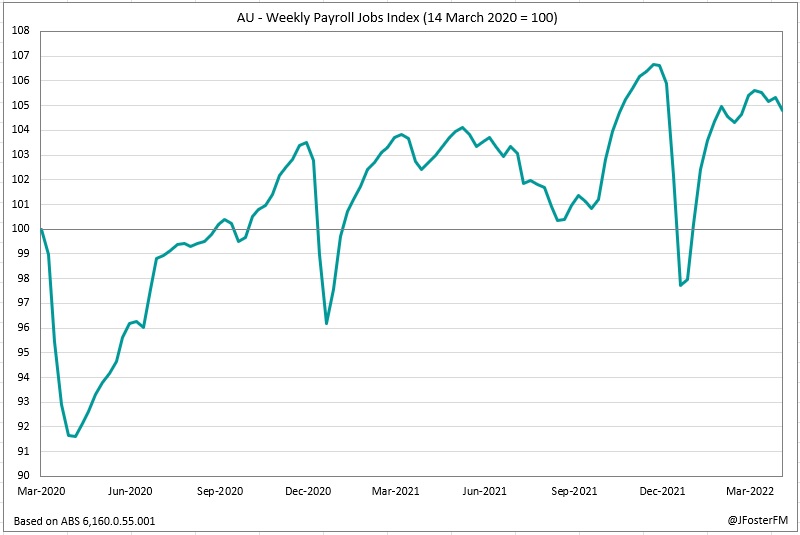
The median estimate is for employment to rise by 30k in April, with forecasts ranging between 20k to 60k. The ABS's high frequency data showed payrolls slowed over the first half of the month leading into the Easter holiday period. School holiday periods, which vary from state to state, were also occurring in and around this point. The risks to the employment figure look to be broadly balanced. The holiday period could see employment coming in below consensus, but it is also possible that the adjustment could come through mainly in a reduction in hours worked. There could also be some catch-up following the slowing in employment in March with labour demand very elevated. 


Having fallen just short of reaching a historic milestone in March, the unemployment rate is expected to decline to 3.9% in April, which would be its lowest since 1974. Forecasts for the unemployment rate range between 3.7% and 4%. 

What to watch | Labour Force Survey

A fall in national unemployment below 4% would generate most of the headlines and would be a significant achievement given that through the last cycle the unemployment rate never got close to these levels despite a more than decade-long economic expansion. There could be some volatility in the outcomes for employment and hours work due to seasonal effects. Market pricing for a 40bps RBA rate hike in June was pared back slightly after yesterday's miss on wages growth, so today's report will be closely watched.  

Tuesday, May 17, 2022

Australian Q1 Wage Price Index 0.7%; 2.4%yr

Australian wages growth disappointed to the downside of expectations in the March quarter rising by 0.7% to 2.4% Y/Y. Weighing on the outcome was a reduction in the share of private sector jobs receiving wage rises from an elevated level in the December quarter. However, for the jobs that did receive a rise, the average wage increase lifted to its fastest in nearly 9 years. A tightening labour market should gradually generate faster wages growth. 

Wage Price Index — Q1 | By the numbers
  • The headline WPI (total hourly rates of pay ex-bonuses) fell short of expectations printing at 0.7%q/q (vs 0.8%), with the annual pace firming from 2.3% to 2.4% (vs 2.5%).
  • Private sector WPI increased by 0.7% in the quarter, matching the rise seen in the previous quarter. Annual growth remained at 2.4%. 
  • Public sector WPI lifted by 0.6%q/q, slightly lower than in Q4 (0.7%), firming the annual pace from 2.1% to 2.2%. 


Wage Price Index — Q1 | The details 

A tightening labour market kept Australian wages growth rising over the first quarter of 2022, albeit at a slower-than-expected pace as the headline WPI lifted by 0.7%. Annual growth has firmed to 2.4%, its fastest since Q4 2018 and up 1ppt from the depths it reached during the pandemic. This compares with Australia's annual inflation rate of 5.1%. The WPI measures wage inflation in the labour market and is driven by variations to awards, enterprise agreements or individual arrangements between employees and employers. The detailed breakdown shows enterprise agreements and individual arrangements made similar contributions to wages growth in Q1 compared with Q4. The contribution from awards returned to historical norms for the March quarter. During the pandemic, the increase in the national minimum wage was phased in by the Fair Work Commission over a longer timeframe than usual.    


Wages growth in the private sector was unchanged from the increases recorded in the prior quarter at 0.7%q/q and 2.4%Y/Y. In the release, the ABS found that the share of jobs receiving wage reviews was in line with the historical pattern for this time of year, though in the prior quarter there had been an unusually high share of jobs that received wage increases. This likely explains why private sector wages did not show a faster rise. This is particularly so given that the ABS also reported that of the jobs that did receive wage rises, the average increase (3.4%) had lifted to its fastest since Q2 2013.  


ABS chart

Public sector wages growth firmed slightly by 0.6%q/q to 2.2%Y/Y. This is slower than in the private sector due to long-standing measures in the sector to contain the pace of wages growth. 


By broad industry sector, wages growth is running fastest in business services (2.6%Y/Y). Job mobility in these industries has lifted sharply over the Covid period as many people have left their jobs to take up other opportunities that have come about amid the economic recovery. This has led to increased competition for workers, putting upward pressure on wages. 


Wages growth in the goods-related sector lifted slightly to 2.4%Y/Y. At the industry level there is significant variation in outcomes. Wages growth is above its pre-pandemic pace in industries that have run up against capacity constraints, including in construction, manufacturing, retail trade and wholesale trade. However, the recovery has lagged in the transport and utilities industries. 


The household service sector saw wages growth boosted by reopenings from the Delta lockdowns during the December quarter. This momentum faded in the March quarter, with wages growth easing in the healthcare and hospitality industries. The recovery continued in the arts and recreation industry, which is now back at its pre-pandemic pace of wages growth. 


Wage Price Index — Q1 | Insights

On the back of today's softer-than-expected outcome, some of the pricing for a 40bps rate hike from the RBA in June has been taken back. Tomorrow's labour market report will be closely watched. Historical relationships suggest that wages growth should be heading higher given the tightness in the labour market (2022 dot is circled), and that also fits with surveys, including the RBA's business liaison, that consistently report rising wage pressures. 

Preview: Wage Price Index Q1

The Australian Wage Price Index (WPI) for the March quarter is due to be released by the ABS at 11:30am (AEST) this morning. Wages growth had recovered to its pre-pandemic pace by the end of last year and is expected to have kept rising over the first quarter in line with the tightening labour market. Although wages growth is being outpaced by inflation, it is forecast by the RBA to rise over the next couple of years to a pace that will be putting upward pressure on prices. A stronger-than-expected rise in the WPI today would firm market expectations for a 40bps RBA rate hike in June.    

As it stands Wage Price Index

Wage pressures were broadening in the Australian labour market as the WPI lifted by 0.7% in the December quarterits fastest quarterly rise in almost 8 years. Annual growth in the WPI firmed from 2.2% to 2.3%, in line with its pre-pandemic range (see here).  


With the labour market tightening, both private and public sector wage costs increased by 0.7% in the quarter; however, annual growth was stronger in the private sector (2.4%) than in the public sector (2.1%) due to the effect of ongoing wage policies in the latter. 


In the effort to retain and attract new staff, many private sector firms have turned to incentives other than raising base wages, such as offering bonuses and more flexible working conditions. Accordingly, the private sector WPI inclusive of bonuses measures accelerated by 1.2% in the quarter to an annual pace of 3%. This compares with a much more modest pace in the public sector at 0.6%q/q and 1.9%Y/Y. 


By industry, the fastest acceleration in wages growth was in the hospitality sector (3.5%), with firms needing to rehire staff following reopenings from the Delta lockdowns and the easing of border closures in a tightening labour market. The retail sector (2.6%) was also facing similar pressures. Wages growth in professional services moderated in Q4 (2.5%) but had picked up sharply from the lows of the pandemic with many people changing jobs. Consistent with private sector surveys, wages growth had continued to rise in manufacturing (2.5%) amid staff shortages. 
 

Market expectations Wage Price Index

The median estimate is for a 0.8% increase in the WPI for the March quarter, between a tight range of forecasts from 0.7% to 0.8%. Growth in annual terms is expected to lift from 2.3% to 2.5%, which if achieved would be its fastest pace since late 2014.   

What to watch Wage Price Index

The RBA's rate hiking cycle is now underway and the Board has made clear its focus is on the evolution of wage-price dynamics. With Q1's inflation data coming in much stronger than expected, building wage pressures reported by the RBA's business liaison contacts was enough to prompt the Board to increase the cash rate target by 25bps to 0.35%. This was also the basis for the RBA to lift its forecasts for wages growth ahead of today's report; growth in the WPI is now forecast to rise to 3% by the end of the year (from 2.75%) and then to 3.5% by the end of 2023 (from 3%). In this sort of range, wages growth will be gradually adding to inflation pressures. The May meeting minutes confirmed a larger rate hike of 40bps was considered and that option remains on the table. A stronger-than-expected rise in wages growth would firm expectations for this course of action at the June meeting.   

Friday, May 13, 2022

Macro (Re)view (13/5) | Sentiment weakens

A rally across global equity markets in Friday's session took the edge off what was a rough week, characterised by weakening sentiment with inflation high and global growth prospects under pressure. A slight moderation in US CPI may have been taken as a sign that inflation has peaked, while easing inflation expectations have taken bond yields lower. 


Australian consumer sentiment fell sharply...

Rising inflation and the RBA starting to hike rates in response to it drove a 5.6% fall in Australian consumer sentiment in May. This was the 6th consecutive month-on-month fall in sentiment that leaves the Westpac-Melbourne Institute Index at its lowest level since August 2020. Weaker confidence is playing out through a re-rating of family finances. With households projecting forward a higher pace of inflation, the squeeze on real incomes together with the anticipation of upcoming rate hikes led to a sizeable deterioration (-11.2%) in assessments of family finances on a 12-month outlook. The key for household spending going forward is how that negative signal interacts with balance sheets that have been bolstered by rising income from a tightening labour market, accumulated savings and higher asset prices over the course of the pandemic, all factors that should give households some resilience to inflation and rate hikes.   


Views on the housing market were also of interest given the sensitivity to rising rates. Sentiment towards purchasing a dwelling is weak, currently at its lowest level in 14 years. Still, consumers expect house prices to rise over the coming year, albeit at an increasingly slower pace. On the economy, domestic factors and global headwinds from the Ukraine war and China's lockdowns saw consumers downgrade their expectations for conditions over the coming 12 months to a below average level. However, despite a fall in May, the 5-year economic outlook remains at an outright strong level, suggesting that households view the near-term headwinds as temporary. 

... but household spending was still robust

As highlighted above, consumer sentiment has been falling throughout 2022 but Australian retail sales have been resilient. March's 1.6% rise followed similar increases over January and February, all solid outcomes amid the disruptions from the Omicron wave and major flooding on the east coast (reviewed here). Over the first quarter, retail sales lifted by a solid 2.9%. Detailed data this week showed that the contribution of inflation to that increase was 1.7ppt, its strongest quarterly rise since 2000, but underlying demand was still robust with volumes adding the remaining 1.2ppt.    


In particular, it was discretionary-related demand that drove the increase in retail volumes. Basic food volumes contracted by 1.5%q/q as supply chain pressures led to less discounting at supermarkets that weighed on demand. Non-food volumes, however, lifted by 2.9% to far outpace the headline increase, rising to 16% above their pre-Covid level. Ongoing reopening effects and the recovery of domestic travel were boosting demand across a range of categories including cafes and restaurants (8.3%q/q), department stores (4.3%q/q) and clothing and footwear (3.6%q/q).

US inflation to keep the Fed on the path to neutral    

In the key release of the week, US CPI data remained consistent with the Fed removing accommodation at an accelerated pace over coming meetings. With the pace of annual CPI to April moderating on both a headline (8.5% to 8.3%) and core basis (6.5% to 6.2%), the peaks for inflation may be in given upcoming base effects, though supply constraints from the Ukraine war and China's lockdowns could yet put renewed pressure on prices. If inflation is now at or around its peak, it's the pace of the descent that markets are keying off and that put the month-on-month CPI rates in focus. A 6.1% fall in fuel prices pulled down headline CPI to a 0.3%m/m rise (from 1.2%), but a range of price rises lifted core CPI by more than expected to 0.6%m/m (from 0.3%).


Durable goods, a major driver of inflation over the past year or so, has seen its peak with annual inflation falling by almost 5ppts over the past two months to 14%yr and will act as a disinflationary pulse on the core CPI. However, services inflation is escalating and reached 5.4%yr (ex-energy) in April, with rising housing and rent costs the major contributor. There are also pandemic-related increases still coming through, for example airline fares surged in April (18.6%m/m). Signs that core CPI will see a protracted slowdown leaves the Fed committed to hiking rates (50bps increases are expected at the next two meetings), but it is also raising risks around the growth outlook, hence the weakness in market sentiment. 

Hawkish shift from the ECB

Expectations have firmed around a July rate hike from the ECB after speeches from key officials tilted hawkish. ECB President Christine Lagarde said this week her expectation was that purchases under the APP program are on track to be wound up "early in the third quarter" and clarified that the guidance for rate hikes to take place "...some time after the end of net asset purchases" could be as short as a few weeks. That timeline would open the door to the first hike coming at the meeting on 21 July. Executive Board member Isabel Schnabel gave an in-depth analysis of global inflation dynamics, arguing that monetary policy could not sit idle despite euro area inflation being largely being driven by offshore influences. A strong demand environment had given domestic firms pricing power, leading to the pass-through of high input prices to consumers. This had bolstered corporate profits, despite the euro area experiencing a terms of trade shock, and led to the possibility of rising wages in a tightening labour market, which could ultimately see high inflation persisting.   

UK growth slows 

First quarter GDP growth in the UK came in at 0.8%q/q, a solid outcome given the headwinds from Omicron and the squeeze on real incomes from high inflation, but slightly weaker than expected (1%) and also down from 1.3% in Q4. Weak growth forecasts published by the Bank of England have put the attention firmly on a challenging outlook for the UK, and that was consistent with the trends in the monthly GDP estimates; growth was frontloaded into January and February before declining in March (-0.1%). In some better news, Q1's growth outcome saw UK GDP rising above its pre-Covid level, a recovery that took 2 years from the onset of the pandemic.

Monday, May 9, 2022

Australian retail sales 1.6% in March; Q1 volumes 1.2%

Resilience in Australian household spending continued in March with retail sales rising by a further 1.6%, while growth in underlying demand was stronger than expected over the first quarter despite prices accelerating. The high level of household savings and a tightening labour market were key supports to demand. 

Retail Sales — March | By the numbers 
  • National retail sales lifted for a third month running rising by 1.6% in March to $33.6bn, in line with the preliminary estimate.
  • 12-month retail sales lifted from 9.1% to 9.4%. 


  • Retail volumes (real terms) posted a stronger-than-expected rise of 1.2% in Q1 (vs 1%), increasing growth over the year from 3.5% to 4.9%. Volumes had surged by 7.9% (revised lower from 8.2%) in Q4 on reopening from the Delta lockdowns.  
  • Retail prices accelerated by 1.7% in the quarter to be 3.3% higher over the year. 


Retail Sales — March | The details  

Australian household spending in the retail sector was resilient over the first quarter of 2022 amid the headwinds of Omicron, major flooding on the east coast and rising prices. It is also notable that spending increased despite the weakening in measures of consumer sentiment. For the month of March, retail sales lifted by 1.6% taking the increase over the first quarter to 2.9%. Breaking this down, rising prices contributed 1.7ppts to quarterly retail sales, though underlying demand growth was still solid adding 1.2ppts. 


After Q4's reopening surge, volume growth moderated in Q1, though as highlighted above, a 1.2% quarterly rise is still a robust result. The impact on demand from Omicron and the floods looks to have been minor, while high accumulated savings and a strong labour market gave households a buffer against rising prices. 

The main area of weakness was in food (-1.5%q/q), with lower sales volumes going through as supermarkets pulled back on discounting due to rising input costs. Excluding food, discretionary sales lifted by a sharp 2.9% in the quarter, well above the headline increase in volumes. With Covid concerns abating there was pent-up demand for going out and for a return to travelling domestically. There were associated rises in cafes and restaurants (8.3%q/q), clothing and footwear (3.6%q/q) and department stores (4.3%q/q). Household goods saw a 0.9% contraction with supply chain disruptions leading to product shortages and pushing up prices, though volumes had surged in the prior quarter (8.5%).       


Turning to prices, Q1's overall increase of 1.7% was the fastest since the tax changes introduced back in 2000. In annual terms, retail prices lifted by 3.3%. Apart from the lift in prices after the initial lockdown reopenings, price growth in the sector was last running this strong during the previous episode of high inflation in Australia after the global financial crisis.  


The fastest rise in prices in Q1 was in the food category (2.7%) reflecting less discounting and higher input costs. Household goods prices continued to rise (1.6%) amid supply chain pressures. More modest price rises were seen across the other categories: clothing and footwear 0.8%, department stores 0.2%, other retailers 1.1% and cafes and restaurants 1%. 


Retail Sales — March | Insights

Household demand for retail sales was resilient through a tough start to the year that included a significant Omicron wave, major floods and rising inflation. Despite consumer sentiment weakening due to these headwinds (and expectations for higher interest rates), discretionary demand lifted sharply (2.9%) to drive the increase in volume growth (1.2%). On a pre-Covid comparison, discretionary volumes (+16%) are comfortably outpacing headline volumes (+10.7%), reflective of the strong demand environment. High accumulated savings and a tightening labour market are supporting household demand despite higher inflation.  


Friday, May 6, 2022

Macro (Re)view (6/5) | Turning to hikes

This week saw the Fed, BoE and RBA hiking rates due to rising wage-price pressures in their respective economies. Markets have been volatile due to uncertainty over the various reaction function of central banks. In the US and Australia, the focus is on bringing down inflation but in the UK weak growth prospects are set to play an increasing role. 


RBA turns hawkish

The RBA hiked rates by 25bps this week and shifted to an explicit tightening bias that has a larger hike on the cards next month. The cash rate target was lifted from 0.1% to 0.35% and the rate on Exchange Settlement balances increased from 0% to 0.25%. The RBA's balance sheet is also set to start winding down, with the Board electing not to reinvest its maturing bond holdings. For more on the May meeting, a full review is available here

The recalibration of the RBA's policy settings came as a revised set of economic forecasts in the Bank's quarterly Statement on Monetary Policy showed projections for a tighter labour market, faster wages growth and inflation above the 2-3% target. With the national unemployment rate now expected to fall to a lower level at 3.5% than anticipated in February (3.75%), rising pressure on labour costs picked up in the RBA's business liaison is forecast to translate to faster growth in the Wage Price Index this year (to 3% from 2.75%) and next (3.5% from 3%). Near-term inflation pressures from supply constraints saw the 2022 forecast for underlying CPI lifted materially from 2.75% to 4.6%. As those bottlenecks ease, inflation pressures are expected to moderate to the top end of the target band in 2023 (3.1%), underpinned mainly by faster wages growth. That outlook for wage-price pressures has put the prospect of a frontloaded hike in June on the radar; a 40bps hike would return the cash rate to its pre-pandemic level of 0.75%.  

Beyond June, rates are set to keep rising, with the above forecasts based on an assumption of the cash rate lifting to 1.75% by the end of the year and then to 2.5% in 2023. This is a more modest path than priced by markets but looks more likely to eventuate. While the RBA's growth outlook for 2022 is robust at around 4.25%, it is projected to slow to 2% in 2023. That slowdown suggests that as 2023 progresses, the growth-inflation trade-off for the Board is set to become more complex.

Australian data remains solid

Staying on the domestic scene, data points through the week were generally solid. Retail sales lifted by 1.6% in March to be up by almost 3% for the first quarter. With prices on the rise, growth in underlying volumes will be of interest in next week's detailed release. In the housing market, housing finance commitments increased by 1.6% in March, but with the RBA's hiking cycle underway and house prices in Sydney and Melbourne declining demand is set to cool (see here). Building approvals remained on the unwind over the first quarter, with the surge seen from mid-2020 to mid-2021 now supporting a large pipeline of residential construction work (see here). Meanwhile, the boost to Australia's terms of trade from rising commodity prices was reflected in another elevated trade surplus in March (see here). 

Fed accelerates policy normalisation...

The Fed delivered what was priced by markets at its meeting this week, announcing a larger rate hike of 50bps to bring its policy rate to 0.75% to 1% and committing to start reducing its balance sheet in June. With inflation running well above the 2% target and a tight labour market generating wage pressures, Fed Chair Jerome Powell said at the post-meeting press conference that the committee's intent over the remainder of the year would be to "... expeditiously move our policy rate up to ranges of more normal neutral levels", revealing that there is broad support to hike by 50bps at each of the next two meetings. 

The FOMC's estimate of the range neutral rate is somewhere between 2-3%, though Chair Powell said it was prepared to tighten rates to a more restrictive range in order to bring down inflation. Strength in underlying demand conditions is giving the Fed confidence that the US economy can withstand what shapes as an aggressive tightening cycle to come. Meanwhile, quantitative tightening will start in June, with $47.5bn of maturing bond holdings to roll off the balance sheet per month, rising to a peak pace of $95bn/mth after 3 months. 

...as the US labour market remains strong 

April's payrolls report was mixed on the headline details but conditions in the US labour market continue to remain strong. Employment advanced by a stronger-than-expected 428k in the month (vs 380k expected), though net revisions saw -39k taken off non-farm payrolls over February and March. Although the unemployment rate was steady at 3.6%, the elevation in job vacancies to 11.5m in March suggests further declines are likely. A tight labour market is seeing average hourly earnings growth rise at a 5.5% annual pace, little changed from the prior month. The most disappointing aspect of the report was the easing in the participation rate from 62.4% to 62.2%, its first decline since May last year.    

BoE hiked rates again but the MPC is divided on the outlook

The Bank of England increased its policy rate by another 25bps to 1% this week, though a complicated economic outlook sees an MPC increasingly divided in their views on the path forward. With the key rate rising to the 1% threshold, BoE staff have been tasked with formulating a framework for sales of the Bank's bond holdings acquired under its QE program, with the details to be reported in August. 

Highlighting the range of views, the MPC voted 6-3 to hike rates by 25bps, with the 3 in the minority voting for a 50bps hike. In looking ahead, 2 members no longer agreed with the Bank's forward guidance that further hikes "...may still be appropriate". This comes after the BoE's latest Monetary Policy Report revised the inflation outlook up and cut forecast economic growth. UK inflation is now expected to peak at 10.2% towards the end of the year. As the squeeze on real incomes intensifies, UK GDP is expected to contract in Q4. With inflation remaining elevated relative to the BoE's target in 2023, GDP growth is forecast to fall by 0.25% next year.  

In the post-meeting press conference, Governor Andrew Bailey said policy was treading a "narrow path" given the outlook. On the one hand, surging inflation had required rates to increase, but on the other the nature of the economic shock to real incomes meant that demand would slow and put downward pressure on inflation. 

Varying messages from ECB officials

Several officials from the ECB provided markets with insights on their thinking this week. Of note, Executive Board member Isabel Schnabel said that once net asset purchases have concluded, a rate hike in July was possible. If there were signs high inflation was becoming embedded through wage negotiations, Schnabel said talking would not be enough and the ECB would "need to act". In a speech, ECB Chief Economist Philip Lane said forward-looking measures of wage growth had found some evidence of faster rises being built into negotiations in 2022 given the high inflationary environment, though increases then slowed in 2023. Meanwhile, Executive Board member Fabio Panetta said a cautious view on policy was required given the risks to the growth outlook building in the continent. 

Thursday, May 5, 2022

Australian dwelling approvals continue to unwind

Australian dwelling approvals posted a large fall in March and contracted for the third consecutive quarter. Since peaking around the middle of last year, house and unit approvals have moved sharply lower following the withdrawal of stimulus measures and capacity constraints in the construction sector. 

Building Approvals — March | By the numbers
  • National dwelling approvals (seasonally adjusted) declined by 18.5% in March to 15,183, a more sizeable fall than expected (-12%) coming off a rebound in February (42%). Approvals are down 35.6% on a year ago. 
  • House approvals weakened by 3.1%m/m to 10,020 (-32.8%yr) after lifting by 13.7% in February.  
  • Unit approvals retraced much of their February surge (106%) with a 37.7% fall to come in at 5,163 (-40.6%yr).


Building Approvals — March | The details 

Dwelling approvals posted another volatile outturn, with March's decline (-18.5%) following a large increase in February (42%) and an outsized fall in January (-26.6%). Overall, this left approvals down by 6.7% in the first quarter. This weakness was concentrated in the house segment (-9%q/q), though higher-density approvals also fell (-2.7%q/q).  

Q1's fall in approvals extended the declines seen over the final two quarters of last year after the withdrawal of the HomeBuilder construction subsidy. Construction subsidies and other stimulus measures brought forward a significant volume of approvals, leading to a large residential pipeline. With that pipeline a long way from being worked through given materials and labour shortages and rising costs, approvals have been retracing from very elevated levels.   


Alteration approvals were flat in the month but remain at an elevated level a bit above $0.9bn. However, over the first quarter, alteration approvals moved lower by 8.9%. Rising costs and shortages of labour and materials are likely to have been a factor here. 


Looking across the states, New South Wales saw approvals rise modestly of the first quarter (1.5%) but all other states declined. The largest falls were in Western Australia (-20.4%) and South Australia (-16.2%), with monthly totals in both states back around their pre-pandemic levels. Declines of similar magnitude were seen in Victoria (-7.6%) and Tasmania (-7.9%). Queensland posted a smaller decline (-4.9%) and monthly approvals there are still well above their pre-pandemic levels.  


Building Approvals — March | Insights  

Around the month-to-month volatility, dwelling approvals remained on a downward trend over the first quarter of the year. Although now well down from the mid-2021 peak, quarterly approvals were still above their range seen over 2019 and into 2020 ahead of the pandemic. The very elevated residential construction pipeline will take time to work through, particularly given the capacity constraints. This could see approvals continue to move lower, while demand could also weaken as the RBA's hiking cycle takes shape over the course of the year.