Independent Australian and global macro analysis

Thursday, February 24, 2022

Preview: Australian Q4 GDP

Australia's December quarter national accounts are scheduled to be published by the ABS at 11:30am (AEDT) today. Following a large contraction in activity associated with the Delta lockdowns, the Australian economy rebounded strongly in Q4 as the affected states reopened. Restrictions started easing early in the quarter after vaccination rates met key thresholds, setting the recovery back on track. Fiscal stimulus played a key role during the lockdowns by supporting incomes and boosting savings, enabling household spending to drive the recovery on reopening. Estimates are for GDP to have rebounded by more than 3% in Q4.


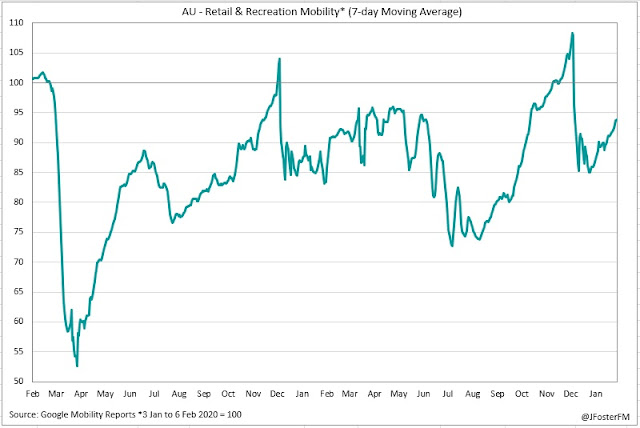
Reflecting the effect of eased restrictions in Sydney and Melbourne, mobility indicators in the nation's two major capital cities recovered to higher levels than before the lockdowns. Meanwhile, average mobility across the other capitals was running well above pre-covid levels by the end of the year. 


With people able to get out and about more and consumer sentiment at strong levels bolstered by the vaccine rollout, visits to retail and recreational venues surged nationally in the lead-up to Christmas, reaching higher levels than 12 months earlier.        

This flowed through to a robust rebound in household discretionary spending, driving the economic recovery. Retail sales volumes increased at a record pace in Q4, with the strongest rebounds seen in clothing and footwear, department stores and cafes and restaurants. 


Strong sentiment, pent up demand and a high level of accumulated savings underpinned the rebound in household spending, while a tightening labour market was also key support. The national unemployment rate fell to a 13-year low in December at 4.2% and occured alongside a recovery in labour force participation to around record highs. Overall, both employment and hours worked rebounded above their pre-pandemic levels after a weak Q3.   


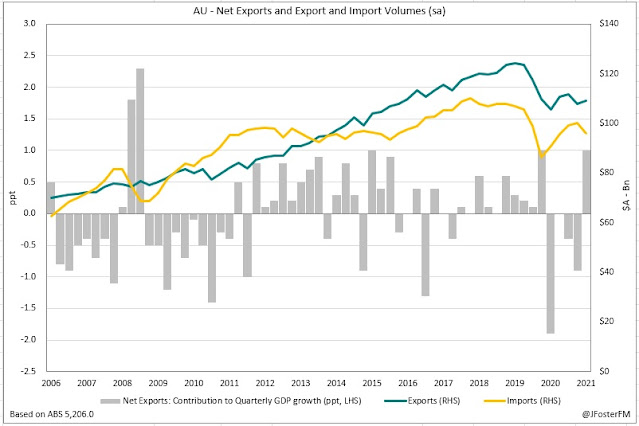
Activity in the Sydney and Melbourne housing markets rebounded in the quarter after being weighed by restrictions during the lockdowns; however, the pace of price gains slowed in both cities. Policy stimulus from the HomeBuilder scheme, government incentives and low rates had led to an elevated residential construction pipeline, though disruptions from lockdowns and capacity constraints had slowed the pace of activity over the second half of the year. Business investment rebounded from a weak Q3 but was patchy, with non-residential construction rising as equipment spending was soft. Net exports look likely to unwind their sizeable contribution to GDP in Q3. The economic recovery supported import spending, though global supply chain constraints remained a headwind. Exports earnings were boosted by rising LNG and Coal prices, even as the iron ore price retraced from elevated levels. 

As it stands | National Accounts — GDP

The return of lockdowns across large parts of the nation following the emergence of the Delta variant led to a 1.9% contraction in Australian GDP in the September quarter. The economy transitioned from the recovery to the expansion phase over the first half of the year, but the Delta setback saw GDP falling back below its pre-pandemic level. 


Offshore, the Delta variant was also a headwind, slowing quarterly GDP growth in OECD economies from 1.7% to 1.1% in Q3. The US economy slowed sharply to 0.6% in Q3 as household spending was weighed by rising virus caseloads, a fading fiscal impulse and supply chain pressures. Across the Atlantic, the euro area economy showed resilience to Delta as GDP firmed to 2.3% in the quarter, while in the UK output moderated to 1.1% after an easing in restrictions boosted Q2 GDP (5.4%). In Asia, regulatory measures to curb leverage and activity restrictions led to a slowdown in China's economy (0.7%), while in Japan GDP contracted (-0.9%) following a resurgence in the virus. 


In Australia, lockdowns were in place in New South Wales, Victoria and the ACT for much of Q3, driving a large fall in household consumption (-4.8%). Hardest hit by the restrictions were the services (-5.8%) and discretionary (-11.3%) categories, though goods consumption also contracted (-3.3%) as in-store retail in the affected states was largely shuttered. 


Alongside the decline in consumption, government income support measures were ramped up to similar levels seen at the outset of the pandemic, leading to a surge in the household saving ratio, from 11.8% to 19.8%.


The strong upswing underway in private investment was disrupted by the lockdowns, falling by 0.3% in Q3. Residential construction stalled (0.1%), with materials and labour shortages an additional constraint. Restrictions associated with the lockdowns temporarily weighed on activity in Australia's major housing markets in Sydney and Melbourne, with listings falling and price gains slowing. New business investment contracted by 1.1% in the quarter as many firms delayed spending on equipment and machinery (-3.1%). 


Both public demand and net exports contributed strongly to quarterly GDP, helping to attenuate some of the weakness in domestic demand conditions. Public spending (3.6%) was boosted by the pandemic response from governments as the rollout of the vaccine was accelerated. Meanwhile, resources exports rebounded from weather-related disruptions, driving a 1ppt contribution to growth from net exports, its largest contribution in 6 years. Import volumes fell in response to the lockdowns and global supply chain pressures, with the latter also causing inventories to be drawn down substantially in the quarter.

Key dynamics in Q4 | National Accounts — GDP 

Household consumption — Reopening from lockdowns and the increase in accumulated savings drove a sharp rebound in household spending. Accordingly, retail sales volumes rebounded by 8.2%, the strongest quarterly rise on record as discretionary demand for goods and services snapped back. Consumer sentiment was at strong levels over the quarter, reflecting confidence in the vaccine to mitigate the pandemic, increasing household wealth and the strength in the labour market.  

Dwelling investment — The upswing in the residential construction cycle lost momentum over the second half of the year, disrupted by lockdowns and materials and labour shortages. Private sector residential construction work contracted by 3% in Q4, with new home building down by 1.9% and alterations falling by 8.7%.

Business investment — Private sector capex rebounded by 1.1% in Q4 but was held back by weakness in equipment spending (-0.1%) on residual lockdown effects and global supply chain constraints.  

Public demand — A 0.4% contraction in Q4 will see public demand weighing modestly on GDP. Government spending stabilised in the quarter (0.1%) and remained at a high level, supported by the pandemic response. Underlying public investment declined in the quarter (-2.2%) but is bolstered by a large pipeline of projects.      

Inventories — Some improvement in global supply chain pressures assisted businesses in restocking inventories over the quarter from low levels. Inventories likely added around 1ppt to quarterly GDP. 

Net exports — Export volumes fell by 1.5% in Q4, weighed by a contraction in resources shipments. Global supply chain constraints remained a headwind to imports (-0.9%). Overall, net exports will subtract 0.2ppt from quarterly GDP. 

Wednesday, February 23, 2022

Australian Capex 1.1% in Q4; 2021/22 investment plans $140.7bn

Australian private sector capital expenditure rebounded in the December quarter but at a weaker pace than anticipated as residual lockdown effects and supply chain pressures weighed on equipment spending. Forward-looking investment plans in 2021/22 were upgraded, while year-ahead plans were higher than they have been in many years as firms look beyond the pandemic. 

CapEx — Q4 | By the numbers
  • Private sector capex rebounded by 1.1% in Q4 to $33.3bn (9.8%Y/Y), broadly reversing the 1.1% decline in Q3 but coming in lower than the 2.5% rise forecast.
  • Equipment, plant and machinery capex eased lower by 0.1% to $15.9bn (8.4%Y/Y), coming on the back of a sharp fall in Q3 (-3.3%).  
  • Buildings and structures capex lifted by 2.2% to $17.4bn to be 11.2% higher through the year. 


  • Firms' 5th estimate of capex plans in 2021/22 was upgraded by 1.6% to $140.7bn, pointing to a year-to-year rise of 15.9%. Meanwhile, the 1st estimate of year-ahead plans was nominated at $116.7bn, its highest since 2014/15.  


CapEx — Q4 | The details

The upturn in Australia's capex cycle generated by the economic recovery from the pandemic recession stalled over the second half of the year as lockdowns returned and pressures in global supply chains weighed on equipment spending. In the first half of the year, capex surged by 9.9% before stalling (0%) over the back half. Lockdowns during the Delta wave drove a 1.1% fall in Q3, which then rebounded at a slower-than-expected pace in Q4 following the reopening of affected states. Overall, this left capex at $33.3bn, equating to a 2.3% rise on its pre-pandemic level.  


Driving the second half weakness in capex was equipment spending, which contracted by 3.5% in the period compared to a 12.3% surge in the first half. Government tax incentives, accommodative financing conditions and the broader recovery in the economy supported the first half surge before it gave way amid the headwinds from lockdowns and supply chain pressures in the second half. 

Non-mining capex was unable to rebound from Q3's fall (-3.6%) coming in broadly flat in Q4 (0.3%), while in the mining sector equipment spending declined for a third consecutive quarter (-2.3%). As the economy weakened with much of the nation returning to lockdown in Q3, demand conditions were hit hard leading to firms delaying equipment spending. The international trade figures for imports of consumption and capital goods were weak over Q4, indicating that supply chain pressures also contributed to holding back business investment. In particular, weakness in vehicle (-10.2%) and industrial equipment (-5%) spending intensified over the quarter, pointing to the effect of the global semi-conductor shortage.   
   

Accordingly, the weakness in equipment spending showed up in goods-related (-0.9%) and business services (-2.9%) industries. In the goods-related area, weakness in wholesale trade was the driver (-6.6%) as it includes categories such as heavy farm machinery and warehouse equipment. Business services equipment was hit by weakness in professional services (-15.3%), potentially due to shortages of IT equipment; rental, hiring and real estate also declined (-2.4%), with this category including vehicle hire services that have struggled to rebuild fleets.   


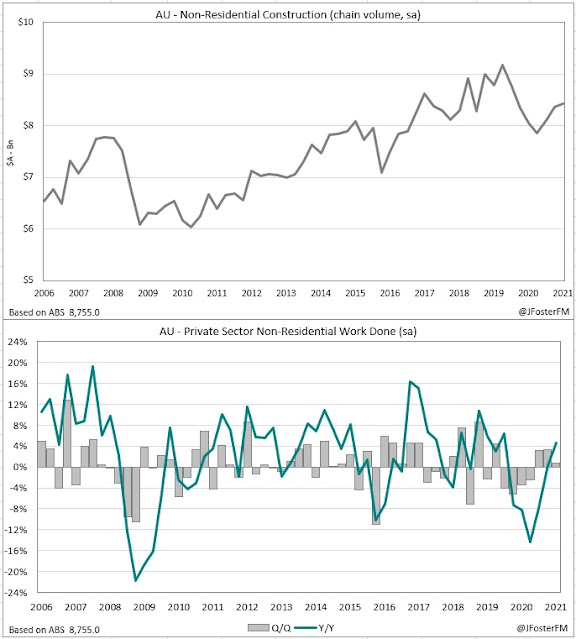
In contrast to falling equipment spending, buildings and structures capex lifted over the second half (3.3%) despite restrictions in the construction sector. This is consistent with yesterday's construction activity data (see here) that reported non-residential construction picked up pace over the back half.   


Turning to investment plans, firms upgraded expected spending in 2021/22 by 1.6% on the estimate put forward 3 months earlier to $140.7bn. This increase was in line with historical upgrades from estimates 4 to 5 but weaker than I had anticipated ($145bn). Overall, this suggested capex is on track for a 15.9% rise compared with 2020/21. Non-mining capex plans were lifted by 1.7% to $98.1bn, centred on a rebound in equipment spending as the supply issues clear (3.5%). Mining capex plans were revised up by 1.2% to $42.7bn.


Year-ahead plans in 2022/23 were estimated at $116.7bn. Although there is a large degree of uncertainty around the evolution of these plans, this was the strongest 1st estimate for total capex since 2014/15. 


CapEx — Q4 | Insights

Lockdown and supply chain disruptions held back equipment spending over the second half of 2021, weighing on business investment. However, there has been some offset from non-residential construction. As the economy rebounds to its pre-Delta momentum and supply chain pressure ease, equipment spending should regain its momentum, bolstered by the support of government tax incentives and accommodative financing conditions. Forward-looking investment plans continue to improve, indicating many firms are optimistic about the economic outlook beyond the pandemic.   

Preview: CapEx Q4

Australian private sector capital expenditure data for the December quarter comes out at 11:30am (AEDT) today. With affected states reopening from lockdowns during the Delta wave, capex is expected to have rebounded in Q4. Forward-looking investment plans should also remain constructive with the economy re-establishing its pre-lockdown momentum.

As it stands | Capital Expenditure

The Delta lockdowns in Q3 across much of the nation disrupted the strong upturn in the capex cycle as the economy was rebounding from the 2020 COVID recession. Capex contracted by 2.2% in the quarter to $32.7bn, falling back to pre-pandemic levels. 


Weakness in equipment spending largely drove the fall in capex with a 4.1% decline in Q4. The economic recovery, accommodative financing conditions and government tax incentives had seen equipment spending rising at pace over recent quarters. Non-mining sector equipment spending fell by 4.6%q/q, consistent with the contraction in domestic demand (-1.7% in Q3) associated with the lockdowns. The restrictions saw many firms delaying capex spending amid the restrictions on activity, while global supply chain constraints were another headwind, particularly in the acquisition of new vehicles. Buildings and structures capex was soft in Q4 (-0.2%), affected by the temporary shutdown of the construction sector in New South Wales and Victoria. 


Mining sector capex lifted by 1.2% in the quarter to $9bn, remaining in its range from the past few years despite commodity prices surging in response to the global economic recovery.  

Pointing to an expectation of temporary lockdown-related disruptions, firms increased their expected capex for 2021/22 to $138.6bn, up 8.7% from 3 months earlier and a stronger upgrade than usual for that stage of the estimates cycle. This implied capex was on track to post a 19.7% year-to-year rise. Capex plans in the non-mining sector increased by 10.3% on the previous estimate, while planned spending in the mining sector was upgraded by a more modest 5.1%. 


Market expectations | Capital Expenditure

Capex in the December quarter is expected to have risen by 2.5%, with the range of estimates between 0.5% to 4.0%. Also in today's report will be firms' 5th estimate of capex plans for 2021/22 and estimate 1 for 2022/23. 

Upgrades from estimates 4 to 5 are generally modest, averaging 1% over the past 10 years. An average result would see estimate 5 for 2021/22 rising to $140bn. However, I think the strength of the previous upgrade (from estimates 3 to 4) signals investment plans are carrying much more momentum than in a 'normal' year, consistent with the economic recovery. For estimate 5, I look for a figure around $145bn. For estimate 1 in 2022/23, a reasonable guide should be around $110bn to $120bn.  

What to watch | Capital Expenditure

Given the fall in Q3, the rebound in capex post lockdown will be important to confirm the resumption of the earlier upswing. The intentions component is also key and will be taken as a guide of the durability of the momentum in business investment beyond the reopening rebound in Q4.  

Australian construction activity -0.4% in Q4

Australian construction activity declined against expectations in the December quarter and was weak over the second half of 2021 as lockdowns and capacity constraints disrupted the upswing established in the recovery from the Covid recession. Elevated residential and public sector construction pipelines should support the resumption of the upswing in 2022.    

Construction Work Done — Q4 | By the numbers
  • Construction work done was much weaker than expected falling by 0.4% in Q4 to $53.5bn (chain volume, seasonally adjusted), though growth through the year was steady at 2.9%. The market consensus was for a 2.5% increase in the quarter, with the lowest estimate looking for a 1% rise. In addition, the contraction reported in Q3 was revised down, from -0.3% to -1.2%.   
  • Across the categories;
    • Engineering work +0.7%q/q to $23.1bn (+4.2%Y/Y)
    • Building work -1.3%q/q to $30.4bn (+2.0%Y/Y), which includes;
    • Residential work -2.9% to $18.3bn (+0.6%Y/Y)
    • Non-residential work 1.3%q/q to $12.1bn (4.1%Y/Y) 


Construction Work Done — Q4 | The details 

Following a strong first half in 2021, the upswing in Australia's construction cycle stalled over the back half of the year. Construction work done had accelerated by 4.6% in the first half of the year reflecting the effects of the HomeBuilder scheme and other policy stimulus but subsequently contracted by 1.6% over the second half as lockdowns and materials and labour shortages held back progress.


Construction activity rebounded in New South Wales in Q4 (5%) after output was hit hard in Q3 (-7.4%) due to the industry being temporarily shut down during the Delta lockdown. Similar restrictions on construction eventually applied in Victoria, which was late in Q3 by that stage. The associated hit to activity looks to have shown up in today's report, with work done in the state declining by 5.5% in Q4. But aside from lockdowns, the momentum was soft with falls in the quarter seen in other states including Queensland (-2.6%), Western Australia (-2.4%) and Tasmania (-0.6%). 


At the national level, the key dynamic has been the weakness in private sector construction over the second half of the year (-3.1%), with activity in Q4 down 2.4%. This was driven mainly by the residential segment, with the 3% decline in Q4 taking the fall over the second half to 3.7%. Private residential work surged by 4.5% in the first half of 2021 following policy stimulus from the HomeBuilder grants, other government incentives and low rates; however, lockdowns and materials and labour shortages were headwinds over the second half. New home building fell further in Q4 (-1.9%) while alterations retraced (-8.7%) from very elevated levels.     


In contrast to the residential segment, non-residential work accelerated over the second half of the year, with Q4's 0.8% increase resulting in a 4.1% rise over the period. Non-residential work lifted by only 0.6% in the first half. This is broadly reflective of business investment picking up as the economic recovery from the Covid recession gathered momentum. However, private engineering work weakened sharply over the second half of the year (-6.5%). 


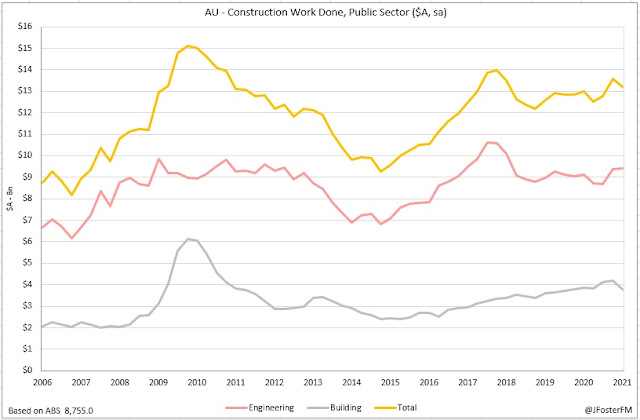
In the public sector, work done lifted by 7.7% over the second half as governments accelerated the rollout of infrastructure projects as part of their pandemic recovery response. In Q4, engineering work lifted by 6.8% and building work advanced by 1.1%.  


Construction Work Done — Q4 | Insights

Lockdowns and capacity constraints disrupted the upswing in Australia's construction cycle over the second half of 2021. Activity in residential construction weakened sharply on these effects, though policy stimulus measures have led to a very large pipeline in the segment that will add to economic growth as it is worked through in 2022. An acceleration in public sector work provided some offset over the second half, and there is much more to come reflecting the focus of governments in recent budgets to invest in infrastructure. 

Tuesday, February 22, 2022

Australian Q4 Wage Price Index 0.7%; 2.3%yr

Australian wages growth firmed in line with estimates in the December quarter, remaining around its pre-pandemic pace. A tightening labour market saw a broader-based lift in wages growth than in the previous quarter, boosted by the reopening from the Delta lockdowns. Although more wage inflation looks to be ahead, the RBA is likely to retain its patience stance with regards to raising rates for now.

Wage Price Index — Q4 | By the numbers
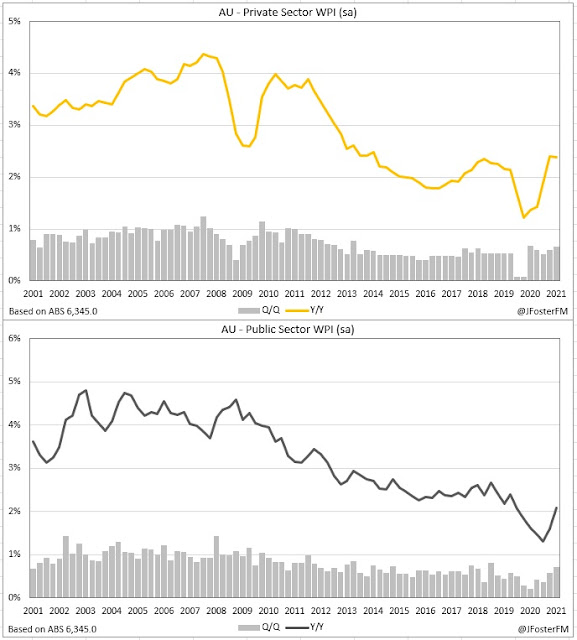
  • The headline WPI (total hourly rates of pay ex-bonuses) came in around expectations at 0.7% in the quarter and 2.3% over the year. This was slightly firmer than the pace seen in Q3 at 0.6%q/q and 2.2%Y/Y.  
  • Private sector WPI increased by 0.7% in the quarter (prior: 0.6%q/q), maintaining the annual pace at 2.4%.
  • Public sector WPI also lifted by 0.7%q/q (prior: 0.6%q/q), lifting growth over the year from 1.6% to 2.1%. 


Wage Price Index — Q4 | The details 

The Wage Price Index (WPI) is a gauge of wage inflation for employers in the Australian labour market. It is driven by changes in wage-setting behaviour, either through variations to awards, enterprise agreements or individual arrangements between employees and employers. The nature of Australia's institutional arrangements, with lengthy enterprise agreements and annual reviews of the minimum wage, together with public sector wage policies, means the WPI is typically a slow-moving indicator, a key point to consider in the context of the material tightening in the labour market over recent months.

In the release, the ABS noted that individual agreements were continuing to drive growth in the WPI. A strong labour market and demand for skilled workers meant a larger number of employers had conducted wage reviews than usually seen at this time of year. Public sector wage freezes in New South Wales and Queensland started to thaw in Q4, leading to a larger 4th quarter contribution to wages growth from enterprise agreements than in recent years. Meanwhile, the phase-in of the 2020/21 minimum wage decision was continuing to contribute to wages growth in Q4. Normally, the bulk of minimum wage increases occur in Q3, but this was altered by the Fair Work Commission in light of the pandemic, delaying the increase in the most affected industries. 


Aside from wage reviews and with employers keen to retain staff, many were turning to other incentives such as sign-on or retention bonuses or offering more attractive conditions to assist in that effort. The WPI inclusive of bonuses lifted by 1.1% in Q4, its strongest quarterly rise since Q3 2019, leaving annual growth up at 2.8% and in line with its pace just ahead of the pandemic. As the chart shows, this is being driven by private sector employers. 
    

At the industry level, annual wages growth had firmed in household services, from 2% to 2.4%, and in the goods-related sector (ex-mining), from 2.1% to 2.3%, as businesses were looking to hire staff back following the Delta wave lockdowns. Wages growth in business services was clearly outpacing these other two sectors in Q3 but the pace moderated in Q4, from 2.6% to 2.4%. 

In household services, the main development is the surge in wages growth in accommodation and food services; the industry hit hardest by the pandemic has been left with staff shortages as venues have reopened, with many switching jobs to work in other less contact intensive industries, while border closures have been an additional constraint. In the other industries in the sector, wages growth is for the most part yet to return to pre-pandemic rates.   


In business services, the rebound seen over the past year lost some momentum in Q4. Over the period, many businesses have been ending temporary wage freezes or cuts implemented at the outset of the pandemic and this has boosted measured wages growth. Strong demand has been another factor behind the rebound. As it currently stands, annual wages growth in professional services (2.5%), finance and insurance (2.3%) and administration (2%) is around pre-pandemic rates. However, rental, hiring and real estate (2.5%) and information media and telecommunications (2.2%) is now seeing wages growth running above their pre-Covid rates and materially so in the latter.   


Developments in the goods-related sector are being driven by reopening effects, with annual wages growth in retail (2.6%), manufacturing (2.5%) and wholesale trade (2.4%) continuing their push higher from pre-pandemic rates. Wages growth in the construction sector moderated (2.4%), which is somewhat surprising after the surge in building work due to construction stimulus measures led to capacity constraints. In the transport industry, wages growth remained constrained (1.8%) but could lift higher now that travel restrictions have eased with airlines needing to rehire staff.  


Wage Price Index — Q4 | Insights

All in all, with the labour market tightening post the Delta lockdowns, there was a broader-based rise in wages growth than seen in the previous quarter. However, aggregate wages growth is only around its pre-pandemic pace. Given the tightening seen in the labour market, with overall underutilisation falling to a 13-year low, historical relationships suggest wages growth should be significantly higher (the latest observation is circled). As highlighted earlier, the WPI is a slow-moving indicator and the churn in the labour market caused by the pandemic, with many switching jobs and moving between industries and often receiving higher pay in the process, likely means we will see wage inflation rising over the quarters ahead. But until that hits the data, the RBA will retain its patient stance on interest rates.    

Preview: Construction work done Q4

The December quarter update of Australian construction work done is due to be released this morning by the ABS at 11:30am (AEDT). A strong upswing in the construction cycle was paused in Q3 amid state lockdowns during the Delta wave and from capacity constraints. Eased restrictions should see a Q4 rebound in activity across the sector.  
   
As it stands | Construction Work Done

Construction activity held up better than expected during a disrupted Q3 with the Delta lockdowns in place in New South Wales, Victoria and the ACT. In the quarter, construction activity declined by 0.3% against a 3% fall expected.  


Public sector activity contracted by 2.7% in the quarter compared to a 0.5% rise in the private sector. Site restrictions hit public building work (-9.7%), driving a 2.2% fall in total non-residential work. This weakness was centred in New South Wales where the temporary shutdown of the construction sector saw non-residential work plunge by 11.3%.   


Private sector residential construction activity stalled over Q2 (0%) and Q3 (0.1%) amid capacity constraints and lockdown disruptions. In Q3, a 0.8% decline in new home building was offset by a 6% rise in alteration work, with the latter benefitting from the pandemic-related shift for the desire for more space and from the HomeBuilder grants program.       


There is a large volume of government infrastructure projects in the pipeline, but as highlighted above public sector work fell in Q3 (-2.7%). Engineering activity lifted slightly (0.5%) but could not offset the lockdown-related fall in building work (-9.7%). 


Market expectations | Construction Work Done 

The easing of lockdowns is expected to drive a rebound in activity, with construction work done forecast to rise by 2.1% on the quarter (range: 1% to 3%). The headwinds to that forecast are from labour and materials shortages holding back progress.   

What to watch | Construction Work Done

Today's report should confirm the resumption of the upswing from the first half of 2021 where there was broad-based momentum in construction activity. In particular, watch activity in the residential segment where there is a very large pipeline of work to be done on the back of the Covid stimulus response.

Preview: Wage Price Index Q4

Australia's Wage Price Index (WPI) for the December quarter is scheduled to be published by the ABS today at 11:30am (AEDT). Aggregate wages growth picked up in Q3 to a little above 2% but was still only around the slow rates that prevailed before the pandemic. A material post-lockdown tightening in the labour market likely increased wage pressures over Q4, though whether that is sufficient to sustain aggressive RBA rate hike expectations remains to be seen as the Board continues to reiterate its patience in assessing Australia's wage and inflation dynamics.   

As it stands | Wage Price Index

The WPI met expectations rising by 0.6% in the September quarter, lifting annual growth from 1.7% to 2.2% and returning to its pre-pandemic pace. The fading of pandemic-related headwinds drove the rise in wages growth: the share of employers conducting salary reviews in the quarter was more in line with historical patterns and due to the very low increase from Q3 2020 falling out of the annual calculation. 


Reflecting a tightening labour market, growth in the private sector WPI was 0.6% in the quarter, taking the annual rate up to 2.4%, its fastest in nearly 7 years. Contributing strongly to this increase in Q3 was the effect of many workers on individual agreements receiving pay rises. The public sector WPI, held back by wage freezes and caps, lifted by 0.5% in Q4 and was at a more muted 1.7% annual pace. 


From an industry perspective, the strongest upward pressure on wages growth was limited to a few industries and was generally where labour shortages were evident. This included professional services (3.4%Y/Y), construction (2.6%Y/Y) and accommodation and food services (2.5%Y/Y). Next strongest was administration (2.3%Y/Y). 


Market expectations | Wage Price Index

The headline WPI is expected to increase by 0.7% in the December quarter, around a range of estimates from 0.6% to 1%. Annual growth is forecast to firm from 2.2% to 2.4%; however, it should be noted that a 0.7% quarterly rise would actually generate annual growth of 2.3%, not 2.4%. Referring to the RBA's February Statement on Monetary Policy, the Bank's implied forecasts for wages growth in Q4 are a touch softer than the market at around 0.6%q/q and 2.3%Y/Y.  

What to watch | Wage Price Index

With inflation back at the midpoint of the RBA's target band for the first time since 2014 and the unemployment rate falling to a 13-year low, markets have moved to price in the first RBA rate hike by June, with a further 100bps of hikes anticipated by the end of the year. This profile looks overdone and could be at risk of being pared back unless there is a strong upside surprise in the Q4 WPI. 

The RBA continues to point out it is taking a "patient" approach, highlighting that although it has had to revise up its inflation forecasts, price pressures are mostly reflecting pandemic-related supply issues. Beyond these effects, the RBA has referred to wages growth of above 3% as a guidepost to the sustainability of delivering on the 2-3% inflation mandate. 

That confirmation in terms of aggregate wages may take some time to materialise as the WPI is a relatively slow-moving gauge and is currently affected by the wage policies in the public sector, years-long enterprise bargaining agreements and annual reviews of the minimum wage. But a tight labour market is creating a lot of churn beneath the surface as people switch jobs and receive promotions, which will be leading to higher wages. All in all, today's WPI should give a broad insight into the extent of wage pressures currently being faced by Australian employers as the labour market tightens.