Independent Australian and global macro analysis

Friday, February 18, 2022

Macro (Re)view (18/2) | Under the weather

Conflicting headlines around Russia-Ukraine tensions dictated sentiment this week, with uncertainty over developments weighing on equities and helping to put a floor under the US dollar amid more insights on policy tightening from the Fed. The overall dynamics kept flattening pressure on yield curves. 


Australia's labour market was heavily disrupted by Omicron early in the year...

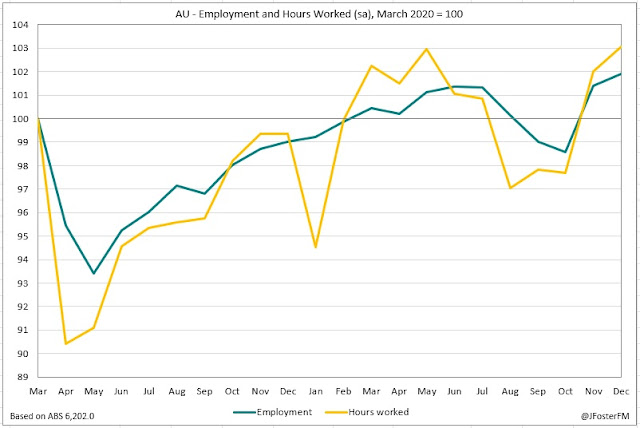
As the Omicron variant spread and caseloads surged, around 5.6% of employed Australians were unable to go to work, either through illness or from being a close contact, in early January. With another 39% of workers on leave during the peak summer period, this week's labour force survey reported the impact from staff shortages on the economy was an 8.8% collapse in total hours worked in January. A fall of that magnitude has been exceeded only once and that was in April 2020 (-9.6%) when the nation went into lockdown at the outset of the pandemic. After building up strong momentum through the recovery from the Delta wave, hours worked in January had fallen to be 6% below their pre-Covid level.    


but underlying conditions were much more resilient than in earlier waves...

Reflecting the resilience the Australian economy has established to the pandemic from each successive wave, underlying conditions in the labour market held up in January. Employment lifted modestly by 12.9k but came in above expectations for a flat outcome. This was broadly sufficient to cover an uptick in the participation rate to 66.2%, keeping the unemployment rate at 13-year lows (4.2%). After tightening considerably in December, underemployment (6.7%) and overall underutilisation in the labour market (10.9%) increased slightly but were still at their lowest levels since 2008. The overall takeaway was that in a tight labour market, businesses are keen to retain staff and despite the uncertainty around Omicron, labour demand continues to rise. Online job vacancies were reported this week to have risen by 4.4% in January to stand 54% above their pre-Covid level, indicating there is scope for the labour market to tighten further. A full review of January's Labour Force Survey can be accessed here


and policymakers are keen to press for more progress towards full employment 

Accordingly, Australia's fiscal and monetary authorities are focused on the push towards full employment despite underlying inflation rising to 7-year highs. Treasury Secretary and RBA Board member Dr. Steven Kennedy told the Senate's Economics Committee this week that while fiscal stimulus is gradually tapering as unemployment declines, support should not be withdrawn early based on historical estimates of full employment. In a tightening labour market, Dr Kennedy highlighted that wage gains linked to productivity growth would be key to containing inflation. There was a complimentary tone in the RBA's February meeting minutes, which reaffirmed maintaining highly accommodative monetary policy to support the return to full employment. That said, higher inflation has prompted the Board to emphasise the need for greater optionality, leading to the early withdrawal of QE and signaling that rate hikes this year were plausible. But there remains some reluctance to the idea of raising rates when inflation is being primarily driven by pandemic-related supply issues and wages growth is only around pre-pandemic rates. 

In the US, the Fed could begin balance sheet runoff earlier...  

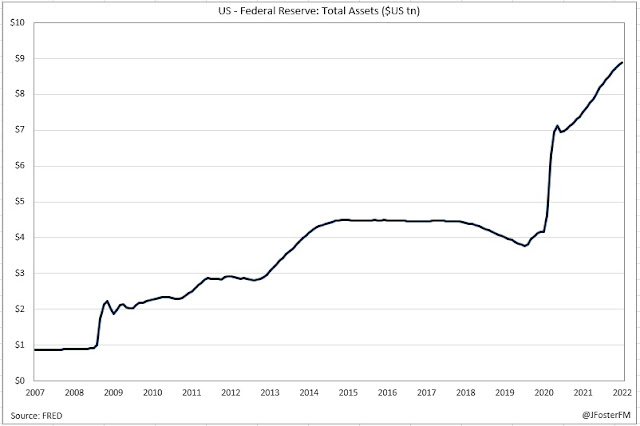
The minutes from the Fed's meeting in late January provided some new insight into how the FOMC sees the process of balance sheet reduction taking place. Boosted by emergency asset purchases over the course of the pandemic, the Fed's balance sheet has expanded from a pre-virus level of around $4tn to around $9tn currently, and the general view of the FOMC is that a "significant reduction" is now appropriate. In light of the strength of the labour market and high inflation, the minutes noted a faster pace of runoff was likely than seen in the previous episode in 2017-2019. The implication is that the timing between liftoff in the policy rate, set to take place in March, and the start of balance sheet runoff will be much shorter in this tightening cycle. The FOMC was also of the view that the strength of the economic outlook likely warranted a more front-loaded increase in its policy rate than during the post-2015 hiking cycle; whether or not that equates to a larger 50bps hike to start with remains a strongly debated issue in markets.

Household spending rebounded sharply early in the year... 

Despite the fall in US consumer sentiment to decade lows being linked to high inflation and residual pandemic effects, household spending rebounded strongly in January. Headline retail sales came in at 3.8%m/m (vs 2% expected) after falling by a downwardly revised 2.5% in December. Excluding the categories that have seen prices rise sharply (such as fuel, cars and building materials), control group sales surprised strongly to the upside with a 4.8% surge (vs 1.3% expected), more than reversing December's 4% fall. 


In Europe, comments from ECB officials remain key...

Aside from geopolitical tensions in the region, messaging around the policy outlook from ECB officials has been key for markets. ECB President Christine Lagarde was before the European Parliament this week outlining to lawmakers that the current high rate of inflation was likely to persist for longer than previously anticipated, necessitating a more flexible outlook to policy. President Lagarde reaffirmed the Governing Council's December announcements: net purchases in its pandemic asset purchase program would cease in March and to the plan for tapering purchases in its other QE program over the course of the year (though this is to be reviewed at the March meeting). ECB Chief Economist Philip Lane meanwhile has continued to emphasise that with the outlook for inflation over the medium-term expected to stabilise around the 2% target, steps to remove policy accommodation could occur in a gradual manner. There was also pushback from ECB Executive Board member Isabel Schnabel to aggressive expectations for 2022 rate hikes, noting that market pricing factored in term premia and was therefore likely to be providing a somewhat misleading signal with regards to the start of the hiking cycle. In any case, Schnabel reiterated that the ECB's forward guidance required asset purchases to have ended before rates start rising.  

UK data were consistent with further BoE rate hikes... 

Although UK employment fell by 38k over the 3-month period to December, this was less severe than expected (vs -58k) as Omicron emerged and the unemployment rate held steady around pre-Covid levels at 4.1%. With employment estimated to be down by 588k on its pre-pandemic level there is tightness in the labour market, confirmed by a further elevation in job vacancies to a new record high. All this is putting upward pressure on wages, with annualised pay rates in the final quarter of the year rising from 3.8% to 4.3% (vs 4.2% expected), adding to concerns over inflation, which in January came in above expectations. 12-month headline inflation edged up from 5.4% to 5.5%, while the core rate was up at 4.4% from 4.2%. Due mainly to upcoming increases in household energy prices, inflation is expected to keep rising to be pressing 7% by April. The light remains green for further BoE rate hikes, though it is debatable the MPC will deliver on the 6 additional hikes factored into market pricing over the remainder of the year.   

Wednesday, February 16, 2022

Australian hours worked -8.8% in January

Hours worked in the Australian economy were crunched by 8.8% in January as the Omicron wave surged. Staff shortages due to illness and isolation requirements were compounded by a higher-than-usual number of Australians taking summer holidays. Despite these disruptions, underlying labour market conditions were much more resilient than in earlier waves of the pandemic, and with labour demand remaining strong, indications are that the labour market can tighten further.   

Labour Force Survey — January | By the numbers
  • Employment increased by a net 12.9k in January against expectations for a flat outcome. December's rise in employment was left unrevised at 64.8k.  
  • Australia's unemployment rate remained at 4.2%, as expected, at 13-year lows. 
  • Labour force participation firmed from 66.1% to 66.2%. 
  • Hours worked fell by 8.8% in January, weighed by Omicron isolation requirements and summer holidays. 


Labour Force Survey — January | The details

The surge of the Omicron waved caused significant disruption in the Australian labour market in January as illness and isolation requirements prevented many people from going to work, while a higher-than-usual number of Australians taking summer holidays compounded staff shortages for businesses early in the year. Very high rates of vaccination have allowed lockdowns to be avoided in this wave, but hours worked still fell very sharply contracting by 8.8% in January, a decline exceeded only by the 9.6% fall seen during the national lockdown at the outset of the pandemic. This left total hours in January 6% down on pre-pandemic levels. Hours by part-time workers (-9.1%m/m) showed a slightly larger fall than in the full time segment (-8.7%m/m). 


Around 5.2m Australians reported working zero or fewer hours than usual due to being on holiday — a significantly higher number for January than in recent years. As Omicron surged many were required to enter isolation either from falling ill or from being a close contact. An extraordinary rise was seen in the number of Australians working fewer hours than usual due to sick leave, lifting from 439.9k in December to 743.5k in January, with nearly 450k unable to work any hours at all due to being in isolation.  


Given the high level of absences, many businesses were faced with significant staff shortages in January and more disruption than at earlier stages of the pandemic. Last week's ABS Conditions and Sentiment survey reported 22% of firms were affected by COVID-related absences in January, with medium and large businesses the most impacted. 

Source: ABS 

Across the states, New South Wales (-13.5%) and Victoria (-13.2%) saw the largest falls in hours worked in January, reflecting the higher caseloads there. On a pre-pandemic comparison, hours in NSW had fallen to a new low (-11.8%) while hours in Victoria were close to the depths seen during its second wave lockdown in mid 2020. Total hours across the other states and territories fell by 2.4% in the month but remained above their pre-pandemic level. Western Australia's low caseloads saw hours worked rise by 1.7%, providing some offset to falls in the other states (Qld -2.9%, SA -7%, Tas -5.1%, ACT -3% and NT -1.3%) as Omicron started to spread after the borders reopened.    


Around the disruptions from Omicron, broader labour market conditions held up fairly well in January. Employment lifted by a net 12.9k, with a 30k rise in part time employment more than offsetting a 17k fall in full time employment. Employment outcomes were weakest in NSW (-22.8k) and Vic (-15.6k). Overall, this left total employment 2% above its pre-pandemic level. Compared with March 2020, full time employment (2.4%) has seen a sharper increase than part time employment (1.2%), mostly because the latter has been more vulnerable to job losses from successive waves of the pandemic.    


Encouragingly, the participation rate lifted slightly in January to 66.2%, which should give some comfort to businesses facing staff shortages that they are not in the position of having to wait for Australians to return to the labour force, as is the case in the US and the UK. However, it is notable that there remains a shortfall in participation in NSW (64.8%) relative to its pre-Delta highs (around 66%). Meanwhile, the employment to population ratio reached a new high at 63.4%. 


With the size of the labour force increasing only modestly and employment rising in the month, overall spare capacity in the labour market remained at similar levels to December. The unemployment rate held at 4.2% (though it edged higher when taken at 2 decimal places). Underemployment lifted fractionally to 6.7% despite the large fall in hours worked; clearly, it is difficult to take on additional hours when many were in isolation. Overall underutilisation in the labour market was 10.9% in January, only a little higher than in December.


Labour Force Survey — January | Insights

The surge of the Omicron wave during the peak summer holiday period led to an unavoidably large fall in hours worked in January, leaving many businesses short staffed. However, unlike in earlier waves, broader labour market conditions were much more resilient on this occasion, reaffirming the resilience the Australian economy has established in coping with the pandemic. In a tight labour market, businesses are keen to retain staff. Meanwhile, prospects for further progress towards full employment look positive given the 4.4% rise reported in job vacancies in January, indicating underlying labour demand remained strong despite Omicron.  

Preview: Labour Force Survey — January

The ABS is due to publish the Australian labour force survey for January at 11:30am (AEDT) today. A strong post-Delta lockdown rebound in the labour market came into the headwinds of the Omicron wave in January as illness, isolation requirements and caregiving needs led to high levels of staff absences during what was also the summer holiday period. With underlying demand for labour remaining strong, today's report should tell the story of the disruption to the economy from staff shortages as Omicron surged, with hours worked the key indicator.  

As it stands | Labour Force Survey

The post-lockdown rebound in the Australian labour market continued in December as employment lifted by an above consensus 64.8k following November's 366.1k surge. Whereas the part-time segment drove the recovery in employment in the prior month, in December it was full-time employment leading the way with a 41.5k rise as the former added 23.3k. 


With eased restrictions and robust economic conditions boosting employment, hours worked continued to rise with a 1% lift in December extending November's 4.5% reopening rebound. Overall, both employment (1.9%) and hours worked (3%) were running well above their pre-pandemic levels and had returned to their levels from prior to the Delta outbreaks.  


With the participation rate holding steady at 66.1%, rising employment and hours saw the labour market tighten considerably. The unemployment rate came in from 4.6% to 4.2% — a 13-year low — while underemployment (6.6%) and overall underutilisation in the labour market (10.8%) were also at their lowest levels going back to 2008. 


Market expectations | Labour Force Survey

Given the January survey took place during the surge of the Omicron wave, and also coincided with the summer holiday period, there is limited visibility going into today's report. The market median is for a flat outcome on the employment number, though the range of estimates is unusually wide between -60k on the low end and +60k on the high side. Unemployment is expected to remain at 4.2% (range: 4% to 4.4%) but is highly dependent on the movement in the participation rate, which could fall in the circumstances. 

What to watch | Labour Force Survey

This is likely to be a volatile report that could throw up some surprises. As with earlier waves of the pandemic, the hours worked measure should be where the main adjustment comes through, reflecting illness, isolation requirements and people staying at home for caregiving needs or to avoid becoming infected. Hours worked are also likely to fall due to summer holidays: recall that in January 2021 hours worked fell by an outsized 4.8% (seasonally adjusted) as a higher-than-usual number of people took time off, delaying their return to work in the new year. Despite the Omicron wave, the underlying strength in labour demand shows no sign of waning; yesterday, the National Skills Commission reported online job vacancies lifted by 4.4% in January to 259k, elevating to 54% above pre-pandemic levels. 

Friday, February 11, 2022

Macro (Re)view (11/2) | 50/50 on 50

This week's US inflation data saw markets turning more hawkish, bringing forward rate hike expectations to the extent where a 50bps move from the Fed in March is now seen as a genuine possibility. Despite repricing for a more front-loaded hiking cycle, markets have been reluctant to shift from their view that the Fed's policy rate will peak at around 2%, a broadly similar level to at the start of the year. This has seen the yield curve flatten to mid-2020 levels, weighing on US equities over the week. A firmer US dollar and push back from ECB officials on rate hikes saw the EUR decline. Elevated commodity prices and a more open view from the RBA on hiking rates in 2022 continue to see the AUD rise from its recent low at the end of January. 


High and rising US inflation has turned up the pressure on the Fed...

An upside surprise in January's data left US inflation up at 40-year highs as the headline CPI lifted from 7% to 7.5% and the core rate turned out at 6% from 5.5% (year-over-year rates). Amid supply constraints and strong demand, durable goods inflation remains extraordinarily high increasing to 18.4%, while energy prices are up by 27% over the year even after cooling a touch over the past couple of months. Pressure on the cost of living is also coming through from food (7%) and housing as owners' equivalent rent reached a near 15-year high (4.1%). Following the release, comments from the St. Louis Fed President James Bullard that he would support rates rising by 100bps by July drove a sharp repricing of rate hike expectations, with a larger-than-usual 50bps increase to start the tightening cycle in March now seen around a 50/50 prospect.


while in Europe, the ECB pushed back on early rate hike calls...

After opening the door to rates rising this year at last week's meeting, ECB President Christine Lagarde cautioned in an interview that hiking early would do little to curb high inflation and would also risk slowing growth and employment. In a similar tone, ECB Chief Economist Philip Lane in a blog post argued the case for a measured response to high inflation given that it was being driven by external supply issues and would likely be temporary, while Executive Board member Isabel Schabel said in a Twitter Q&A that adjustments to policy would be made in a gradual manner. This all came as the European Commission's Winter 2022 Economic Forecasts sharply raised the inflation outlook for this year from 2.2% to 3.5% due to persistent increases in energy prices and a broadening of prices pressures before easing back to 1.7% (1.4% previously) and below the ECB's target in 2023. 

UK economy was still in the recovery phase as Omicron emerged...

UK GDP expanded by 1%q/q in Q4, broadly in line with consensus and matching the pace seen in the prior quarter. Overall, this still left the UK economy 0.4% below its pre-Covid level from Q4 2019. Monthly estimates highlighted the Omicron effect as activity turned from growth of 0.7% in November to a 0.2% contraction in December; the decline being driven by a 0.5% fall in service sector output as concerns over the virus hit the retail (-3.7%) and hospitality industries (-9.2%). Similar to the Fed, the Bank of England was last week grappling with the idea of a larger-than-usual hike in rates but ultimately settled for a 25bps hike. The BoE's Chief Economist Huw Pill used a speech this week as justification, putting forward that taking measured steps was the most prudent approach to normalising policy.    


In Australia, the RBA maintained its patient message on policy...

Reaffirming the key themes from last week's Board meeting and 'Year Ahead' speech, RBA Governor Philip Lowe told the House of Representatives Standing Committee on Economics that given the uncertainty around wage and inflation dynamics, there were risks to tightening monetary policy too quickly, principally in hindering the effort to drive the unemployment rate down even further to generational lows. Flexibility to keep pushing the full employment side of the mandate comes from an RBA yet to be convinced that the recent return of underlying inflation to the middle of the 2-3% target for the first time in 7 years can be sustained, particularly as pandemic-related supply issues had contributed strongly to the rise in inflation even though their effects had been more pronounced in economies offshore. Confidence in meeting the inflation target requires a stronger pace of wages growth, which is currently only running around pre-pandemic rates. However, the RBA acknowledges there could be more upward pressure on pay rates than implied by the Wage Price Index, and with the QE program coming to an end this week, Governor Lowe said it was plausible that the cash rate may need to rise in 2022.


but expectations of 2022 rate hikes are weighing on consumer sentiment... 

Certainly, households sense RBA rate hikes are nearing with a deterioration in assessments of family finances driving a 1.3% fall in consumer sentiment in February, taking the Westpac-Melbourne Institute Index back to a neutral level. In this latest survey, two in three respondents with a mortgage thought rates would rise this year. Post the Delta lockdowns, consumer sentiment was elevated in the optimistic range and that helped drive a record increase in retail sales volumes of 8.2% in Q4, rebounding from Q3's 4.4% record fall (reviewed here). Discretionary consumption across the non-food categories surged by 15.7%, with clothing and footwear (43.1%), department stores (25%), and cafes and restaurants (18.8%) benefitting from eased restrictions.      


while Omicron disruptions are impacting businesses and the labour market

Though the impact of Omicron on the economy will be less severe than earlier waves of the virus, it is still is causing significant disruptions. The NAB Business Survey for January reported a sharp fall in overall conditions for firms, from a +8 to +3 reading, as the trading, profitability and employment components all weakened. However, confidence rebounded from the month prior (-12 to +3), indicating many firms thought the disruptions would be temporary. In the labour market, a slower post-holiday rebound compared to 2021 in the latest high frequency payrolls data pointed to the effects of Omicron as the ABS's business survey highlighted the significant extent of staff shortages in January due to isolation requirements.  

Sunday, February 6, 2022

Australian retail sales -4.4% in December; Q4 volumes 8.2%

Australian retail sales volumes posted their strongest increase on record in Q4 as the shops reopened from the Delta lockdowns. December's fall in sales indicates the momentum was fading towards the end of the quarter and have subsequently been hit by the Omicron wave. However, underlying household spending remains well supported by a strong labour market and accumulated savings, with retail sales likely to again rebound as concerns over the pandemic ease.   

Retail Sales — December | By the numbers 
  • National retail sales pulled back by -4.4% in December to $31.9bn after a 7.3% surge saw turnover rising to a record high in November.
  • 12-month retail sales moderated to a 4.8% pace from 5.8%.


  • Retail volumes (real terms) rebounded by a record 8.2% in Q4, stronger than expected (7.8%), swinging year-ended growth from -2.2% to 3.6%. Volumes contracted by 4.4% amid the Delta lockdowns in Q3. 
  • Retail prices firmed by 0.5% in the quarter to be 1.6% higher over the year.


Retail Sales — December | The details  

Quarterly retail sales volumes rebounded from a record fall in Q3 (-4.4%) during the Delta lockdowns to post a record rise (8.2%) on reopening in Q4. 


Volumes across the states reopening (NSW, Vic & ACT) surged back rising by 12.9% in the quarter after falling by 8.6% in Q3 and rebounded back above their pre-pandemic levels. Across the rest of the nation, volumes advanced at a firmer pace (2.1%) than in the prior quarter (1.6%) to remain well above their pre-pandemic levels. 


Pent-up demand post lockdown and Black Friday sales in the run-up to Christmas saw discretionary retail consumption surge, with volumes ex-food up by 15.7% in Q4. Consistent with eased restrictions, clothing and footwear (43.1%), department stores (25%), and cafes and restaurants (18.8%) drove the rebound. With people returning to dining out, basic food volumes contracted (-1.6%).   


Retail prices were held to a 0.5% rise in the quarter as a decline in food prices (-0.1%) attenuated the impact of strong increases in some of the other categories. During Q3, clothing and footwear (-3.8%) and department store (-2.6%) prices fell sharply due to widespread discounting as retailers sought to clear accumulated winter inventories. Despite the Black Friday period falling in Q4, less discounting than in the previous quarter saw prices bouncing back: clothing and footwear 2.7% and department stores 2%. Consistent with the recent CPI data, household goods prices accelerated in the quarter (2.1%) as strong demand and supply constraints pushed up prices for many consumer durables. Prices at cafes and restaurants saw their fastest quarterly rise in a year (0.9%) coming out of the lockdowns. 


Turning to December's sales, turnover moderated from the record high reached in the prior month when Black Friday sales were in full flow and many were Christmas shopping early to avoid stock availability issues. While December's 4.4% fall was the largest since the national lockdown at the outset of the pandemic, this only took retail sales back to a little above their level in October. With non-food sales driving the surge in November (14.4%), they unwound in December (-8.5%); basic food sales lifted by 2.2%, boosted by supermarket (1.4%) and liquor sales (8.6%) for the Christmas/new year period. 


Unsurprisingly, given the easing in restrictions and with Black Friday sales coming in the month prior, online spending continued to decline from its peak during the Delta lockdowns. Online sales were down 4.9% in the month, with non-food sales falling by 9.6%, though food sales lifted by 8.5%. 


Retail Sales — December | Insights

Household spending at the shops was incredibly robust once they reopened in the states affected by the Delta lockdowns. The rebound in volumes in Q4 (8.2%) comfortably surpassed the previous record set post the national lockdown (6.3%). Income support at similar levels to the JobKeeper program at the outset of the pandemic meant that pent-up demand combined with elevated savings to drive household spending in the quarter. December's fall shows this momentum started fading towards the end of the period, ahead of the Omicron wave. Mobility data confirms a sharp decline in retail footfall through January as precaution behaviour, isolation requirements and supply issues kept many away from the shops. However, as with earlier waves, expect retail spending to bounce back once these concerns ease, supported by a strong labour market and accumulated savings. 

Friday, February 4, 2022

Macro (Re)view (4/2) | New realities

The RBA's first meeting for 2022 during the week confirmed the end of purchases in its QE program as the Board sought optionality in its messaging on policy for the year ahead (reviewed here). A very strong rebound in the economy since the Delta lockdowns ended has seen conditions in the labour market tighten materially, and with inflation meeting the midpoint of the 2-3% target band for the first time in 7 years, the Board determined the time had come to cease QE purchases. With the program's bond holdings not starting to mature until July, the RBA has delayed making a call on what this will mean for its balance sheet until the May meeting. In the quarterly Statement on Monetary Policy, upgrades to the unemployment and inflation forecasts imply the Bank is on track to meet its objectives sooner, necessitating flexibility in its monetary policy settings. At his 'Year Ahead' speech to the National Press Club, Governor Philip Lowe opened the door to hiking the cash rate in 2022; a prospect assessed by the Bank as being inconsistent with its previous set of forecasts. 

Reflecting the impact of the Omicron wave, the growth outlook for 2022 was lowered from 5½% to 4¼% before moderating to a below-trend pace of 2% (revised from 2½%) in 2023, with the latter factoring in the key assumption that the cash rate evolves in a similar, though seemingly less aggressive manner, than the hiking cycle being priced in by markets —something Governor Lowe was dismissive of this week. That reticence comes about due the to labour market being "...within sight of a historic milestone" with unemployment close to falling through 4%, and that objective could be pursued under the current forecast path for inflation. That said, the underlying inflation forecasts were lifted significantly — the rate now expected to peak at 3¼% (+1ppt) by Q2 before easing to the upper end of the target at 2¾% (+0.5ppt) by the end of the year as supply issues ease. It is then seen holding at that pace out to mid-2024, whereas it was previously anticipated to rise no higher than 2½% by the end of 2023. Emphasised by the RBA in its communications throughout the week was that the evolution of wage-price dynamics remains exceptionally uncertain amid pandemic-related factors and a tight labour market. In that context, the Bank is maintaining its "patient" stance, only pledging to act once it has more clarity on the medium-term outlook for inflation. Should inflation pressures increase more than expected or show signs of becoming more persistent, the February Statement notes the Bank "will do what is necessary to maintain low and stable inflation" emphasising that objective as a precondition to sustaining a strong labour market. 

Also in Australia this week, a host of data updates were released. Retail sales moderated from a record high level with a 4.4% decline in December's initial estimate. National housing prices recorded their fastest pace of increase since 1989 rising by 22.4% for the 12-months to January as housing finance commitments reset to a new record high level in December (reviewed here). Dwelling approvals closed out the year with an 8.2% rise but still contracted materially over the quarter as the retracement post the HomeBuilder stimulus continued (reviewed here). Meanwhile, net exports look likely to subtract from GDP in Q4, reversing their sizeable contribution to activity in the previous quarter (reviewed here). 

— — — 

Offshore, with inflation concerns intensifying, the Bank of England and the European Central Bank responded at their respective policy meetings this week. The BoE announced a 25bps rate hike, and with the policy rate rising to the previously stated threshold of 0.5%, it will now turn to balance sheet reduction, confirming that maturing bond reinvestments will cease. A larger rate hike of 50bps wasn't on the radar for markets ahead of the meeting, but that was very nearly the outcome: the decision went the way of a 25bps hike in a 5-4 vote by the Monetary Policy Committee. Further increases in household energy prices and rising traded goods and food prices pushed up the forecast peak in inflation to 7¼% by April 2022 (from 6% previously) in the Bank's latest Monetary Policy Report. As a net importer of energy and traded goods, Governor Andrew Bailey in the post-meeting press conference likened the situation to a terms of trade shock for the UK economy. Complicating matters is that with the labour market tightening rapidly, there is upward pressure on wage costs and there are signs that will continue through the year. Amid that outlook, the MPC was left with a difficult message that a "further modest tightening in monetary policy" is likely over coming months despite rising cost of living pressures. 

While the ECB announced an unchanged policy stance this week, its messaging has taken a hawkish turn following a much stronger-than-expected inflation report. January's headline inflation rate was expected to ease from 5% to 4.4% as some pandemic-related factors fell out of the annual calculation, but the pace came out higher at 5.1%. There was at least some respite on the core rate, which softened to 2.3% from 2.6%. In the post-meeting press conference, ECB President Christine Lagarde noted that the risks to the inflation outlook are "tilted to the upside" — the first time the ECB has made such an assessment in many years — and went on to say "the situation has indeed changed" from earlier guidance that pushed back against the prospect of raising rates in 2022. However, President Lagarde did emphasise that the Governing Council's sequencing, which requires QE to have been wound up before rates rise, remained key in its policy deliberations. As a result, markets were on the move expecting that an accelerated tapering schedule will be announced at the March meeting ahead of rate hikes later on in 2022.  

Lastly in the US, what was widely anticipated to be a fairly soft report in response to the Omicron wave surprised significantly to the upside of consensus with nonfarm payrolls in January rising by 467k vs 125k expected. Furthermore, revisions over the prior two months boosted payrolls by a net 709k. Helping to explain these outcomes, the BLS outlined in their release that updates to its seasonal adjustment and benchmarking processes were incorporated into this report. Overall, though, underlying labour market conditions are strong: December job openings lifted by 1.4% to 10.9mn, while annual growth in average hourly earnings accelerated from 4.9% to 5.7%. The unemployment rate edged up slightly, from 3.9% to 4.0%, though that was accompanied by a rise in participation, which at 62.2% is still 1.2ppt down on its pre-pandemic level.    

Thursday, February 3, 2022

Australia's trade surplus narrows to $8.4bn in December

Australia's trade surplus followed its narrowing trajectory of recent months coming in to a still very elevated $8.4bn in December. Strength in import spending was seen in December and over Q4 amid rising prices from supply constraints. Export earnings were lower through Q4 as iron ore prices declined, though rises in other key commodity prices lessened the headwind. 

International Trade — December | By the numbers
  • Australia's trade surplus narrowed by $1.4bn coming in at $8.4bn in December against $9.9bn expected. November's surplus was revised up to $9.8bn from $9.4bn previously. 
  • Exports increased by 0.8%m/m to $45.3bn to be 16.8% higher over the year.
  • Imports posted a 5% rise in the month to $37.0bn for annual growth of 21.7%. 


International Trade — December | The details

The narrowing in Australia's trade surplus from the record high in July extended to a 5th consecutive month. December's $8.4bn surplus was the lowest seen since March but remains at a historically elevated level. Over the December quarter, the nation's trade surplus came to around $29bn, down 21.6% on Q3's record high. Export earnings fell by 2.7% in the quarter, driven by weakness in non-rural goods (-4.6%q/q) as the nation's iron ore exports (-28.2%) reflected the retracement in prices for the commodity on global exchanges. Import spending in Q4 advanced by 4.3%, with the largest contribution by far coming from intermediate goods (11.2%) as supply chain pressures pushed up input prices. 


In the December month, Australia's export earnings saw a modest rise of 0.8%. Rural goods (-3%m/m) eased from a record high in the prior month driven by other rural products (-7.3%m/m) and cereals (-1.5%m/m). The other categories saw offsetting gains. Non-rural goods (0.4%m/m) firmed on the back of a rebound in iron ore (12%m/m), though the other major commodities all declined (coal -14.2%, metals -2.3% and LNG -0.3%). Services exports lifted by 1.4% in the month but continue to remain at low levels impacted by the pandemic.  


Monthly import spending followed up the 8.3% rise in November with a 5% lift in December. Consumption goods saw the fastest month-on-month rise (7.9%) in a couple of years, with vehicle imports up sharply (25.6%) and consistent with some easing of supply constraints in the automobile production sector. Capital goods posted a 2.6% increase in the month. This was driven by telecommunications equipment (13.8%), which has risen by 28.2% over the past 2 months, possibly reflecting price increases on the back of chip shortages. Intermediate goods saw another strong rise (5.5%), with fuel and a host of other inputs driving the rise as supply constraints push up prices. Services imports were modestly higher (0.5%) in December. 


International Trade — December | Insights

Net exports contributed 1ppt to activity in the September quarter, attenuating the impact of the Delta lockdowns on GDP (-1.9%). This looks likely to reverse in Q4, with export earnings looking fairly weak. Import spending was up at a solid pace through the quarter, though rising prices due to supply constraints were a major factor.  

Wednesday, February 2, 2022

Australian dwelling approvals rise 8.2% in December

Australian dwelling approvals lifted for the second month running on the back of strength in the higher-density segment. For the December quarter, dwelling approvals fell as the post-HomeBuilder unwind continued.  

Building Approvals — December | By the numbers
  • National dwelling approvals (seasonally adjusted) closed out 2021 with an 8.2% gain in December to 17,698 vs the median estimate for a 1% fall. Approvals in November lifted by 2.6%, revised down from 3.6% in today's report. 12-month approvals are down 7.5%. 
  • House approvals declined by 1.4% to 10,617 (-20.8%yr). November's initially reported rise (1.7%) was revised to a 1.4% fall. 
  • Unit approvals followed up November's 11.2% rise with a 26.7% boost in December, the monthly aggregate advancing to 7,081. Approvals in the segment are up 23.5% over the year, with the base period coming around the time of their pandemic-related lows.


Building Approvals — December | The details 

Strong increases in the higher-density segment saw dwelling approvals post back-to-back monthly gains for the first time since February-March. However, despite seeing an 11% over the final two months of the year, approvals still contracted by 9.5% over the quarter. In Q3, approvals fell by 10.9%. This sharp decline in approvals over the second half of 2021 reflects an unwind from very elevated levels after the withdrawal of the HomeBuilder construction subsidy. 


This has impacted the detached segment, with quarterly approvals down 6.4% after rolling over by 17.1% in Q3. However, Q4's total was still substantially higher than pre-pandemic levels and exceeded the levels seen at the peak of the previous cycle through 2017-18. Higher-density approvals declined in Q4 (-14.7%) despite the strong increases in November (11.2%) and December (26.7%) — with the state of Victoria the major contributor. For context, the quarterly total for higher-density approvals was around 25% above the depths seen in mid-2020. 


Alteration approvals surged under the support of the HomeBuilder stimulus but have remained at elevated levels despite the closure of the scheme. Effects relating to the pandemic (spending patterns and working from home), rising materials and labour costs and the strength in the housing market could all be factors in sustaining alteration approvals at historically high levels. 


Approvals in the non-residential space were weak over Q4 falling by 6.7%. The available detail suggests that weakness was broad-based across commercial, industrial and office projects.  


Building Approvals — December | Insights  

Dwelling approvals fell substantially from their peaks earlier in 2021 following the closure of the HomeBuilder scheme. The scheme, together with other stimulus measures, brought forward a large volume of approvals and this has led to a very large pipeline of residential construction work. Even after unwinding, approvals remain at historically high levels.