Independent Australian and global macro analysis

Friday, November 19, 2021

Macro (Re)view (19/11) | Keeping options open

With Australia's inflation outlook taking on increased uncertainty and upside risks, optionality is the name of the game for the RBA. An important speech from Bank Governor Philip Lowe during the week discussed the global and domestic inflation trends and led to the conclusion that the inflation trajectory would depend on the rebalancing of spending patterns and the recovery in the labour market. The central scenario for the RBA is that the current inflation pressures are temporary and will ease as spending patterns rotate back towards pre-pandemic shares of durable goods and services, and the labour market adjusts to the increase in demand for the latter as reopenings broaden out. But it is acknowledged by the RBA that the situation could turn out differently and inflation pressures may be more persistent. Markets are therefore keeping rate hikes priced into next year's profile despite further direct push back on that scenario from Governor Lowe this week. October's meeting minutes cited the "shifting upwards" in the distribution of possible inflation outcomes and the potential for rate hikes to come earlier than its 2024 guidance as reasons for the Board formally ending its 3-year yield target policy. Of course, that came after the RBA decided not to defend the 0.1% target against a severe market repricing in the days leading up to the meeting. The ungainly exit from the policy that ensued clearly sits with some unease as the minutes revealed a review of the yield target is set to take place next year.

Governor Lowe's contribution to the transitory inflation debate this week centred on wages growth. The Governor puts forward that prices and wages are likely to move together over time. As such, the RBA will be looking to wages growth as a "guidepost" in assessing the stickiness of inflation. Governor Lowe's estimation is that sustainably delivering on the 2-3% inflation mandate is consistent with wages growth at "3 point something", based on inflation hitting the midpoint of the target and productivity gains of around 1%. This week's update of the Wage Price Index for Q3 showed there is a long way to go in achieving this. Growth in the headline WPI was in line with market and RBA estimates at 0.6% in the quarter and 2.2% over the year (reviewed here). Despite forecasts for the labour market to tighten considerably, the RBA expects wages growth to rise only gradually, due in large part to the inertia embedded into wage-setting processes in Australia. Annual reviews of increases to the minimum wage, years-long enterprise agreements and caps to limit growth in public sector wages are likely mean slow progress in wages recalibrating to a tightening labour market. Skills shortages looked to be generating upward pressure on wages growth in only a couple of industries in Q3, mainly in construction and professional services.    

Moving offshore to the US where prospects for a speedier recovery in the labour market amid the high rate of inflation are opening up talk of an acceleration in the Federal Reserve's tapering process. Current guidance is that Fed asset purchases will slow by $15bn per month to be completed by mid-2022. However, the Vice Chair Richard Clarida and Governor Christoper Waller said on Friday that a more accelerated withdrawal of QE might be appropriate if the economy achieves faster progress towards the Fed's objectives. This aligns with comments made by the St. Louis Fed President James Bullard earlier in the week, though a couple of other Fed officials had been of the view that the current taper schedule need not be sped up. This all comes with markets still awaiting a call from President Biden on his nomination to chair the Federal Reserve, the decision understood to be between the incumbent Jerome Powell and Fed Board member Lael Brainard. US data through the week was generally upbeat, indicating that momentum in the economy was building up after Q3's slowdown. Industrial production strongly outperformed expectations with a 1.6% rise posted in October, for its best increase in 8 months restoring production to pre-pandemic levels. But it was a strong report on retail sales that was the highlight of the week. October sales beat consensus rising by 1.7% (vs 1.4%) while the control group — a proxy for household consumption in GDP accounting advanced by 1.6% (vs 0.9%) to be up sharply from a modest gain in September (0.5%). While there is an inflation component to these gains, that is well understood so the comfortable beat on expectations is significant. These outcomes saw both headline and control group sales accelerating further above pre-Covid levels.  

In Europe, rising Covid cases have put lockdowns and restrictions back on the table with winter approaching. On inflation, with euro area headline (4.1%yr) and core (2.0%yr) rates surging to highs dating back to 2008, a speech by ECB Executive Board member Isabel Schnabel set out the importance of taking a risk-management approach to monetary policy. The ECB's forward guidance is sending a strong signal that rates will not be lifted in response to inflation pressures seen as temporary, but it was appropriate to retain some optionality in the event that longer-term inflation expectations were to deviate from the target. In the UK, inflation for October came in hotter than expected as annual headline CPI lifted from 3.1% to 4.2% and the core rate elevated from 2.9% to 3.4%  both measures now at decade highs. The main contributor to the rise this month came from household energy prices following the increase to the price cap announced by the regulator. With the next reset due in April and given the surge in wholesale energy prices, inflation is expected to be pressing 5% by Q2 next year. Inflation pressures drove the Bank of England close to raising rates at its previous meeting, though it held back to await more data on the labour market as it transitioned off the furlough scheme. That data started coming to hand this week and with an upside surprise on employment pushing the unemployment rate down from 4.5% to 4.3%, a 15 basis point rate hike is priced in for the December meeting.


Tuesday, November 16, 2021

Australian Q3 Wage Price Index 0.6%; 2.2%yr

Australian wages growth returned to its pre-pandemic pace at a little above 2%Y/Y in the September quarter as the proportion of jobs receiving wage increases was more in line with historical patterns. However, the pace of wages growth remains slow and labour shortages look to be driving up wages in only a small number of industries, mainly construction and professional services. 

Wage Price Index — Q3 | By the numbers
  • The headline WPI (total hourly rates of pay ex-bonuses) matched expectations in Q3 coming in at 0.6%q/q and 2.2% over the year. This was a rise in the pace from Q2 at 0.4%q/q and 1.7%Y/Y.  
  • Private sector WPI increased by 0.6% in the quarter to be up 2.4% through the year; its fastest since Q1 2019. 
  • Public sector WPI was stronger in Q3 rising by 0.5%, lifting annual growth off a record low to 1.7%.


Wage Price Index — Q3 | The details 

The Wage Price Index is the primary measure used to analyse wage inflation faced by employers in the Australian labour market. Importantly given the lockdowns seen in Q3, the WPI is not affected by changes in the quantity (or hours) of work done, nor by quality characteristics associated with an employee such as their qualifications or experience etc. In this way, the WPI is a reflection of the pure price change in labour from one quarter to the next using a sample of 18,000 matched jobs. It is therefore driven by changes in wage-setting behaviour, either through variations to awards, enterprise agreements or individual arrangements between employees and employers. Another important point is that the expenditure weightings used to construct the WPI are those from 2018, thus reflecting the composition of the labour market at that time. The pandemic delayed the ABS's reweighting process that was due to occur last year but this will now be incorporated into the next WPI report. Given the shifts in employment across industries caused by the pandemic, this is something to keep in mind in the analysis of today's report. 

In the September quarter, wage-setting patterns appeared to be returning towards pre-pandemic norms. ABS analysis finds that the proportion of jobs recording a pay rise in the quarter was in the historical range for this time of year (35-40%). The Covid shock had seen that figure fall to just 20% a year ago, reflecting the implementation of wage cuts and freezes as firms focused on making it to the other side of the lockdowns. In the quarters since, these measures have gradually been unwound leading to a recovery in wages growth. This remained a factor in Q3 as the low point for wages growth last year fell out of the annual calculation. As a result annual WPI growth lifted from 1.7% to 2.2%, to be around its pre-pandemic pace.

The main driver of wages growth in Q3 came from individual agreements, which is a reflection of the pockets of the labour market where shortages are driving upward pressure on wages. The contribution to wages growth from enterprise agreements was the strongest it has been for two years and is reflecting the end of wage freezes. The lift in the national minimum wage added only modestly to wages growth. This reflects the earlier decision by the Fair Work Commission to stagger the implementation of the increase in the industries hit hardest by the pandemic. 


Rather than turning to wage increases in an attempt to retain or attract new staff, many firms have been using other incentives such as sign-on or retention bonuses or offering more attractive conditions to workers. The increase in the WPI inclusive of bonuses measure was 0.8% in Q3, only a little stronger than the headline increase (0.6%).


At the industry level, the fastest pace of wages growth is being recorded in business services. This is being driven by strong demand for labour in professional services, with that industry recording the fastest rise in wages in the quarter (1.3%) and over the year (3.4%). Off the back of this, wages in admin and support have also rebounded to their pre-pandemic pace. Wages growth in rental, hiring and real estate services look to be rebounding on the strength of the residential property market.


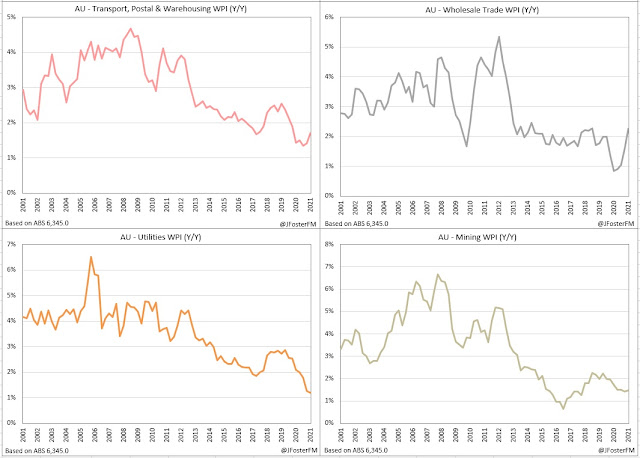
In the goods-related sector, the main development is the acceleration seen in wages growth in the construction industry. Very strong demand for construction from stimulus measures and rising housing prices is creating competition for labour and this has pushed up wages growth in construction to a 7-year high at 2.6%Y/Y, though that is a modest pace in a historical context. Wages growth in manufacturing, retail and wholesale trade has recovered to around their pre-pandemic rates.


In the household services sector the effects of the pandemic are continuing to play out. Wages growth in health care, education and training and arts and recreation is yet to retrace their pandemic induced slowdown. This is to be expected given the widespread lockdowns that were in place in large parts of the nation in Q3 and the public sector wage policies that would be applying to health care and education industries in particular. On aggregate, wages growth in accommodation and food services is now a little above its pace in the years prior to the pandemic. This may be reflecting shortages for hospitality workers in the states that were not affected by lockdowns in Q3. 


Wage Price Index — Q3 | Insights

There are signs in today's report that wages growth in Australia is moving back towards pre-pandemic norms, but the pace remains low and is well short of what the RBA assesses would be consistent with an economy generating sustainable 2-3% inflation. There remains an absence of broad-based pressure on wages, though labour shortages look to be having a clear effect on wages growth in professional services and in construction. The "inertia" to which RBA Governor Philip Lowe referred to in yesterday's speech is likely to hold back wages growth stemming from enterprise agreements and changes in award rates. The area to watch is wages growth coming from individual agreements that can be more responsive to the labour market recovery. 

Preview: Wage Price Index Q3

Australia's Wage Price Index (WPI) for the September quarter is due to be released by the ABS at 11:30am (AEDT) today. The WPI measures wage inflation for employers in the Australian labour market. As RBA Governor Philip Lowe noted in his speech yesterday, with wages growth seen as "one of the guideposts" to meeting the target of sustainable 2-3% inflation this series carries a lot of weight going forward. The reversal of temporary wage cuts and freezes implemented early in the pandemic and the recovery in the labour market has seen wages growth rebound from the depths of 2020 over recent quarters. In today's report, annual growth in the WPI is expected to have returned to its pre-pandemic pace at a little above 2% despite the Delta lockdowns.  

As it stands Wage Price Index

In the June quarter, the WPI printed below consensus estimates rising by 0.4%q/q to be 1.7% higher through the year. After slowing sharply in 2020 to a record low by Q3, annual growth in the WPI has lifted over recent quarters as temporary wage freezes and cuts implemented at the outset of the pandemic have been reversed. However, the WPI was still yet to recover to its pre-pandemic pace. 


The private sector WPI increased by 0.5% in Q3, moderating from the pace in the previous two quarters. Annual growth firmed from 1.4% to 1.8%. For the third consecutive quarter, growth in the public sector WPI was 0.4%q/q as existing wage caps and freezes were retained. A base effect established a new record low for annual growth as it eased from 1.5% to 1.3%. 


Before the recent Delta lockdowns, the strong recovery in the labour market had not generated broad-based wages pressure. Firms had generally responded by using non-wage strategies to retain or hire staff including sign-on or retention bonuses or offering more flexible working conditions to employees rather than raising base rates of pay. In the release, the ABS noted that there were only "a few isolated examples of skills shortages placing pressure on employers to meet expected market rates".  

Market expectations Wage Price Index

For the September quarter, the market consensus is for a 0.6% rise between a range from 0.4% to 0.8%. Such an outcome would lift annual growth from 1.7% to 2.2%, driven by base effects with the low point for wages growth in the pandemic falling out of the calculation.  

What to watch Wage Price Index

The main point markets will be interested in from today's release is how wages growth is tracking relative to the RBA's expectations. The recent RBA Statement on Monetary Policy forecast wages growth to reach 2¼% by the end of the year and rise only gradually thereafter. This is predicated on the "inertia" Governor Lowe referred to yesterday when he spoke about the wage-setting process in Australia. The effects of annual resets on the minimum wage, the presence of multi-year enterprise bargaining agreements and the slow adjustments to public sector wages meant that an acceleration in wages pressure would be difficult to generate. 

Thursday, November 11, 2021

Macro (Re)view (12/11) | Transitory put to the test

The key event in Australia this week disappointed markets as October's labour force data came in weaker than expected. Employment was down for a third consecutive month falling by 46.3k against a median estimate (+50.0k) that was factoring in a reopening boost. The unemployment rate pushed up from 4.6% to 5.2%, exceeding the most bearish of forecasts (see summary charts below). Much of this weakness can be attributed to the earlier timing of the survey reference period, coming ahead of the end of the lockdowns and also coinciding with school holidays in several states. As a result, the continuation of the lockdown in Victoria weighed heavily in October. But there were positive outcomes for employment, participation and hours worked in New South Wales ahead of the state's reopening and this should be the start of what is to come as the recovery broadens out. Notably, participation in NSW had started to rebound rising from 61.8% to 62.6% and this drove the first increase in the national participation rate (64.5% to 64.7%) since the Delta lockdowns. With indicators of labour demand very elevated, participation returning to the record highs seen earlier in the year is key to the recovery. For a full review of the October Labour Force Survey see here.   


Survey data through the week were broadly supportive of a strong reopening rebound about to come through. Consumer sentiment on the Westpac-Melbourne Institute index lifted by 0.6% in November and remained at a strong level (105.3). The key outcomes were rising confidence in the economic outlook on both the 12-month (3.3%) and 5-year (2.6%) time horizons, supported by the now very high vaccination rates in the country. However, even more notable was the sharp fall in unemployment expectations to their best levels in around 25 years, with households sensing strong labour market conditions. All these indicators are clear positives for the household spending outlook. Meanwhile, the NAB Business Survey for October reported a reopening-driven surge in the confidence (+21 from +10) and conditions (+11 from +5) measures. However, price pressures for many businesses were on the rise, with input prices lifting to a decade high on the back of the constraints in global supply chains. 

— —    

Moving offshore where it was the sharp upside outcome on US CPI inflation that gained much of the focus given the Federal Reserve's expectation for price pressures to be transitory12-month headline CPI lifted from 5.4% to 6.2% (vs 5.9% exp), its fastest since November 1990, while the annual core rate is now running at a high dating back to August 1991 after increasing from 4.0% to 4.6% (vs 4.3% exp). Supply constraints associated with the pandemic are continuing to keep the heat on inflation, but there were signs in the report that these pressures were broadening out. This was evident in services where the 12-month pace increased from 3.2% to 3.7% (and from 2.9% to 3.3% for the index excluding energy services), and also in housing costs as rents advanced from 2.4% to 2.7% and owners' equivalent rent pushed up to 3.1% from 2.9%. Strong consumer demand saw inflation for durable goods reaccelerate in October (to 13.2%Y/Y) after easing in the past few months. Meanwhile, energy prices elevated further to 30.0%Y/Y responding to supply shortages. Looking ahead, with pipeline inflation remaining high at 8.6%Y/Y on the PPI, upward pressure on consumer prices is set to persist as the Fed awaits a broader recovery in the labour market. 


In the UK, supply constraints and the rise of the Delta variant look to have been the contributing factors behind the slowing in the pace of the recovery. In Q3, GDP moderated to a 1.3%q/q rise after the reopening-boosted 5.2% lift in Q2. This brought UK GDP to within 2.1% of its pre-covid level; a threshold it is likely to return to by Q1 next year. In the most recent quarter, an easing in growth in household consumption, from 7.2%q/q to 2.0%q/q, drove the overall slowdown. There were signs of the Delta impact with spending growth in some areas such as restaurants and hotels and transport slowing, though overall the profile suggested the broader rebalancing away from goods into newly available services was continuing. Supply constraints may accelerate this shift, especially considering the inflationary pressures on goods. 


In the continent, despite headwinds to the outlook from supply constraints and rising inflation, the latest forecasts prepared by the European Commission show the economy is on track to move from recovery to expansion. Forecast EU GDP growth for 2021 was lifted from 4.8% to 5.0% before moderating to 4.3% in 2022 and then to 2.5% in 2023. The inflation forecasts have been lifted sharply, now seen hitting 2.4% this year from 1.9% previously, while there is a 0.8ppt uplift expected in 2022 to 2.2% before cooling to 1.4% in 2023.  

Wednesday, November 10, 2021

Australian employment -46.3k in October; Hours worked -0.1%

Australian employment declined against market expectations falling by 46.3k in October, largely reflecting the effects of the lockdown in Victoria. North of the border, there were positive signs for the recovery in New South Wales where employment, participation and hours worked all lifted ahead of the reopening. With lockdowns now ended and indicators of labour demand elevated, the recovery should broaden out over the coming months. The speed of the rebound in participation back to pre-Delta levels is now the key factor for the recovery. 

Labour Force Survey — October | By the numbers
  • Employment (on net) fell by 46.3k in October, disappointing the market consensus for a rise of 50.0k. September's fall was revised to show a larger decline of -141.1k from -138k previously.
  • Headline unemployment lifted from 4.6% to 5.2% (vs 4.8% expected), reflecting rises in unemployment and in the labour force.  
  • Labour force participation increased slightly, to 64.7% from 64.5%, driven by a return of workers in NSW (+0.8ppt to 62.6%).  
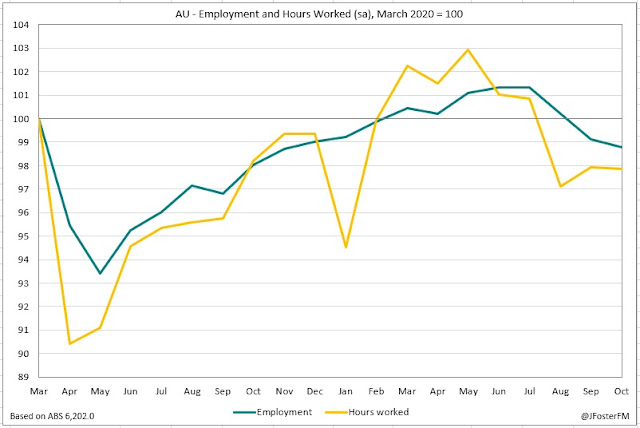
  • Hours worked softened in October falling by 0.1%m/m (-0.4%yr). A 3.9% surge in NSW ahead of the reopening was offset by weakness associated with the Victoria lockdown and school holidays in the other states. 


Labour Force Survey — October | The details

A number of crosscurrents affected the outcomes in today's labour market update. As touched on in the preview, the ABS shifted the reference period for the October survey forward by a week relative to what would normally have been the case, due to 2021 being a Census year. This meant that the reference period ended on October 9, before NSW had reopened and around 2 weeks before restrictions started to be eased in Victoria. It also reflected the effects associated with school holidays in some of the other states, between late September into early October. Although the ABS's seasonal adjustments are applied to account for the earlier reference period, this was an especially unusual time when considering the lockdowns in the two most populous states.    

These factors help to explain the weakness in October's employment outcome of -46.3k relative to the 50k rise forecast by markets. Overall, this takes the fall in employment over the Delta lockdowns to -333.7k since July. This represents a contraction of 2.5% over the period, much smaller than the 6.6% fall seen at the outset of Covid. In October, the full time segment (-40.4k) drove the headline fall in employment, with part time employment down modestly (-5.9k). But over the Delta lockdowns, part time employment has fallen by 250.3k, substantially larger than the 83.4k fall in the full time segment.  


Across the states in October, preparations ahead of the reopening led to a 21.7k rise in employment in NSW. But with the lockdown continuing in Victoria employment there fell by another 49.6k. Declines were also seen in Queensland (-7.8k), Western Australia (-4.4k) and Tasmania, coinciding with school holiday periods. 

Nationally, hours worked were down 0.1% for the month, smaller than the decline in employment (-0.4%). This left total hours worked down 2.1% on pre-pandemic levels. The recovery in NSW continued in October with hours worked up 3.9% after the tide started to turn in September with a 2.7% rise. However, the gain in NSW was offset by the impact of the lockdown on hours worked in Victoria (-4%m/m), while hours worked across the other states and territories fell sharply (-6.8%m/m) reflecting people taking leave during school holidays. According to today's report, around 189k people worked zero hours in October due to 'economic reasons', including around 97k in Victoria rising substantially from the previous month (74.2k).   


These dynamics also affected participation in the month. Nationally, the participation rate lifted slightly, from 64.5% to 64.7%, recording its first rise since May. NSW drove this increase as people started returning to the labour market ahead of the reopening; participation in the state lifted from 61.8% to 62.6% but was still well down on pre-Delta levels. However, the lockdown drove a further fall in Victoria (64.6% from 64.9%). Participation across the other states fell in Queensland, Western Australia and Tasmania but lifted in the other regions, including a 0.2ppt rise in the ACT (68.4%) as its lockdown came to an end. 


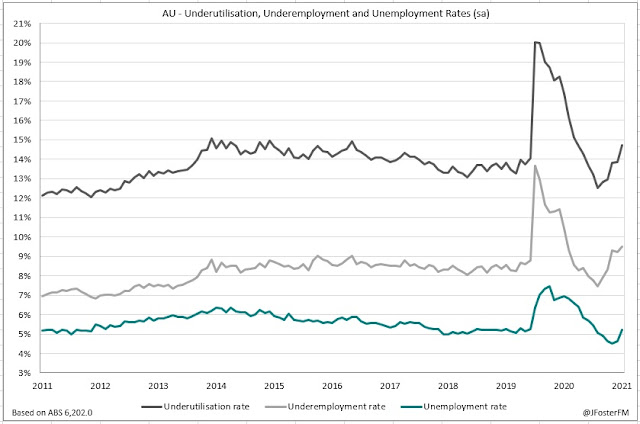
The configuration of rising participation into falling employment drove a sharp increase in the unemployment rate, from 4.6% to 5.2%, to its highest level since April. As more people return to the labour force in the coming months, the unemployment rate could drift higher, but the very elevated level of job vacancies, including the 7.8% rise reported by the federal government for October this week (see here), highlights labour demand is very strong. Reflecting the disruptions from lockdowns through the hit to hours worked, broader measures of spare capacity have been on the rise since mid year and this continued in October. The underutilisation rate has risen to 14.7% and the underemployment rate is now at 9.5%, with both backing up to their highest levels since late 2020.   

 
Labour Force Survey — October | Insights

A weak report today but this is one that more reflects statistical volatility than the underlying conditions in my interpretation. With lockdowns having run their course after vaccination rates reached key thresholds, the consensus can now form around a larger rebound in November than previously expected. Labour demand is clearly elevated in many industries and will support hiring. The key to the recovery now is the extent and pace at which participation rebounds.

Preview: Labour Force Survey — October

With the end of the Delta lockdowns in sight, today's Australian Labour Force Survey (due at 11:30am AEDT) is expected to show the recovery getting underway in October. Participation and employment are likely to have increased as preparations for reopening ramped up, while the rebound in hours worked should also continue after rising in September.    

As it stands | Labour Force Survey

In September, Australian employment fell to its lowest level since the start of the year as the Delta lockdowns continued. Following on from August's 146.3k decline, employment was down by a further 138k in September (vs -110k expected). In this latest outturn, the weakness came entirely in the part-time segment (-164.7k), extending its fall from August (-78.2k). Full-time employment posted 26.7k rise in September, partially rebounding from the month prior (-68k).  


With large parts of the nation in lockdown, many workers had been stood down or were on reduced hours in recent months. For the period between May and August, hours worked had declined by 5.6%. September saw the early signs of recovery as hours worked lifted by 0.9%m/m, driven by rebounds in Queensland (5.4%) and New South Wales (2.7%).


The labour force participation rate was around record highs prior to the Delta lockdowns but had subsequently fallen to a 15-month low at 65.4% by September. This reflects the effects of the stay-at-home restrictions and the relaxation of income support requirements. In NSW, the fall had exceeded the depths seen at the outset of the pandemic, with participation in the state crunched to a 17-year low (61.8%). 


Nationally, the fall in participation has been larger than the decline in employment; a configuration that has seen the unemployment rate moving lower over recent months, from 5.1% in May to 4.5% in August before ticking up to 4.6% in September. A more reliable guide to conditions has come from underutilisation and underemployment, which factor in the loss of hours worked and these measures have backed up sharply over the lockdown period as a result.  


Market expectations | Labour Force Survey

The market expects the recovery to have gained traction in October, with the consensus for employment at 50.0k. However, the range of estimates around today's outcome is wide, sitting between -50k to 120k. Australia's unemployment rate is forecast to move up to 4.8% from 4.6% (range: 4.5% to 4.9%), driven by increasing participation. The extent to which upcoming reopenings were able to draw workers back to the labour force is the major uncertainty.  

What to watch | Labour Force Survey

One point to highlight is that the ABS has advised that the reference period for today's survey shifts forward by a week relative to what would normally be the case, due to 2021 being a Census year. In this case, today's survey will be reflecting hiring done in preparation for the reopening, before the lockdowns had ended. Yesterday's high-frequency payrolls data suggests this will mainly be coming from NSW and the ACT, with Victoria's initial reopening not occurring until later in the month. The weakness in the other states is likely associated with school holidays. Overall, the change in hours worked and participation rate will be the key indicators of the state of labour market activity. 

Friday, November 5, 2021

Macro (Re)view (5/11) | Patience takes many forms

In Australia, the RBA at this week's meeting validated an improving economic outlook and the global repricing at the front end of curves by withdrawing its 3-year government bond yield target and removing its 2024 guidance for rates to start rising. The RBA's updated forecasts in the November Statement on Monetary Policy factor in a larger hit to the economy from the recent lockdowns than previously anticipated, but it sees a strong rebound occurring over Q4 and Q1 following the rollout of the vaccine and easing of restrictions. This has driven the growth outlook for 2022 up from 4¼% to 5½%, moderating to growth around trend in 2023 at 2½%. Key to this week's moves from the Board was the upward revision to underlying inflation across the forecast period, reaching the midpoint of the target by the end of 2023. However, keeping it there will require a tighter labour market to generate a faster pace of wages growth, with Governor Philip Lowe saying in the post-meeting press conference that the Board could be patient with rates given this configuration of outcomes. For a detailed review of this week's RBA meeting see here.

To the activity data where retail sales volumes posted their steepest contraction on record with a 4.4% fall in Q3 (reviewed here). Combined, volumes across New South Wales and Victoria were down by 8.5% in the quarter, a significantly larger hit than seen at the outset of the pandemic (-5.4%) reflecting the tighter restrictions on in-store retail this time around. However, with national nominal sales returning to growth in September (1.3%) and the lockdowns now ended, a strong rebound is in prospect in the run-up to Christmas. The ongoing unwind of the HomeBuilder grants led to another fall in dwellings approvals, down 4.3%m/m in September (reviewed here), while housing finance commitments declined by 1.4% for the month heavily impacted by the lockdown in Victoria (reviewed here). Remaining with housing, CoreLogic reported a 1.5% rise in house prices nationally in October, to be 21.6% higher than a year ago. While prices remain on the rise, the pace of the gains is on a slowing trajectory. Meanwhile, Australia's trade surplus narrowed for the first time in 6 months but remained at an elevated level of $12.2bn in September driven by strength in prices for major commodity exports (reviewed here).  

— — 

The long-awaited decision from the Federal Reserve on tapering its QE purchases was announced at this week's meeting. Assessing that the US economy had made "substantial further progress" towards meeting its employment and inflation objectives, the Committee decided the time was right to start dialing back QE. Consistent with the plans discussed in the September minutes, the Committee announced a $15bn taper that will slow the monthly pace to $105bn initially. Purchases will then reduce to $90bn in December and are planned to keep slowing by $15bn per month thereafter so that QE is wound up by the middle of next year. However, the Committee noted that this schedule could be adjusted if "changes in the economic outlook" warranted it. The decision statement also made a tweak to the Committee's messaging on inflation. It now notes that elevated inflation was reflecting factors "expected to be transitory", a softer stance than its earlier assertion of "transitory". 

Speaking in the post-meeting press conference, Chair Jerome Powell said that the central view of the Committee was that inflation would continue to be elevated well into 2022 but would eventually be reined in as the effects of the pandemic fade and the supply side of the economy recovers. Given that assessment, Chair Powell said that the Committee could be patient as it waited for inflation to slow, not wanting to raise rates and risk curtailing the pace of recovery in the labour market. On the labour market, encouraging news was at hand with nonfarm payrolls coming in above consensus at 531k in October vs 450k expected, indicating the economy is coming out of Q3's Delta-driven slowdown with momentum. Upward revisions saw a net 235k added back to payrolls for the prior two months. The strong employment outcome led to declines in both unemployment (4.6% from 4.8%) and underemployment (8.3% from 8.5%). However, the issue remains a constrained supply of labour, with the participation rate unchanged at 61.6% and still well down on pre-pandemic levels above 63%. This is adding to wages pressure, with annual growth in average hourly earnings pushing up from 4.6% to 4.9%.  

At the Bank of England's meeting, market expectations for a rate hike were dashed as the Bank Rate was left unchanged at 0.1% in a 7-2 analysis by the Monetary Policy Committee. The minutes that accompanied the statement noted that "there was value in waiting for additional information on near-term developments in the labour market" before deciding to hike rates. With transitional effects from the recent end of the UK's pandemic furlough scheme playing out, the MPC will now have the benefit of more data to establish a better read on conditions ahead of its next rate decision in mid-December. The guidance from the MPC is that "some modest tightening of monetary policy over the forecast period was likely to be necessary" to meet the inflation target, with this process to start "over coming months". That markets have overdone this appears to be the MPC's central message. Governor Andrew Bailey noted in the post-meeting press conference that under the conditioning assumption of rates moving in line with the market curve, inflation would be coming in below target and an output gap would be emerging in the UK economy by the end of 2024, according to the forecasts published by the Bank this week in its November Monetary Policy Report. In the near term, the outlook for the UK economy is a challenging one, with forecast growth in Q4 2021 downgraded by 1ppt to 1% due to supply chain constraints and surging energy prices. These factors will keep the pressure on inflation, which is expected to rise to a 5% pace by April next year. Over in Europe, there was pushback on market pricing from the ECB, with President Christine Lagarde using a speech to say its forward guidance for raising rates was "very unlikely to be satisfied next year".

Thursday, November 4, 2021

Australia's trade surplus narrows to $12.2bn in September

Australia's trade surplus moderated from a record high coming in at $12.2bn in September. This was the first narrowing seen since March, with the trade surplus pushing higher and higher over the period on the tailwinds from surging commodity prices. 

International Trade — September | By the numbers
  • Australia's trade surplus narrowed by $2.5bn in September to $12.2bn, broadly in line with consensus. August's record high surplus was revised down to $14.7bn from $15.1bn.  
  • Export earnings fell by 6.4%m/m to $45bn (prior: 3.6%m/m), slowing growth over the year to 33.3% from 46%.   
  • Import spending declined by 1.8% for the month to $32.7bn (prior: 1.8%m/m), with annual growth rising to 16.3% from 10.6%. 


International Trade — September | The details

The nation's trade surplus narrowed for the first time in 6 months falling by $2.5bn in September. This saw the trade surplus decline from a record high in August to $12.2bn, though it was still the third largest on the ABS's records that date back to the early 1970s. Over the quarter, the trade surplus smashed all prior records elevating above $40bn, an increase of almost 30% from Q2. Exports were up 9.1% in Q3 despite a fall in iron ore (-1.8%) as prices rolled over from elevated levels. The heavy lifting was done by coal (47%) and other mineral fuels (38.4%) as energy prices across global exchanges surged.  Imports posted a 2.3% rise in Q3, with intermediate goods the key contributor (7.8%). This looks to reflect the rise in input prices associated with the global supply chain shortages. 


Export earnings were down by 6.4%m/m on the back of weakness in non-rural goods (-6.3%). This reflected a sharp fall in iron ore exports (-15.9%), with the ABS's estimates suggesting prices for the commodity were down by around 20-30% for the month. This was able to be partially offset by increases in coal (5.8%) and other mineral fuels (7.9%). Rural goods exports were around unchanged on the month (0.3%) and remain at record high levels. Global demand for many of Australia's rural commodities is high and the rise in prices means the sector is continuing to deliver a sizeable contribution to national income. Services exports (3.3%m/m) remain at very low levels due to the international border closure.


Import spending was down 1.8% in September, weighed by a sharp fall in consumption goods (-10.1%m/m). This may have been weakness associated with the domestic lockdowns, as imports of new vehicles plunged (-37.6%m/m). Partial offset came through from capital goods (6.9%m/m). Intermediate goods were little changed (-0.5%m/m) around record highs. Services imports lifted by 4.4%m/m but are roughly only at half the level that prevailed before the outset of Covid, largely due to the restrictions on offshore travel.


International Trade — September| Insights

Net exports were a sizeable drag on activity in Q2, taking 1ppt away from headline growth (0.7%). The Delta lockdowns are likely to see a contraction of around 3% for Q3 GDP, though net exports look like making a sizeable positive contribution to output and may be able to attenuate the magnitude of the decline to some degree. The terms of trade reached a record level in Q2 and appear likely to push higher again.   

Wednesday, November 3, 2021

Australian retail sales 1.3% in September; Q3 volumes -4.4%

Australian retail sales volumes fell by 4.4% in the September quarter, the largest quarterly contraction on record as many retailers were closed during the lockdowns in New South Wales and Victoria. The start of the easing of restrictions saw retail sales return to growth by the end of the quarter, with turnover rising by 1.3% in September. 

Retail Sales — September | By the numbers 

  • Retail turnover (nominal terms) lifted by 1.3% in September to $29.7bn, in line with the preliminary estimate. Turnover fell by 1.7% in August. 
  • Year-on-year growth turned positive on this outcome, rising to 1.7% from -0.7%. 


  • Retail volumes (real terms) contracted by 4.4%q/q against expectations for a larger fall of -5%. Volume growth through the year fell to -2.2% from 8.8%. Retail prices were near flat in Q3 (0.1%) due to discounting associated with the lockdowns.  


Retail Sales — September | The details  

The Delta lockdowns led to a 4.4% contraction in retail sales volumes in Q3, exceeding the decline seen at the outset of the pandemic. This was driven by a very large decline in New South Wales (-11.6%q/q) where restrictions on retail trade were tighter than compared with the 2020 national lockdown, while Victoria also posted a sizeable fall (-4.5%q/q) as the lockdown there became more stringent. The chart below illustrates that the Delta lockdowns had a much more severe impact on the sector in New South Wales than during the first wave of Covid. Retail volumes advanced in the other states that remained open: Western Australia (4.1%), Tasmania (2.2%) and South Australia (1.7%), but growth in Queensland was flat (0.2%) after a short lockdown in the capital city.  


Looking at the category details, the effects of the lockdowns in New South Wales and Victoria crunched discretionary (non-food) retail, down 10.8% in the quarter. That compares with a fall of 7% in the first half of 2020. The largest declines were seen in clothing and footwear (-25.1%q/q), department stores (-19.5%q/q) and cafes and restaurants (-18.7%q/q). Food sales benefitted from the stay-at-home restrictions, up 5.3%q/q to almost match the surge from Q1 2020. 


As foreshadowed in last week's CPI data, there was very significant discounting that occurred in clothing and footwear in Q3 (-3.8%q/q), as retailers cut prices to clear winter inventories and to generate cash flow. This also occurred in department stores, with prices there down 2.6%q/q. Food prices fell by 0.6%q/q, with the CPI data showing a fall in fruit prices in Q3. These declines held overall growth in retail prices to a 0.1% rise in Q3, down from 0.7% in Q2.   


The good news is that nominal retail sales returned to growth in September with a 1.3%m/m rise after falling in each of the prior 3 months. This was driven by a 5.2% rise in Queensland as virus concerns eased and by the start of the reopening in New South Wales (2.3%). Sales ex-food posted a much larger rise (3.6%) than the headline increase. This was supported by rebounds in clothing and footwear (5.9%), cafes and restaurants (5.0%) and household goods (4.3%) after falls in August.    


Spending in the online segment continued to rise in September (3.4%), though the pace was much slower than the surges seen in each of the prior 3 months that ranged between 14-17%. Non-food sales were up 4.5%m/m and food sales were broadly flat (0.3%m/m). Over Q3, total online sales surged through $12bn, with around $9bn of this occurring in the non-food space. 


Retail Sales — September | Insights

The Australian economy likely contracted by around 3% in Q3, with the bulk of this linked to falling household spending due to the lockdowns following the Delta outbreaks. The rise in nominal sales in September is an encouraging sign during what was the very early stages of reopening in New South Wales. High-frequency indicators on household spending have shown strong momentum since the lockdowns were ended, and with a more accelerated easing of restrictions occurring this points to a robust rebound in Q4.