Independent Australian and global macro analysis

Tuesday, November 2, 2021

Australian dwelling approvals fall 4.3% in September

Australian dwelling approvals continue to unwind from record levels earlier in the year on the withdrawal of construction stimulus. Approvals saw their sharpest quarterly fall in nearly 5 years but were still at much higher levels than prevailed prior to the pandemic. With the stimulus measures pulling approvals forward, there is a very elevated volume of work coming down the pipeline.
  
Building Approvals — September | By the numbers
  • Dwelling approvals (seasonally adjusted) fell by more than expected in September, down 4.3%m/m to 18,090 against a forecast decline of 2%. The ABS revised its estimate of approvals in August higher, adjusting the previously reported rise of 6.8% up to 7.6%. Annual growth in approvals slowed to 12.8% from 32.5%. 
  • House approvals declined by 16.1% to 10,275 (prior: 4.3%m/m), with annual growth slipping into contraction (-3.5%) for the first time since June 2020.  
  • Unit approvals lifted by 17.4% on the month to 7,815 (prior: 14.4%m/m), leaving annual growth a little slower at 44.9% from 49.1%. 


Building Approvals — September | The details 

The end of construction stimulus from the federal government's HomeBuilder scheme continues to see dwelling approvals unwind after reaching a record high level earlier in the year. The HomeBuilder scheme closed to new applicants in mid-April. In September, dwelling approvals were down 4.3%, as house approvals fell by 16.1%. But a 17.4% rise in unit approvals moderated the headline fall. For Q3, dwelling approvals were down by 12.4% on the previous quarter, for its largest quarterly decline in nearly 5 years. Approvals at the headline level are down 23.1% on March's record high.  


However, even with the effects of the HomeBuilder scheme unwinding, dwelling approvals were around 55.5k for the quarter, well above the levels seen prior to the pandemic. House approvals contracted by 18.3% in Q3 but were still very elevated at 34.3k over the period. Against this broader decline, unit approvals were broadly flat in Q3 (-0.3%), with the HomeBuilder grants targeted at the detached segment. 


These trends can be seen more clearly in the disaggregated data. As house approvals have declined from record highs over recent months, higher density approvals have been rising, but note the data for the latter are not seasonally adjusted by the ABS. Approvals for both high rise and townhouse developments have risen off their pandemic-driven lows reached earlier in the year.   


Residential alteration approvals, which qualified for the HomeBuilder grants, are in the process of unwinding from record levels. However, they recorded an outsized decline in September of -20%m/m, likely associated with the temporary suspension of activity in the construction sector amid the Sydney lockdown, restricting the ability for people to plan renovations.


At the state level, approvals continue to pullback reflecting the end of the HomeBuilder scheme. This has been sharpest in the states outside New South Wales and Victoria. Volatility associated with lockdowns is impacting the major two states.


Approvals in the non-residential segment were lower in September (-11.3%) and over the quarter (-8.4%) and appear to have weakened in response to the setback with the pandemic from the middle of the year. 


This weakness looks to be centred in both commercial (including retail, wholesale and transport sectors) and industrial approvals.


Building Approvals — September | Insights 

While dwelling approvals are on the decline, the stimulus measures had the effect of bringing demand forward and elevating the level of work in the pipeline. This should support residential construction activity through much of the next year, though capacity constraints and rising costs are headwinds that could slow the pace at which the sector can work through it.    

RBA removes yield target and 2024 forward guidance

The RBA at today's meeting elected to call time on its 3-year government bond yield target, removing one of the emergency measures implemented by the Board at the outset of the pandemic. An expected strong rebound in the economy from the recent Delta lockdowns and rising inflation pressures have led the Board to move away from its previous 2024 guidance on rate hikes, switching to a more data-dependent focus going forward. However, the RBA's revised forecasts have pushed back against aggressive market pricing, not signalling a rate rise until well into 2023. The cash rate was left at 0.1% and QE purchases will continue at the $4bn weekly pace. 

Strong rebound: Higher inflation 

In today's decision statement, Governor Philip Lowe outlined the key changes to the Bank's economic outlook. Overall, the revised outlook was less robust than I had anticipated in my preview, but the main themes were the same: the economy is expected to rebound strongly from the recent lockdowns and inflation pressures are rising. GDP growth in 2021 was lowered to 3% from 4% previously, reflecting a larger hit to activity from the Q3 lockdowns than the Bank had earlier forecast. However, the high rate of vaccination and eased restrictions has boosted GDP for 2022 from 4¼% to 5½%, with this rebound cycled into growth at an around trend pace in 2023 (2½%). Unemployment remains on the same downward trajectory anticipated in August, falling to 4¼% next year and then to 4% in 2023. 

The key shift from the RBA has come in its inflation outlook, prompted by the upside surprise in Q3's CPI data. Higher fuel prices, the surge in residential construction costs, and the effects of the global supply chain constraints are seen lifting trimmed mean inflation to 2¼% in 2021 (up from 1¾%) and being sustained at that pace through 2022 (from 1¾%). It then firms a little further to 2½% by the end of 2023, hitting the midpoint of the target band earlier than forecast in August. The expectation is that upward pressure on wages will continue to be a gradual process. Wages growth in 2022 was left at a 2½% pace, though there was a slight upgrade in 2023 to 3% (from 2¾%), the level the Bank has said is required to meet the inflation target.  

Yield target removed: Forward guidance shifts to a more state-based focus

The decision to end the 3-year yield target policy is an effective validation of the repricing seen at the front end of yield curves across the globe. With markets bringing forward rate hike expectations, Governor Lowe said in his post-meeting press conference that holding the 3-year government bond rate at 0.1% in support of its forward guidance to keep rates unchanged through 2024 was no longer credible. 

Accordingly, the removal of the yield target has prompted a shift in forward guidance. Previously, in addition to achieving its employment and inflation objectives, the Board had said that a rate hike was not expected "before 2024". But there is now no specific timing attached to when the cash rate is expected to rise, leaving the data to dictate the timeline. The conditions needed for a rate hike are: "...actual inflation... sustainably within the 2 to 3 per cent target range" together with a "...labour market... tight enough to generate wages growth that is materially higher than it is currently". 

In a pushback to market pricing, the statement goes on to say that "The Board is prepared to be patient..." in achieving its objectives. And then the Governor validates this by noting that its inflation forecast is "...no higher than 2½ per cent at the end of 2023" and is accompanied by gradually rising wages. Overall, the revisions to the forecasts point to a rate rise occurring sometime in 2023, likely in the second half. But if there was any doubt, Governor Lowe said in the post-meeting press conference that the new outlook does "...not warrant an increase in the cash rate in 2022".  

QE continues 

The commitment to maintaining QE purchases at the $4bn weekly pace through February next year was reaffirmed. It was also noted that these purchases will now include the April 2024 bond, which was the target bond for the yield target, though it already holds 63.5% of this line. QE will next be reviewed in February. Tapering has been made contingent on an assessment of progress towards the Board's employment and inflation objectives, the moves taken by other central banks, and overall bond market functioning. 

Monday, November 1, 2021

Preview: RBA November meeting

What a difference a month can make. At the conclusion of the RBA's October meeting, policy appeared set to chart a steady course over the summer as states reopened from extended lockdowns and as the recovery got back on track. But with global inflation concerns mounting, markets have issued a stern challenge to the lengthy timelines for rate hikes put forward by central banks. In what shapes as an important juncture, the RBA gets its chance today to reset expectations, while the Federal Reserve and Bank of England will get theirs later on this week. The writing appears to be on the wall for the RBA's 2024 rate hike guidance and associated yield target policy after last week's severe repricing in the bond market, but a revised set of economic forecasts may be used to signal back to the markets that policy tightening expectations are overdone.

For today's meeting (decision due at 2:30PM AEDT) interest rates (0.1%) and QE ($4bn per week) are likely to remain unchanged, but there could be changes to the tools the RBA will use and to its forward guidance for rate hikes. 

Economic Forecasts 

The RBA will publish its revised economic forecasts this week, and while they won't be available until Friday's quarterly Statement on Monetary Policy, they will be in front of the Board today. My expectation is for those forecasts to be upgraded significantly, broadly in line with the 'upside scenario' presented in August's quarterly statement.

Growth for 2021 will be lowered sharply, from 4% to around 1%, to incorporate a much more significant hit from the Delta lockdowns than the 1% contraction for Q3 previously expected. But very elevated vaccination rates and a faster easing of restrictions will boost growth in 2022 from 4¼% to something with a 6 in front of it, to be followed by growth at around trend in 2023. 

Despite some near-term upward pressure, the stronger growth profile will speed up progress in lowering spare capacity. August's upside scenario has unemployment falling to 3.5% by the end of 2023. A tighter labour market will encourage a faster pace of wages growth, potentially rising to the key 3% pace by the end of next year. 

Following last week's Q3 CPI data, inflation is already running ahead of the Bank's forecasts for 2021, while the stronger outlook for growth, employment and wages in 2022 and 2023 adds upward pressure through this key window for policy determinations. August's upside scenario has trimmed mean inflation hitting the midpoint of the 2-3% target sometime in 2023, rising to 2¾% by the end of that year. 

Policy Options

A baseline outlook that is broadly consistent with the above is likely to be suggesting to the Board that its employment and inflation objectives will be met by around mid-2023. By that stage, the unemployment rate will be close to estimates of full employment at around 4%; trimmed mean inflation will be around the middle of the target band; and crucially, wages growth will be around the 3% pace the RBA assesses as required to keep inflation running between 2-3%. In this context, the 3 policy options I see as most likely to be announced at today's meeting are discussed;    

  • Option 1: Remove the 3-year AGS yield target: If the RBA's forecasts point to a rate hike earlier than its current 2024 guidance, then the yield target policy (focusing on the April 2024 bond) can be removed.  
  • Option 2: Shift the 3-year AGS yield target forward: A variation on option 1. Forward guidance is recalibrated to the outlook as above, but it is backed by the yield target moving to an earlier maturity, the April 2023 line.  
  • Option 3: Retain the existing 3-year AGS yield target: If the revised outlook turns out not to be as robust as that discussed above, it is possible the RBA will retain its 2024 guidance and associated yield target. The RBA owns 63.5% of the $32.9bn April 2024 line, so there remains scope for further purchases in support of the 0.1% target.   

My expectation is along the lines of option 1, where the Board formally removes the 3-year yield target policy in response to an economic outlook that is consistent with rates starting to rise earlier than the current 2024 guidance. The decision not to defend the 0.1% target last week suggests that the policy may have run its course. But in this scenario, the Board may elect to tweak its forward guidance, to more of a state-based rather than a date-based approach. The revised forecasts would then signal to markets that rate hike pricing has moved too aggressively. With a focus on actual outcomes, a rate hike could be made conditional on inflation being confirmed at (or close to) the target and then forecast to remain or to be rising from there. This would need to be underpinned by wages growth running at 3% (or close to it), generated by a labour market assessed at full employment.  
 
QE Tapering   

Back in September, the RBA stuck with its earlier call to taper the weekly pace of QE purchases from $5bn to $4bn, but it delayed the timing of the next review of the program from mid-November to mid-February 2022. This was about removing the risk of expectations for another taper building at a time when the economy would be recovering from the Delta lockdowns. Through its various communications this week, the RBA may choose to provide some clarity around the tapering timeline beyond February and the conditions needed for that to occur.  

Sunday, October 31, 2021

Australian housing finance down 1.4% in September

Australian housing finance commitments contracted by 1.4% in September, posting back-to-back declines for the first time since the outset of the pandemic. Victoria's lockdown weighed heavily on owner-occupier commitments, which nationally were down 2.7%m/m. In a repeat of what was seen in August, investor commitments were resilient to the broader weakness rising by 1.4%m/m. After surging to a record high level earlier in the year, housing finance commitments are now retracing as stimulus measures have expired or are getting close to running their course, while affordability concerns due to rising house prices and some modest tightening of policy settings will also have their say. 

Housing Finance — September | By the numbers
  • Housing finance commitments ($ value, ex-refinancing) were down 1.4% for the month in September to $30.3bn, coming off the back of August's 4.3% fall. Annual growth slowed further, from 47.4% to 35.5%. 
  • Owner-occupier commitments declined by 2.7%m/m (prior: -6.6%m/m) to $20.7bn (20.8%yr from 33.5%) 
  • Investment commitments increased by 1.4%m/m (prior: 1.5%m/m) to $9.6bn, with annual growth standing at 83.2% from 92.2% previously.   
  • Total refinancing activity contracted sharply, down 9.1% for the month (prior: 3.2%m/m) for its largest decline since last November, to around $16.2bn. That lowered annual growth to 24.7% from 58.1%. 


Housing Finance — September | The details 

Australian housing finance commitments fell further in September (-1.4%) after registering their sharpest month-on-month decline in 15 months in August (-4.3%). The major influence over this period has been the Delta lockdowns in New South Wales and Victoria. This month, New South Wales stabilised but Victoria pulled the national figure down as activity was severely curtailed by the lockdown. 


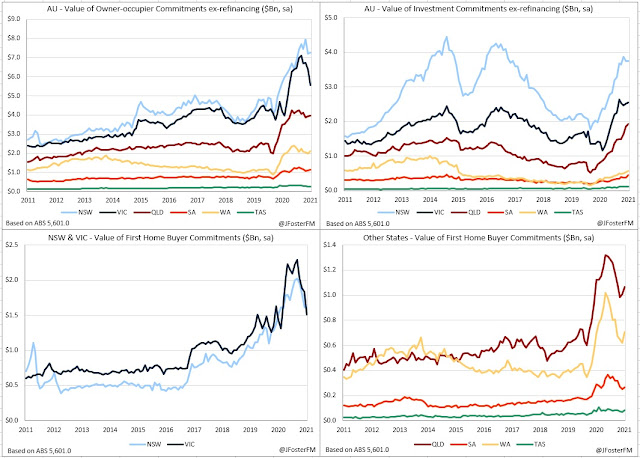
Owner-occupier commitments were down 2.7% for the month, a more moderate decline than seen in August (-6.6%). This was driven by a 12.7% fall in Victoria while Tasmania saw a small decline (-1.3%). Within the segment, there were broad-based falls: upgraders -2.4%, first home buyers -1.9% and from the construction-related area -5.4% with the earlier boost from the HomeBuilder scheme continuing to unwind.       


The weakness in commitments was also reflected in the approvals data, shown in the charts below. Construction-related approvals are falling at a faster rate than for upgraders with the HomeBuilder effect passing through. First home buyer approvals have retraced to mid-2020 levels on the withdrawal of incentives to that group, with affordability concerns likely also a contributor.  


Lending to the investor segment defied the broader weakness, lifting by 1.4% in the month. While still expanding, the pace has slowed markedly over the past 4 months from the surge seen earlier in the year. 


Refinancing activity fell sharply in the month, down 9.1% on an aggregated basis for its steepest decline since November 2020. But it must be said that refinancing hit a record high in the prior month and is still at very elevated levels. Refinancing to owner-occupiers fell 9.6%m/m and was down by 8.4%m/m to investors. 


Stepping back, the quarterly picture showed a sharp divergence between owner-occupiers and investors, though the effects of the lockdowns are a complicating factor in trying to reach conclusions. Total commitments were down by 2.6% in Q3, weighed by the owner-occupier segment contracting by 6.6%. Aside from the lockdowns, the end of the HomeBuilder scheme and the withdrawal of incentives to first home buyers was also occurring, with commitments to that group down 15.2% on the quarter. Investor commitments posted a 7.9% lift in Q3, with the tightening in some rental markets (outside Sydney and Melbourne) and rising house prices positive fundamentals for the segment.  


Housing Finance — September | Insights

An overall mixed picture in September as the lockdown in Victoria had an outsized impact on the headline result. Owner-occupier commitments were generally flat to higher across most of the other states and are at very elevated levels. Investor commitments remain on the rise but the momentum has slowed. Looking ahead, the reversal of stimulus measures still has further to run, while the effect of house prices — shown to have risen by more than 20% nationally over the year in the latest release from CoreLogic  on affordability are headwinds. There is also the recent announcement from APRA on the increase to serviceability buffers and speculation of further macroprudential measures. If interest rates are to rise sooner than currently expected by the RBA, that could also slow conditions more rapidly.

Friday, October 29, 2021

Macro (Re)view (29/10) | Policy reappraisals

The push from markets to bring forward rate hike expectations well ahead of the timelines signalled by central banks was on again this week, and nowhere more so than at home. Last Friday, the RBA had for the first time since February come back to the market to defend its 0.1% 3-year yield target following a small upward deviation. But this week it stayed on the sidelines as the yield on the targeted April 2024 line surged above 0.75% (see here)All indications are that the Board's current 2024 guidance will be recalibrated to the new forecasts to be presented in the November Statement on Monetary Policy, consistent with an earlier rise in the cash rate. Over at the Bank of Canada, the Governing Council came through with a hawkish set of announcements; new QE purchases are to cease, and with the inflation target expected to be hit sooner a rate rise is now forecast for "the middle quarters of 2022" from the "second half of 2022" previously. In contrast, vastly more patient stances were reiterated by the European Central Bank and Bank of Japan at their respective meetings this week, with the latter going against the trend by revising down its 2021 inflation outlook in its revised forecasts.   

Coming back to Australia, this week's Q3 CPI report (reviewed here) and the inaction from the RBA were the catalysts for the extraordinary repricing seen in the domestic bond market. Annual headline inflation actually slowed from 3.8% to 3.0%, but it was the stronger-than-expected outcome on underlying inflation at 2.1%Y/Y, which has moved back inside the RBA's target band for the first time in 6 years, that seems to have prompted a reappraisal on the outlook. That said, significant pandemic-related volatility is continuing to push and pull on the inflation data and this was accentuated by the Delta lockdowns in Q3. This week's developments are certainly interesting in the context of RBA Governor Philip Lowe's Anika Foundation speech in September where in relation to meeting the inflation target he said: "It won't be enough for inflation to just sneak across the 2 per cent line for a quarter or two"and that confidence in delivering sustainable 2-3% inflation would require: "wages... to be growing by at least 3 per cent" — something the official data are yet to show. In that speech, Governor Lowe had also strongly pushed back against the market pricing at the time for rates to start rising in 2022. The other interesting aspect is whether there will be any implications for the QE program if the RBA's guidance on rates comes forward. In September, the Board effectively pledged to keep QE running on autopilot through the summer at the rate of $4bn per week, giving time for the domestic recovery to gather pace before making its next move. A faster taper from February or even ending the program at that date could now be genuine options. On the recovery itself, there was good news as retail sales returned to growth in September with a 1.3% rise after falling in each of the 3 prior lockdown-impacted months. High-frequency data on card spending suggests the rebound in spending in the run-up to Christmas will be carrying strong momentum.  

In the US, markets are keenly awaiting next week's Federal Reserve meeting. With the Committee's stipulated pre-condition of "substantial further progress" on employment and inflation thought to have been achieved, a formal tapering timeline is expected to be announced. Indications are that the taper will be in the order of $15bn per month, leading to the end of QE by around the middle of next year. With markets pushing for a more aggressive response to high inflation  its preferred core PCE deflator is running at 3.6%Y/Y — the Fed will be keen to continue to emphasise that the hurdle to start hiking rates has a substantially more stringent test attached to it than tapering QE. It will also be of interest to gauge the Fed's reading of the economy in light of the slowdown seen in Q3. The impacts of the Delta wave and supply constraints lowered GDP for the period to growth of 0.5%q/q from 1.6%q/q in Q2. Growth in real personal consumption came in little more than flat for Q3 (0.4%) from a robust pace in the prior quarter (2.9%). The effects of supply constraints hit goods consumption, which swung from growth of 3.1% in Q2 to a 2.4% fall in Q3, while the surge in the Delta variant weighed on services consumption as quarterly growth eased to 1.9% from 2.8%. Aside from the slowdown in household consumption, both business investment and net exports weighed on Q3 output.  

Across the Atlantic, the response by ECB President Christine Lagarde to the opening question in the press conference of "...inflation, inflation, inflation" summed up the focus of the Governing Council. With pandemic-related factors and surging energy prices pushing up inflation, the ECB has shifted to a more balanced view of the situation, expecting these pressures to persist for longer. This came as October's initial estimate of euro area inflation surged ahead of expectations to 4.1%Y/Y, its fastest since mid-2008. However, President Lagarde was clear in emphasising that its analysis still leads it to conclude that inflation will slow in 2022. A strong summer reopening rebound in the euro area was confirmed by an upside surprise on Q3's GDP growth outcome of 2.2% following the 2.1% increase in Q2, with the economy now just 0.5% short of returning to its pre-pandemic level. But the momentum is fading as output is running up against supply constraints, while risks around the virus will be present over winter. In the UK, the question is whether the Bank of England will commence its hiking cycle by taking its policy interest rate from 0.1% to 0.25% at next week's meeting. But the focus this week was on Chancellor Sunak's Autumn Budget. An elevation in the growth outlook to 6.5% for 2021 (from 4%) following the rapid rollout of the vaccine has the economy on track to return to pre-Covid levels by the turn of the year, while a reduction in the estimation of longer-term pandemic scarring effects have established a strengthened fiscal position for the government. This adds with increased taxes to fund a commitment to boost spending on public services by £150bn per year out to 2024/25, with the balance of the windfall saved for a later date. Accordingly, there has been a reduction in the profile for public borrowing, with Gilt issuance for 2o21/22 now forecast to be around £58bn lower than anticipated back in April.   

Tuesday, October 26, 2021

Australian Q3 CPI 0.8%, 3.0%Y/Y

Australian headline inflation matched expectations in the September quarter, moderating from a 13-year high to 3.0%Y/Y. The underlying measures came in above consensus, lifting above 2% for the first time since 2015. While that may prompt an upward revision to the RBA's forecasts it will take more than that to shift its 2024 guidance on rate hikes. 

Consumer Price Index — Q3 | By the numbers 
  • Headline CPI came in on consensus at 0.8% in Q3, in line with Q2's outcome, while the seasonally adjusted CPI also printed at 0.8%. Base effects slowed annual CPI from 3.8% to 3.0% (vs 3.1% expected) on the headline rate and from 3.7% to 3.0% on the seasonally adjusted measure. 
  • The underlying measures (which are seasonally adjusted) printed to the upside of expectations, clearing 2% for the first time since 2015;
  • Trimmed mean was 0.7%q/q (vs 0.5%), lifting the annual rate to 2.1% (vs 1.8%) from 1.6%. 
  • Weighted median increased 0.7%q/q (vs 0.5%) as the 12-month pace firmed from 1.6% to 2.1% (vs 1.9%). 


Consumer Price Index — Q3 | The details 

Australian inflation in the September quarter continued to be buffeted by pandemic-related volatility. The effects of earlier government measures to support households through various subsidies and rebates are fading and boosting inflation, but the lockdowns in place through the quarter created new crosscurrents with many items unavailable, making it difficult to establish a clean read on conditions. Markets will be buoyed by the stronger-than-expected outcomes on the underlying measures, which have moved above the RBA's 2% lower target for the first time since 2015, as a sign that inflationary pressures are broadening.  


The main drivers of inflation in Q3 came from new dwelling purchase costs as the dampening effect from the federal government's HomeBuilder grants diminished and from fuel as rising demand amid global shortages sent prices higher. These two items contributed 0.63ppt to the quarterly CPI figure. The effects of the global supply chain bottlenecks on prices for consumer durables are visible, though the impact is significantly lower than seen in many other countries.       


Inflation in the housing group posted a 1.7% rise for the quarter, its fastest rise in 4 years. This was driven by a 3.3% surge in new dwelling prices as demand, boosted by stimulus measures, has run up against materials shortages and supply disruptions. Construction-related grants have held down the measured purchase price of new dwellings over the past two quarters, but with these schemes either closing or winding down fewer government subsidies were distributed, leading to the acceleration. Rents were only modestly higher in Q3 (0.2%), weighed by further declines in Sydney (-0.5%) and Melbourne (-0.3%) amid the locdowns, though declining vacancy rates were pushing up rents across the other capitals. 


The transport group CPI lifted by a strong 3.2% in the quarter as rising global oil prices pushed up the cost of filling up further. Automotive fuel prices rose by another 7.1% in Q3 following the increases of 8.7% and 6.5% in the previous two quarters. Fuel prices are up 24.6% over the year, accounting for almost one-third of the rise in annual inflation.


With consumer demand robust, the signs of the supply-chain bottlenecks and semi-conductor shortages were evident through the rise in prices for consumer durables. This included rises in Q3 for furniture and furnishings (3.4%), new vehicles (1.4%) and computers and AV equipment (1.8%). The one major exception was a substantial fall in clothing and footwear (-3.8%) as the lockdowns in New South Wales and Victoria led to retailers cutting prices to clear winter inventories. This subtracted 0.14ppt from quarterly inflation.     


In other highlights in the report, food & non-alcoholic beverages were held to a 0.3% rise for the quarter by falling fruit & vegetables prices (-3.5%) due to seasonal conditions boosting supply and the lockdowns hitting demand from restaurants.


Consumer Price Index — Q3 | Insights 

The outcomes for underlying inflation at a 2.1% annual rate are likely to prompt an upward revision to the RBA's central forecasts next week. The recent October minutes did flag the potential for this to occur. As they currently stand, the Bank's underlying inflation forecasts do not show trimmed mean inflation rising to the lower 2% target until mid 2023. The question is whether that scenario prompts any shift on its 2024 guidance for rate hikes. Given the RBA's shift in reaction function from forecasts to actual outcomes, I do not see that as likely. The speech from Governor Lowe in September makes it clear that the RBA wants to see inflation around the middle of the 2-3% target band and to have wages growth running at around 3% to give it confidence that it can sustainably deliver this aspect of its mandate; outcomes which are yet to occur. 

Preview: Australian CPI Q3

Australia's inflation report for the September quarter is due for release at 11:30am (AEDT) today. Government policy decisions and shifts in spending patterns associated with the pandemic are having a significant impact on inflation and the lockdowns seen through Q3 add further complexity to the mix. In today's release, annual headline inflation is expected to moderate from a 13-year high as base effects fade while the underlying measures are forecast to remain below the bottom of the RBA's target band. With markets shifting aggressively ahead of the RBA's 2024 guidance on rate hikes, to as early as Q3 next year, will there be enough in today's report for that outlook to hold up? 

As it stands CPI 

Headline inflation came in at 0.8% in the June quarter, stronger than both the consensus estimate (0.7%) and Q1's outcome (0.6%). The annual rate accelerated to its highest since Q3 2008 at 3.8% from 1.1%, driven largely by the reversal of pandemic-related price falls. 


The underlying measures lifted modestly in Q2 to 0.5% from 0.4% on both the trimmed mean and weighted median measures. Base effects took the trimmed mean up to 1.6%Y/Y from 1.1%Y/Y and to 1.7%Y/Y from 1.3%Y/Y on the weighted median.   


Inflation readings are being impacted by a range of crosscurrents, mostly related to the pandemic. Fuel prices returning to pre-pandemic levels and the unwinding of some government measures (including free childcare and electricity rebates) to support households have made the largest contributions to the rise in annual headline inflation. A notable contribution in the June quarter came from an unseasonal rise in fruit and vegetable prices after supply was impacted by floods and cyclones on the east coast. 


On the other hand, a number of government subsidies, such as the HomeBuilder policy, discounted airfares and voucher schemes were weighing on inflation. Within the housing group (around 24% of the CPI), new dwelling costs (8.5% of the CPI) contracted by 0.1% in the quarter, held down by the HomeBuilder grants and state government initiatives. Without these subsidies, the ABS reports the quarterly rise would have been 1.9%. The federal government's half price airfares package to support domestic tourism led to a 1.3% fall in domestic holiday travel & accommodation, weighing on the recreation & culture group in Q2 (-0.1%). Meanwhile, meals & takeaway foods fell in Q2 (-0.7%), reflecting voucher schemes in New South Wales and in Melbourne that lowered out-of-pocket costs of dining out.  


Market expectations CPI

The consensus forecast is for headline inflation to have risen by 0.8% in Q3, with the range of estimates sitting between 0.5% to 1.1%. Annual inflation is expected to come back to 3.1% from 3.8%, with the 1.6%q/q rise from Q3 2020 falling out of the calculation. For the underlying measures, the consensus for both the trimmed mean and weighted median is 0.5% on the quarter. The annual pace for the trimmed mean is expected to firm to 1.8% from 1.6% and to 1.8% from 1.7% for the weighted median.  

What to watch CPI 

The complexities in assessing the inflation dynamics are elevated given the Q3 lockdowns across large parts of the nation, leading to the unavailability of many items in the CPI basket. As far as policy goes the underlying measures are key. The recent RBA October meeting minutes signalled upside risks to its subdued underlying inflation outlook, which the Bank does not see hitting the middle of the 2-3% target band over the forecast period out to 2023. A close watch should also be on the housing group as it presents an upside risk to overall inflation as the dampening effect of the HomeBuilder grants on dwelling prices recedes and as conditions in rental markets improve. 

Friday, October 22, 2021

Macro (Re)view (22/10) | New dawn in the recovery

An initial easing of restrictions in Melbourne signalled an important moment in Australia's recovery as the sun set on the last of the Delta lockdowns in place since June. A high and rising national vaccination rate (now above 70%) gives optimism that reopenings are now sustainable. An expansionary reading in October's preliminary PMI (52.2 from 46) for the first time since June reflects the change in conditions with the disruption from lockdowns fading as firms prepare for a strong summer rebound. The services sector has benefitted most from the easing in restrictions with activity lifting to 4-month highs (52 from 45.5), necessitating firms to increase hiring to meet pent-up demand. Further expansion was recorded in the manufacturing sector (57.3 from 56.8), though the increase in backlogs sitting on firms' order books points to the impacts afflicting global supply chains from input shortages and increased delivery times. Supply issues emanating offshore come at a time when large parts of the domestic economy coming out of lockdown, putting pressure on input prices for both services and manufacturing firms. More detail on this will come to hand in next week's Q3 CPI data. 

Reports in the survey of strong labour demand were consistent with the 4.9% lift in job vacancies tracked by the National Skills Commission for September (see chart below). Driving that increase was New South Wales  vacancies there surging by 16.7%  as firms readied for reopening. This appears to have translated into a steadying of conditions in the labour market, with the ABS's payrolls index rising by 0.2% over the second half of September compared to a 0.6% fall over the first half. Meanwhile, there were more encouraging signs from the high frequency indicators this week on mobility as New South Wales moved clear of the 80% vaccine threshold, triggering a further easing of restrictions, and from bank card data where momentum in discretionary spending continues to build.

Chart of the week 

The minutes from the RBA's October meeting held firm to recent themes, with the Board expecting the recovery to recommence as states start to reopen and for wage and inflation pressures to rise only gradually, though it did acknowledge there was some upside risk. However, there is no sign of any forthcoming shift in policy — in fact, the commitment to existing settings was reaffirmed after the bond for the yield target had followed global yields higher with rate hike expectations being pulled forward. For the first time since February, the RBA made purchases in support of its 0.1% target on the 3-year yield, while it also lifted the cost of borrowing the April 2024 line from it (from 0.25% to 1.0%), making it much more expensive to short the bond and place upward pressure on its yield. 

— — 

Risk sentiment in markets offshore has generally remained well supported over the week despite the ongoing concerns around the outlook for inflation and the implications that might have on growth. In China, the headwinds from the deleveraging of the property sector, increased regulatory compliance and Covid-related impacts on industrial production came together to slow Q3 GDP growth from 7.9%Y/Y to 4.9%Y/Y (vs 5.0% expected). In better news, retail sales rebounded by more than expected to 4.4%Y/Y, with the durability of that momentum key to growth prospects. 

Over in the US, the focus has remained on inflation dynamics during a quiet week on the data front. In speeches from Fed Governors Waller and Quarlesupside risks to the inflation outlook stemming from the persistence of a constrained supply side struggling to match pace with demand were cited. With tapering of the $120bn monthly pace of Fed asset purchases widely expected to be announced at the November meeting, markets are continuing to bring forward expectations for the timing of the lift-off in rates. Pricing now has two Fed rate hikes factored in for 2022, a more aggressive path than conveyed in the recent dot plot of FOMC members' projections where expectations are divided around late 2022 and early 2023 for the first rate hike. Ahead of the November meeting, the latest Fed Beige Book characterised growth as having slowed to a "modest to moderate rate" with supply chain constraints, labour shortages and the impacts of the Delta variant key headwinds. Meanwhile, the key insight on inflation was that there seemed to be more confidence amongst firms that they could pass through higher input costs onto end prices faced by households. 

Expectations for a November rate hike from the Bank of England have firmed further on the comments from the Bank's chief economist Huw Pill in an FT interview after the strong indications from Governor Bailey that with inflation running well above the 2% target the time to respond was nearing. UK inflation moved marginally lower in September to 3.1%Y/Y for the headline rate and to 2.9%Y/Y on the core reading, but rising energy prices and supply shortages will keep the heat on with Pill saying that the pace could lift to around 5% by early 2022. In Europe, the economy remains on track in its recovery, though the momentum is starting to fade as October's preliminary composite PMI reading came in at 54.3, signalling its slowest rate of expansion in 6 months. Supply chain constraints are a major issue in the manufacturing sector  activity there falling to an 8-month low — restricting firms' output and their ability to receive and deliver goods on schedule. A slowing in the services sector from 56.4 to 54.7 was attributed to the fading effects of the summer reopening and renewed Covid concerns.