Independent Australian and global macro analysis

Monday, February 10, 2020

Australian housing finance runs hot in December

Australian housing finance commitments increased at their fastest pace in 39 months with a 4.4% acceleration in December, driving the annual pace to a 33-month high of 14.0%. The Reserve Bank of Australia is increasingly mindful of the balance between the support an improving housing market will provide to the domestic economy and the potential medium-term risks posed to financial stability from increased borrowing.    

Housing Finance — December | By the numbers

  • The total value of housing finance commitments (excluding refinancing) surged by 4.4% in December to $19.637bn to easily beat the median forecast for a 1.6% rise and follows a 1.9% increase in November (revised from 1.8%). In annual terms, commitments accelerated by 14.0% through the year; up from a 3.3% pace just one month earlier to now be running at their fastest pace in 33 months. 
  • Owner-occupier housing finance commitments posted their sharpest increase in a single month since August 2015 rising by 5.1% in December to $14.196bn (prior rev: 1.6%), driving the annual pace from 5.7% to 17.9% — its fastest since August 2017.
  • Investor commitments increased by 2.8% to $5.44bn (prior rev: 2.5%), which resulted in the annual pace swinging from -2.4% to 4.9% and is now expanding for the first time since August 2017.


  • By number of approvals made to the owner-occupier segment nationally;
    • Loans written to purchase established dwellings advanced by 2.9% to 20,619 (2.3%yr)
    • Loans for the purchase of newly built dwellings were up by 5.6% to 3,692 (18.9%yr)
    • Loans for construction lifted by 5.1% to 3,185 (-3.4%yr)

Housing Finance — December | The details 

December's 4.4% rise in housing finance commitments was the strongest month-to-month increase recorded since September 2016 that dates back to a time when the last upswing was about to take place after the Reserve Bank of Australia (RBA) had twice lowered the cash rate earlier that year. Fast forward to 2019, the key themes supporting this current upswing have been; 3 RBA rate cuts, an easing in macroprudential controls and the removal of uncertainty relating to changes in taxation policy following the federal election outcome.

The combination of these factors began to take hold from the second half of the year (see chart, below). In Q3, the total value of commitments increased by 7.5%, which was its first quarterly rise in 2 years. In the quarter just completed, commitments lifted by another 6.7%, led by a 7.8% rise from the owner-occupier segment — its fastest quarterly increase since Q3 2015 — and a smaller 4.0% rise from investors. Further highlighting the remarkable pivot that occurred, total commitments were expanding at annualised pace of around 35% over the second half of 2019 compared to contracting by around a 6% annualised pace in the first half.  

Looking at the state-based details, owner-occupier commitments in December expanded in New South Wales 3.9% (22.5%yr), Victoria 7.5% (19.4%yr), Queensland 5.9% (22.0%yr), South Australia 2.4% (5.1%yr) and Western Australia 3.8% (9.3%yr). Tasmania is the only state in contraction, falling by 1.0% in the month and 8.7% lower through the year.

For Q4, New South Wales led the gains up by 10.9%, followed by Victoria (7.7%), Queensland (6.8%), South Australia (4.6%), and Western Australia (2.4%). Tasmania fell by 4.9%.   

In the investor segment, the details in the month were; New South Wales 2.6% (-3.3%yr), Victoria 2.4% (14.3%yr), Queensland 6.9% (14.6%yr), South Australia 3.0% (1.9%yr) and Western Australia 0.0% (6.3%yr), while Tasmania fell by 5.1% (3.5%yr). 

The quarterly rates were mixed, with increases for New South Wales (3.8%), Victoria (6.0%) and Queensland (8.0%), as South Australia (-3.3%), Western Australia (-0.5%) and Tasmania (-2.9%) contracted. 


Housing Finance — December | Insights

The upswing in housing finance commitments increased pace towards the end of 2019, driven mainly by the owner-occupier segment, though with signs of rising support from investors, and remains consistent with improving conditions in the established housing market. The RBA has taken this as a sign that its 2019 rate cuts are gaining traction, in turn providing it with confidence that it will support a lift in household consumption growth as it anticipates. However, while housing credit growth remains low at the moment, RBA Governor Philip Lowe highlighted last week (see here) that the Bank is now balancing that upside with the medium-term risks posed to financial stability through increased borrowing at a time when house prices are rising. Thus, the hurdle to any further rate cuts appears to have risen, with a deterioration of conditions in the labour market a necessary precondition.

Friday, February 7, 2020

Macro (Re)view (7/2) | RBA maintains constructive outlook

Events domestically this week were focused on the latest communication from the Reserve Bank of Australia (RBA), which was the first time markets have heard from the Bank in 2020. On Tuesday, the Board elected to hold the cash rate steady at 0.75%, as expected (see here), but the decision statement conveyed optimism over both the domestic and global economic outlook in spite of Australia's summer bushfires and the outbreak of the coronavirus. With data over the inter-meeting period showing a decline in the nation's unemployment rate from 5.3% to 5.1% and an underlying inflation print of 1.6%yr in Q4 that matched the Bank's forecasts, the Board received sufficient justification to continue its wait-and-see approach on policy settings, noting that the "long and variable lags" associated with last year's rate cuts (in June, July and October) meant that their transmission into the real economy was still ongoing, but identified a lower exchange rate and improvements in household balance sheets as signs easier monetary policy was gaining traction. However, with the unemployment rate expected to remain above the 4.5% level estimated by the RBA to be consistent with full employment over the next couple of years, the decision statement retained the Board's easing bias.   

On Wednesday, RBA Governor Philip Lowe gave an address to the National Press Club (titled: 'The Year Ahead') that appeared to indicate the threshold for the Board to act further on that easing bias had risen. Governor Lowe explained that while the cash rate could be lowered further in an attempt to speed up employment growth and inflation, there were now seen to be offsetting risks posed to financial stability through additional leverage at a time when house prices are in an upswing and for consumer confidence to deteriorate more rapidly from such an action. Where that balance would tilt in favour of more easing would be in the event that the "unemployment rate were to be trending higher and there was no further progress being made towards the inflation target" Governor Lowe said. That was a message reiterated by the governor during the Bank's semi-annual appearance before the House of Representatives' Standing Committee on Economics on Friday (Hansard here), as was the view that unconventional policies in the form of quantitative easing and negative rates were not expected to be required. 


To round out the week, the Bank published its quarterly Statement on Monetary Policy and updated economic forecasts in which it maintained its constructive view on the outlook for domestic growth to pick from its below-trend pace of the past year or so (current pace is 1.7%Y/Y as of Q3 2019) to trend (2.75%) by the end of 2020 and then rise a little further to 3.0% in 2021 (see chart of the week, below). The bushfires and coronavirus are seen as having a short-term transitory impact on growth concentrated in the first half of the year, with the outlook downgraded from a 2.6% pace to 1.9% before recovering over the second half of the year through rebuilding efforts and activity returning to normal. Certainly, the market has viewed this outlook as optimistic, and while the RBA acknowledges the uncertainties both domestically and offshore are material, it contends the fundamentals are strong.


Chart of week 


The RBA's forecast for growth to pick up over 2020 is predicated on more a constructive global growth impulse in line with receding trade tensions and a stabilisation of the downturn in the manufacturing sector. Domestically, the key is consumption growth improving on household balance sheets bolstered by earlier rate cuts that have lowered debt servicing costs and boosted house prices, with data from CoreLogic this week confirming the upswing in national dwelling prices was running at its fastest pace in more than 2 years at 4.1% through the year to January. Accordingly, the RBA will have welcomed this week's data that showed retail sales volumes lifted by a stronger-than-expected 0.5% in the December quarter, though as discussed here this was likely was boosted by Black Friday sales.

While the ongoing downturn in residential construction activity has the Bank anticipating it to remain a drag on overall growth over coming quarters, improving dwelling approvals data, including this week's broadly stable update for December (see here), has prompted a shift to a more sanguine outlook where the cycle turns later this year. Meanwhile, a mining sector-led pick up in capital expenditure following 7 years of decline is expected to support a 9.3% rise in business investment through 2020. Based on this week's international trade data for December, indications are that net exports will contribute modestly to economic growth in Q4 (see here), though the RBA expects the export sector to be affected notably by the bushfires and coronavirus through reduced education-and holiday-related tourism.


— — —

Switching the focus offshore, Chinese markets came back online this week after Lunar New Year holidays resulting in local equities catching down in response to the coronavirus outbreak, however liquidity-injecting measures from the People's Bank of China helped keep fears in global markets contained. Also in China, authorities announced a halving of imports tariffs on $75bn of US-produced goods, with levies to fall on February 14 from 10% to 5% and from 5% to 2.5% depending on the goods in question, in a response that reciprocates commitments made by the US under the phase one trade deal. The highlight of the week came on Friday where data confirmed the US labour market remained robust at the start of the year as non-farm payrolls advanced by 225k in January to outperform expectations for a 165k rise. The unemployment rate edged up from 3.5% to 3.6% and underemployment retraced its decline from December in rising from 6.7% to 6.9%, though that in part reflected a 0.2ppt lift in the participation rate to 62.4%, while annual revisions resulted in employment gains being lowered by 514k through the year to March 2019. Growth in average hourly earnings also surprised to the upside firming from 3.0% to 3.1% year on year. In another positive sign for the US economy, activity in the manufacturing sector expanded for the first time in 6 months in January as the ISM index improved by 3.1pts to 50.9, well clear of the 48.5 level expected. This was driven by positive swings in the month from new orders (+4.4pts) and production (+9.5pts), though this is yet to reflect coronavirus-related impacts. Meanwhile, conditions for services firms remained robust in January as the ISM non-manufacturing index recorded a 0.6pt lift to 55.5 completing a decade of continuous expansion of activity in the sector. 

In Europe, the growth impulse showed signs of improvement at the start of the year, though the risk is that this recovery is derailed by the coronavirus given the bloc's high exposure to the global economy through its key export sector. For the moment, Markit's Composite Purchasing Managers' Index showed activity in the euro area economy improved to its strongest in 5 months rising from 50.9 to 51.3 in January. There were continued signs of stabilisation of the downturn in the manufacturing cycle, with activity in the sector still in contraction but on the rise from 46.3 to 47.9 in January according to the Markit Manufacturing PMI. Against the manufacturing rollover, Europe's services sector has remained resilient, though Markit reported activity softened a touch in January from 52.8 to 52.5 due to underperformance in France and Spain. On the consumer front, retail sales volumes pulled back by -1.6% in December after a 0.8% lift in November, slowing the annual pace from 2.3% to a subdued 1.3%. Meanwhile, Europe Central Bank President Christine Lagarde told a parliamtentary hearing this week that structural weakness in the bloc from slow productivity and ageing demographics had contributed in driving interest rates to their very low levels, in turn limiting its and other central banks' scope to respond to economic downturns through easier monetary policy settings. 

Thursday, February 6, 2020

Australia's trade surplus $5.2bn in December

Australia's monthly trade surplus was below consensus at $5.2bn in December as export earnings were outpaced by spending on imports. Over the December quarter, the trade surplus contracted sharply on weakness in commodity prices, though net exports are still likely to contribute positively to GDP growth in Q4.


International Trade — December | By the numbers
  • December's trade surplus was $A5.223bn missing to the downside of the consensus forecast of $5.5bn. November's trade surplus was revised down to $5.518bn from the $5.8bn figure intially reported by the ABS.   
  • Export earnings lifted by 1.4% in the month to $41.293bn to broadly match the 1.3% increase in November (revised from 1.8%), as the annual pace accelerated from 5.1% (revised from 5.5%) to 8.3% driven by a base effect.     
  • Import spending advanced by 2.4% in December to $36.070bn mostly retracing the 2.8% contraction in the month prior. The annual pace swung from -2.7% to 5.8%, which was also accentuated by base effects. 


  • The trade surplus for Q4 was $14.706bn ($3.965bn in October, $5.518bn in November and $5.223bn in December) stepping down from a record high level in Q3 at $19.627bn. After seasonal adjustments, the trade surplus corrected sharply by $4.692bn or 25.5% over the quarter to $14.469bn the ABS estimates.

International Trade — December | The details 

Export earnings lifted by 1.4% (or $557m) in December to $41.293bn to be 8.3% higher through the year. However, softness hit in Q4 as earnings contracted by 3.5% to reflect the drag from weaker commodity prices. In December, exports were led by a 1.1% rise ($289m) from non-rural goods, most notably from metal ores and minerals (inc iron ore) ($348m) and other mineral fuels (inc LNG) ($137m). Volatile non-montary gold exports lifted by 14.0% ($266m) in the month, while rural goods increased by 1.6% ($63m) to more than offset November's 1.1% fall. Services exports fell by 0.7% in the month (-$62m) on weakness in tourism, though the ABS reported no discernible impact from the bushfires.


Import expenditure advanced by 2.4% in the month ($853m) to $36.070bn and was up by 5.8% on a year earlier. For the quarter, imports were broadly steady rising by a modest 0.5%. December's increase was driven by strong gains from capital goods (6.0%m/m) and consumption goods (3.6%m/m), while services saw their strongest monthly rise (2.4%) since March 2018, with a lower Australian dollar a key factor as these purchases become more expensive. Intermediate goods were up modestly overall (0.6%) despite a strong rise from fuels and lubricants on higher oil prices.   


International Trade — December | Insights

The decline in the trade surplus in Q4 appears mainly to be price related, with last week's international trade prices data implying the terms of trade fell in the order of 4.5% over the quarter as commodity prices retracted from highly elevated levels. In Q3, net exports contributed modestly to activity (0.2ppt) and indications are that it will be a similar outcome for the December quarter. 

Wednesday, February 5, 2020

Australian retail sales -0.5% in December; Q4 volumes +0.5%

Australian retail spending pulled back by 0.5% in December following the Black Friday-induced splurge in November where turnover advanced by its most in a single month in 2 years. However, real retail sales increased by more than expected in the December quarter.   

Retail Sales — December  | By the numbers 
  • Retail turnover fell by 0.5% in December to $27.765bn which was larger than the 0.2% contraction expected. However, turnover growth in November was revised up from 0.9% to 1.0%. Turnover growth in annual terms slowed from 3.3% (revised from 3.2%) to 2.7%.


  • Retail volumes (nominal spending adjusted for price changes) increased by 0.5% in the December quarter; an upside surprise on the 0.3% rise expected and a sharp improvement on the 0.1% contraction from Q3. In annual terms, volume growth remains broadly flat, though it improved from -0.3% to +0.4%.  


Retail Sales — December | The details

December saw retail turnover contract by 0.5% after posting its strongest monthly gain in 2 years with a 1.0% rise in November. The most likely interpretation is that consumers front-loaded spending in the lead up to Christmas to take advantage of widespread discounting around the Black Friday period. Consistent with that assessment, discretionary spending (sales excluding food) fell by 0.7% in December after surging by 1.2% in November, and within this, there were sharp pull backs from clothing and footwear (-1.5% in December from +3.2% in November), department stores (-2.8% from +3.7%) and household goods (-0.3% from 1.3%). Overall, retail turnover was up by a moderate 0.9% in the December quarter, though the detail was positive with every category experiencing growth; food +0.8%, household goods +1.2%, clothing and footwear +1.5%, department store +1.3%, 'other' retail +0.2%, and cafes and restaurants +1.2%. The annual pace of turnover growth surged in November from 2.2% to 3.3%, though around half of this increase was retraced in December easing to 2.7% to be broadly in line with the 2.6% pace recorded for the year ending Q3. 


In Q4, retail prices lifted by 0.4%, the softest quarterly rise since Q3 2018, with annual growth slowing from 2.7% to 2.3%. This was driven mostly by a 1.1% rise in food prices, likely boosted by drought-related impacts. Aside from more modest rises from 'other' retail (0.8%) and cafes and restaurants (0.6%), prices weakened across the discretionary categories reflecting the impact of discounting for Black Friday sales. 


Adjusting nominal sales for these price changes, the breakdown of volume growth across the categories is presented in the chart, below. The impact of price discounting saw demand rise for household goods (+1.4%q/q), clothing and footwear (+1.5%q/q) and department stores (+2.1%q/q). As a result, discretionary volumes lifted by 1.0% in Q4 — twice the pace of growth for total retail (+0.5%).      


Bringing it all together, from this next chart, it can be seen that retail demand was boosted in Q4 by the impact of cheaper prices due to discounting and may have also been assisted by earlier RBA rate cuts and tax refunds to low-and middle-income earners. This saw annual growth improve from -0.3% — its weakest pace since 1991 — to +0.4%.  


Turning to the states, nominal turnover growth in the month was positive in only Tasmania (+1.1%), with flat outcomes in Victoria and Western Australia, while contractions were recorded in New South Wales (-1.2%), Queensland (-0.5%) and South Australia (-1.3%). The ABS reported that bushfires impacted spending in New South Wales in the month, most notably for food retailing and cafes and restaurants. For Q4, spending nationally rose by 0.9%, meaning that New South Wales (+0.4%), Victoria (+0.7%) and South Australia (+0.3%) lagged. Outperformance came from Queensland (+1.8%), Western Australia (+1.1%) and Tasmania (+3.3%). Annual growth in the majority of states is stronger than the national pace underscoring the weakness in New South Wales (+0.8%). State volume details are provided in the table in the 'By the numbers' section above. 


Retail Sales — December | Insights 

There were mixed details from today's report, with December seeing a sharper-than-expected pull back in nominal sales (-0.5%m/m vs -0.2% expected) after November's Black Friday-induced surge (1.0%), though the outcome from volume growth in the quarter was more constructive than anticipated (+0.5%q/q vs +0.3% expected). Weakness in discretionary spending has been weighing on household consumption growth over recent years, but in Q4 it was the discretionary categories that drove retail volume growth. Whether or not that is sustainable is debatable given the impact of Black Friday sales in the quarter and weakness in consumer sentiment. The RBA anticipates that improved household balance sheets, in part due to last year's rate cuts resulting in higher asset prices, will support consumption growth rising through the year.    

Tuesday, February 4, 2020

RBA resumes on hold stance

The Reserve Bank of Australia Board resumed its "on hold" policy stance at its first meeting in 2020, leaving the cash rate at 0.75% in Sydney today. Both financial markets and economists had widely anticipated this outcome. In spite of recent bushfires, the outbreak of the coronavirus, and the ongoing uncertainty over trade and geopolitics, the decision statement from Governor Philip Lowe was constructive on both the domestic and global economic outlook. Most notably, it revealed that the Bank will maintain its expectation for GDP growth to return to trend pace (2.75%) through 2020 before firming to 3.0% in 2021 when it publishes its updated set of forecasts in February's Statement on Monetary Policy on Friday. 


The governor's assessment was that the bushfires and coronavirus "will temporarily weigh on domestic growth", though it is of interest to note that the previous description of the Australian economy appearing to have reached "a gentle turning point" was removed from this statement. Seemingly, the outlook is now seen to be more constructive, with the expected pick up in growth this year and next supported by low interest rates, tax refunds, infrastructure investment, a more optimistic resources sector and an anticipated recovery in the residential construction cycle. Additionally, the ongoing expectation is that the boost to house and other asset prices from lower rates will stimulate increased consumption spending through wealth effects. The governor also acknowledged the recent weakness in the Australian dollar by noting it was "around its lowest level over recent times" and that is also clearly being seen as a positive development for the domestic economy.

At the Board's previous meeting, the unemployment rate was at 5.3%, though over the inter-meeting period it fell to 5.1%, with the governor anticipating it to remain around this level through the year compared to the Bank's previous estimate of 5.25%, before easing to 5.0% in 2021. On inflation, Q4's CPI data provided no surprises and as such, the Bank's preferred trimmed mean measure is still anticipated to rise slowly towards 2% over the next couple of years.

From an offshore perspective, the governor offered a more upbeat assessment of conditions. Whereas the risks to the global growth outlook were previously described as "tilted to the downside" this reference was removed from today's statement and was replaced with the line; "There have been signs that the slowdown in global growth that started in 2018 is coming to an end", with the pace of growth expected to be stronger in 2020 than it was last year. This comes despite the uncertainty cited around the ongoing trade tensions between the US and China, as well as the coronavirus, though on the latter it was "too early to determine how long-lasting the impact will be". 

In the final paragraph, Governor Lowe indicated the Board's wait-and-see approach was still the preferred course of action given the "long and variable lags" associated with the transmission of last year's rate cuts into the real economy. To that end, it was noted; "The Board will continue to monitor developments carefully, including in the labour market". There is still a preparedness for the Board the cut rates further given its explicit easing bias was retained in today's statement, though given the constructive outlook anticipated, it seems conditions will have to deteriorate noticeably for that to occur.

Monday, February 3, 2020

Preview: RBA February meeting

The Reserve Bank Board gathers in Sydney today for its first policy meeting of 2020, with the decision statement from Governor Philip Lowe to be published at 2:30PM (AEDT). After cutting the cash rate on 3 occasions last year to support employment and income growth and in response to headwinds offshore, the Board ended 2019 very much in wait-and-see mode and this was reflected in December's meeting minutes that outlined its summer recess would allow it take stock ahead of an eventual reassessment of its economic outlook in February, coinciding with the release of its updated forecasts. 


In the event, the inter-meeting period has proven to be a turbulent time. A key risk the Bank was confronted with throughout 2019 was heightened uncertainty emanating from trade and geopolitical developments, though these headwinds appeared to be easing as the US and China formalised a partial trade deal and the likelihood of a hard Brexit faded. However, working in the other direction, Australia's bushfires intensified over the Christmas/new year period, and more recently the outbreak of the coronavirus in China has emerged as a risk that has the potential to derail a stabilisation in the global economy from its slowdown of the past 18 months. With the associated impacts on activity still very unclear, the most likely course of action would be for the Board to remain in wait-and-see mode, continue to describe the risks around its outlook as being "tilted to the downside" and reiterate that it has the ability to cut rates further if ultimately required. Tomorrow's address by Governor Lowe to the National Press Club (titled: 'The Year Ahead'), as well as Friday's quarterly Statement on Monetary Policy and parliamentary testimony, should provide much greater detail on how the Bank now assess the outlook and the balance of risks than today's decision statement.

Since its previous meeting, the Board has received a raft of data updates, though the labour market data and Q4's inflation update have been of most importance. On the labour market, when the Board last met the unemployment rate stood at 5.3% but it is now at a 9-month low of 5.1% following much stronger-than-anticipated gains in employment in November (see here) and December (see here). Meanwhile, the Bank's preferred trimmed mean measure of inflation came in at 1.6% through the year to Q4 (see here) and this was in line with its expectations. The Board will have also noticed that conditions in the established housing market have continued to improve into the new year, which it has previously identified as a factor supporting the growth outlook, though the bushfires may have tempered its short-term expectations somewhat, with tourism and retail trade most likely to have been affected.  

Given the ongoing uncertainty around the outlook mixed with positive signals from the labour market, expect the Board to keep the cash rate on hold at 0.75% at today's meeting. For reference, no change in policy is the call from 22 of 25 economists surveyed by Bloomberg Australia, while financial markets are pricing in around a 1 in 4 chance of a 25 basis point rate cut being announced at 2:30PM. 

Sunday, February 2, 2020

Australian dwelling approvals stabilise in December

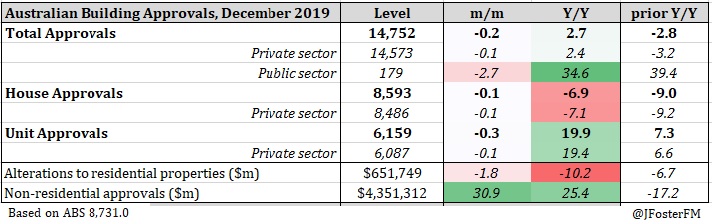
Australian dwelling approvals posted a broadly stable outturn in December after rising sharply in the month prior. In a sign that the rollover from the past couple of years is beginning to level out, approvals posted their first quarterly rise in 2 years in Q4.  

Building Approvals — December | By the numbers
  • Dwelling approvals (including the private and public sectors) on a seasonally adjusted basis were broadly stable in December, easing by -0.2% to 14,752, with the market anticipating a fall of 5.0%. Approvals in November accelerated by 10.9% (revised down from 11.8%).
  • In annual terms, growth in dwelling approvals swung from -2.8% to 2.7%; turning positive for the first time since June 2018.
  • House approvals were steady in the month (-0.1%) at 8,593 after posting a 6.0% rise in November (revised from 6.2%). The annual decline eased from -9.0% to -6.9% to be contracting at its slowest pace in 11 months.
  • Unit approvals posted a very minor decline of 0.3% in December, which followed an 18.6% escalation in the previous month (revised from 20.8%), to come in at 6,159. In through-the-year terms, the pace accelerated from 7.3% to 19.9% to its fastest since March 2018. 


Building Approvals — December | The details 

Coming off a 10.9% surge in November, dwelling approvals were broadly unchanged (-0.2% or -26) in December. Note that approvals have now outperformed consensus in the past two months; in November the market had forecast approvals to rise by only 2.0% and then in today's release they had anticipated a 5.0% pullback. Incorporating October's weak result (-6.3%), approvals totaled 42,852 in Q4 for a 6.1% rise on the previous quarter's total (40,389). As the chart (below) shows, this was the first positive quarter for approvals growth since Q4 2017.


Unit approvals drove this increase rising by 16.6% in Q4 to 17,452, while house approvals were near-stable on the quarter (-0.2%) at 25,310.


The ABS's detailed estimates, which are not seasonally adjusted, suggest the high-rise segment has been driving the increase in unit approvals, though low-rise approvals also appear to have lifted modestly.


Turning to the states, volatility in this month's report was elevated. Approvals in New South Wales pulled back sharply in the month (-30.5%), though this came after a 50.5% rise in November and was also mitigated by a 34.0% acceleration in Victoria. Queensland approvals contracted for the third straight month with a 5.7% fall in December, while South Australia (-20.1%) and Tasmania (-8.9%) both recorded sharp declines. Western Australian approvals posted a 5.4 rise in the month, though this only retraced November's decline.    


The next chart highlights Victoria as the leading contributor to approvals growth in Q4 (+26.7%) and over the past year (+38.5%), though New South Wales posted a modest gain in the quarter (+1.2%) and improved from a sharp contraction in Q3 (-14.8%). Elsewhere, the profile has been weak.    


Also in today's report, the value of non-residential approvals bounced back from a weak month prior surging by 30.9% in December to $4.351bn (25.4%yr). Meanwhile, the value of alteration work approved to existing residential properties fell by 1.8% to $651.7m to steepen the annual decline from -6.7% to -10.2%. 

     
Building Approvals — December | Insights

Momentum in dwelling approvals appears to be stabilising after falling sharply over the past couple of years. Unit approvals improved notably over the December quarter, however approvals of the type are volatile from month to month so it remains to be seen whether this is temporary or the start of a more sustained improvement from very weak levels. Given their relative stability, house approvals appear more than likely to have leveled out but again are at a low level. Overall, residential construction activity is likely to remain a drag on economic activity through much of 2020, reflecting the earlier weakness in dwelling approvals, though there are signs this weakness is past its trough. 


Friday, January 31, 2020

Macro (Re)view (31/1) | Steady as it goes

As the spread of the coronavirus continued to rattle sentiment in markets, central banks moved into greater prominence this week, though overall their wait-and-see stances on policy settings were maintained. In the US, the Federal Reserve's FOMC voted unanimously to keep its benchmark interest rate target range unchanged at 1.50-1.75%, with the Committee maintaining its assessment that it has monetary policy appropriately calibrated to support to the continuation of its 11-year long economic expansion, robust labour market conditions and inflation returning to its 2% target. Chair Jerome Powell outlined post-meeting that the Committee had not altered its outlook and would need to see a deterioration in the data flow to the extent that it prompts "a material reassessment" of conditions to open the door for further rate cuts. However, it is noteworthy that in its decision statement the Committee downgraded its assessment of the pace of household spending from "strong" to "moderate"; a subtle but key change given the consumer has bolstered the US economy from enduring a more protracted slowdown over the past 18 months in response to trade tensions and weaker demand conditions offshore. Consistent with this change, while this week's initial read on Q4 US GDP growth came in stronger than anticipated at an annualised pace of 2.1%, consumption spending slowed from 3.2% to 1.8% annualised. Also notable was Chair Powell clearly articulating the concerns the Committee has with inflation persistently running below target. Aside from these developments, the theme of the post-meeting press-conference was largely centred on the Fed's treasury bill purchases — interpreted by many market participants as quasi quantitative easing — with Chair Powell outlining that at the current run rate (around $60bn mth) reserves were on track to sustainably "reach ample levels" (estimated to be no lower than $1.5 trillion) to ensure that fed funds rate remains within the target range without having to resort to the sort of frequent, large-scale interventions it has been making in the repo market since last September. As such, Chair Powell said as that point approaches, its monthly purchases and repo operations would begin to taper off. 

Over in the UK, the Bank of England appears to be no closer to cutting rates as the Monetary Policy Committee (MPC) voted 7-2 to maintain the Bank Rate at 0.75% for the third straight meeting in what was Governor Mark Carney's last in charge. The tone of the MPC's decision statement highlighted a patient approach, noting signs of stabilisation in the global economy and reduced uncertainty for businesses and households over the nature of the UK's withdrawal from the EU, with these developments contributing to the Bank's constructive outlook in its Monetary Policy Report for GDP growth to pick up from its current below-trend pace to above trend over the coming year. However, at the post-meeting press conference, Governor Carney outlined that caution was warranted as trade tensions could re-emerge and other risks, such as the coronavirus, could weigh on the global economy, while these more positive signals from the UK would need to be translated into the hard data, most notably from business investment. Given these uncertainties, Governor Carney highlighted that if the expected recovery in the domestic economy were to falter, more policy support was an option for the MPC. In Europe, 
GDP growth disappointed estimates expanding by just 0.1% in Q4, while the annual pace eased from 1.2% to 1.0% to its slowest in 6 years, confirming the bloc's growth pulse softened further over the second half of 2019 as uncertainty continued to weigh on trade and business investment. Meanwhile, January's flash estimate of inflation lifted from 1.3% to 1.4% in annual terms, though this impulse was driven by volatile items as the underlying pace of inflation slowed from 1.3% to 1.1% over the year. More encouragingly, labour market slack in the bloc continues to tighten with the unemployment rate falling unexpectedly from 7.5% to 7.4% in December to its lowest since May 2008. 

— — — 

Turning to domestic developments, in last week's review we highlighted how market pricing for a February Reserve Bank of Australia had been scaled back significantly (from around 60% to a 20% chance) following December's much stronger-than-expected employment data. Expectations fell even further to a little above 10% this week following Q4's Consumer Price Index data. While the report was consistent with the familiar theme from recent years of an inflationary pulse that is low and steady, headline CPI at 0.7% in Q4 surprised slightly to the upside of consensus (0.6%) and annual growth was expected to remain at 1.7% but firmed to 1.8% (see our full review here). Meanwhile, the RBA's preferred trimmed mean CPI measure matched consensus in the quarter rising by 0.4% and though the annual pace remained at 1.6% this was above the 1.5% outturn expected and, more importantly, was in line with the Bank's official forecast. Thus, despite languishing below the RBA's 2-3% target range for 4 years now (see chart of the week, below), Q4's inflation data relative to the Bank's own expectations suggest a rate cut at next week's board meeting is unlikely. 


Chart of the week

Also this week, NAB's Business Survey for December (note the results for this survey were collated in early January) showed a notable deterioration in confidence from a reading of 0 to -2 to be at its weakest in 6½ years, while conditions eased from +4 to +3 and remain at a well below-average level. The weakness in confidence aligns with a decline in capital expenditure to a below-average level, though at this stage employment intentions have held steady to point to jobs growth averaging around 18k per month for the next 6 months according to analysis from NAB Economics. For the outlook, the detail was soft with further weakness in forward orders and capacity utilisation at a subdued level.


Tuesday, January 28, 2020

Australia Q4 CPI 0.7%, 1.8%yr; trimmed mean 0.4%qtr, 1.6%yr

Australia's Consumer Price Index (CPI) printed above expectations on a headline basis in the December quarter. Meanwhile, underlying inflation based on the trimmed mean measure preferred by the Reserve Bank of Australia (RBA) was in line with its official forecast at 1.6% in annual terms and continues to remain well below its 2-3% target range. 

Consumer Price Index — Q4 | By the numbers 

  • Headline CPI increased by 0.69% in Q4 to come in a touch above consensus (0.6%) and firmer than in Q3 (0.52%). Annual CPI lifted from 1.67% to 1.84% against an expected 1.7% rise, reaching its fastest pace since Q3 2018. 


  • Details for the underlying measures are as follows;
    • Trimmed mean inflation increased by 0.43% in the December quarter (expected: 0.4%, prior revised: 0.4%), which saw the annual pace unchanged at 1.57% (expected: 1.5%). 
    • Weighted median inflation lifted by 0.36% in Q4 (expected: 0.4%, prior 0.36%), with the annual pace easing very slightly from 1.31% to 1.28% (expected: 1.2%). 
    • The average of the underlying measures was little changed at 0.4% in Q4 (prior: 0.38%) and 1.42%Y/Y (prior: 1.44%Y/Y)


Consumer Price Index — Q4 | The details 

Looking into the headline CPI result, Q4's increase of 0.69% was slightly firmer than anticipated and was the strongest quarterly rise since Q3 2016. As an overview, the main contributors to the quarterly outcome were from alcohol and tobacco (+0.27ppt), food and non-alcoholic beverages (+0.24ppt) and transport (+0.18ppt). Groups subtracting from inflation in Q4 were; furnishings, household equipment and services (-0.03ppt), communication (-0.02ppt), health (-0.02ppt) and clothing and footwear (-0.01ppt).

   
From another perspective, the next chart shows the price changes recorded by each group in Q4 and for the year. 

Alcohol and tobacco prices jumped by 3.0% in Q4 to be up by 6.5% over the year. This was predominantly driven by an 8.4% rise in tobacco prices in the quarter (14.0%yr) linked with the remainder of the annual tobacco excise tax increase, effective from the final month of Q3. Alcohol prices declined by 0.7% in Q4 but were up by 1.4% year on year. 

The transport group saw prices firm by 1.5% in Q4 and rise by 2.8% over the year. The key factor was a 4.4% rise in petrol prices (2.9%yr) following increases in global oil prices and a softer Australian dollar. Moderating this increase, new vehicle costs declined by 0.6% in the quarter (3.4%yr). 

Food and non-alcoholic beverage prices lifted by 1.3% in Q4 and by 2.6% in annual terms. Most notably, fruit prices spiked by 6.8% in the quarter, while beef and veal prices lifted by 2.9%, with both being affected by drought conditions. The ABS reports that meat prices have also been driven up by strong global demand and by the spread of African Swine Flu in Asia. Takeaway meal and restaurant prices rose by 1.0% in Q4. 

The recreation and culture group lifted by 0.9% in the quarter and by 1.5% over the year. Q4's increase was driven mainly by a 7.3% rise in domestic holiday travel associated with the peak holiday period, suggesting that bushfire-related impacts have not yet been captured. On the other hand, international travel prices fell by 2.9% in the quarter coinciding with the off-peak seasons in Europe and the US. 

Insurance and financial services costs were up by 0.4% in the quarter but were up only modestly through the year (0.7%).

The key housing group continued its recent weakness, with prices virtually flat in Q4 (0.1%) and over the year (0.2%). In the quarter, rents were flat (0.2%yr), while new dwelling costs lifted by 0.4% (-0.1%yr). Utility prices fell by 0.3%, due mainly to regulatory changes that have resulted in lower electricity prices.

Education costs were little changed in Q4 (0.1%), with the annual pace at 2.9% reflecting rises from secondary education (4.2%) and primary education (2.9%). 

The largest fall in prices was recorded by the communication group that declined by 1.0% in Q4 and by -3.8% over the year. Strong competition between service providers continues to result in cheaper prices for consumers. 

Health prices slid by 0.3% in Q4 but were up by 3.2% over the year. Q4's decline reflected a larger number of consumers becoming eligible for subsidies available under the federal government's Pharmaceutical Benefits Scheme, which reduces out-of-pocket costs.

Clothing and footwear prices fell by 0.3% in Q4, though were up modestly in annual terms (1.4%). Q4's decline likely reflects widescale discounting by retailers over the Black Friday promotional period and this competition moderates the impact of the pass-through to prices from a lower Australian dollar.

The furnishings, household equipment and services group fell by 0.3% in the quarter to be up by 1.1% on the year. Discounting associated with Black Friday weighed on household textiles (-3.7%) and furniture (-1.4%) prices during the quarter. However, child care prices lifted by 1.5% in Q4 and are up strongly (7.2%) over the year. 


Overall, the breakdown of inflation continues to show that non-tradables (influenced by domestic factors) are the dominant source of inflation pressures (1.98%yr), though tradables inflation (reflecting global influences) has been on the rise in recent quarters (1.66%yr) reflecting the pass-through from a declining Australian dollar.  

Consumer Price Index — Q4 | Insights 

Inflation in Australia continues to remain steady and well below the RBA's 2-3% target range. The December quarter's results on the headline measure at 0.7%q/q and 1.8%Y/Y were slightly stronger than the consensus forecasts but a touch under the RBA's forecast from November's quarterly statement (1.9%Y/Y). The Bank's preferred trimmed mean measure matched consensus in Q4 at 0.4% but surprised to the upside in annual terms at 1.6%, however this was in line with the RBA's expectations. Overall, there looks to be little in today's report that would greatly alter the Bank's assessment of the inflationary environment. As such, markets have responded by further lowering pricing for a February rate cut to below 10%; this after last week's stronger-than-expected employment report prompted expectations to fall from around a 60% chance to around 20%.