Independent Australian and global macro analysis

Friday, October 8, 2021

Macro (Re)view (8/10) | RBA patient; US payrolls disappoint

As reopenings draw closer, the RBA remained upbeat on the outlook for the domestic economy at this week's meeting where all settings remained unchanged (reviewed here). Governor Philip Lowe's decision statement on Tuesday noted that many businesses are now preparing for reopenings and that the recovery should start to get back on track over the coming weeks. At the previous meeting in September, the RBA linked the path of its monetary policy to the recovery by extending bond-buying at the $4bn weekly run-rate through to "at least mid February". Firmly reiterating that rates will be on hold until sustainable 2-3% inflation is achieved  something not expected "before 2024"  the RBA retains a stance that sees it amongst the more patient and dovish group of its global counterparts.

With the period of a very low central bank policy rate set to extend, the RBA's latest semi-annual Financial Stability Review identified there had been a "build-up of systemic risks associated with high and rising household indebtedness". Expectations for housing prices to continue to rise could result in increased borrower risk-taking and would be accentuated if banks loosened lending standards, the RBA noted. In that context, banking regulator APRA this week announced an increase to the serviceability buffer lenders apply when assessing new loans. Accordingly, new borrowers will have their ability to service mortgage repayments tested at a minimum of 3ppts above the prevailing interest rate, up from a 2.5ppt buffer previously, placing a curb on borrowers' maximum loan sizes. Further measures could be in prospect with the Council of Financial Regulators indicating it will publish a paper later on in the year on the design and implementation of potential macroprudential policies. 

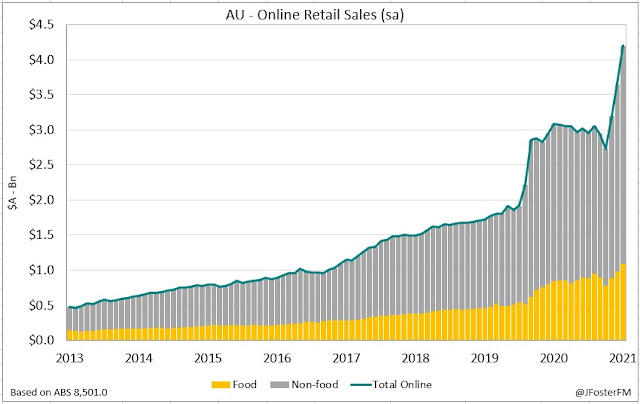
The data to hand through the week continued to reflect the effects of broad-based lockdowns. Retail sales contracted for a third consecutive month with a 1.7% fall posted in August, to be down by 6% since the Delta outbreaks (reviewed here). Over the 3-month period to May, closures and density restrictions have crunched non-food sales (-14.2%), while the stay-at-home mandates have boosted food spending (6.1%) and driven an extraordinary acceleration in online sales (53.5%) from previous highs (see chart below). The latest reading from the ABS's high-frequency payrolls data showed further deterioration in the labour market over the first half of September due to the lockdowns in New South Wales, Victoria and the ACT. As a result, expectations ahead of next week's Labour Force Survey are centered on a 120k fall in employment in September following the 146k contraction in August. In better news, the nation's monthly trade surplus surged through $15bn in August, resetting to a record high for the third month running (reviewed here). Despite a drag from iron ore as prices came off elevated levels, exports were supported by higher prices for other key commodities.

Chart of the week    
— — 

The surge in global energy prices amid supply constraints and strong demand have added to the inflation concerns in the market, intensifying speculation over how policymakers may respond. This week, the RBNZ raised rates by 25bps to 0.5%, becoming the second of the G10 central banks to commence its hiking cycle following Norway's Norges Bank. With NZ inflation expected to rise above 4% due to capacity constraints and rising energy prices, the Committee assessed a reduction of stimulus was warranted.

At the Federal Reserve in the US, the question is whether the green light for a November tapering announcement remains on after a weaker-than-expected nonfarm payrolls report for September. Against a consensus of 500k, employment disappointed lifting by 194k in the month, though revisions added back 169k jobs over July and August. As the BLS noted, seasonal volatility played its part in the September report, attributed as the cause of a particularly large fall of 161k seen in state and local government schools that weighed heavily on the headline number. But with job openings sitting at a very elevated 10.9 million, it appears to be the supply side of the labour market holding back the recovery. The participation rate declined 0.1ppt to 61.7% and remains well below pre-pandemic levels at a little above 63%. Despite enhanced unemployment benefits recently expiring and the reopening of schools, people have not returned to the labour force as yet in the volumes many had expected them to. As highlighted in this week's ISM services survey, with labour supply insufficient to meet surging demand, the capacity constraints many businesses report are set to persist.    

Shifting across to Europe, the account of the ECB's September policy meeting reiterated that high inflation was expected to be temporary, though there is more nuance emerging around this central view. Some concern was voiced that, with recent readings coming in hotter than forecast, the ECB's internal models may not be accurately reflecting the current inflation dynamics, and that that baseline projection for inflation in 2023 (1.5%) was too low. As noted by ECB Executive Board member Isabel Schnabel in a speech this week, the pandemic may "have altered or reinforced structural trends" and that could affect inflation for years to come. The Governing Council's decision at the September meeting to announce a "recalibration" of its PEPP purchases  moderately dialing back the pace of purchases but keeping the 1,850bn envelope intact — due to a firmer inflation outlook and improved financing conditions portends much more significant discussions in the coming months. With expectations that the PEPP will wind down as guided next March, reporting from Bloomberg indicated ECB officials were discussing introducing a separate program, complementing the existing APP but with greater flexibility, giving it the firepower to quell the risks of a widening in peripheral bond yield spreads.   

Tuesday, October 5, 2021

Australian retail sales fall further on lockdowns

Australian retail sales continued to fall with state lockdowns restricting household spending. Sales in August were down a further 1.7%, taking the overall decline since the emergence of the Delta outbreaks to 6%. Lockdowns are hitting non-essential retail hard, though the stay-at-home restrictions continue to see online sales soar while also boosting food and liquor spending. 

Retail Sales — August | By the numbers 
  • National retail sales declined by 1.7%m/m in August, in line with the preliminary estimate, to $29.3bn. This followed declines of 1.8% in June and 2.7% in July, with turnover down 6% since May. 
  • Annual turnover growth remained negative at -0.7% but eased from the -3.1% pace in July.


Retail Sales — August | The details  

Lockdowns in New South Wales, Victoria and the ACT drove national retail sales lower again, falling by 1.7% in August. This takes the contraction in retail sales over the Delta period to 6%, though if basic food (which benefits from lockdowns) is excluded, turnover on that basis is down 14.2% since May and is at a 16-month low. 


The category detail reflected lockdown effects, with areas benefitting from stay-at-home orders rising while those impacted by trading restrictions fell sharply. Food sales lifted by 2.1%m/m, supported by a boost in spending at supermarkets (2.1%) and liquor stores (5.3%). There were also gains in the month seen in some familiar lockdown-supported sub-categories including hardware and gardening supplies (3.6%) and pharmaceuticals (2.1%). 


But the major beneficiary from the Delta lockdowns has been online sales with the 15.1% rise in August following gains of 16.8% in June and 14.2% in July in a surge similar to that seen at the outset of the pandemic. Since May, online sales have soared by 53.5% with gains over the period of 59.1% in non-food sales and 39.6% in food sales.  


Due to closures and capacity restrictions, clothing and footwear sales (-15.7%m/m) and spending at cafes, restaurants and takeaway outlets (-7%m/m) plunged to mid-2020 lows, while turnover at department stores (-10.2%) collapsed to the level seen during last year's national lockdown.   


In comparison to the national lockdown in March-April 2020, spending patterns have shown similar trends in the Delta lockdowns, albeit generally less pronounced this time around. Adhering to this has been spending at supermarkets, liquor stores, and at pharmacies. Hardware sales have not seen a clear boost as in 2020, with the nation's major retailer in this space more affected by in-store restrictions through the Delta period. Electrical goods surged at the start of the pandemic as people prepared for work and school from home and upgraded their in-home entertainment. With that once-off spending out of the way, there has not been another surge in 2021, but there has been no marked drop-off either. As discussed earlier, the acceleration in online spending has been something to behold, continuing to soar to new record highs as restrictions persist. 


With lockdowns extended or enacted, retail sales fell sharply in the month in the ACT (-19.9%), New South Wales (-3.5%) and Victoria (-3.0%), with the first two back below pre-pandemic levels. Across the other states, a 6.6% reopening rebound occurred in South Australia, while the pace in Western Australia lifted to a 2.8% rise. Sales in Queensland fell by 0.9% for the third month running with the weakening momentum coinciding with localised Delta outbreaks, while Tasmania posted a 1.1% fall in August.    


Retail Sales — August | Insights

Tightening and extending lockdowns in response to the spread of the Delta variant has driven retail sales sharply lower since May. Some of that weakness has been attenuated by the boost to food sales due to the stay-at-home restrictions, while online sales have soared as a substitute for not being able to be out and about. Overall, there have been similar, though mostly less pronounced, shifts in spending patterns in the Delta period to that seen at the outset of the pandemic. High-frequency data tracking foot traffic at Australian retailers suggests spending firmed slightly in September, though based on the state reopening roadmaps, restrictions on non-essential retail are likely to persist until later this month or into early November. 

RBA reaffirms dovish patience

As expected, the RBA left all monetary policy settings (0.1% targets on the cash rate and 3-year government bond yield and QE purchases of $4bn/wk) unchanged at a low key meeting on Tuesday, with the Board intent on maintaining its accommodative stance as it awaits the reopenings of states to get the economic recovery back on track. 

Amid all the talk around the path to policy normalisation by central banks across the globe, the RBA continues to remain at the more dovish end of the line. While true that, since the September meeting, QE purchases have been accumulating at the slightly tapered $4bn weekly run rate (from $5bn previously), the deferral of the next review from November "until at least mid February 2022" sets up a slower path to normalisation in Australia following a significant Deltra-driven setback to the economy in Q3. Furthermore, forecasts for subdued wage and inflation dynamics continue to have the Board asserting through its forward guidance and 3-year yield target that rate hikes are not expected "before 2024". 


In today's decision statement, RBA Governor Philip Lowe highlighted the effects of the current lockdowns on the economy noting that GDP is anticipated to have "declined materially" in Q3, with the disruptions causing a 4% fall in hours worked in August alone. But the RBA remains optimistic that it is a recovery delayed, not derailed, citing observations from its liaison program where businesses have reported calling back or hiring (or at least attempting to) new staff in preparation for reopenings, and confidence levels that have "held up reasonably well".

However, Governor Lowe pointed out that it was unlikely to be smooth sailing, with the strength of the rebound "likely to be slower" than seen from earlier lockdowns and much uncertainty surrounding the degree and speed at which restrictions will be eased. The latter point is particularly relevant given the varying approaches of states to reopenings. Another factor that could weigh on the recovery are the global supply chain constraints, though Governor Lowe said their effect on Australian inflation "remains limited" for the time being. Broadly, the RBA agrees with the transitory inflation narrative, with today's statement noting that the underlying inflation rate in Australia is 1.75% (its target band is 2-3%) and wages growth is running at a similar pace.

In regards to the housing market, Governor Lowe largely reiterated the message contained in the recent statement by the Council of Financial Regulators that macroprudential measures to curb the pace of credit growth were being discussed. Ahead of Friday's RBA Financial Stability Review, the importance of lending standards being maintained and "appropriate" loan buffers were emphasised during this period of a very low RBA cash rate.

All in all, today's RBA meeting reaffirms its dovish patience at a time when many central banks offshore are moving towards reducing support. RBA watchers can probably take it easy over the summer with policy unlikely to be tweaked until the recovery from the Delta setback is well underway. 

Monday, October 4, 2021

Australia's trade surplus surges through $15bn in August

The surplus on Australia's monthly trade account has reset to a new record high for the third month running rising to $15.1bn in August. Despite iron ore posting its first decline since February, gains in other commodities and rural goods kept the surge in export earnings rolling. Imports slowed for the first time since April and are potentially showing some signs of the input shortages and bottlenecks impacting global supply chains.   

International Trade — August | By the numbers
  • Australia's monthly trade surplus lifted by $2.4bn in August to a new record high of $15.1bn, well exceeding the consensus estimate of $10.1bn. July's surplus was revised higher, from $12.1bn to $12.7bn. 
  • Export earnings advanced by 4.1% (prior: 4.9%m/m) to $48.52bn — another record level — to be 47.6% higher over the year. 
  • Import spending pulled back by 1.5% in the month after rising by 3.6% in July. This brought imports to $33.45bn, for annual growth of 11%.


International Trade — August | The details

The widening in Australia's trade surplus extended north of $15bn in August, defying market expectations for a narrowing to around $10bn. Australia has benefitted from the reopening of economies offshore with demand for its key commodities rising, pushing prices to elevated levels and driving export earnings to record highs. This has easily ouptaced the rebound in import spending generated by the recovery in the domestic economy. These factors have widened the trade surplus by a stunning $8.4bn since its recent low in March. 


Export earnings were 4.1% higher in August at $48.5bn, continuing its record run for a third month. The largest contribution came from non-rural goods (3.3%m/m), even as iron ore exports declined (-3.8%) for the first time in 6 months as prices came off their recent highs.


Rising prices in other commodities more than offset the iron ore decline, with exports of coal, coke and briquettes (12.7%), other mineral fuels (15.7%) and metals (23.9%) all on the rise. 


Rural goods advanced strongly in the month, up 11.3% to a record $5.4bn. Sharp gains were seen across the category; meat 6.6%, cereals 16.7%, wool 59.3% and 'other' goods 2.1%. 


Non-monetary gold added weight to export earnings rising by 3.5% in August. Services exports were little changed in the month (-2.6%) and remained at low levels reflecting the closure of the international borders to offshore tourists. 

Turning to imports, spending was down by 1.5% in August, making this its weakest outturn since April. Still, at $33.4bn import spending is 11% higher than around the depths of the first wave of the pandemic a year ago. 


Weighing on imports in the month was intermediate goods which fell 6.5%, the category's sharpest decline in nearly a year. That was driven by parts for capital goods (-42.9%) coming down from a surge in the month prior. After a sharp run-up of late, primary industrial supplies were also well down on the month (-28.1%). Capital goods posted a 4% decline in August as weakness from the prior month (-0.2%) accelerated. That included declines in telecommunications equipment (-2.1%), industrial transport equipment (-7.2%) and other goods (-35.9%). These declines may be pointing to the impacts of the input shortages and bottlenecks evident in global supply chains. 

Consumption goods (4.3%m/m) saw a rebound after declines in the past two months to be up 4.6% over the year. That was led by non-industrial transport equipment lifting 12%m/m (39%yr) as demand for passenger vehicles remains very strong. Services imports lifted by a modest 1.2%m/m and are substantially below pre-pandemic levels with offshore travel prohibited.  

International Trade — August | Insights

Another record high on the monthly trade surplus, though with iron ore prices well down from their earlier highs a narrowing appears in prospect. Uncertainty is a factor on the import side amid a domestic reopening from the Delta outbreaks and the constraints in global supply chains pushing prices higher.  

Preview: RBA October meeting

With QE switched onto autopilot for the summer as the RBA waits for the reopening of state economies to put the recovery back on track, monetary policy will be left unchanged at today's monthly meeting (decision due at 2:30pm AEDT). Assessing the Delta setback as a case of recovery delayed, not derailed, the RBA at the September meeting confirmed its previous announcement to taper the weekly run rate of QE purchases from $5bn to $4bn (chart below). However, the Board elected to push back the date of the next review of the program from November "until at least mid February 2022", lifting expectations for the stock of QE purchases over the period by $11bn (see here) and giving time for the recovery to take shape before making its next move. 


Today's statement from Governor Philip Lowe should reiterate the RBA's upbeat outlook for the domestic economy in light of the rise in vaccination rates and the recent roadmaps for reopening in New South Wales and Victoria. The unemployment rate is expected to rise over the near term, but elevated job vacancies indicate underlying labour demand has been strong despite the lockdowns, pointing to an upcoming rebound in conditions.  

Uncertainties around the recovery remain the outlook for household spending amid significantly higher caseloads than seen in earlier reopenings, while the situation offshore with supply-side constraints pushing inflation higher is another factor that may draw consideration in the domestic context. While government bond yield curves have taken on a steepening impulse of late, the comments from Governor Lowe at his Anika Foundation speech pushing back against market pricing for rate hikes as early as next year indicates the Board is still firmly of the view that its forward guidance remains appropriate, with the wage and inflation dynamics consistent with a higher cash rate not expected "before 2024". 

Ahead of Friday's semi-annual Financial Stability Review, comments on the housing market will also be of interest, with the recent statement from the Council of Financial Regulators (which includes the RBA) noting that a "period of credit growth materially outpacing growth in household income" posed risks to the economy and could prompt macroprudential measures to come into play.  

Friday, October 1, 2021

Macro (Re)view (1/10) | Leaving Q3 behind

A volatile September quarter drew to a close during the week, a period that saw a resurgent virus, growth concerns, rising inflation and tentative signalling of the start of policy normalisation by central banks all in the mix. These themes were the main topics of discussion at the keynote panel event at this week's ECB forum in which the heads of the ECB, Fed, BoE and BoJ noted that supply constraints associated with reopenings of economies were holding back recoveries and adding to inflation pressures. While these factors are broadly expected to ease over time, they were seen as likely to persist for longer than initially anticipated. The rise of the Delta variant has led to significant disruptions within supply chains at a time when global demand for goods has surged, with prices rising sharply as a result of these imbalances. Product shortages were weighing on output, with activity data through PMIs across the globe reporting that many firms are working through elevated backlogs sitting on their order books. But while there is a broad consensus on the analysis of the issues at hand, global central banks are setting up to take varying moves on policy and that is likely to be a theme that will play out over Q4 and into next year. 

In the US this week, Fed Chair Jerome Powell during testimony told lawmakers that reopening effects and supply chain constraints had been more pronounced and persistent than expected, but inflation was anticipated to moderate back towards the 2% target as these factors abate. While conditions are nearing closer to warranting a tapering in the $120bn run rate of monthly asset purchases, likely in November, it was the shifting expectations coming out of last week's Fed meeting around the path of rate hikes to start in late 2022 or early 2023 that has driven a steepening in US and global yield curves. High inflation has been another driver here, with the Fed's preferred core PCE measure holding at a 3.6% annual pace in August (chart below). Meanwhile, signs of the Delta impact may have been in play despite a solid rebound in personal spending of 0.8%m/m in August after falling 0.1% in July. Growth in services spending eased back to 0.6% from 1.1% in each of the previous three months, which came alongside a rebound in goods spending of 1.2%m/m from July's -2.1% outcome. Next week in the US, the highlight will undoubtedly be September's non-farm payrolls report where early expectations are sitting at around a 500k gain.   


As for Europe, a speech titled 'Monetary Policy during an atypical recovery' by ECB President Christine Lagarde was used to reiterate that its forward guidance had been recalibrated to allow its reaction function to focus on inflation dynamics one and two years ahead rather than on volatility in the near term. As President Lagarde outlined, the reopening and pandemic-related falls were contributing to the high rate of inflation, which according to the September flash estimates had accelerated to 13-year highs for both the headline (3.4%Y/Y) and core measures (1.9%Y/Y) (chart below). The ECB expects inflation will moderate towards its 2% target in the months ahead, with price pressures not assessed to be broadly based across the economy, and with it seeing little sign of a feed-through to higher wages. In the UK, while also assessing its recent rise in inflation to 9-year highs as transitory, Governor Andrew Bailey at the Bank of England in a speech this week noted that it was alert to the risk of higher prices becoming entrenched in rising inflation expectations. The adjustment to policy in such a situation would come from higher rates, and Governor Bailey said that it was possible that move could occur before its asset purchases had been completed by around the end of the year. 


Turning to Australia, the housing market was a key focus this week with conditions remaining robust around lockdown disruptions. Housing prices according to CoreLogic posted a further gain in September, up 1.5% on the national median to be 20% higher over the year in response to strong demand from an expansive package of stimulus measures amid low levels of supply on the market. In that context, housing credit growth continues to expand rising at its fastest pace since 2018 at 6.2%Y/Y through August. The risks posed to the economy from a period in which housing credit is "materially outpacing" household income growth was highlighted in the quarterly statement from the Council of Financial Regulators this week, with macroprudential measures approaching their radar screen. For now, lockdowns in New South Wales and Victoria have weighed on demand as housing finance commitments posted their sharpest fall in 15 months with a 4.3% contraction in August (reviewed here). However, commitments to both owner-occupiers and investors remain at very elevated levels. On the supply side, dwelling approvals surprised with a 6.8% lift in August against expectations for a 5% fall (reviewed here). The HomeBuilder scheme brought forward a significant volume of approvals from mid 2020 but that has subsequently retraced by 20% since its March expiry date. Other data points this week were heavily impacted by lockdown restrictions with retail sales down for a third month running with a 1.7% fall in August, while national job vacancies contracted by 9.8% for the 3-month period to August. But with vacancies still very elevated to pre-covid levels, indications are that strength in underlying labour demand is holding up through the ongoing disruptions. 

Thursday, September 30, 2021

Australian housing finance down 4.3% in August

Australian housing finance commitments fell by more than expected in August, posting their steepest decline since May 2020 with key policy stimulus measures unwinding, demand cooling in response to the sharp rise in housing prices, and as the impacts of lockdowns in New South Wales and Victoria disrupted activity. 

Housing Finance — August | By the numbers
  • Housing finance commitments ($ value, ex-refinancing) fell by 4.3% m/m in August vs -2.0% expected (prior: 0.2%) — to $30.8bn, with annual growth moderating to 47.4% from 68.2%.  
  • Owner-occupier commitments contracted by 6.6% in the month (prior:-0.4%m/m) to $21.3bn, slowing growth over the year to 33.5% from 58.3%. 
  • Investor commitments lifted by 1.5%m/m (prior: 1.8%) to come in at $9.5bn, for annual growth of 92.2%. 
  • Total refinancing activity advanced by a further 3.2%m/m (prior: 6.0%) to $17.8bn (58.1%yr), led by the investor segment (11.5%m/m) as owner-occupiers declined (-1.0%m/m). 


Housing Finance — August | The details 

The effects of the end of the HomeBuilder scheme and state-based initiatives, rising housing prices reducing affordability, and lockdowns in New South Wales and Victoria weighed on housing finance demand in August. Commitments (in value terms) saw their sharpest month-on-month fall (-4.3%) since the outset of the pandemic.


The owner-occupier segment drove the headline fall, with commitments down 6.6% on the month, for its steepest fall in 15 months. Within the segment, there were declines from upgraders (-7.1%m/m) and first home buyers (-4.1%), and the construction-related category (-4.7%) continued to reflect the unwind from the expiry of the HomeBuilder scheme.


Momentum in commitments to the investor segment has slowed over the past 3 months from the very strong pace of growth seen earlier in the year, but they still advanced in August (1.5%) and are at an elevated level at $9.5bn — its highest going back to 2015.   


Activity in the first home buyer segment is continuing to retrace from its recent peak due to the unwind of policy stimulus measures and as concerns over affordability due to rising housing prices weigh, while lockdowns were also a headwind. Commitments to the segment declined by 4.9%m/m to $5.6bn, while the number of approvals made by lenders fell 3.0%m/m to around 12.5k. 


Approvals to the owner-occupier segment were down across the categories in August, with upgraders -3.4% (22.2%yr) and construction-related -7.4% (5.2%). The latter is winding down from HomeBuilder, with approvals for newly-constructed homes -12%m/m and those to facilitate new builds -4.9%m/m.     


Commitments at the state level and across the major segments are summarised in the table below. Lockdown impacts were weighing in New South Wales and Victoria. 


Owner-occupier commitments are easing off their recent peaks in all states, but they remain at very high levels reflecting the boost from stimulus measures and rising housing prices.    


Housing Finance — August | Insights

A sharper-than-expected pullback in commitments in August was driven by a combination of factors, including the runoff of policy stimulus, rising housing prices slowing demand, and the disruptions associated with state lockdowns in New South Wales and Victoria. Conditions might be cooling in the major housing markets, though they still remain very robust according to most indicators. Just today, CoreLogic reported that prices nationally were up another 1.5% in September, to be 17.6% higher than at the end of 2020. Earlier this week, the quarterly statement from the Council of Financial Regulators signalled that macroprudential measures were being considered. 

Wednesday, September 29, 2021

Australian dwelling approvals rise 6.8% in August

Australian dwelling approvals lifted for the first time since the expiry of the HomeBuilder scheme posting a 6.8% rise in August. That defied expectations for further weakness as both detached and unit approvals increased. 
  
Building Approvals — August | By the numbers
  • Dwelling approvals (seasonally adjusted) posted an unexpected rise in August, up 6.8%m/m to 18,716 against the market consensus for a 5% fall (prior -8.6%). Annual approvals growth lifted from 21% to 31.2%.
  • House approvals lifted by 3.8%m/m to 12,125 (23.7%yr)
  • Unit approvals advanced by 12.7%m/m to 6,591 (47.7%yr)


Building Approvals — August | The details 

An upside surprise on building approvals in August ended a run of four consecutive monthly falls following the expiry of the HomeBuilder scheme. After falling by 25% from their March peak, dwelling approvals were up 6.8%m/m in August. Gains were seen in units (12.7%) and detached houses (3.8%m/m), with both segments posting their best outturns since March and April respectively.

Notwithstanding the HomeBuilder expiry, support from low interest rates and rising housing prices are supporting approvals. Even with the bring-forward effect from HomeBuilder now unwinding, private sector detached approvals are almost 40% higher than pre-pandemic levels. Unit approvals were less supported by these factors, but have lifted from last year's depths where the pandemic was a significant headwind on demand.  


Despite the return of lockdowns, New South Wales (7%) and Victoria (9.6%) were key drivers of the rebound in house approvals in August, with South Australia (16.5%) also contributing. Queensland and Western Australia are recalibrating from their HomeBuilder-driven highs. 
 

Alteration approvals showed renewed strength in August, rising by 10%m/m — to be only slightly below their recent peak. As with approvals for new builds, alterations are being supported by easy financing conditions and a robust housing market. More time at home in response to the pandemic has also been a factor in people making improvements to their homes.   


Building Approvals — August | Insights 

Dwelling approvals rebounded in August despite the return of lockdowns and the winding down of policy supports. Beyond the lockdown disruptions that restricted activity on sites more than in earlier lockdowns, capacity constraints emerging from the elevated pipeline of work that has accumulated could be a limiting factor on approvals. 

Friday, September 24, 2021

Macro (Re)view (24/9) | Paths to policy normalisation

In a policy-heavy week, meetings at 6 of the G10 central banks, as well as several in emerging markets, featured. As the OECD outlined in its latest outlook, the meetings came at a complex time amid intensifying headwinds to global growth from the Delta variant, supply constraints and rising inflation, while the concerns around Evergrande in China are a recent addition. In the advanced economies, patient stances continued to be maintained at the BoJSNB and Riksbank as others look to chart the course in dialing back peak monetary policy support. In fact, the Norges Bank is already there raising rates from zero to 0.25% this week.  

Undoubtedly though, the US Federal Reserve's meeting was this week's highlight. While the FOMC announced an unchanged stance, it guided markets towards the start of policy normalisation. This came on the back of its updated summary of economic projections that reflected confidence in the US outlook once the near-term uncertainties fade. Delta concerns have lowered the median estimate for 2021 GDP growth to 5.9% from 7.0% but assessments in the out years were upgraded to 3.8% in 2022 and 2.5% in 2023. The Delta presence leads to a more cautious assessment of the unemployment rate in 2021, now expected to fall to 4.8% compared to 4.5% anticipated in June, but the forecasts for 2022 (3.8%) and 2023 (3.5%) remained intact. Reflecting the persistence of supply constraints, substantial upward revisions to both headline (4.2% from 3.4%) and core (3.7% from 3.0%) inflation were put forward by the FOMC members in 2021, with moderating overshoots on the 2% target seen thereafter through to 2024.

With the inflation side of the dual "substantial further progress" test stipulated by the Committee to start tapering asset purchases met, developments in the labour market are left dictating the timing. On this, Chair Jerome Powell in the post-meeting press conference said that in his view the employment aspect of the test was "all but met", firming up expectations for a November tapering announcement, with the process to be completed by "around the middle of next year". Given the current $120bn per month run rate, that implies a slowing of around $15bn per month, assuming a straight-line tapering. Throughout recent communications, Chair Powell has been keen to delink tapering from signaling on rates, with a "substantially more stringent" test attached to commencing lift-off from near zero. The revised dot plot shows expectations for the timing of the first rate hike are split between late 2022 and early 2023. Notably, the dots have taken on a steeper trajectory since the June projections, rising to 1.8% by 2024. That is pointing to more rate hikes than the 3-4 markets are pricing in over the period, leaving bond markets to reassess the situation over recent days. 

The sense coming from this week's Bank of England meeting was that the Monetary Policy Committee (MPC) was moving closer to exiting from the emergency settings it implemented at the nadir of the pandemic. In an unchanged decision on Thursday, the accompanying minutes noted a "strengthened case" had developed for the guidance the MPC put forward at the previous meeting that the expected path of the economy would likely be consistent with a "modest tightening of monetary policy". The key development over the intervening period had been a sharp rise in the pace of annual inflation from 2.0% to 3.2% in August, to be more than 1ppt above the MPC's target. As noted by the MPC, the rise could extend to a pace above 4% in Q2 next year due to higher energy and goods prices. In their exchange of letters, Chancellor Sunak had agreed with Governor Bailey's assessment that base effects associated with the reopening and capacity constraints were driving up inflation but welcomed that over the medium term the pace was expected to moderate back towards the target. With the BoE's asset purchases on track to be completed by around the end of the year, attention has turned to rates where markets are pricing in around 2 hikes next year. But with considerable uncertainty around the outlook for wages growth and how the labour market will respond to the end of the furlough scheme, those expectations may prove too optimistic.    

Over in Europe, signs are evident that the robust recovery there is starting to lose some momentum with capacity constraints and rising prices weighing on output. The September flash Composite PMI at 56.1 remained at levels consistent with strong expansion, but that was a 5-month low and it marked a sharper slowdown than markets had expected (58.5) from August's reading (59.0). Delta appeared to be weighing on services with activity in the sector slowing from 59.0 to 56.3 in September. Meanwhile, the manufacturing PMI came out at 58.7 — its softest reading in 7 months and well down from 61.4 in August. Production at responding manufacturers had recorded its slowest increase since around the turn of the year with supply chain bottlenecks and product shortages causing a further rise in order book backlogs. In the knowledge that manufacturers are sitting on low inventory levels, suppliers are continuing to push through higher prices with input costs in the sector rising to around record highs. While rising prices are coming down the pipeline to households, the ECB's latest Economic Bulletin noted that these pressures were expected to fade from early next year.  That said, a Reuters report during the week quoting Governing Council sources said that preparations were being made for PEPP purchases to wind up as planned in March on the basis that inflation could rise by more than currently expected. So as to avoid "cliff effects" once the $1,850bn programme concludes, a temporary boost to its Asset Purchase Programme was being considered.   

In Australia, the minutes from the RBA's September meeting reiterated that the Delta impact and associated lockdowns would delay, but not derail, the recovery. At that meeting, the Board stuck to its modest tapering announcement of weekly bond-buying from $5bn to $4bn, but the setback to the economy prompted it to push back the timing of the next review from November to February. The RBA expects that it will take until mid next year for the economy to return the trajectory it was on prior to the Delta outbreaks. However, the minutes noted that the Board still judged that tapering was warranted, citing that this was the path many of its global peers was on. Instead, the Board saw greater option value in the recailibration it made to the next review date, with markets now having greater clarity over its bond purchases for longer.    

Friday, September 17, 2021

Macro (Re)view (17/9) | Strength in resilience

The sharp deterioration in the Australian economy since the middle of the year following the rise of the Delta variant and broad-based lockdowns was confirmed by this week's labour market data. Employment recorded its steepest decline since the 2020 national lockdown with 146.3k jobs lost in August. With caseloads surging and restrictions tightening New South Wales has seen a 210k fall in employment since the lockdown was called in June. Mobility restrictions and the current design of support payments have seen labour force participation fall away by 1ppt over the past couple of months to 65.2%; the decline in New South Wales a sobering 3.5ppts to be near the levels the state saw in the depths of 2020. Falling employment and a shrinking labour force saw hours worked crunched lower by 3.7% in August to be 2.9% below the level that prevailed before the pandemic emerged (see chart below). Hours worked in New South Wales have collapsed to be 11.1% below their pre-pandemic level, with the Delta hit proving to be a greater disruption than anything seen there in 2020. The fall in hours worked in Victoria and across the rest of the nation highlights the widespread hit to economic activity. For a full review of the August Labour Force Survey see here.   

Chart of the week 

Readings from this week's NAB Business Survey showed mild improvements in confidence and conditions in August. But, since June, both have deteriorated very sharply with confidence falling from +10 to -5 and conditions down from +24 to +14. The latter is still well above average in absolute terms, reflecting its strong pre-Delta position and more resilience to the current disruptions than seen in earlier lockdowns. Resilience was also a key theme in the latest consumer sentiment survey with the Westpac-Melbourne Institute Index rising by 2% in September. Westpac's Chief Economist Bill Evans attributed the result to confidence that the accelerating progress in vaccinations will bring the difficult times to an end. While the level of optimism has fallen by around 6% compared to pre-Delta, at a 106.2 reading the index remains strong. This is sending an important signal in that it supports the thesis that household spending will rebound sharply when the lockdowns have run their course. In the housing market, the survey highlighted renewed concerns over affordability following the strong rise in prices seen over the first half of the year. Data from the ABS this week showed a record quarterly increase in housing prices of 6.7% in Q2 (see here).  

The speech from RBA Governor Philip Lowe to the Anika Foundation reiterated the key theme discussed from last week's Board meeting that the Delta disruptions had delayed, but not derailed, the recovery. A boost to already high accumulated savings from enhanced fiscal support was providing the RBA confidence that household spending will get the recovery back on track once vaccinations have hit their targets. Of note in the speech was the push back from Governor Lowe to current pricing in rates markets for the cash rate to start rising from late 2022. Outside of transitory effects, the low wage and inflation dynamics in place prior to the pandemic are expected by the RBA to persist, with the Board signaling it does not anticipate to be raising rates before 2024.

— — 

Switching offshore, the transitory inflation narrative was in focus as was the slowdown in activity in response to Delta. Notably, tightened restrictions saw China retail sales slowing sharply from 8.5% to 2.5%Y/Y in August. That was against a consensus estimate for a moderation in growth to 7.0%Y/Y. Other activity data for industrial production (5.3%Y/Y) and fixed asset investment (8.9%ytd) also slowed by more than expected. Meanwhile, developments around the Evergrande situation have been a key factor driving sentiment in Asian equity markets in particular on reports of contagion risk. 

In the US, inflation data slowed in August as price pressures associated with the reopening of the economy showed signs of cooling. Headline CPI posted its slowest month-on-month increase this year at 0.3% (vs 0.4% expected) as the annual rate matched consensus in easing 0.1ppt to 5.3%. A more pronounced slowing was seen in core CPI at 0.1%m/m (vs 0.3%) as 0.3ppt came off the annual rate to 4.0% (vs 4.2%). The main story was that price declines were recorded in many of the categories that have been boosting inflation of late where demand has surged on the reopening. Including in this was used cars (-1.5%m/m) and travel-related areas in airfares (-9.1%m/m), car rentals (-8.5%m/m) and hotels (-3.3%m/m). From a broader perspective, durables CPI — key in driving the inflation surge — saw its weakest month-on-month outcome (-0.2%) since January, while services CPI was little more than flat (0.1%m/m). Concerns that high inflation could be weighing on consumer spending look to be misplaced as retail sales came in above estimates in August, rebounding from the weakness seen in July. Headline sales lifted by 0.7%m/m, defying consensus for a -0.7% result. Strong beats also came through in core sales (ex-autos and gas) at 2%m/m and in the key control sales group at 2.5%m/m, both of which had been expected to come in flat in August. Given the underlying composition of sales, the Delta impact may have been evident with rises in the stay-at-home areas including nonstore (online) retail (5.3%m/m), food and beverage (1.8%m/m) and furniture (3.7%m/m). At the same time, spending at restaurants and bars pulled back to be flat in August after rising by 1.3% in July. 

Across the Atlantic, reopening effects were playing through in surging inflation readings. In the UK, inflation printed above expectations in August, with the headline CPI rising from 2.0% to 3.2%Y/Y — a 10-year high — as core CPI elevated from 1.8% to 3.1%Y/Y. This takes both measures to more than 1ppt above the Bank of England's target ahead of next week's policy meeting. The rise predominantly reflected the downward impact on inflation associated with the government's discounted eating out scheme from last year falling out of the 12-month calculation. But there were also boosts coming from the reopening with strong rises in airfares (10.9%m/m), accommodation (5.9%m/m) and used cars (4.9%m/m). Similar dynamics are evident in the euro area where headline inflation was confirmed to have risen to its highest since 2011 at 3.0%Y/Y to August from 2.2%, while annual core inflation is at a 9-year high at 1.6%. ECB Executive Board member Isabel Schnabel addressed the matter in a speech this week, noting that a range of base effects, including from the reversal of the temporary cut in the German sales tax and from reopening distortions, were driving inflation higher. However, under the ECB's reformulated forward guidance, policy will not be reacting to short-term volatility in the data. As Ms. Schanbel outlined, the emphasis is on ensuring the inflation outlook is converging around the 2% target one and two years out before rate hikes will be considered to prevent the risk of tightening prematurely and slowing the recovery.