Independent Australian and global macro analysis

Wednesday, March 6, 2024

In review: Australian Q4 GDP: Momentum continues to slow

Momentum in the Australian economy slowed materially in 2023. With the recovery from the pandemic having run its course, household consumption - the largest component of the economy - was left increasingly exposed to cost-of-living pressures and higher interest rates as the year progressed. Real GDP growth was 0.2% in the December quarter, slowing from 2.1% to 1.5% through the year. The slowdown intensified in the back half of the year; GDP increased by 0.5% in the period - the softest half-year outturn excluding the Covid period since 2008 following the global financial crisis.  


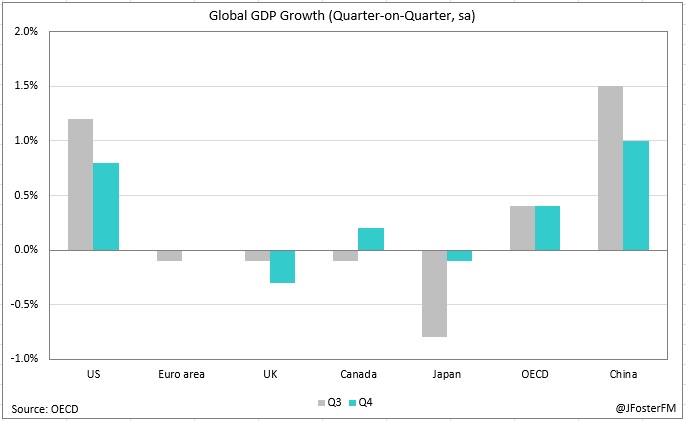
Similar trends were seen offshore. Although growth in the US economy remained strong, most other advanced economies slowed sharply in the second half of the year. In China, consumption growth eased with the pandemic recovery winding down. 

In Australia, domestic demand (0.1%q/q, 2.3%Y/Y) has been bolstered by the public sector (0.4%q/q, 4.7%Y/Y). This has helped to offset weakening private demand (0%q/q, 1.3%Y/Y) as household consumption slowed to the point of stalling and dwelling investment contracted; however, business investment was resilient, contributing strongly to output growth. 


The December quarter GDP outcomes were in line with RBA expectations. Notwithstanding this, the RBA's assertion of the economy operating in excess demand looks harder to sustain. Economic growth is now at a subdued pace (and -1%Y/Y in per capita terms); inflation slowed sharply into year-end; and the labour market - while still robust - has eased from cycle tights. 


Declining inflation improved real income dynamics in the quarter, but households are continuing to feel the effects of pressures on their budgets. In 2023, mortgage interest payments and income tax accounted for more than a 21% share of disposable income. 


Some relief is on the way via the upcoming stage 3 tax cuts, while the case for the RBA to ease restrictive monetary policy settings from its 4.35% cash rate will build if the incoming data continues to suggest that momentum in the economy is weak. 


— — 

National Accounts — Q4 | Expenditure: GDP (E) 0.4%q/q, 1.6%Y/Y


Household consumption (0.1%q/q, 0.1%Y/Y) — The accumulation of pressures from the higher cost of living and RBA rate hikes effectively brought household consumption to a standstill in the December quarter. Consumption went backwards in categories including new vehicles (-3.6%), hotels and cafes (-2.8%) and clothing and footwear (-2.5%), reflective of a broad-based rotation away from discretionary-related consumption over the past year (-1.6%) to essential goods and services (1.2%).


The news around real incomes saw some welcome developments. Real disposable income lifted by 1.5% in the quarter - its best result since Q3 2021 - turning positive in annual terms (0.3%) for the first time since mid-2022. This came as nominal income increased by 2.3%q/q - underpinned by rising wages growth in a still-robust labour market (1.4%), social assistance payments (5.9%) and interest income (6.7%) - and inflation (on the household consumption deflator) eased to 0.8%q/q. 


As a result, the improvements to real income dynamics supported a rise in the household saving ratio to 3.2%, lifting from a 15-year low in Q3 (1.9%). Although this remains well below pre-pandemic levels of around 5-6%, households still, on aggregate, retain a substantial stock of excess savings accumulated during the Covid period.  


Dwelling investment (-3.8%q/q, -3.1%Y/Y) — Residential construction activity slumped into year-end contracting by 3.8% in Q4 to be down 3.1% through the year. The effects of higher interest rates, weak sentiment and supply and labour constraints - legacies of the pandemic - are all weighing on the sector. Declines in Q4 were sizeable in both new home building (-3.5%) and alterations (4.2%), the latter contracting for the 9th time in the past 10 quarters, unwinding from its stimulus-driven peaks seen during the pandemic. 


Business investment (0.7%q/q, 8.3%Y/Y) — A frontloading of business investment into the first half of the year (6.7%) ahead of the withdrawal of tax incentives led to an inevitable easing of momentum in the second half (1.5%). Overall, business investment lifted sharply through the past year (8.3%), contributing 1ppt to the 1.5% increase in real GDP over the period. In the most recent quarter, business investment lifted 0.7%. The major driver was non-dwelling construction (2.5%q/q) - up a robust 9.3%Y/Y - as machinery and equipment investment saw a pullback (-1.3%q/q).    


Public demand (0.4%q/q, 4.7%Y/Y) — Despite moderating in Q4 (0.4%), public demand was still up by a solid 4.7% through the year. This has delivered a key offset to the economy alongside the slowdown in private demand. In Q4, public expenditure increased by 0.6%, led by assistance payments to households and the staging of the Aboriginal and Torres Strait Islander Voice Referendum held in October. Underlying investment was surprisingly soft in the quarter (-0.2%) but has risen significantly over the past year (13.7%) as progress on the substantial pipeline of public infrastructure projects has ramped up.   


Inventories (-0.3ppt in Q4, -0.9ppt yr) — Subtracted from growth in Q4 (-0.3ppt) and over the past year (-0.9ppt). Inventories declined in the December quarter as earlier disruptions that affected production and transportation in the resources sector cleared, amid strong demand for Australia's bulk commodities offshore. This was moderated by a sizeable increase in public authorities inventories.


Net exports (0.6ppt in Q4, 0.3ppt yr) — Contributed 0.6ppt to GDP in Q4 but added only modestly to growth over the past year (0.3ppt). Export volumes declined by 0.3% in the quarter, rounding out a soft second half in 2023 (-0.5%); goods trade (-2.2%) was weighed by disruptions to resources shipments and the recovery in the services sector (mainly tourism and education) moderated (8.3%). Overall, exports are still 3.2% short of recovering to pre-Covid levels. By contrast, imports remain substantially above pre-Covid levels (+6.2%); however, a sharp decline of 3.4% in Q4 reflects the weakness seen in domestic demand into year-end. Notable contractions came in consumption (-5.4%) and capital goods (-3.4%) as well as in travel services (-9%).    


— — 

National Accounts — Q4 | Incomes: GDP (I) 0.2%q/q, 1.4%Y/Y 


A 2.3% rise in the terms of trade - coming after declines of 7% in Q2 and 2.1% in Q3 - supported Australian national income in the final quarter of the year. This was driven by a 3.1% acceleration in export prices as commodity prices increased, outpacing a 0.8% rise in import prices alongside a weaker Australian dollar. Notwithstanding this, the terms of trade fell by 3.9% through the year to be down almost 12% from its record high in mid-2022. 


The increase in the terms of trade underpinned rising nominal GDP, up 1.4%q/q to 4.4%Y/Y. A year earlier, nominal GDP had expanded at 12.1%Y/Y pace, with declines in commodity prices driving the slowdown.  


Higher commodity prices flowed through to mining company profits, reflected in non-financial corporations operating surplus rising by 2.9%, partially rebounding from material declines in Q2 (-7.5%) and Q3 (-3.9%). Financial corporations operating surplus posted a 1.6%q/q rise to be up 6.3% through the year, with rising interest rates boosting net interest margins for banks. By contrast, margin pressures are weighing on small company and farming profits, with gross mixed income falling 4.1% q/q and 8.6%Y/Y. 


Growth in wage incomes moderated to 1.4% in Q4 (8.4%Y/Y) after receiving a large boost in the previous quarter (2.8%) from increases to the minmium wage and award rates. In Q4, wages were supported by mandated increases that flowed through to workers in the aged care sector and by hiring associated with the Voice Referendum. 


Due to hours worked in the economy falling over the past couple of quarters (-0.7% in Q3 and -0.3% in Q4), growth in hourly earnings (non-farm wages) has picked up to be running at a 6%Y/Y pace. But this has not translated to an associated rise in unit labour costs; this is because measured productivity outcomes increased in Q3 (1.5%) and Q4 (0.5%), the result of economic growth rising as hours worked declined.  


— — 

National Accounts — Q4 | Production: GDP (P) 0.1%q/q, 1.6%Y/Y

The GDP production estimate was 0.1% in the December quarter, easing from 1.9% to 1.6% at an annual pace. Gross Value Added to the economy rose at the same pace for goods-related (0.3%) as services-based industries (0.3%) in the quarter. Public administration (1%) was a notable contributor to growth, driven by activity associated with the Voice Referendum. 


In the goods-related sector, goods production (0.5%) more than offset weakness in goods distribution (-0.2%). Goods production saw a rise on the back of increased output in the mining industry (1%) and in utilities (0.9%) as warm weather increased demand for electricity. The fall in goods distribution reflected declines from wholesalers (-0.6%) - associated with a reduction in grain exports - and transport (-0.3%) as demand for postal services eased and imports weakened. 


Turning to the services sectors, household services stalled (0%) as consumption rotated away from discretionary-related areas to essential services. Accordingly, weakening demand led to declines in accommodation and food services (-3.2%) and in arts and recreation (-0.8%). This contrasts with gains across health (0.5%) and education services (0.4%). Business services advanced 0.5% overall in Q4. Professional services (1.2%) led the way on increased demand for engineering services.

Tuesday, March 5, 2024

Australian GDP 0.2% in Q4

The December quarter National Accounts confirmed that momentum in the Australian economy slowed materially in 2023. Real GDP printed at 0.2% in Q4 (vs 0.2% expected, 0.3% prior) as year-ended growth eased from 2.1% to 1.5%. With the recovery from the pandemic having run its course, household consumption in 2023 became increasingly exposed to the headwinds of higher interest rates and cost-of-living pressures. As this played out, GDP growth slowed from 1% in the first half of the year to 0.5% through the back half, its softest half-year outturn outside of the Covid period since 2008 following the financial crisis. Alongside this, inflation slowed notably into year-end and labour market tightness also eased. The RBA's assessment of the economy operating in excess demand was already contentious and looks even harder to sustain now. 


Over the past year, public demand has been the major driver of growth - as governments have boosted cost-of-living support and progress on infrastructure works have ramped up - helping to offset slowing private demand. This was also the case in Q4: domestic demand (0.1%) was held up by a 0.4% lift in public demand as private demand stalled (0%). Net exports added to growth (0.6ppt) while inventories weighed (-0.3ppt).  

Private demand remained supported by business investment (0.7%q/q), which has risen strongly over the year (8.3%) on a delayed rebound from the pandemic, but has been weighed by weakness in household consumption (0.1%q/q, 0.1%Y/Y) and dwelling investment (-3.8%q/q, 3.1%Y/Y).


Household consumption has effectively stalled. Over the past year, pressures on finances through higher mortgage payments, increased income tax alongside rising wages and the rise in the cost of living prompted households to wind back discretionary consumption (-1.6%) and prioritise essentials (1.2%). 


There were tentative signs, however, that suggest the outlook for consumption could improve. With inflation slowing sharply in Q4 and following an earlier acceleration in wages growth, real disposable income growth turned positive (albeit very slightly) in annual terms (0.3%) for the first time since mid-2022. Over this period of negative real income growth, savings accumulated during the pandemic have been drawn down to support consumption and this could continue into 2024. Also helping is that the government's Stage 3 tax cuts will come into effect from the middle of the year, while weakness in the data has firmed expectations for 1-2 RBA rate cuts this year. Furthermore, the improved dynamics around real incomes halted the slide in the household saving ratio; however, at 3.2%, it remains well short of returning to pre-Covid levels (5-6%). A faster or more substantial weakening in the labour market is the obvious risk to this optimism.   


More to come. 

Monday, March 4, 2024

Australia Current Account $11.8bn in Q4; net exports +0.6ppt

Australia's current account surplus rebounded to elevated levels in the December quarter ($11.8bn) as export income advanced and import spending declined. The ABS reported that net exports will contribute 0.6ppt to GDP growth in Q4 - an above consensus outcome - although this belies weakness in underlying trade volumes. 


After narrowing materially through the middle quarters of 2023, the current account surplus rebounded to $11.8bn in the December quarter (around 1.8% of GDP), its highest since Q2 2022. The previous quarter's outcome for the current account was revised to a surplus of $1.3bn from a broadly balanced position of -$0.2bn reported initially. This represents a $10.5bn increase in the current account surplus since Q3, with the key movements being a wider trade surplus ($8.2bn) and a narrower income deficit ($1.9bn). 
 

The rebound in the current account surplus was driven by the terms of trade - the ratio of export prices to import prices - rising by 2.2%, a net income boost for Australia. Export prices rose by 3.1%, largely on the back of a 9.4% surge in iron ore prices, while import prices lifted by 0.8%. 


In price-adjusted or volume terms, exports were soft falling 0.3% in the quarter; however, there was a much larger 3.4% fall in imports. The ABS reports that this combination of outcomes will see the trade component adding 0.6ppt to GDP growth in Q4, a reversal of its negative contribution to output in Q3. 


For exports, its decline in Q4 was driven by goods (-0.4%), reflecting weaker demand for rural goods (-2.3%) and non-monetary gold (-8.8%). Services exports lifted by 0.5%q/q, indicating the rebound in the domestic tourism and education sectors continued through Q4. Over the past year, all the growth in exports has come from the services sector. 


The 3.4% contraction in import volumes reflected weakness in both goods (-2.8%) and services (-5.3%). There were falls in consumption (consumer) goods (-5.4%) and capital goods (associated with business investment) (-3.4%); while quarterly movements can be volatile, growth in year-ended terms is negative for consumption goods (-2.9%) and modest for capital goods (1.6%). These are signs of softness in domestic demand conditions. The fall in services volumes follows a couple of very strong quarters when many Australians were holidaying overseas. However, services imports remain considerably below pre-Covid levels (-24.7%), whereas services exports have recovered above that baseline (3.2%). 

Australian dwelling approvals decline 1% in January

Australian dwelling approvals opened the year with a 1% decline in January, remaining around cycle lows. This comes after annual approvals fell to an 11-year low in 2023. Volatile unit approvals rose sharply in the month (14.5%), but this was more than offset by a slide in house (detached) approvals (-9.6%) to mid-2012 levels. 


Weakness in house approvals drove dwelling approvals to a 1% decline in January, coming in around 12.9k. This was the third consecutive decline in house approvals, with the current level (7.6k) at its lowest since mid-2012 and around 47% below the cycle peak in early 2021. The combined effects of the withdrawal of construction subsidies, higher interest rates, supply constraints and weak sentiment have all been contributing factors behind the slide. 


Approvals in the unit segment, volatile month to month, rose 14.5% to 5.3k in January following a 22% fall in December. On a 3-month average basis, approvals in the segment sit just above cycle lows. The underlying detail indicates that high-rise and townhouse approvals have declined to very low levels. 

Sunday, March 3, 2024

Australian Business Indicators Q4: inventories -1.7%

The Australian Business Indicators report was consistent with a subdued economic growth outcome in the December quarter. Softness in sales volumes reflects the pressures that are weighing on household demand, while volatile inventories will weigh heavily on growth in the quarter. Higher commodity prices drove a rebound in company profits. 


Ahead of the GDP figures for Q4 (out Wednesday), today's Business Indicators series has validated expectations for subdued growth. The demand backdrop was soft over the back half of the year; higher interest rates, cost-of-living pressures and the winding down of the pandemic rebound all playing a role. After a 0.1% lift in Q3, sales volumes lifted by just 0.2% in Q4. The main takeaway is that this is consistent with a subdued economic growth outcome. As the chart below shows, the quarterly change in sales volumes has a strong correlation with growth in the production estimate of GDP.  


Sales growth remains patchy across the economy. Some industries saw sales increase into year-end, but that was largely offset by weakness in others. From the perspective of households, demand for hospitality (-3.2%q/q) and arts and reaction services (-1.7%q/q) weakened sharply, but other areas such as transport (1.1%q/q) and retail (0.6%q/q) lifted. 


With sales essentially flatlining over the year (0.6%), inventories have trended sideways around quarterly swings. The quarterly profile for inventories in 2023 was: Q1 1.4%, Q2 -1.4%, Q3 1.2%, and Q4 -1.7%.


Whereas in Q3 inventories added considerably to GDP growth (0.9ppt), this looks to reverse in Q4. Based on today's report, inventories are estimated to deduct 1ppt from Q4 GDP. The mining industry - the main factor behind higher inventories in Q3 due to transport delays - saw a 5.5% contraction in Q4 as these disruptions cleared.   


Company profits rose by a robust 7.4% in the quarter to $141bn, but were down 5.4% on a year ago. Quarterly profits lifted thanks almost entirely to the mining sector (17.3%), driven by higher commodity prices, while non-mining profits were broadly flat (0.1%). Adjusting for changes in inventory valuations (a similar approach is used in the National Accounts), underlying company profits lifted by a more modest 3.8%q/q to be down 5.9% through the year, reflecting headwinds from earlier falls in commodity prices, higher input costs and slowing demand.   


Growth in the wages bill continues to slow, reflecting the easing in labour market conditions that has occured, with employment growth moderating and businesses cutting back on hours worked. Annual growth remains elevated at 8% but is down from the peaks above 11% in late 2022 and early 2023. Quarterly growth slowed to 0.9%, its weakest outcome since Q3 2021 which was impacted by Covid lockdowns (-1%). The wages bill was coming off a 3% acceleration in Q3 as rises to the minimum wage and awards came into effect.