Independent Australian and global macro analysis

Tuesday, January 9, 2024

Australian CPI 4.3% in November

Australia's 12-month headline inflation rate fell to its lowest since January 2022, slowing to 4.3% in November (vs 4.4% expected) from 4.9% in October. Falling fuel prices drove the decline and government subsidies continue to keep much larger price rises for electricity and rents at bay. Confirmation of an easing in price pressures for a range of household services was reflected in a cooling in the measures of underlying inflation. The RBA last raised the cash rate (4.35%) at the November meeting and today's report suggests monetary policy will remain unchanged in February.  


Headline inflation continues to slow with the disinflationary impulse from overseas still working its way through to Australia. At 4.3% in November, 12-month inflation in Australia has eased to a 22-month low and has halved from its peak (8.4%) at the end of 2022. On a 6-month annualised basis, headline inflation was tracking at a 4.2% rate; however, it is substantially slower at 2.3% in 3-month annualised terms.  


Disinflation in many countries accelerated into year-end and this looks very likely to also be the case for Australia. This should be confirmed in the full quarterly CPI report for Q4, due to be published at the end of the month. 


The underlying inflation measures remain on a downward trend; however, they are higher than the headline rate. The trimmed mean eased from 5.3% to 4.6%; CPI excluding volatile items softened from 4.7% to 4.5% and CPI excluding volatile items and holiday travel (in seasonally adjusted terms) declined from 5% to 4.8%.  


Reflecting the disinflationary impulse from overseas - in large part due to the declines in petrol prices - tradables inflation has slowed substantially to 1.6%. That compares with inflation of 5.7% in the more domestically driven (and services-based) non-tradables category.  


This particular release included updates on many services prices. Overall, services inflation eased from 5% to 4.7%, still elevated but cooling a 12-month low nonetheless. By contrast, goods inflation has fallen to a 2-year low at 4%. 
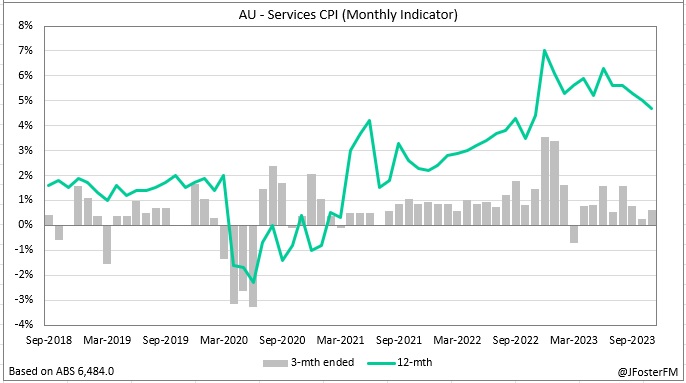

Notable price movements in the services category included holiday travel and accommodation falling from 1.3% to -0.3%, while the government's assistance package capped rent inflation at 7.1% (from 6.6% in October) from what the ABS reported would have otherwise been an 8.8% rise.


Goods inflation slowed on the back of falling petrol prices (-0.5%m/m), declining from 8.6% to 2.3% at an annual rate. Food inflation eased from 5.3% to 4.6%. Rises in electricity prices were contained to 10.7% (from 10.1%), with government rebates preventing much steeper rises from being passed through to households over the back half of the year.

Monday, January 8, 2024

Australian dwelling approvals rise 1.6% in November

Australian dwelling approvals lifted by 1.6% for the month in November following October's surprise 7.2% rise (revised from 7.5%). Approvals defied expectations for a 2% decline in today's report, putting back-to-back gains together for the first time since February-March 2023. Unit approvals (7.2%) drove the increase - as they did in October (16.8%) - while house approvals (-1.9%) reversed their lift from the prior month. 


After lifting to a 5-month high in October (14.3k), dwelling approvals advanced by a further 1.6% in November (14.5k). However, approvals continue to remain at low levels, down around 37% from cycle highs in early 2021 and 4.6% below their level from 12 months ago. Higher interest rates are weighing on home-building activity, while builders also remain stretched in working to complete record numbers of homes under construction in the pipeline. Rising housing prices and pressure on the existing housing stock from rapid post-pandemic population growth have yet to translate into turning the tide on the downtrend in approvals. 


Detached housing approvals have stabilised after unwinding from their highs, averaging around 8.5k per month through the back half of the year to date. That compares with an average of 8.3k per month in the first half. Victoria and Western Australia are two states that have seen house approvals trend higher through the second half of the year. 


In the unit or higher-density segment, the chart below shows the rise in approvals in October (16.8%) and now November (7.2%) has largely been driven by the high-rise category. But this is a very volatile component and is thus difficult to draw signal from. 


In the alterations segment, the value of renovation work approved continues to remain at elevated levels, well above the $1bn line. This partly reflects that the cost of renovation work is substantially higher post the pandemic period. 

Black Friday drives Australian retail sales

Black Friday sales drove Australian retail sales to a 2% lift in November (vs 1.2% consensus), the fastest increase in 2 years. Sales slid in the prior month (-0.4%) as households delayed purchases ahead of Black Friday and in the run-up to Christmas. The upside lift in November sales reflects households taking advantage of price discounting amid cost-of-living pressures and an extended sales period compared to recent years. 


The 2% rise in headline sales was driven by a 3.1% surge across the non-food or discretionary categories. This was the sharpest rise in discretionary sales in 21 months, highlighting the popularity of the Back Friday period in 2023. Food sales saw a 0.4%m/m rise, in line with the October outcome. 


In 2023, Black Friday had the largest effect on household goods (7.5%), with significant increases coming through in electrical appliances (14.4%) and furniture (9.7%). This differs from prior years where clothing and footwear has typically seen the sharpest increase of all the categories during the Black Friday sales. Clothing and footwear still posted a solid 2.7%m/m rise, though that was broadly in line with the outcome from 12 months ago (2.2%). Department stores (4.3%) posted their strongest rise since the opening month of the year. Additional foot traffic through shopping malls may have contributed to an associated rise in turnover at cafes and restaurants (0.4%), with the category rebounding from declines over the prior two months.   

The online segment saw a similar spike for Black Friday in 2023 when compared with 2022. While turnover for November increased at a much slower pace in 2023 (3%) than in 2022 (6.6%), the segment accounted for an almost identical share of total spending at 12.7% when compared with the previous year (12.6%). While online platforms are popular for Black Friday sales, many of the discounts are available in-store and the profile of sales growth in November being led by household goods reflects this.  


In looking ahead, the pattern in recent years has been for retail sales to fall back in the December month following the surge for Black Friday in November. This effect was quite pronounced in 2022 as sales swung from a 1% rise to a 3.4% fall. The pullback was less severe in 2021 (6% to -3.3%) and 2020 (5.7% to -2.9%); however, lockdown and reopening effects were also at play during those pandemic-affected years. 

Friday, December 22, 2023

Macro (Re)view (22/12) | Markets ride high to close 2023

Markets go into the holiday season riding high. It has been a stellar year for US and European equities while Japan has been the standout in Asia. Expectations for rate-cutting cycles are increasingly being backed up by the data - as seen in the latest inflation data in the US and UK this week. The 2-year US Treasury yield (4.32%) trades at lows going back to May while at the longer end the 10-year yield (3.89%) has retraced to 5-month lows having pressed 5% as recently as October. This backdrop has weakened the US dollar, the Australian dollar a notable beneficiary rallying by around 8% against the USD from its October lows.  


Cooling inflation in the US continues to underpin expectations for a sizeable Fed easing cycle in 2024. The headline PCE deflator eased from 2.9% to 2.6% at an annual rate to November and the core deflator softened from 3.4% to 3.2%, both in below expectations and at their lowest since early 2021. Notably, on a 6-month annualised basis, the core deflator at 1.9% is now inside the Fed's inflation target for the first time since September 2020. Should this momentum continue, there is an entirely plausible scenario where underlying inflation returns to the target by the middle of next year.   


Markets were left none the wiser on the timeline for policy normalisation following the Bank of Japan's meeting this week. All policy settings were left unchanged (-0.1% key rate and 0% 10-year yield target) and its forward guidance to step in with "additional monetary easing" if required has remained intact. The meeting statement conceded there are 'extremely high uncertainties' for the inflation and economic outlook in Japan, leaving policymakers reluctant to signal forthcoming policy changes. While inflation is expected to run above the 2% target through 2024, this is due mainly to the pass-through of higher imports prices and is judged as unlikely to be sustained. Underlying inflation is anticipated to 'increase gradually toward achieving the price stability target'; however, that relies upon growth picking up to an above-trend pace to underpin a rise in wages growth.   

The BoE's pushback to near-term rate cuts failed to gain traction after last week's meeting, and downside surprises in the UK's inflation report for November have only added to the extent of easing priced for 2024 (rising to around 130bps from 115bps). 12-month headline inflation fell from 4.6% to 3.9%, printing at a 26-month low and well below the 4.3% consensus figure. Inflation has declined substantially from its 11.1% peak 13 months ago driven largely by falling energy prices; however, there are increasing signs that the disinflationary process is broadening to other categories of the basket. This was reflected by a decline in the core rate from 5.7% to 5.1% (21-month low) against 5.6% expected. An easing in services inflation to 6.3% (from 6.6%) rounded out an encouraging report, but the BoE will want to see far more progress in this key component through the early months of 2024. 


The minutes of the RBA's December meeting get across the Board's tightening bias remains in place, but the message has been dated by recent events. Most notably, at the time of the meeting, the board members observed that 'market expectations for policy rates in other countries had eased significantly over the prior month, while being little changed for Australia'. Subsequently, those expectations have spilled over into Australia as the data have softened, with around 50bps of RBA cuts priced for 2024. The timing has meant the RBA goes into its summer break not having had the opportunity to push back on that pricing in the way the ECB (subsequently reiterated by Vice-President de Guindos) and BoE did last week. 

As to the December decision, the Board elected to leave rates on hold assigning greater option value on waiting for additional data than delivering a follow-up hike to the 25bps increase in November. It was noted there had been 'encouraging signs of progress towards the Board's objectives' while the 'pace of disinflation in some other countries... had accelerated' and that if this flowed through to prices in Australia it 'would be helpful in bringing inflation back to target'. The case to hike further rested on upside risks to the inflation outlook, driven by strength in domestic demand conditions. However, the sharp slowdown in GDP growth to 0.2% in the September quarter has made this a difficult narrative for the RBA to sustain going into next year.

A Merry Christmas to all and best wishes for 2024. A sincere thank you for reading. 

Friday, December 15, 2023

Macro (Re)view (15/12) | Fed turn adds to year-end rally

A Fed that surprised with a dovish turn by opening the door to rate cuts has added weight to the year-end rally in equities and fixed income, reducing a host of other top-tier events through the week to little more than glancing interest for markets. Equities advanced broadly (but underperformed in Europe and China), the USD came under renewed pressure and bond yields fell sharply. At this stage, the Fed stands in contrast to the pushback seen at the ECB and BoE to expectations for rate cuts despite presiding over much weaker economies. 


Although the Fed's FOMC held rates in the 5.25-5.5% range this week, the Committee is now openly discussing rate cuts - something Chair Jerome Powell had said would be premature only a couple of weeks ago. Markets were emboldened by this shift in messaging, bringing forward their timing for the first cut to March (from May) and pricing in more cuts next year (150bps from 125bps). 

In the post-meeting press conference, Chair Powell explained that with the Committee seeing what it had been wanting to see in the US economy: strong growth moderating, heat coming out of the labour market and inflation cooling, discussions were turning towards 'when it will become appropriate to begin dialing back the amount of policy restraint that's in place'. That framing is crucial and contrasts with a situation where the Fed is easing to head off a recession. Data this week showed retail sales outperformed expectations with a 0.3%m/m rise in November; meanwhile, headline inflation printed at 3.1%yr in November (from 3.2%) and the core rate was unchanged at 4%yr, both as expected. Notably, Chair Powell also said that rates could be cut before inflation was back at the 2% target to avoid leaving restrictive policy in place for too long.     


This discussion of policy easing was predicated on the FOMC's updated dot plot increasing the number of rate cuts implied for 2024 from 2 to 3, while it also needs to be remembered that the rate hike it had signalled for this meeting back in September has not eventuated. Broadly, the accumulation of FOMC members' forecasts points to an expected soft landing for the US economy in 2024, with growth cooling to 1.4% (revised from 1.5%) but unemployment rising only modestly from 3.8% to 4.1% (unchanged). These dynamics see the projections lowered for both headline (2.4% from 2.5%) and core inflation (2.4% from 2.6%) to be within reach of the 2% target by year-end in 2024.  

Source: Kathy Jones (Charles Schwab) via Twitter/X

By contrast to the Fed, policymakers at both the European Central Bank and the Bank of England continued to push back on prospects for rate cuts at their respective meetings this week. At the ECB, the Governing Council held its key rates unchanged (MRO 4.5%, MLF 4.75%, DF 4%) while reaffirming the need for these settings to be left in place "for a sufficiently long duration". It was also announced that reinvestments of maturing bonds in the PEPP portfolio would be tapered through the second half of 2024, reducing at a run-rate of €7.5bn per month and discontinued by year-end.

While markets price around 150bps of cuts next year, ECB President Christine Lagarde held firm in the post-meeting press conference saying it would not lower its guard. This came as the ECB's updated macroeconomic projections marked down an already weak growth outlook to 0.6% in 2023 (from 0.7%) and 0.8% in 2024 (from 1%) and sharply lowered its 2024 headline inflation forecast to 2.7% (from 3.2%), with the core rate also easing to 2.7% (from 2.9%). But inflation is still seen on a protracted path back to the 2% target in 2025/26 and President Lagarde said risks remained around domestic price and wage pressures. 

The BoE's Monetary Policy Committee (MPC) held a steady hand at 5.25% on Bank Rate. A 6-3 vote (the minority with siding with a 25bps hike) and a continuation of the line that restrictive policy would likely be required "for an extended period of time" gave the decision a clearly hawkish tilt. The meeting minutes conveyed that the core of the MPC remains alert to inflationary risks due to ongoing pressures in services prices and wages. There remains an expectation that these pressures will be slow to ease. 

In Australia, both the November Labour Force Survey and the mid-year update to the 2023/24 Federal Budget were neutral from an RBA perspective. Employment is accelerating into year-end rising by 61.5k in November, surprising strongly to the upside for the second month running following a 42.7k gain in October (full review here). Surging population growth is supporting employment and adding to labour supply, the participation rate resetting to a new record high (67.2%). This is rebalancing the labour market, resulting in the unemployment rate rising to 3.9%, still very low historically but now up 0.5ppt from cycle lows a year ago. Hours worked (0%m/m) showed further signs of being a margin of adjustment to slowing economic growth.


Significant upgrades to forecast revenue on the back of economic resilience, surging population growth and elevated commodity prices is estimated to deliver a windfall of around $67bn to the government over the next 4 years. In MYEFO (reviewed here), the Treasurer indicated 92% of the windfall would be used to offset future pressures on spending, lowering forecast deficits. New policy announcements add a modest $5.3bn of new stimulus through to 2026/27. In response, the AOFM announced its funding task for 2023/24 was expected to be $50bn (of which $23.6bn has already been completed), down from $75bn anticipated following the May Budget.  

Wednesday, December 13, 2023

Australian employment 61.5k in November; unemployment rate 3.9%

Australian employment surged to a 61.5k rise in November, coming in well above expectations for the second month in succession. Rapid post-pandemic population growth is supporting employment and has seen labour force participation reach a new record high (62.7%). However, the unemployment rate has lifted to 3.9%, its highest since May 2022, while hours worked were flat in the month. The labour market is rebalancing from peak tightness and validates the RBA's decision to hold rates unchanged over its summer break.    

November by the numbers...
  • Employment increased by a net 61.5k in November, sharply above the expected 11.5k rise. A downward revision lowered October's increase to 42.7k from 55k reported initially.  
  • Headline unemployment shifted from 3.8% (revised up from 3.7%) to 3.9% in November, a high since May last year. With the underemployment rate rising from 6.3% to 6.5%, total underutilisation moved from 10.1% to 10.4%, softening to a 21-month high.
  • Labour force participation reset to a new record high at 67.2% from 67%, while the employment to population ratio also stands at a record level after rising to 64.6% from 64.5%. 
  • Hours worked stalled in November coming off a 0.4%m/m lift in October, up 1.6% over the year. 


The details...

After coming through a patchy Q3, employment is accelerating into the back end of 2023. In November, employment increased (on net) by 61.5k, its strongest outcome since August that came as markets were expecting a post-referendum moderation in hiring (11.5k). This was driven by a resurgence in the full time segment (57k) over part time (4.5k), counter to the recent trend. Even allowing for the downward revision to employment in October to 42.7k (from 55k), employment is up by a net 104.2k over the past two months, already well above the increase seen in Q3 (76.1k). 


The main takeaway is that momentum in employment growth remains solid. The 3-month average increase to November was 37k, broadly in line with its average through the first half of the year (38.5k). On a 3-month annualised basis, employment growth is tracking at a 3.2% pace.


Regular readers of these reports would be aware that I have been of the view that strong population growth would keep employment supported even as momentum in the economy slows. This looks to be what is playing out currently. Simply put, the working-age population is surging (3%yr) on the back of net overseas migration (MYEFO yesterday put the rise at 510k in 2022/23). 


This has delivered additional workers into the country, reflected in record-high labour force participation (67.2%). The participation rate is up 1.4ppts on its pre-Covid level, with 0.4ppt of this rise coming through over the past year. Meanwhile, the share of working-age Australians employed has never been higher (64.4%). 


However, as this additional labour supply has arrived, the labour market has loosened. The unemployment rate lifted from 3.8% to 3.9% in November, up from the cycle lows of 3.4% seen a year earlier. Underemployment stands at 6.5% compared to its post-Covid low of 5.8%. Overall, underutilisation - the combination of the two - is now 10.4%, its highest since February 2022. But while the labour market has clearly receded from peak levels of tightness, it still remains robust. 


A broad range of indicators - including last week's Q3 National Accounts - are aligning to convey that the economic slowdown in Australia is currently playing out through a reduction in hours worked rather than employment. The various ABS measures report hours worked declined between 0.6-0.8% in Q3. The Labour Force Survey reported an encouraging 0.4% rebound in hours worked in October. I was hopeful this could extend; however, today's report showed hours worked came in flat month-on-month in November. 


In summary...  

A solid report today that was headlined by an acceleration in employment into year-end. Employment increasingly looks to be supported by strong population growth, and I remain upbeat that this can continue. But there is a rebalancing occurring in the labour market, reflected in the easing in conditions from peak levels of tightness and weakness in hours worked. Together with the slowdown in Q3 GDP growth, I think today's report will be read by the RBA as validating the decision last week to leave rates unchanged. 

Preview: Labour Force Survey — November

Australia's Labour Force Survey for November is due today at 11:30am (AEDT), the last major domestic data point left on the calendar for the year. After sharply outperforming expectations in October, employment is anticipated to moderate in November (11.5k), with the unemployment rate seen ticking up to 3.8%.       

A recap: Employment lifted strongly in October, but the unemployment rate increased 

Employment lifted by 55k in October, surprising strongly on the upside of expectations (24k). Full time employment saw a 17k rise; however, employment continued to be driven by the part-time segment (37.9k), potentially boosted by temporary hiring for the Voice Referendum. 


While employment increased strongly, it was outpaced by a rise in the participation rate, which increased from 66.8% to 67% to be back at record highs. As a result, the unemployment rate increased from 3.6% to 3.7%, returning to its level from July and August. With the underemployment rate remaining unchanged (6.3%), the uptick in unemployment saw the combined underutilisation rate rising from 9.9% to 10%.  


Hours worked saw their strongest rise in 6 months lifting by 0.5% in October. However, this was after a weak Q3, with the estimates across the various ABS measures suggesting hours worked declined in the order of 0.6-0.8% in the quarter. The recent weakness in hours worked is the clearest sign of an adjustment in the labour market to the slowdown in the economy.  


Employment is expected to moderate in November...   

Markets forecast a modest rise in employment of just 11.5k in November, with the band of estimates ranging between -30k to 30k. The moderation expected reflects the recent volatility in monthly employment outcomes. It also seems to be based on the view that the Voice Referendum boosted the October figure. The ABS's payrolls series fell slightly (-0.2%) for the month to mid-November, weighed by a sizeable decline in the index for public administration and safety industry (-6.7%) post the Referendum. Expectations are for the unemployment rate to lift from 3.7% to 3.8% (range: 3.6-3.9%). 


... with hours worked remaining in focus 

Given the recent volatility in employment outcomes is expected to continue, the hours worked figure should provide the cleanest read on conditions. Markets sense that the recent weakness in hours worked reflects a loosening in the labour market. But after a rebound was seen in October, the question is whether another rise can come through in November. 

Australia MYEFO 2023/24: Revenue upgrades drive lower deficits

The Australian government presented today its Mid-Year Economic and Fiscal Outlook (MYEFO) for 2023/24. Since the Treasurer handed down the 2023/24 Budget in May, revenue has come in well ahead of earlier estimates, delivering a windfall to the government that is anticipated to extend. The Treasurer in today's update indicated that 92% of the revenue upgrades will be used to lower future deficits, with the remainder directed at new spending in health and aged care and housing.  

MYEFO 2023/24 | Fiscal Position

Despite headwinds to the Australian economy from slowing growth domestically and offshore, MYEFO reports that the outlook for the nation's finances has improved markedly since the May Budget. Government revenue is now projected to be $67.4bn higher over the forward estimates out to 2026/27. This has been driven by the rapid post-pandemic increase in the population (510k in 2022/23 vs 400k estimated), still-elevated commodity prices and the robust labour market. This windfall is partially offset by a cumulative (or 4-year) increase in costs of $27.8bn, largely in the major 5 items of government spending (NDIS, health, aged care, defence and debt interest). However, this still leaves the government with a net boost to forecast revenue, which it is electing to use mainly as a buffer against future budget deficits. 

Accordingly, the budget is now forecast to be broadly in balance by the end of the 2023/24 financial year (-$1.1bn or 0% of GDP), an improvement from a deficit of $13.9bn (0.5% of GDP) projected back in May. The revenue windfall then allows the government to run smaller deficits through the out-years when pressure from the 'major 5' is set to intensify. The revised profile for the deficit is now: $18.8bn in 2024/25 (from $35.1bn previously), $35.1bn in 2025/26 (from $36.6bn), and $19.5bn in 2026/27 (from $28.5bn). All told, this has cut the size of the deficit projected through to 2026/27 to $74.6bn from $114.1bn anticipated in the May Budget. 


MYEFO 2023/24 | Overview 

The main theme in MYEFO is the sizeable upgrades expected in government revenue. As noted above, revenue upgrades total $67.4bn out to 2026/27. This almost exclusively reflects the boost from 'parameter changes' ($66.1bn), underpinned by a higher tax-take ($64.4bn). This windfall flows from a resilient economy and strong labour market (that is also larger due to population increase) that boosts the associated income tax receipts, while elevated commodity prices drive higher corporate taxes. Meanwhile, new policy decisions have added $1.2bn to the coffers, with over half of this coming via higher taxes levied on foreign investors in the housing market. 


On the other side of the ledger, government payments have been marked up by $27.8bn over the forward estimates. Of this, $21.3bn is attributed to 'parameter changes' - reflecting increased spending in the NDIS and Child Care Subsidy and from the impact of higher interest rates. New policy decisions taken since the May Budget come at a cost of $6.5bn. This is headlined by additional funding to the Pharmaceuticals Benefits Scheme ($3.5bn), new housing ($0.7bn), aged care reform ($0.5bn) and support for the NDIS ($0.5bn), but a 're-profiling' of infrastructure spending has clawed back $7.4bn for the government. Overall, Treasury estimates that these measures will inject a modest net stimulus to the economy of $5.3bn over the next 4 years.

As a result of the revenue upgrades and their effect on lowering the deficit, the profile for government net debt has improved relative to expectations in the May Budget. Lower budget deficits mean the government's funding requirement is reduced, while higher bond yields have led to a fall in the market value of Australian government bonds on issue. Net debt in 2023/24 is now forecast to come in at 18.4% of GDP ($491bn), down from 22.3% of GDP ($574.9bn) previously. Over the out-years, net debt increases but on a slower trajectory than in the May Budget - reaching 20.8% of GDP in 2026/27, well down from the previous projection of 24.1% of GDP. The profile for net interest payments was little changed in MYEFO.  


MYEFO 2023/24 | Economic Outlook

The baseline economic outlook from Treasury is broadly unchanged compared to the May Budget. As covered last week in the Q3 National Accounts, the Australian economy is slowing as headwinds domestically (cost-of-living pressures and higher interest rates and offshore (conflicts and uncertainty) are impacting. Still, Treasury continues to forecast a soft landing, in alignment with the RBA's outlook. 


Domestic growth is anticipated to be weak in 2023/24 (1.75%) and subdued in 2024/25 (2.25%). This helps to ease inflation over the period, but a return to the midpoint of the RBA's target band is not anticipated until 2025/26. The extended timeline reflects the outlook for the labour market to remain in robust shape: the unemployment rate is seen reaching a high of 4.5% through 2024/25 into 2025/26, still a historically low level in Australia through the decades. Both the RBA and Treasury see the current pace of wages growth (4%) as the peak for the cycle. 

The nominal side of the economy is supported by a deferral in the timing of the expected retracement in commodity prices (to US$60/t for iron ore; US$140 for metallurgical coal; and $US$70/t for thermal coal), by 6 months to the September quarter in 2024. This has resulted in a slower decline in the terms of trade, driving a substantial upgrade to the growth outlook in 2023/24 for nominal GDP to 4.25% from 1.25% previously.