Independent Australian and global macro analysis

Tuesday, December 5, 2023

Australian GDP slows to 0.2% in Q3

Growth in the Australian economy slowed to 0.2% in the September quarter, below expectations (0.5%) and the weakest quarterly growth rate in a year. There was little change in year-ended growth at 2.1% from 2.0% previously, but that has been underpinned by post-pandemic population growth (2.4%), implying a continuation of declining growth on a per capita basis (-0.3%Y/Y). Demand conditions have cooled materially as headwinds have impacted household spending. A continuation of this trend - which looks likely - should help ease inflationary pressures. The RBA Board has not ruled out further tightening, but that looks even less likely now than it did after yesterday's meeting. 


Notably, household consumption growth dried up in Q3 (0%) and is little more than flat (0.4%) through the year. Residential construction activity (0.2%) remains weak, though business investment - while moderating to 0.6% in the quarter - continues to be broadly resilient. These dynamics combined to see private sector demand ease from 0.6% in Q2 to just 0.2% in Q3, up 1.4% through the year. By contrast, public demand achieved that pace of growth in Q3 alone (1.4%), with both spending and investment advancing further. Inventories were a key growth support (0.4ppt), but net trade took 0.6ppt off quarterly growth, driven by weakness in exports (-0.7%). 


The main story in the National Accounts is around households. The headwinds that are impacting household finances from cost-of-living pressures and rising interest rates are intensifying. While households benefitted from a rise in wages growth as award increases came through, that was offset by increasing interest costs on mortgages (7.6%) - despite the RBA pausing through Q3 - and a higher tax burden (7.6%) due to the Low and Middle Income Tax Offset ending. Accounting for those factors, disposable income - what households are left with - was virtually flat in Q3 (0.1%) and up 1% through the year. Adjusting for inflation, real disposable incomes continued to decline (-1.3%q/q, -4.6%Y/Y)


That backdrop has driven the slowdown in real household consumption, stalling in Q3. Weakness was concentrated in goods consumption (-1.3%) - despite vehicle purchases surging (13%) - with services advancing (0.8%), supported by overseas travel and hospitality services during the FIFA Women's World Cup. This led to the unusual situation of discretionary consumption (0.8%) accelerating despite the headwinds.


But that looks unlikely to be repeated into year-end: the household saving ratio has fallen to just 1.1% - its lowest since 2007. Households will need to draw down on their accumulated savings, which are substantial, to support consumption. 


More to come. 


RBA closes 2023 on hold

There was no follow-up increase to the cash rate (4.35%) from the RBA today after it elected to resume its tightening cycle last month. The Board will now assess developments over its summer break and has kept its options open to hike again if needed. But with significant easing cycles being priced into rates markets offshore in 2024, the window for the RBA to press on looks to be narrowing. 


In today's statement, Governor Michele Bullock revisited the November decision explaining that the call to hike by 25bps and end its 4-month pause came as the Board assessed "the risk of inflation remaining higher for longer had risen". That refers to the upward revisions the RBA made to its inflation outlook last month, with both headline and core CPI falling more slowly to reach 3% - the top of the 2-3% target band - by the end of 2025 (up from 2.75% previously). But the governor said there was no need to hike today given that the incoming data since the last meeting had been "limited" and the updates it had received on the labour market and inflation had been in line with its expectations. While the Board has gone back into pause mode, the governor noted that higher rates were working to cool demand and that the full effects of the tightening cycle on the economy remained in the pipeline.

The Board has retained its guidance that "Whether further tightening of monetary policy is required..." will be determined by the incoming data. Pausing today leaves the RBA to watch the data over the summer months, which will shape how it responds upon its return in February. The RBA is maintaining the optionality to hike further, but the cash rate may well be at its peak already. Inflation offshore looks to be slowing at an accelerated pace, prompting markets to price aggressive rate cutting cycles in the US and Europe next year. Governor Bullock took a cautious view saying that trends in goods prices offshore had been "encouraging" but services inflation "remained persistent". Only time will tell which narrative prevails. 

Monday, December 4, 2023

Australia Current Account -$0.2bn in Q3; net exports -0.6ppt

This morning's Australian international trade data have come in materially weaker than expected. The nation's current account returned to a broadly balanced position (-$0.2bn) in the September quarter, with large surpluses having been commonplace over recent years, while net exports look to have weighed more heavily on economic growth in Q3 (-0.6ppt) than markets had anticipated (-0.2ppt). 


Australia's current account narrowed from a surplus of $7.8bn in the June quarter (1.2% of GDP) to -$0.2bn in the September quarter (vs $3.3bn exp). This movement (-$7.9bn) was primarily driven by the trade surplus declining from $30.8bn to $22.9bn, with export income falling 2.1% ($163.3bn) and import spending rising 3.3% ($140.5bn); the income deficit was little changed at -$22.3bn (from -$22.7bn). 

Total income from exports contracted by 2.1% in Q3, reflecting falls in both underlying volume demand (-0.7%) and prices (-1.5%). The fall in volumes was driven solely by non-rural goods (-4.0%) as shipments of resource commodities contracted 4.7% in aggregate (iron ore -3.4%, coal -6.8% and LNG -6.3%). Although iron ore prices advanced (6.9%) there were sizeable falls in the prices received for coal (-9.1%) and LNG (-7.6%) exports. Services export volumes advanced by 1.9% in the quarter - slower than the gains of prior quarters - likely supported by travel associated with the FIFA Women's World Cup.


On the import side, expenditure rose at a 3.3% quarterly pace, with volumes lifting 2.1% and prices rising 1.2%. Volume demand for goods was relatively flat (0.5%) but services surged (8.4%), driven by overseas travel through the back end of the Australian winter. The rise in goods volumes came on the back of capital goods (3.4%) as industrial transport equipment (16.6%) spiked. 


Overall, the key takeaways from Q3 are: i) import volumes rose (2.1%) and exports fell (-0.7%), a dynamic estimated by the ABS to deduct 0.6ppt from Q3 GDP, and ii) import prices increased (1.2%) as export prices declined (-1.5%), resulting in the terms of trade falling 2.6% in the quarter, representing a hit to national income. 


Preview: RBA December meeting

The RBA is expected to leave the cash rate (4.35%) unchanged at today's meeting. This is to be the final policy meeting for 2023 and the last time the Board will meet at a monthly frequency - the RBA's practice for the past 3 decades - as it downshifts to an arrangement of 8 meetings per year from 2024 onwards, a key recommendation adopted out the recent review into the central bank.


Economic resilience and upside risks to the inflation outlook prompted the Board to resume its tightening cycle with a 25bps hike in November, ending a 4-month pause. Since then, the RBA's messaging has been widely interpreted as hawkish, though markets have detected a reluctance to hike again at this stage. That partly reflects a tweak in the Board's guidance from "Some further tightening of monetary policy may be required..." in October to "Whether further tightening of monetary policy is required..." coming out of the November meeting. 

Recent labour market data have remained solid, though the unemployment rate stands at 3.7% as of October, up from cycle lows (3.4%) 12 months earlier. Wages growth has accelerated with a lag, rising to 4% year-ended (a high since 2009) following the largest quarterly increase on record in Q3 (1.3%) on adjustments to awards, broadly in line with RBA forecasts. Markets effectively priced out any chance of a follow-up hike last week when the monthly CPI indicator surprised on the downside: headline CPI slowed from 5.6% to 4.9%yr in October, with the core rate (5.3%yr) and services inflation (5%yr) also easing.   

For a data-dependent Board, the fact that a couple of key data points are imminent, including the Q3 GDP outcome and the November labour market report adds to the case to hold. Pausing today will also afford the RBA time over its summer break to assess how the global disinflationary trends, which look to be accelerating in the US and Europe, are playing out and to consider the implications for Australia.    

The disinflationary process in Australia is lagging developments offshore and with the current forecasts only pointing to inflation being at the top of the 2-3% target band by late 2025, the RBA will clearly want to retain the optionality to hike further. Markets acknowledge this but price the chance of a February hike only at around 33%. The key to that decision will likely be the December quarter CPI report due in late January. 

Australian housing finance advances 5.4% in October

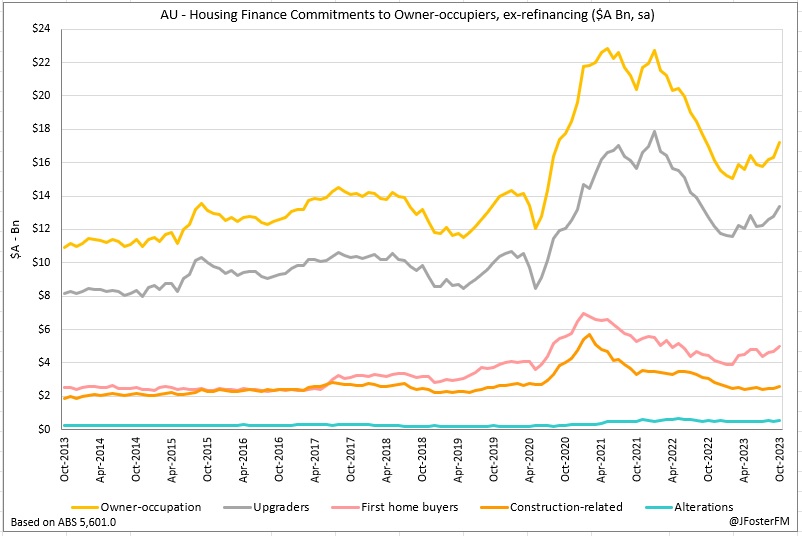
Australian housing finance commitments rose for the third month in succession lifting by a stronger-than-expected 5.4% (vs 1.1%) in October ($26.7bn). Commitments are now 17.5% above the cycle low in February ($22.8bn) as supply-demand imbalances have led to an upturn in housing prices, despite further RBA rate increases through the year. CoreLogic has clocked this upturn at around a 10% rise in the median capital city house price since January. 


October's 5.4% rise was the sharpest month-on-month lift in commitments since May. This gain came after the RBA held rates unchanged between July and October. It will be interesting to assess how the resumption of the tightening cycle in November may have impacted this momentum. 


Commitments to the owner-occupier segment posted a 5.6% lift - its sharpest rise going back to November 2021. At $17.2bn, commitments to the segment are up 14.2% on their trough in February ($15.1bn). Of note this month, construction-related lending accelerated 6.3% to $2.6bn, a high to the start of the year. Commitments to upgraders increased by 4.6% to $13.4bn, a 14-month high. There was also participation from first home buyers, with the value of commitments up 6.2% ($5bn) and loan volumes rising by 5.1% (9.8k).  


In the investor segment, new commitments lifted by 5% to touch a 16-month high at $9.5bn. These commitments have increased for 8 months on end to stand 23.9% above their cycle low ($7.7bn). Very low capital city vacancy rates, strong rent inflation and rising house prices have clearly been attractive fundamentals for many investors.  


Refinancing fell by 7% ($17.4bn), declining sharply for the third month running. Over this period, the value of refinancing has fallen by 19.5% (-21.6% in the owner-occupier segment and -15.2% for investors). Refinancing activity is clearly moderating after rising very sharply through the past couple of years as many borrowers rolled off fixed-rate periods onto higher variable rates. The RBA pausing rate hikes may have accelerated the decline.   

Sunday, December 3, 2023

Australian Business Indicators Q3: inventories 1.2%

Australia's Business Indicators report for the September quarter contained some constructive detail around discretionary demand, while the result for inventories (1.2%) points to a strong contribution (0.9ppt) from this component to Q3 GDP growth (currently expected at around 0.4%). 


Sales volumes in the third quarter contracted marginally (-0.1%) on a headline basis but lifted modestly (0.2%) excluding the mining sector (-1.8%). This was an improvement for non-mining sales following a 0.1% fall in the previous quarter, consistent with expectations that discretionary-related demand fared better in Q3. Reflecting this, categories such as hospitality (1.5%) and arts and recreation (2.6%) posted their strongest quarterly rises for 2023, likely boosted by the FIFA Women's World Cup, co-hosted by Australia and New Zealand in late July to late August. Retail sales (1.4%) also advanced at their fastest pace in a year. 


A key factor behind the improvement in discretionary demand was a strengthening in real incomes. Aggregate wage costs lifted by 2.7% in the quarter (9.7%Y/Y), outpacing the gains in the prior two quarters (Q1 1.9% and Q2 2.0%) as award rates increased following the Fair Work Commission's 2022-23 ruling. 


Company profits declined at a headline level by 1.3% in the quarter to $131.1bn (-1.7%Y/Y). Adjusted for inventory valuation effects, profits were down by 0.9% in Q3. The decline in company profits was driven entirely by a 7.7% contraction in the mining sector (to $54.9bn), reflecting falls in commodity prices. Non-mining profits lifted by 3.8% (to $76.2bn), rebounding from their Q2 fall (-3.3%). Profits in the non-mining sector are up 15.7% through the year, strongly suggesting that higher input costs have been passed through to consumers rather than being absorbed within margins. 


Inventory levels are estimated to have increased by 1.2% in the quarter to $209bn, completely counter to expectations for a 0.8% decline. This increase points to a sizeable contribution of 0.9ppt to Q3 real GDP. The mining sector was the key driver seeing its inventory levels surge by 8.9% for the quarter. By contrast, retail inventories were flat and declined in wholesale trade (-0.2%) and hospitality (-1.9%).  

Friday, December 1, 2023

Macro (Re)view (1/12) | November to remember

A broad-based rally across markets closed out a memorable November. US equities lifted between 8-11% and Europe by around 8%, coming alongside substantial declines in Treasury yields, at both ends of the curve. This backdrop has kept the Australian dollar supported at 3-month highs. Falling inflation has buoyed optimism for significant rate-cutting cycles in 2024 on the view that central banks will look to normalise monetary policy from the restrictive settings that prevail in many countries presently.  


In the US, comments from Fed Governor Waller indicating that falling inflation opened the door to lower rates resonated strongly in markets. Later in the week, Fed Chair Powell offered some pushback by saying it was premature to conclude that rates had peaked, let alone to speculate on the timing of rate cuts. These assessments appear to reflect the core view of FOMC members, though Chair Powell did concede that rates were "well into restrictive territory", seemingly making additional tightening less likely. The inflation data back this up, with the core PCE deflator slowing from 3.7% to 3.5% at an annual rate in October, a low to April 2021. But in 3-month (2.4%) and 6-month (2.5%) annualised terms, the recent momentum suggests core inflation is on track to be within touching distance of the Fed's 2% target.   


There were several public appearances by top ECB officials this week but downside surprises in November's inflation data spoke loudest of all. Headline inflation declined from 2.9% to 2.4%yr (vs 2.7% expected) - a low to August 2021 - while the core rate came in from 4.2% to 3.6% (vs 3.9%), a 19-month low. These outturns imply inflation is declining on a faster trajectory than currently forecast by the ECB, leading markets to start pricing in rate cuts as soon as April next year. This expectation is driven not only by disinflationary momentum but also by weakness in economic activity. Euro area GDP contracted marginally in Q3 (-0.1%) and recent PMI readings have been consistent with declining output continuing.


Despite its hawkish messaging of late, including from Governor Bullock in Hong Kong this week, the chances of the RBA hiking at next week's meeting have always looked remote. But whatever chance there was of a December rate hike dissipated following this week's data. Headline inflation surprised on the downside falling from 5.6% to 4.9% in October (vs 5.2% exp), with the measures of underlying inflation also softening but sitting in a more elevated range of 5-5.3% (full review here). Meanwhile, retail sales posted their weakest outturn in four months falling 0.2% in October as spending was delayed ahead of Black Friday sales (see here). 


Aside from the RBA meeting, attention next week will be on the Q3 National Accounts. My detailed preview (see here) sets out what is known about how the Australian economy performed in Q3, with GDP growth of around 0.4%q/q anticipated. Partial indicators received this week that feed into the GDP outcome reported stronger than expected detail for construction activity at 1.3%q/q (see here), but capital expenditure by firms slowed to 0.6%q/q, printing on the soft side of estimates (see here). National housing prices according to CoreLogic remained on the rise - albeit at a slowing pace of 0.6% in November - to be nearly 10% above cycle lows. A housing supply shortfall has largely driven this upswing in prices, outweighing the effects of RBA tightening. However, this has not translated to any material improvement in building approvals, although they posted a welcome 7.5% rise in October (see here). 

Thursday, November 30, 2023

Preview: Australian Q3 GDP

Australia's National Accounts for the September quarter are due to be published by the ABS today (11:30am AEDT). Headwinds impacting household finances saw momentum in the economy slow over the first half of the year and that is expected to have continued. Real GDP growth is forecast to have remained moderate expanding by around 0.4% in Q3 and 1.8% through the year. 

A recap: Economic growth remained subdued in the June quarter...

The Australian economy expanded by a subdued 0.4% in the June quarter, with year-ended growth easing from 2.4% to 2.1%. From solid growth in the back half of 2022 (1.3%), momentum in the economy slowed over the first half of the year (0.7%) as cost of living pressures and higher interest rates saw households cut back on discretionary spending.  


Australia's population has increased at a rapid pace in the post-Covid period, underpinning economic growth over the past year. But this has equated to weakness in per capita growth, which contracted narrowly in quarterly (-0.3%) and year-ended terms (-0.3%). Another factor that has detracted from the quality of headline growth has been a decline in labour productivity (-3.5%Y/Y), reflecting hours worked (5.8%) expanding at a faster rate than output (2.1%). Unit labour costs have been rising as a result, highlighted by the RBA as posing a key risk to the inflation outlook. 


... as headwinds continued to weigh on household spending

Household consumption came close to stalling in the June quarter (0.1%), slowing year-ended growth to 1.5%. Excluding the Covid period, this was the weakest quarterly growth rate since Q3 2019. Over the past year, household consumption has been driven by growth in essential goods and services - including rents and utilities - with pressures from the cost of living and higher interest rates prompting a winding back of discretionary purchases. This theme remained evident in Q2: essentials advanced by 0.5% as the discretionary category declined by 0.5%.


Aside from a rotation in consumption patterns, pressures on household budgets had also caused a reduction in saving. The household saving ratio declined to 3.2% in the quarter to stand at a 15-year low. However, the stock of savings accumulated by the household sector during the pandemic years remained substantial. 


Services exports rebounded further and had added strongly to growth over the past year, supported by the recovery in the domestic tourism and education sectors. Business investment was defying the broader slowdown, expanding further (2.1%) on the back of momentum in equipment spending as order backlogs eased and firms took advantage of tax incentives. Residential construction activity remained weak overall (-0.2%); while new home building saw a welcome rise (1.2%), higher interest rates and ongoing capacity constraints were headwinds and alterations (-2.4%) continued to moderate from their cycle highs reached during the pandemic. 


September quarter overview: Can consumption defy the headwinds? 

The incoming data for the September quarter points to moderate growth in the Australian economy. Household consumption appears to have been a little stronger in Q3, supported by an improved dynamic around real incomes. 


Although quarterly headline inflation lifted (1.2%q/q), wages growth accelerated (1.3%q/q) as increases decided upon by the Fair Work Commission boosted award rates and the minimum wage. Other factors that supported household consumption were the FIFA Women's World Cup and the RBA holding the cash rate unchanged at 4.1% over the quarter.   


Retail sales volumes posted their first quarterly rise in a year, with broad-based increases coming through across the discretionary categories. Per capita growth in retail volumes continued to contract in Q3 (-0.5%), though at a much slower pace than in prior quarters.  


Labour market conditions remained robust but have eased slightly. Employment growth had slowed to a pace that was broadly matching the rate of growth in the population, resulting in the unemployment rate rising slightly from its cycle lows late last year. But, on the whole, firms appeared to be mainly responding to the slower demand environment by adjusting hours, with hours worked contracting in the quarter.  


Housing prices remained on the rise as housing supply remained tight amid rising population growth and headwinds in the homebuilding sector, outweighing the effects of higher interest rates. 


Summary of key dynamics in Q3

Household consumption — Appeared to fare better in Q3, supported by a pick-up in wages growth. Retail sales volumes (0.2%) rose for the first time in a year with the discretionary categories the drivers, notably department stores (1.5%) and household goods (0.8%). 

Dwelling investment — A rise in alteration work (5.1%) looked to underpin a 1.2% increase in residential construction activity in the quarter. New home building saw a modest rise (0.5%), constrained by higher interest rates and ongoing capacity constraints.

Business investment — Private sector capex slowed to a 0.6% rise in Q3 following strong momentum through the first half of the year. The expiration of tax incentives at the end of the financial year weighed on non-mining equipment investment (-0.5%).   

Public demand — Increases in public spending (1.1%) and investment (2.4%) combined to contribute around 0.3ppt to quarterly output.

Inventories — Expected to add around 0.5ppt to quarterly activity, partially reversing its drag on growth in Q2 (-1.1ppts). Private non-farm inventories contributed an estimated 0.9ppt to GDP but public sector inventories were a drag at -0.4ppt. 

Net exports — Estimated to deduct 0.6ppt from GDP in Q3. Imports advanced 2.1% on the back of strong services demand (8.4%) for overseas travel, while exports declined by 0.7%, weighed by resources (-4.7%). 

Australian dwelling approvals rebound to multi-month highs

Australian dwelling approvals rebounded by 7.5% in October, rising to their highest level (14.2k) in 5 months. This far exceeded the consensus expectation (1.7%) following a 4% fall in September (revised from -4.6%). A surge in unit approvals (19%) drove the headline increase, with house approvals (1.2%) also supporting. Approvals, however, remain at low levels at a time when housing supply in Australia has been pressured by population growth. 


There was a welcome upside surprise for dwelling approvals in October, with a 7.5% increase lifting the monthly total to 14,223, its highest since May. This comes amid housing supply in Australia coming under significant pressure from rapid population growth following the Covid years and capacity constraints holding housing completions to subdued levels. Higher interest rates have been another headwind, although housing prices have risen alongside the RBA's hiking cycle, reflecting the demand-supply dynamics described. This is of course a very volatile series, meaning little signal can be taken from any given month. Taking a 3-month average to smooth the volatility, approvals sit just off cycle lows having declined in the order of 35% from their 2021 peaks. 


Unit approvals surged in October (19%) but that came after declines in 3 of the past 4 months. The underlying detail in the report suggests that the lift this month was driven by major increases in approvals from Brisbane and Perth. By dwelling type, the low-rise segment led the way with high-rise approvals declining. 


Detached or house approvals lifted by 1.2% in October and are broadly in line with the low levels that were seen ahead of the pandemic. These approvals are around 40% below their cycle high in early 2021.  


With new builds - especially in the detached segment - remaining challenged, alterations have remained at elevated levels following their surge during the pandemic. However, the value of alteration work approved fell in October (-3.2%) to be down 2.4% over the year. 

Wednesday, November 29, 2023

Australian Capex 0.6% in Q3; 2023/24 investment plans $171bn

Capital expenditure by Australian firms slowed in the September quarter (0.6%), coming in below expectations (0.8%) to post its softest outturn since the middle of last year. The winding up of Covid-related tax incentives for equipment purchases at the end of the 2022/23 financial year and weakness in commercial construction were the key factors. This was attenuated by the strongest quarterly rise in mining sector capex (5.6%) in 11 years. Investment plans for 2023/24 remain resilient to economic headwinds, upgraded to a decade high ($171bn) in the latest estimate. 


Private sector capex has risen strongly over recent quarters, but the momentum slowed in Q3. This was driven by a moderation in both equipment (0.5%) and buildings and structures (0.7%). 

Equipment spending looks to have been frontloaded into the first half of the year (6.3%) before temporary full expensing - a measure introduced to support the economic recovery from the pandemic that allowed businesses to fully write off the cost of eligible assets in their first year - wound down at the end of the financial year.

Non-residential construction was also strong in the first half of the year (7.7%) but then weakened in Q3, consistent with yesterday's construction work report.   

 
These dynamics led to non-mining sector capex declining by 1.3% in the quarter, its weakest outturn in 3 years, reflecting falls in equipment (-0.5%) and buildings and structures (-2.2%). By contrast, mining sector capex accelerated by 5.6% to post its strongest rise since Q2 2012. This came on the back of gains in equipment (5.9%) and buildings and structures (5.4%).  


In volume terms, the level of non-mining capex remains elevated, up 12.1% on pre-pandemic levels. Mining sector capex has risen 15% through the year to be near the levels seen ahead of the investment boom in the sector more than a decade ago. 


Firms' investment plans have remained resilient to headwinds to the growth outlook in Australia and offshore. The 4th estimate of expected capex in 2023/24 was upgraded by 8.5% on the previous estimate put forward 3 months ago, rising to a figure of $171bn - a high back to 2013/14. This estimate is also up by 10.3% on a year-to-year basis. But these estimates are in nominal terms, so include the impact of higher inflation. 

Non-mining sector investment plans were revised up by a strong 9.2% ($121bn), driven by a 12.5% upgrade in estimated spending on equipment ($57bn), with buildings and structures rising by 6.4% ($64bn).


For the mining sector, 2023/24 investment plans lifted by 6.9% compared with estimate 3 to stand at $51bn (up 8.5% year-to-year). A 6.6% upgrade came through in buildings and structures spending ($37) while equipment spending was seen 8% higher ($14bn).