Independent Australian and global macro analysis

Tuesday, September 5, 2023

Australian Q2 GDP expands 0.4%

The Australian economy expanded by 0.4% in the June quarter, in line with expectations and unchanged from Q1 after revisions. This was a resilient outcome considering household consumption (more than 50% of the economy) continued to slow amid cost of living pressures and higher interest rates. Weaker offshore growth dynamics also hit, reflected in the terms of trade falling 7.8% as commodity prices unwound, driving a 1.2% contraction in nominal GDP. 

Real GDP increased by 2.1% through the year, underpinned by rapid post-pandemic population growth (2.4%). Reopened borders have also bolstered growth by facilitating the recovery in services exports, including tourism and education, adding more than 2ppts to GDP over the past year. 


Household consumption growth almost stalled in Q2 (0.1%) and has slowed sharply over the past year (1.5%). With pressures on household budgets intensifying, discretionary consumption continues to weaken, falling 0.5%q/q as year-ended growth slowed to just 0.6%.


A strong labour market has supported household incomes, but the tax burden has increased alongside this, interest rates have risen sharply and inflation has been elevated. All told, real disposable income has fallen 3.2%Y/Y. That consumption at 1.5% is still positive in this environment speaks to the resilience of the consumer and their willingness to spend out of savings accumulated during the pandemic. Whether households are able to take this much further is an open question, with the saving rate in the June quarter declining to a 15-year low (3.2%).  


Together with slowing household consumption, residential construction also remained weak in Q2 (-0.2%), albeit new home building saw a welcome lift (1.2%). However, private demand held up relatively well (0.5%) as business investment (2.1%q/q, 8%Y/Y) continued to defy the prevailing headwinds. This has been supported by eased supply chain pressures. As backlogged orders - particularly for vehicles and machinery - have been filled, inventory levels have declined, weighing on GDP (-1.1ppts in Q2). Public demand (1.2%q/q, 2.7%Y/Y) remains a growth support as progress on infrastructure projects gains momentum. Net exports (+0.8ppt) made the largest contribution to growth in Q2 as the recovery in domestic tourism and education services continued at pace. 


More to come. 


RBA extends pause in September

The RBA Board left its key rates unchanged today at 4.1% on the cash rate and 4% for Exchange Settlements. This was the 78th and final meeting overseen by Governor Philip Lowe, his tenure concluding the same way it started back in October 2016 with the Board holding a steady hand. Headwinds offshore and signs that the transmission of tighter monetary policy is in train through slower domestic growth, some easing in the labour market and declining inflation have kept the Board on hold for 3 meetings in succession now, a pause that looks likely to extend. 


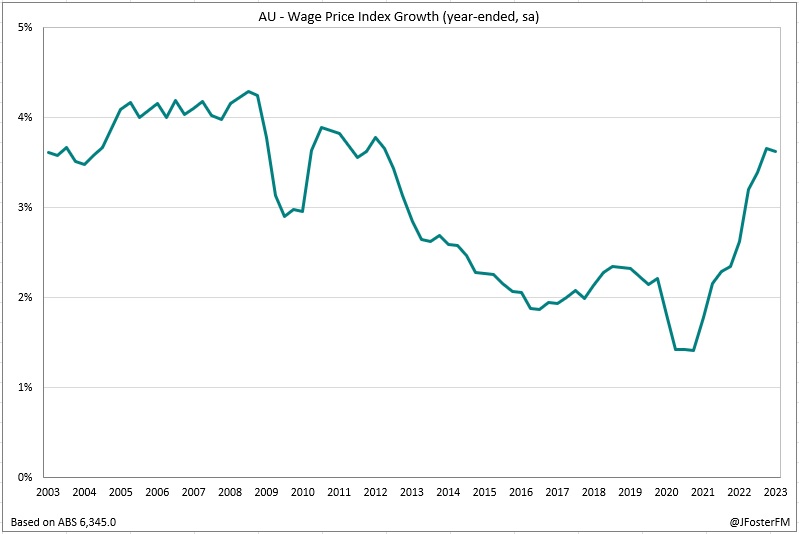
Today's decision statement from Governor Lowe was largely unchanged from the previous meeting in August. The overall tone is that a data-dependent Board is seeing enough progress in the domestic economy to warrant remaining on the sidelines, particularly with uncertainty around the Chinese economy clouding the outlook for global growth. As such, the RBA's central scenario for inflation to fall back to the 2-3% target - forecast for "late 2025" - with growth and employment still increasing remains intact. The current pace of wages growth (3.6% year-ended) is not seen as a constraint to returning to 2-3% inflation, although stronger productivity growth remains a key part of that assessment. 

Reflecting the risk that inflation could remain more elevated than anticipated for longer, the Board has retained its tightening bias, noting that "some further tightening of monetary policy may be required...". The key uncertainties regarding inflation are how elevated services prices evolve and how wage and price settings adjust to slower growth. However, unless these factors materialise to prompt a revision of the inflation outlook, the Board seems set for an extended pause. 

Monday, September 4, 2023

Australia Current Account $7.7bn in Q2; net exports +0.8ppt

Australia's current account surplus narrowed from $15.5bn ($A) in the March quarter to $7.7bn in the June quarter (estimated at around 1.2% of nominal GDP), a slightly larger decline than expected ($8bn). The narrowing was driven by falling commodity prices, hitting national income by around 8% in the quarter. Nonetheless - but for one quarter in 2022 - the nation has run a current account surplus for the past 4 years, a period without precedent for Australia. The topline detail for net exports was strong, with the ABS reporting an expected contribution of +0.8ppt to Q2 GDP, well above expectations for +0.3ppt. 


The current account surplus narrowed by $4.8bn to $7.7bn in the June quarter. The drivers were the trade surplus contracting by $8bn in the period (to $31.4bn), with the income deficit improving by $3.2bn (to -$23.4bn) as returns from offshore investments lifted (3.7%).   


The value of the nation's exports has eased from record highs, declining by 4.2% in the quarter, weighing on the trade surplus. That movement was driven by an 8.2% decline in export prices, reflecting a retracement in commodity prices. Underlying export volumes advanced 4.3% in the quarter. Import values lifted 0.4%q/q, on a combination of softer prices (-0.2%) and a modest lift in volumes (0.7%).  


What this all means is that national income took a large hit during the June quarter - the terms of trade fell by 7.9%q/q, its sharpest quarterly decline in 14 years - but international trade actually added substantially to economic growth, due to export volumes (4.3%) far outpacing import volumes (0.4%).  


The contribution to GDP growth coming through from net exports in Q2 will be 0.8ppt, helping to attenuate very weak business indicators data yesterday. 


The ongoing recovery in the domestic services sector, notably tourism and education, on reopened borders continued to drive exports. Services exports were up a further 12.5%q/q and have been the major contributor to export growth over the past year. Other notable dynamics were: strong offshore demand driving rural exports (0.9%) to a record high in Q2; meanwhile, commodity exports lifted by 2.4%q/q, as shipments rebounded from disruptions in Q1. 


Import volumes were soft in Q2 (0.7%), slowing to a pace of 4.4% through the year from 5.7%. Slowing imports reflect the backdrop of weakening domestic demand; however, this has centered in goods (0.7%Y/Y) as services post-pandemic remain elevated (22.9%Y/Y). Key dynamics in Q2 were: consumption goods (-1.1%) and capital goods (-3.3%) falling on weak demand; by contrast, continued resilience was seen in services (4.7%), bolstered by overseas travel to the northern hemisphere as the Australian winter approached. 

Preview: RBA September meeting

The RBA is set to extend its tightening pause today, leaving the cash rate on hold at 4.1% for the third meeting in succession (decision due 2:30pm AEST). This is Governor Philip Lowe's final meeting of his 7-year tenure leading the RBA and will be followed by a speech titled Some closing remarks on Thursday (1:05pm AEST).   


After leaving rates on hold at the July and August meetings, the Board will very likely maintain that position today. Amid economic headwinds offshore and signs that the effects of its tightening cycle are in transmission through slower domestic growth and declining inflation, a data-dependent Board has been content to stay on the sidelines and monitor developments. 

Forecasts updated by the RBA last month showed the central scenario is for the economy to remain on the "narrow path" where inflation falls back to the 2-3% target band over the next couple of years, with growth and employment still increasing. A hint that the Board is thinking along the lines of an extended pause was evident in the August meeting minutes, which noted that there was "a credible path back to the inflation target with the cash rate staying at its present level". However, the Board ultimately retained its tightening bias that "some further tightening of monetary policy may be required...", contingent upon "... the data and the evolving assessment of risks".   

The incoming data since the August meeting looks to support the continuation of the RBA's pause. The most notable developments have been softening wage and price data. In the June quarter, the Wage Price Index eased back to a 3.6% annual pace, printing on the soft side of RBA expectations for an unchanged 3.7%. Last week, 12-month headline inflation was reported to have declined from 5.4% to 4.9% in July. Labour market conditions also softened in July as the unemployment rate ticked up from 3.5% to 3.7% on the back of employment falling by 14.6k in the month.

All in all, the cash rate appears set to remain at 4.1%, with the data continuing to allow the Board time to observe the effects of its tightening cycle on the economy and inflation. While cracks may be starting to emerge in the Board's tightening bias, this seems likely to remain in place at this juncture, on the eve of the handover to the new Governor, the current deputy Michele Bullock. 

Sunday, September 3, 2023

Australian Business Indicators Q2: Inventories -1.9%

Australia's Business Indicators report for the June quarter was consistent with a backdrop of softening domestic demand. Going into Q2's National Accounts on Wednesday, inventories are set to weigh notably on the GDP outcome, while business profits were down sharply in the quarter.  


Sales volumes across the economy contracted by 0.3% in the June quarter; outside of Covid lockdown periods, this was the weakest outcome for quarterly sales since Q3 2016. Beneath the surface, the picture of demand is more nuanced, with cost-of-living pressures and higher interest rates weighing heavily on some sectors - such as manufacturing (-2%), wholesale trade (-3.4%), finance and insurance (-1.8%), and retail (0%) - as others displayed resilience, including transport (3.3%), arts and recreation (1.0%), and hospitality services (0.4%). 


Broadly speaking, a large drawdown on inventories in the quarter (1.9%q/q) appears consistent with this softer demand backdrop, with firms not having to restock. On rough estimates, this outcome maps to a 1ppt deduction from Q2 GDP. Sector volatility may, however, accentuate the weakness, with mining -5.2% - potentially on disruptions - and wholesale -2.3% - pulling back after a delayed harvest due to flooding boosted gain production in Q1. Retail inventories fell 2.1% in the quarter, consistent with slowing consumer demand. 


Gross company profits saw a large decline of 13.1% in the June quarter, or -11.8% after adjusting for inventory valuation effects. The fall was driven by a 21.3% retracement in mining profits as commodity prices declined. Profits across the non-mining sector were down 5% quarter-on-quarter, with weaker demand and margin pressures the likely headwinds. 


The positive is that labour market conditions remain resilient to the broader slowdown; elevated job vacancies suggest that strong demand for employees may see the labour market holding up for longer than in past slowdowns. Wages and salaries expanded by 1.8% in the quarter to be up 9.9% through the year.   

Friday, September 1, 2023

Macro (Re)view (1/9) | Upbeat start to September

Data through the week reaffirmed expectations that central bank tightening cycles are at or near their peaks, while additional measures from the authorities in China contributed to upbeat sentiment. The Australian dollar saw its first weekly rise to the USD in 7 weeks, reflective of the tailwinds that drove equity markets to strong gains. The recent upward pressure on front-end US yields was reversed by an easing in labour market conditions and inflation data that matched expectations. 


US data painted a constructive picture of conditions as far as markets were concerned, the mix indicating the consumer continues to underpin economic resilience, alongside an easing of labour market tightness and inflation pressures that suggest the Fed can remain on hold. Personal spending (0.8%m/m/6.4%yr) has outpaced incomes (0.2%m/m/4.6%yr), with elevated savings continuing to support consumption. Declining inflation has also been a factor, reducing the drag on real incomes. Headline (3.3%yr) and core PCE prices (4.2%yr) actually rose modestly in July, but these rates are well down from their 2022 peaks of 7% and 5.4% respectively. 


Indications are that the Fed is likely to be content with that progress, particularly with signs of better balance in the labour market. Job openings fell from 9.5 million to 8.8 million in July. Although nonfarm payrolls printed above expectations at 187k in August (vs 170k exp), with -110k of revisions to June and July the 3-month average increase has slowed to around 150k, its lowest since the onset of the pandemic. Softer labour demand saw the unemployment rate lift from 3.5% to 3.8%, though that came alongside a rise in labour force participation to 62.8%, a high back to February 2020. Meanwhile, average hourly earnings at 4.3%yr softened from 4.4%. 

Momentum for an ECB hiking pause is building, with signs the Governing Council may be shifting to a more balanced outlook on rates as the latest inflation data broadly met expectations. In light of a deteriorating growth backdrop in the euro area and elevated inflation, the account of the ECB's July meeting revealed that the Governing Council discussed the risk of a "phase of stagflation" emerging as opposed to a "more benign scenario of a soft landing". Printing at 5.3%yr on both a headline and core basis in August (from 5.3% and 5.5% respectively in July), inflation still remains well above the ECB's 2% target. Given that weakening growth will assist in bringing inflation back to 2%, the ECB's Isabel Schnabel reiterated the Governing Council remained in a data-dependent mode, yet to determine if rates are appropriately calibrated at a "sufficiently restrictive" level.


Easing inflation in Australia points to the RBA leaving the cash rate on hold (4.1%) next week, this to be the final meeting led by Governor Philip Lowe. Headline CPI fell from 5.4% in June to 4.9%yr in July - below expectations for 5.2% - with the core measures also softer, the key trimmed mean gauge into 5.6% from 6% previously (reviewed here).


Modest economic growth of around 0.4% is expected to be reported in the June quarter National Accounts next week. My detailed preview (see here) discusses that the main theme remains around the consumer, with household consumption weighed by headwinds from falling real incomes and rising interest rates. But there is an underlying resilience in spending, seen in retail sales lifting by 0.5%m/m in July (see here).

A contributing factor may be the upturn in housing prices, which lifted for the 6th month running in August (0.8%) to nearly reverse their earlier peak-to-trough fall of around 10%. Housing finance has lifted on the back of this, but commitments fell by 1.2% in July (see here). Construction activity (0.4% in Q2) continues to be held back by constraints in the residential sector (see here), and dwelling approvals slid a further 8.1% in July (see here). Despite the broader slowdown, business investment continues to advance, with capex up 2.8%q/q (see here).

Thursday, August 31, 2023

Australian housing finance declines 1.2% in July

The value of Australian housing finance fell by 1.2% in July ($24.2bn), driven by a 1.9% month-on-month decline in lending to owner-occupiers, the investor segment broadly flat (-0.1%m/m). The backdrop of the RBA's rate hiking cycle saw commitments fall 33.1% from the peak in January 2022 to the trough in February 2023; however, commitments are subsequently up 5.8% to July, with housing prices up around 5% nationwide to August, as rapid population growth has brought supply-demand dynamics to the forefront of the price cycle. Refinancing elevated to a new cycle peak ($21.5bn), up 5.4%m/m. 


Note: The ABS has temporarily suspended the first home buyer components from the series. 


July's 1.2% decline was steeper than markets anticipated (-0.5%) and came on the back of a 1.6% fall in June. Data from CoreLogic this morning reported national housing prices are now up 4.9% from their floor in February, with this upturn driving commitments up by 5.8%, despite the falls of the past couple of months. 


Owner-occupier lending was 1.9% lower in July, with weakness evident across the various loan types. Home building sentiment is weak, with this reflected in the value of construction-related lending falling by 4%m/m ($2.4bn) as loan volumes plunged by 9.7% (3,950) to be in line with their previous low in 2008. Lending to upgraders softened by 0.4%m/m ($12.1bn), a fall of 14.5% over the past year, with loan volumes down 11%yr.   


Lending to the investor segment eased 0.1% in July ($8.6bn), but commitments are up 11.6% from the February low. Queensland has been the major driver, with investor lending surging 31% since February. 


Total refinancing lifted 5.4% on the back of rises in both major segments: owner-occupiers 4.9% and investors 6.5%. This elevated refinancing to a new record high at $21.5bn, up 21% since the start of the RBA's rate hiking cycle in May 2022.

Preview: Australian Q2 GDP

Australia's National accounts for the June quarter are due to be published today at 11:30am (AEST). Growth in the Australian economy has slowed over the past year as the effects of falling real incomes and rising interest rates have weighed on household consumption. Expectations are for modest growth of around 0.4% in the June quarter. 

A recap: Australian economic growth slowed sharply in the March quarter...

Real GDP slowed to 0.2% in the March quarter. Excluding quarters that were impacted by Covid lockdowns, this was the weakest quarterly growth rate since the December quarter of 2018. Year-ended growth eased to 2.3%, underpinned by post-pandemic population growth on reopened borders, with GDP per capita up 0.3% through the year. 


Output growth continued to be exceeded by hours worked (7.1%Y/Y), describing productivity weakness. Weak growth in per capita terms and declining productivity pose challenges for the nation's policymakers, the latter currently putting upward pressure on unit labour costs, a key consideration for the RBA in its assessment of the inflation outlook.    


... as household consumption continued to moderate 

A weakening international economic backdrop and domestic headwinds from cost-of-living pressures and rising interest rates have contributed to slower growth in Australia. Reflecting this, household consumption was soft in Q1 (0.2%q/q) and has added little to output growth over the past couple of quarters. Residential construction activity (-1.2%q/q) has also been weighed by higher interest rates. 


Exports advanced further in the March quarter and have contributed substantially to economic growth over the past year. Reopened borders have facilitated a strong recovery in domestic tourism as well as in the education sector. Business investment has been another positive, defying the broader economic slowdown and tighter financing conditions.  

June quarter overview: Headwinds to economic growth persisted

Incoming data have been consistent with Australian economic growth remaining subdued in the June quarter. A range of crosscurrents continued to influence household consumption. Inflation declined further in the quarter after peaking at around 8% in late 2022, but concerns over elevated services prices prompted the RBA to hike rates at the May and June meetings, lifting the cash rate to 4.1%.  


Falling inflation has eased cost-of-living pressures slightly; however, household budgets remain pressured by declining real incomes, keeping consumer sentiment stuck at very weak levels. Inflation continued to outpace wages growth (3.6%Y/Y), though a boost from larger-than-usual increases to award rates and the national minimum wage announced by the Fair Work Commission will start flowing through in the September quarter. Some targeted cost-of-living support measures included in the May budget are also on the way. These measures stem from a windfall in federal government revenues from elevated commodity prices and strong labour market conditions.        


The pace of population growth is having broad effects across the economy. Population growth is boosting demand, in turn supporting employment and adding to the labour supply.   


Employment lifted at a solid pace in the quarter (103.2k), keeping the unemployment rate around 3.5% at half-century lows, alongside record-high levels of labour force participation. 


In the June quarter, retail sales volumes contracted by a further 0.5% to be 1.7% below their peak in Q3 2022. But much larger falls are evident in per capita terms - these volumes fell by 1.1% in Q2 and have contracted by 3.7% from the cycle high reached a year earlier - highlighting the support to consumption from population growth.     

Declining retail volumes have been driven by a weakening in discretionary-related areas of goods consumption; however, services consumption has remained more resilient. Strong labour market conditions, savings accumulated during the pandemic, and an upturn in housing prices are providing a supportive impulse to consumption.    


The rate of population growth continued to put pressure on the nation's housing stock. Despite a very substantial housing pipeline, supply remains tight as headwinds faced by homebuilders have held back completions. This has outweighed the effect of rising interest rates, reflected in capital housing prices rising by 6% since flooring in February, largely reversing their 9.7% peak-to-trough decline.


Summary of key dynamics in Q2

Household consumption — Pressures associated with falls in real incomes and rising interest rates continued a discretionary-driven slowdown in consumption growth. Non-food retail sales volumes contracted by 0.4% in the quarter, with the weakness mainly in household goods (-1.5%) and department stores (-1.4%). Services-related consumption appears to be remaining more resilient.    

Dwelling investment — Private sector home building came close to stalling over the first half of the year as rising interest rates and headwinds from capacity constraints and margin pressures weighed on activity. Alterations continued to unwind from their pandemic highs.   

Business investment — Capex advanced by 2.8% in the quarter, extending its upturn to a 10.8% rise through the year. Remains resilient to slowing economic growth and rising interest rates.   

Public demand — Boosted output by around 0.5ppt in the quarter. Driven largely by expanding investment in public infrastructure projects.     

Inventories — Saw a large drawdown in the June quarter (-1.9%) amid a backdrop of soft domestic demand. Expected to subtract around 1ppt from Q2 GDP.

Net exports — To add a substantial 0.8ppt to GDP growth in the quarter. Export volumes lifted 4.3% on the back of the ongoing recovery in the domestic services sector, outpacing a tepid rise in imports (0.7%). 

Wednesday, August 30, 2023

Australian Capex 2.8% in Q2; 2023/24 investment plans $157.8bn

A strong capital expenditure report for the June quarter confirms that Australian business investment continues to defy slower economic growth and rising interest rates. Meanwhile, year-ahead investment plans were upgraded sharply from the previous set of estimates, despite uncertainty clouding the economic outlook. 

Capex advanced by 2.8% in the June quarter - well above the 1% rise expected - to be up by 10.8% through the year. This follows a 3.7% lift in the March quarter, this outturn revised up from a 2.4% rise initially reported by the ABS. The topline details were a 3.5% expansion in buildings and structures and a 1.9% lift from equipment-related capex. 


Driving the uplift in capex has been the non-mining sector, which has seen a 14.2% rise come through over the past year; despite headwinds from slowing economic growth and tighter financing conditions, firms are investing - this partly a response to supply-demand imbalances that emerged through the pandemic. By contrast, mining sector capex is up 2.7% year-on-year, the earlier surge in commodity prices coming out of the pandemic having little effect by way of spurring investment. 


In the non-mining sector, buildings and structures lifted by a further 3.5% in the quarter to be up 15% through the year; equipment was 1.9% higher in the quarter and has risen by 6.4% in year-ended terms. 


Some of this upturn reflects a catch-up from the pandemic when planned spending was shelved; eased capacity constraints in the construction sector and in global supply chains (notably affecting new vehicles) have supported the upturn. In today's release, the ABS highlighted that many firms have likely brought forward capex spending ahead of tax incentives ceasing at the end of the 2022/23 financial year. Rising investment in renewable energy projects has also been a factor in the capex cycle moving counter to the broader economic climate. 


Forward-looking investment plans for the 2023/24 year remain resilient to current headwinds and uncertainty over the economic outlook, the latter cited as weighing on measures of business confidence. Estimate 3 of firms' investment plans for 2023/24 came in at $157.8bn (its highest since 2014/15), representing an upgrade of 14.5% on plans from three months ago, and 7.1% above the corresponding estimate for plans in 2022/23. This latest estimate trials total capex spending by firms in 2022/23 ($165.1bn) by 4.4% at this stage.


Looking further into the details, non-mining investment plans were lifted by 16.5% on estimate 2 to $110.6bn (tracking 8.4% higher on a year-to-year basis), with mining investment plans advancing 10.1% to $47.3bn (up 4% year-to-year). These estimates partly reflect inflationary effects; however, the upturn in the capex cycle shows there is an underlying imperative among firms to increase investment.