Independent Australian and global macro analysis

Wednesday, August 16, 2023

Australian employment -14.6k in July; unemployment rate 3.7%

Australia's Labour Force Survey for July was much weaker than expected across the major aspects of the report, going against the trend of recent outcomes. This looks to be attributable to seasonal volatility around the end of the financial year and school holidays. Today's report, together with an underwhelming rise in wages growth in the June quarter, appears consistent with the RBA remaining on pause. 

The key details were: 
  • Employment declined by 14.6k (on net) in July, against expectations for a 15k rise and after a 31.6k gain in June (revised from 32.6k). 
  • The unemployment rate lifted from 3.5% to 3.7% (vs 3.6% expected) on the back of the fall in employment. The broader underemployment rate was unchanged at 6.4% while total underutilisation rose from 9.9% to 10.1%. 
  • Labour force participation declined from 66.8% to 66.7% but remains just off the record high in May (66.9%). 
  • Hours worked lifted by 0.2% in July and have increased by 5.2% over the year. 


The tone of the July report was weak. As covered in my preview, I had suspected today's report may have been a repeat from 12 months ago, with seasonal volatility around the end of the financial year and school holidays impacting the data significantly. Today's release from the ABS made reference to these factors in its analysis. While only time will tell, the labour market remains strong and there looks to be no reason not to expect a rebound in August.  

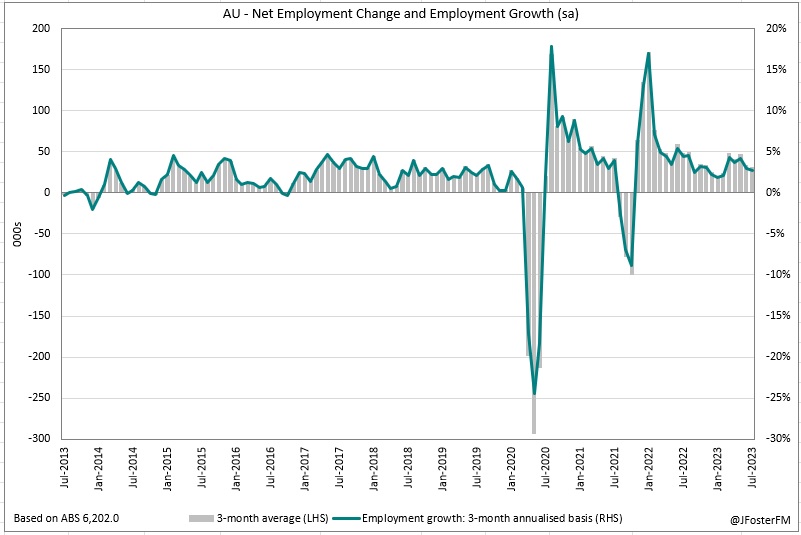
July's employment outcome (-14.6k) was the weakest going all the way back to the Delta wave lockdowns of the pandemic in 2021, and only the third monthly fall since then. Full-time employment (-24.2k) accounted for all of the decline, with part time employment rising (9.6k). 


Incorporating the July outcome, employment gains have averaged a solid 31.1k over the past 3 months. At a 2.7% annualised rate, that broadly matches the rapid growth seen in the working-age population, suggesting post-pandemic migration has been a factor that has kept labour demand supported, despite slower economic growth. 

With the labour force increasing by around 21k in the month and employment falling, unemployment increased by 35.6k in the month, explaining the uptick in the heads-based national unemployment rate from 3.5% to 3.7%. The participation rate was lower in July at 66.7%, though it's difficult to read much into this statistic given the timing of the survey.'Two broad perspectives on the labour market are that: 1) the share of Australians in work (measured by the employment to population ratio) remains around the highest levels on record, and 2) spare capacity in the labour market (measured by the underutilization rate) is at very low levels, though it has loosened slightly in recent months. 


Hours worked ticked up by 0.2% in the month, softer than the 0.4% rise in June. The ABS noted the number of people on annual leave was lower than usual for this time of year; however, illness-related absences have picked up to elevated levels again this winter but are well down from the highs of the pandemic. 


Overall, hours worked have risen by 5.2% over the year. On a pre-pandemic comparison, hours worked have expanded by 10.7% compared to an 8.2% increase in employment. 

Preview: Labour Force Survey — July

Australia's Labour Force Survey for July is due at 11:30am (AEST) today. Strong momentum in employment saw the unemployment rate decline from 3.6% to 3.5% in June; however, that is expected to reverse in July due to a slowdown in employment. Seasonality around the end of the financial year could have a large effect on today's report.  

Employment has increased strongly in recent months... 

Labour market conditions remained robust in June. Employment increased by 32.6k (on net), well above the expected 14k rise and coming on the back of a 76.5k surge reported in the May series. Employment in the full-time segment advanced by 39.3k, with part-time employment declining (-6.7k). The 3-month change in total employment was 105.3k, an expansion of 3.1% in annualised terms that outpaced growth in the working-age population on an equivalent basis (2.7%) and over the past 12 months (2.8%).


... keeping the unemployment rate around cycle lows... 

The strength in employment saw the unemployment rate falling back from 3.6% to 3.5%, close to the cycle low (3.4%) from late 2022 and remaining around the lowest levels overall since the 1970s. With the underemployment rate holding at 6.4%, total labour force underutilisation declined from 10% to 9.9%, in line with 15-year lows. Alongside these outcomes, the labour force participation is sitting around record highs printing at 66.8% in June. 


... and increasing hours worked  

Hours worked were 0.3% higher in June and increased by 4.7% over the year. Strong labour demand has added to employee headcounts and boosted hours worked. This has seen many workers shift into full time work from part time employment. Full time hours have increased by 5.6% over the past year, by contrast part-time hours have risen by just 0.4%. 


A slowdown is forecast in July...  

The median estimate is for employment to slow to a rise of 15k in the month, but there is little conviction around this central view as estimates range from -20k to +45k. The high-frequency payrolls data softened over the first half of July (-0.3%); however, the reliability of that signal is questionable given the ABS noted in the release that this is a seasonally volatile period, coinciding with the end of the financial year and school holidays. Based on an expected slowdown in the employment figure, and the participation rate holding at 66.8%, the unemployment rate is anticipated to tick up to 3.6% (range: 3.5% to 3.7%).   


... but this may be due to seasonal volatility

Seasonal effects around the end of the financial year raise the level of uncertainty going into today's report. If last year is any guide, the risks around the employment outcome look to be to the downside of expectations. In July 2022, employment snapped a run of strong gains posting a 3.1k decline but then bounced back with an above-consensus rise in August (56.8k). If employment does print soft today, some caution would be warranted in the analysis - particularly given the momentum of employment through the June quarter.   

Monday, August 14, 2023

Australian Q2 Wage Price Index 0.8%; 3.6%yr

Australian wages growth came in on the soft side of expectations in the June quarter, with the annual pace easing back to 3.6%. The momentum in private sector wages growth moderated over the first half of the year, though there is likely to be pick up next quarter when the effects of announced increases to award rates and the national minimum wage flows through. Public sector wages growth ticked up to a 10-year high. Declining inflation and an underwhelming report on wages today look unlikely to sway the RBA away from its pause in the near term.    


  • The headline WPI (total hourly rates of pay ex-bonuses) printed soft relative to expectations at 0.8% in the June quarter (vs 0.9%), matching Q1's increase. In year-ended terms, wages growth ticked down from 3.7% to 3.6% (vs 3.7%). 
  • Private sector wages posted a 0.8% quarterly rise (unchanged from Q1), with the annual pace holding at 3.8%. 
  • Public sector wages moderated to a 0.7% quarter-on-quarter rise from 1.0% in Q1; however, the annual pace firmed from 3.0% to 3.1%.


Continued strength in Australian labour market conditions maintained solid momentum in wages growth through the first half of 2023. Wages growth was 0.8% in the June quarter following a 0.8% rise in the March quarter; this saw the pace in 3 and 6-month annualised terms hold at 3.4%, the recent momentum being a touch softer than the increase over the past year (3.6%).  


Wages growth in the private sector (0.8%q/q) remained at decade highs at 3.8% over the year, but there has been a slowing in the recent momentum compared to the back half of of 2022. The 3-month annualised pace was 3.1% (compared to 3.7% in Q4 2022) and in 6-month annusalised terms the pace was 3.3% (from 4.3%). 


The ABS reported that only 12% of private sector jobs received a pay increase in the June quarter, down from a 14% share seen in the previous quarter and in the same period 12 months ago. But the size of the average pay increase has continued elevate coming in at 4.5%. 


In the public sector, annual wages growth broke above 3% for the first time in 10 years. The pace has lifted from 2.4% a year ago, reflecting the gradual flow-through of new wage agreements across the sector. 


Across the major sectors of the economy, wages growth looks to be running in the 3-4% range. Wages growth in business services (3.8%) held flat in the quarter, with professional services moving higher (4%) but finance and insurance softening (3.6%). Household services saw a firming in wages growth to 3.4%, but this segment will see a boost from the Fair Work Commission's announced increses to awards from next quarter. Likewise, industries such as retail and transport may push wages growth in the goods sector (3.9%) higher in Q3. 
 

Preview: Wage Price Index Q2

Australia's Wage Price Index for the June quarter is scheduled for release at 11:30am (AEST) today. Strong labour market conditions have underpinned a rise to decade-high wages growth in Australia, with the upward momentum set to continue. However, the pace at 3.7% in annual terms remains well below the inflation rate (6%) and is in a range the RBA assesses is not a constraint on a return to its 2-3% inflation target band.   

A recap: Wages growth continued to rise in the March quarter...

Wages growth is running at 10-year highs in Australia, having rebounded from record lows during the Covid period. This acceleration reflects wage settings responding to strong labour market conditions - with the national unemployment rate at half-century lows - and high inflation. In the March quarter, the Wage Price Index was 0.8%, elevating the increase to 3.7% over the year from a 3.4% pace previously.     


Private sector wages growth (0.8%q/q) lifted to 3.8% (year-ended) and to a 4.1% pace inclusive of bonuses. This continued to outpace wages growth in the public sector (0.9%/q) at 3.0% over the year, the pace having been held back by measures enacted in the sector to cap pay growth.   


... with the share of larger wage gains increasing 

While only a relatively small share of jobs received a pay rise in the March quarter, the upward shift in the size of wage increases continued. The share of jobs with wage increases of 0-2% and 2-3% has declined notably, with increases of 3-4% (14.4%), 4-6% (24.5%) and 6%+ (10.6%) all picking up. 


Wages growth looks to have held up in the June quarter... 

The median estimate is for headline wages growth to rise by 0.9% in the June quarter, with estimates ranging from 0.8% to 1.1%. In annual terms, wages growth is anticipated to hold at 3.7% (range: 3.5% - 3.8%). The risks around today's report appear balanced. Analysis of high-frequency wage trackers in the RBA's August Statement on Monetary Policy indicates the momentum in wages growth was steady over the June quarter.  

... and is set to increase further in the quarters ahead 

The Fair Work Commission's announcement of a 5.75% increase to award rates and an 8.6% rise in the national minimum wage will not be reflected in today's numbers. These increases will largely flow through in the September quarter. Based on its estimates in its August statement, the RBA forecasts a rise to a peak of 4.1% in the WPI by the end of the year. The main impulse to wages growth in the June quarter may come from the public sector, reflecting the continuation of new wage policies and enterprise agreements coming into effect. 

Friday, August 11, 2023

Macro (Re)view (11/8) | US inflation offers more encouragement

Risk aversion was the prevailing theme across markets this week, with growth concerns in China outweighing continued encouraging US inflation data. Weak loan demand, a heavy fall in imports, and a deflationary reading on the CPI in July were taken as further signs of the Chinese economy faltering from its reopening effort. These dynamics and a still-resilient US economy boosted the dollar. Bond yields ended the week higher, with many highlighting a tepid 30-year US Treasury auction as the catalyst; higher energy prices were likely also a factor on the basis that, if sustained, may complicate the downward path of inflation. 


July's CPI data confirmed the continuation of the disinflationary process playing out in the US, with the Fed likely to extend its pause. For the second month running, both the headline and core rates printed at 0.2% month-on-month, in line with expectations. At annual rates, headlined CPI firmed from 3% to 3.2%, lifting mechanically due to large energy price falls from 12 months ago, and core CPI softened from 4.8% to 4.7%, a 21-month low. 

Importantly, the recent momentum in the monthly readings highlights the easing of price pressures. On a 3-month annualised basis, headline inflation was 1.9% (on track with the Fed's inflation target) and 3.1% for core inflation, these rates well down from 3.3% and 4.3% respectively at the end of last year. 


At this week's parliamentary testimony, RBA Governor Philip Lowe said that while the Board may resume hiking rates, policy was already at a restrictive setting and it was mindful of striking the right balance to meet both sides of its mandate for full employment and 2-3% inflation. After leaving rates on hold at the July and August meetings, the Board was taking time to assess developments, but recent data had indicated that inflation remained on track to return to target, with the economy avoiding a downturn in the process.

The RBA's pause has given households a reprieve from adding to cost-of-living pressures, but it has had a surprisingly limited effect on sentiment. The Westpac-Melbourne Institute Index of consumer sentiment remained at a deeply negative level in August and has improved only modestly since June (2.3%). The NAB Business Survey for June reported confidence among firms is also weak; however, the gauge of business conditions is at a strong level reflecting the ongoing resilience in demand. That said, order books continue to point to an upcoming slowdown with forward orders in decline.


In the UK, an upside surprise on June quarter GDP at a 0.2%q/q expansion sees the economy holding up amid cost-of-living pressures and rising interest rates. Growth over the past year has been weak (0.4%) but ultimately more resilient than many - most notably the Bank of England - had anticipated. While a downturn has been kept at bay, UK GDP has yet to recover to its pre-pandemic level of output 3½ half years on from the eve of the crisis.

Friday, August 4, 2023

Macro (Re)view (4/8) | Peak in sight for RBA

While equity markets saw broad-based pullbacks this week, this was overshadowed by developments in the US Treasury market. The US 10-year yield traded near 12-month highs on news of a ramp-up in debt issuance at next week's refunding auctions and Fitch announcing a US ratings downgrade, while spillover effects from the BoJ's tweaking of Yield Curve Control may have also played a role. But late in the week, the US 10-year yield reversed course sharply after key employment data missed expectations.   


US payrolls underwhelm 

A fall in the unemployment rate from 3.6% to 3.5% in July reaffirmed that the US labour market remains robust; however, employment gains are moderating. Nonfarm payrolls lifted by 187k in the month - below the 200k figure expected - and downward revisions subtracted a combined 49k from payrolls in May and June. This has seen the average increase on payrolls over the past 3 months slow to just below 220k, its lowest since early 2021. 


Average hourly earnings growth remained at a 4.4% annual pace - a clip too elevated to be consistent with the Fed's 2% inflation target - though this has slowed from 5.4% a year earlier. Key factors in this have been the moderation in employment gains and a recovery in participation (62.6%), with the major 25-54 years cohort (83.4%) well above pre-pandemic levels of participation. 

RBA at the peak? 

A pause on tightening from the RBA for the second meeting in succession left the cash rate at 4.1% (reviewed here). The fullness of the RBA's communications through the week - including the August Statement on Monetary Policy - confirms the Board is very much in a data-dependent mindset. The Board's key judgments are that rates are at a restrictive setting, the full effects of tightening have yet to materialise, and the data flow has been consistent with inflation falling back to the 2-3% target band, forecast to be achieved in the back half of 2025. Tightening is not off the table - the Board maintains the guidance that further tightening "may be required" - but for these reasons, the data will need to start painting a different picture for the RBA to recommence hiking rates. The revised forecasts in the August Statement remain consistent with a soft landing scenario in Australia - the economy and employment continuing to expand as inflation declines - so the Board will be wary of the risk of overtightening.

On the data front, there were a number of highlights. Headwinds from rising interest rates and cost of living pressures are weighing on household spending, retail sales volumes contracted by 0.5% in the June quarter, their third consecutive quarterly decline (see here). Increased activity and demand in the housing market were reflected in a further 0.7% lift in national housing prices in July, with housing finance commitments rising strongly in the June quarter (see here). Dwelling approvals rebounded in Q2, albeit off a low base (see here). A wider trade surplus in June to $11.3bn was driven by declining imports (see here). 


Bank of England eases tightening pace 

The Bank of England hiked rates by 25bps to 5.25% this week, with improved inflation data allowing the MPC to downshift from a 50bps hike in June. The decision was backed by 6 of the 9 MPC members; 2 members preferred another 50bps hike while there was a sole vote cast to leave rates on hold. How much further rates may rise remains an open question. The MPC's guidance that signs of persistent inflationary pressures would be met with "further tightening" was left intact, unchanged since the February meeting; however, in the post-meeting press conference, Governor Bailey said rates were already at a restrictive setting and this was having a notable effect on the economy. 

An outlook for declining inflation in the Bank's August Monetary Policy Report projects a return to the 2% target in Q2 2025. Falling energy prices drive lower inflation in the near term, but the Bank notes the trajectory further out will to a large extent be determined by labour market conditions and wages growth. In this respect, the Bank is taking a cautious view - due to prior upside surprises on wages growth, the expectation is that these pressures will take longer to abate than they did to emerge. To that end, the message from Governor Bailey was that rates will be left at a "sufficiently restrictive" setting for a "sufficiently long" period to ensure the return to 2% inflation. 

Thursday, August 3, 2023

Australia's trade surplus widens to $11.3bn in June

Australia's trade surplus widened in June to come in at $11.3bn, driven by a fall in imports. Exports also declined in the month, with lower commodity prices a key factor. Services trade remains robust as the post-pandemic recovery continues. 

International Trade — June | By the numbers
  • Australia's trade surplus widened to $11.3bn in June (vs $10.8bn exp) from $10.5bn in May (revised from $10.3bn).  
  • Export values declined by 1.7% in the month to $55.6bn - a partial unwind of May's 3.2% rise - to be down 10.8% on a year ago. 
  • Import spending contracted by 3.9%m/m to $44.3bn (0.3%yr), which followed a 3.5% lift in May. 


International Trade — June | The details

June's trade surplus of $11.3bn was the largest in the second quarter following surpluses of $10.3bn in April and $10.5bn in May. Collectively, that put the trade surplus at $32.1bn in the June quarter, narrowing from $39.4bn in the March quarter. 


Exports declined by 3.7% in the quarter, easing from around record highs as commodity prices weakened. Import spending lifted modestly (0.6%q/q) on increased consumption goods spending. 


In the month of June, export earnings fell by 1.7%, the weakness coming through from non-rural (-3%) and rural goods (-1.2%) that partly reflects the effect of lower commodity prices. Non-rural goods exports are down around 19% from their peak 12 months ago, with coal exports contracting 43% over the period. The value of rural goods exports has fallen by 6.3% on a year ealier on broad-based declines across cereals (-3.8%), wool (-15.2%) and rural products (-10.8%). Services exports rose 2.1% to be up 48.7% on 12 months ago, the post-pandemic recovery seeing inbound travel doubling over the period.  


Import values in June fell by 3.9% on a rollback in consumption goods (-12.4%), with declines also posted by intermediate (-3.4%) and capital goods (-1.1%). The large fall in consumption goods was associated with an unwind of vehicle imports (-32.6%) after they had surged in May (28.7%). Fuel imports dipped a further 1.4% in June to be down by almost a third on their peak from September last year, weighing on intermediate goods. Services trade was 2.4% higher in June (13%yr); overseas travel saw a notable bump (13%m/m) amid the peak summer season in Europe. 


International Trade — June | Insights

Another robust trade surplus was posted in June, though the underlying detail was soft with both exports and imports declining in the month. Nonetheless, export earnings remain near record highs while imports are also at elevated levels. 

Wednesday, August 2, 2023

Australian retail volumes -0.5% in Q2

Australian retail sales volumes slid further in the June quarter as household demand continued to be weighed by higher interest rates and elevated inflation. Discounting for end-of-financial years sales boosted demand for clothing and footwear. 

Retail Sales — June | By the numbers 
  • Retail sales reversed a 0.8% rise in May with a 0.8% decline in June to $35.2bn. 
  • 12-month retail sales slowed from 4.1% to 2.3%. 


  • Quarterly retail sales volumes contracted by 0.5% - in line with expectations - posting its third consecutive decline. 
  • Year-ended volume growth contracted by 1.4% from 0.3%.
  • The retail price deflator printed at 0.9% in the quarter. 


Retail Sales — June | The details  

Headwinds from rising interest rates, cost-of-living pressures and weak sentiment continue to hit retail demand. Volume growth in retail sales contracted by 0.5% in the June quarter, which follows falls of 0.4% (Q4 2022) and 0.8% (Q1 2023). This is the weakest stretch for retail volumes since 2008. Despite weaker demand, retail turnover lifted by 0.4% in the quarter, reflecting prices rising by 0.9%q/q. 


Most categories saw volume declines in the quarter. Clothing and footwear (1.1%) went against the trend, with the ABS attributing this to promotions and discounting for end-of-financial-year sales. Given this, discretionary (or ex-food) volumes saw a smaller decline (-0.4%) than the headline fall (-0.5%). Over the past year, household goods (-8.5%) has been the weakest category, likely reflecting a combination of factors from reduced housing market activity and spending patterns rotating to services post the pandemic.   


Retail price inflation remained elevated but continues to ease, reflecting global disinflationary impulses from improved supply chains and weaker demand. The strongest price rises in the quarter were in food (1.4%) and (by association) cafes and restaurants (1.6%), with overhead cost increases also a factor for the latter. At the other end of the scale, clothing and footwear prices fell 1%q/q on the back of discounting.       


Retail Sales — June | Insights

Weakness in retail demand extended to a third consecutive quarter, indicating RBA rate increases and high inflation are weighing on household consumption. Rapid population growth is pushing against these headwinds; in per-capita terms, retail volumes have contracted by 3.7% over the year (compared to -1.4% in headline terms). While retail demand has weakened substantially, services spending has remained more resilient.  

Tuesday, August 1, 2023

Australian dwelling approvals lift in June quarter

Australian dwelling approvals declined in June but posted their first quarterly rise in 12 months. Higher density approvals have rebounded from cycle lows, but house approvals are at decade lows.   

Building Approvals — June | By the numbers
  • Dwelling approvals (seasonally adjusted) pulled back by 7.7% in June to 13.8k following a 20.5% rise in May. Approvals are down 18% over the year. 
  • House approvals declined by 0.8% to around 8.2k, a fall of 16.9% on 12 months ago and 43.2% below the cycle high from March 2021.   
  • Unit approvals unwound by 16.2% to around 5.7k after a 60.1% uplift in May, leaving these approvals down by 19.6% over the year. 


Building Approvals — June | The details  

Dwelling approvals slid in June (-7.7%) but posted their first quarterly rise in a year (6.2%) and the strongest gain since Q1 2021. The June decline came after the volatile unit or high-density segment partly unwound (-16.2%) from a spike in May (60.1%), while house or detached approvals were marginally lower in the month (-0.8%). 


For the June quarter, unit approvals rebounded to rise by 20.1% as house approvals fell by 1.5%, declining for the third quarter in succession. As the chart below shows, quarterly approvals remained at low levels - the effects of rising interest rates, earlier falls in housing prices and margin pressures faced by homebuilders all headwinds. In these circumstances - and with homebuilders already working through a record-high pipeline of houses under construction - the flow of new approvals has slowed significantly.   


By type, approvals for detached housing continued to ease over the quarter to be at 10-year lows. In contrast, higher-density approvals have trended up on the back of high-rise and townhouse developments.  


Alteration approvals remain at a high value reflecting strong demand and increased costs associated with home renovations. Meanwhile, non-residential approvals have surged over recent months, though this in part reflects higher construction costs. 


Rising non-residential approvals has been driven mostly by commercial and industrial projects. To a lesser extent, office approvals have also been supportive. 


Building Approvals — June | Insights    

Dwelling approvals rebounded in the June quarter, albeit coming off a very low base. The higher-density segment drove the increase as house approvals remained at decade lows in Q2. Rising interest rates and other headwinds faced by homebuilders have weighed significantly on the flow of approvals.