Independent Australian and global macro analysis

Monday, April 5, 2021

Preview: RBA April meeting

The Reserve Bank of Australia's latest monthly policy meeting takes place today, with Governor Philip Lowe's decision statement (2:30PM AEST) expected to confirm an unchanged stance from the Board. During the time since the previous Board meeting, the state of play was best summarised by Governor Lowe during his speech to the AFR Business Summit on March 10. While the reopening was well advanced and activity indicators had come in stronger than expected; output was almost back to pre-covid levels and the recovery in employment had been v-shaped, the Australian economy remained "operating well short of full capacity" and there was uncertainty ahead with the Federal Government's JobKeeper wage subsidy withdrawn at the end of March.  


More detail was provided around the Board's full employment and inflation objectives, which to be met would likely require the unemployment rate (currently 5.8%) to fall towards the "low 4s" and for wages growth (currently 1.4%Y/Y) to be running "sustainably above 3 per cent". The RBA is not expecting these conditions to be met "until 2024 at the earliest" and it has also made clear that the forecast rise in headline inflation to the 3% upper range by mid-year will be treated as transitory, reflecting pandemic-related volatility in prices. While optimism around the global economic recovery and strong activity data in Australia has led to financial markets speculating on prospects for an earlier tightening in policy, Governor Lowe explicitly pushed back against such expectations during his March 10 speech. Additionally, it was stated (and then repeated in the March meeting minutes) that the Board was neither considering removing the yield target nor changing the target from 0.1%.

All in all, expect today's decision to reiterate the RBA's commitment to keeping the 3-year segment of the yield curve anchored at the 0.1% target for the cash rate. The progress achieved in the recovery in the domestic economy and labour market has been encouraging, but crucially this is likely to continue to be viewed as a sign of vindication of existing monetary policy settings rather than arguing the case for an earlier tightening, especially when considering that the RBA's current forecasts (that extend to mid-2023) do not show either its full employment or inflation objectives being achieved. Commentary on the strength of conditions in the housing market will also generate plenty of attention ahead of Friday's Financial Stability Review, though for the time being this appears to be something that the RBA is monitoring more so than concerned about. 

Friday, April 2, 2021

Macro (Re)view (1/4) | Confidence in the recovery strengthens

Australian economic updates released during the week remained strong and were consistent with the momentum in the recovery. In terms of households, though retail sales declined in February, the 0.8% decline was not as severe as expected (-1.1%) and was attributable to short lockdowns that were enacted in the states of Victoria and Western Australia (reviewed here). Key is that outside these states turnover advanced by 0.9%m/m driven by solid growth in the discretionary categories, while growth nationally of 9.1% over the year underlines the strength that has been evident in retail spending since the reopening. Strength in housing market conditions has also been a key factor in the recovery on the back of policy stimulus measures. The upswing in housing finance hit a pause in February as commitments fell for the first time in 9 months with a 0.4% decline, but the level was still very elevated at $28.6bn and is nearly 49% higher than a year earlier (reviewed here). While February's decline was driven by owner-occupiers (-1.8%), commitments to the segment are up 55% over the year, and investor loans showed further strength in the month (4.5%) to lift the annual pace to 31.6%. 

The effect of strong financing conditions continues to be reflected in rising house prices, which advanced by 2.8% nationally in March (5.9%yr) according to CoreLogic making this its strongest month-on-month gain since the late 1980s. Meanwhile, dwelling approvals rebounded by 21.6% in February as house approvals established a new record high level with builders continuing to bring forward projects ahead of the end of the HomeBuilder grants scheme (reviewed here). Also setting records of late has been the trade surplus, though it moderated from January's all-time high of $9.6bn to $7.5bn in February (reviewed here). This narrowing reflected a softer result from exports (-1.3%m/m) as strength in iron ore retraced together with a lift in import spending (4.5%m/m). Notably, imports of consumption goods are running at their strongest annual pace in 11 years at 22.1%, indicative of the strength in demand conditions with the domestic recovery well underway. But, perhaps the highlight report this week was the surge higher in job vacancies, which lifted by 13.7% in the 3 months through February to be up almost 27% over the year. With the state of the labour market to undoubtedly be a key focus at next week's RBA meeting, the rise in job vacancies following on from February's strong employment report will give encouragement to the Board that its policy settings are well calibrated.

Events offshore this week were headlined by President Biden's $2.25 trillion stimulus plan to revitalise infrastructure investment in the US. This latest proposal comes on the back of the packages already enacted in December ($0.9tn) and March ($1.9tn), which were focused on providing immediate and direct relief to households in the wake of the pandemic, mainly through stimulus cheques and extending unemployment assistance. The Biden Administration's infrastructure plan is longer-term in nature by distributing spending over an 8-year timeframe, while its cost is to be mainly offset through a hike in the corporate tax rate from 21% to 28%, raising $2tn over 15 years. But its passage through the Congress will be far from straightforward with Republicans already lining up to oppose the plan. But for the time being, the focus remains on the strength of the reopening in the US, highlighted by March's labour market report. Employment on nonfarm payrolls increased by 916k in the month, its strongest rise going back to August and well clear of the 660k rise expected by markets. Both headline unemployment (6.0% from 6.2%) and underemployment (10.7% from 11.1%) declined in the month and are well down on their pandemic crisis peaks from April of 14.8% and 22.9% respectively. However, with employment still 8.4 million down on its pre-pandemic level and with the participation rate now substantially lower at 61.5%, this is a recovery that has a long way to go yet. With Q1 drawing to a close during the week it is worth reflecting on the key narrative that played out in markets through the steeping of yield curves. Expectations for a very strong recovery in the US economy supported by extraordinary monetary and fiscal stimulus and an accelerating vaccine roll-out were reflected in a doubling of the 2s/10s Treasury yield spread over the quarter, which is now out to its widest since mid-2015 (see below).  

Chart of the week 

In Europe this week, pandemic developments remained in focus with President Macron enacting a third shutdown across France in an effort to contain a rising spread of virus cases. The move only intensified criticism of the vaccine rollout in the continent, which was described as "unacceptably slow" by Europe's top official within the World Health Organization. In macro news, inflation remained subdued in March, defying market expectations for a pick-up in price pressures. Headline CPI lifted to 1.3%yr from 0.9% but was weaker than the 1.4% pace forecast, while underlying inflation slowed unexpectedly to 0.9%yr from 1.1%. With much market interest residing around the inflation outlook globally, ECB Chief Economist Philip Lane provided a timely analysis of the dynamics in Europe. The main points here were that any upcoming spike in inflation will be assessed as transitory by the ECB due to a range of technical and statistical factors, while the outlook for inflation remained subdued due to elevated spare capacity resulting from pandemic-related effects. Key to the ECB meeting its inflation target is "sustained wage pressures" emanating from a labour market that is "sufficiently hot". Meanwhile, ECB President Christine Lagarde warned bond markets during a Bloomberg TV interview this week that it would use its full range of tools to push back against higher yields if that threatens to tighten financing conditions.   

Thursday, April 1, 2021

Australia's trade surplus narrows to $7.5bn in February

Australia's trade surplus has narrowed from January's record high but was still elevated at $7.5bn in February. Export earnings declined as iron ore retraced after surging in January, while imports advanced reflecting strength in domestic demand conditions generated by the reopening.   

International Trade — February | By the numbers
  • Australia's trade surplus narrowed by $2.1bn in February, falling from a record high of $9.6bn in the month prior (revised from $10.1bn) to $7.5bn that came in below the median estimate of $9.9bn. 
  • Export earnings declined by 1.3%m/m to $38.9bn (prior 3.8%m/m), with a base effect driving up the annual pace to 9.1% from 1.6%.  
  • Import expenditure advanced by 5.2% in February to $31.4bn coming off a 2.0% fall in the month prior. This reduced the decline in annual terms to -3.6% from -12.2%. 


International Trade — February | The details

After soaring to a record high in January, the nation's monthly trade surplus retraced to $7.5bn in February to be in line with its level from December. Export earnings contracted by 1.3% (or -$0.5bn) in the month to $38.9bn as non-rural exports declined by 3.0% after rising strongly in January (7.4%). The main contributor to this was metal ores and minerals (mainly iron ore) exports falling by 7.1% on lower volumes, mostly unwinding the 9.8% surge in the month prior. Rural exports remain a success story for the domestic economy following drought-breaking rain in early 2020, with the category up another 6.6% in February (11.8%yr). Here, cereals are leading the way, rising 18.3%m/m to be 154.1% higher than a year earlier. 


Elsewhere, non-monetary gold exports lifted by 6.5% in February, while services exports were a modest drag on overall earnings, falling by 2.7% remaining at a very low level due to the impact of travel restrictions. 


Import spending advanced by 5.2% (or $1.6bn) in February to $31.4bn (-3.6%yr). This was a rebound from declines of 1.6% in December and 2.0% in January. The gain in February was led by intermediate goods (12.9%), in which fuels and lubricants were up 30%. Consumption goods lifted 2.7%m/m to be up by 22.1%yr — its fastest annual pace in 11 years reflecting the strength in demand conditions generated by Australia's reopening. Meanwhile, services contributed modestly rising by 3.8% but were 48.0% lower than a year earlier due to the overseas travel ban. Capital goods were soft in February (-0.7%), though the strength in domestic demand conditions and tax incentives included in the 2020 Federal Budget has driven these imports up by 13.1% from a year ago.


International Trade — February | Insights

The trade surplus pulled back by more than was expected but still remained elevated at $7.5bn in February. This was after reaching a record high in the month prior at $9.6bn. Export earnings are 9.1% higher than a year earlier, due mainly to higher commodity prices, while strength in domestic demand since the reopening is helping to lift import spending. 

Wednesday, March 31, 2021

Australian housing finance pauses in February

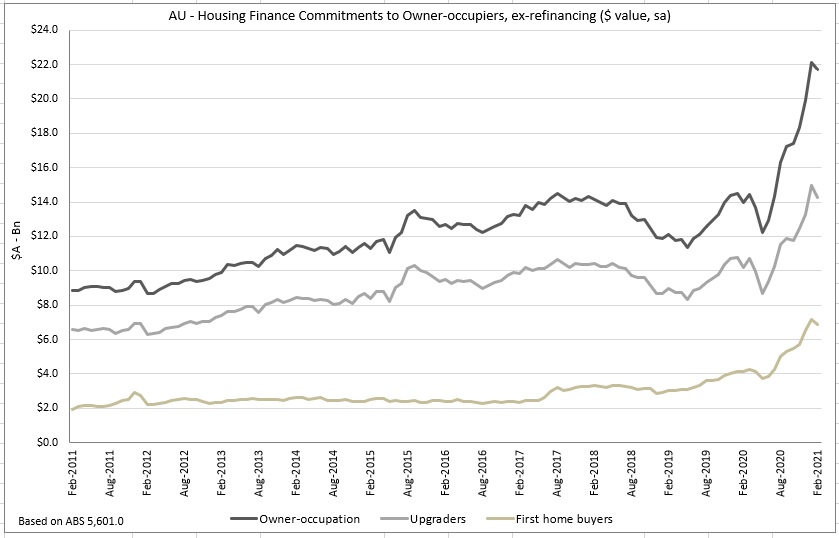
The upswing Australian housing finance commitments was paused in February as the value of borrower-accepted loans posted their first monthly decline since May. This was driven by a 1.8% fall in commitments to owner-occupiers, with declines recorded in both the upgrader (-4.5%) and first home buyer (-4.0%) segments. In contrast, investor commitments advanced for a 9th consecutive month with a 4.5% rise. 

Housing Finance — February | By the numbers

  • Housing finance commitments ($ value, ex-refinancing) declined for the first time in 9 months, softening by 0.4% in February to $28.6bn. This came after a 10.5% surge in January, while the annual pace moved a little higher to 48.8% from 44.3%.
  • Owner-occupier commitments pulled back by 1.8%m/m to $21.7bn (prior 10.9%m/m) but are up by 55.2% over the year.  
  • Refinancing by owner-occupiers posted a 3rd consecutive double-digit month-on-month gain, rising by 11.1% to $8.6bn (21.0%yr). 
  • Investor commitments lifted by 4.5%m/m to $6.9bn (prior 9.4%m/m), driving annual growth up from 22.7% to 31.6% — a near 4-year high.    


Housing Finance — February | The details 

Policy support from low rates and government incentives since the onset of the pandemic have combined with reopening dynamics to drive an acceleration in housing finance activity from the second half of 2020. February's data reported a pause in this momentum, centred on the owner-occupiers. Commitments to the segment fell 1.8% overall to $21.7bn (55.2%yr), with the declines being driven by upgraders (-4.5%) and first home buyers (-4.0%). Meanwhile, investor loans, which had a more delayed pick up initially, are now running very strongly elevating by a further 4.5% to $6.9bn (31.6%yr).


Reflecting the moves in commitments, loan approvals to owner-occupiers pulled back for both upgraders (-3.2%m/m) and first home buyers (-3.3%m/m). Construction-related approvals slowed to a 1.6% gain overall for its weakest month-on-month gain since the inception of the HomeBuilder policy. But with a month to go before the scheme ends it has already had a profund effect with approvals of this type up by more than 118% on a year earlier. Loan approvals for new construction are running at 166%yr while those for newly constructed homes are up 34%yr.  


For the states, owner-occupier commitments fell in New South Wales (-4.9%m/m) and Queensland (-2.8%m/m), which more than offset gains across the rest of the nation. Weakness in first home buyer commitments was more spread out in the month, indicating the momentum is starting to fade; New South Wales -4.8%, Victoria -1.9%, Queensland -5.7% and Western Australia -5.5%. However, state-based investor commitments lifted further rising in all jurisidctions except in Tasmania.  


Housing Finance — February | Insights

Momentum in the upswing in housing finance activity was paused in February due to a pullback in the owner-occupier segment from both upgraders and first home buyers. However, activity from investors lifted further. The upswing has pushed house prices higher with data from CoreLogic out earlier today reporting the fastst month-month gain nationally in March of 2.8% since late 1988.

Australian retail sales fall 0.8% in February

Snap pandemic lockdowns enacted in Victoria and Western Australia in February contributed to Australian retail sales declining by 0.8% in the month. Turnover remains elevated on its pre-pandemic level, up 9.1% on a year earlier, with online (52.5%yr) and household goods (19.4%yr) seeing the strongest increases over the period, benefitting from increased in-home spending as a result of the lockdowns.

Retail Sales — February | By the numbers 

  • Retail turnover (nominal) declined by 0.8% in February to $30.3bn, less severe than the preliminary and market estimate of -1.1%. Turnover in January rose 0.3%; the pace revised from 0.5% in today's report. 
  • Annual growth in turnover slowed to a 9.1% pace from 10.6%. 


Retail Sales — February | The details  

National retail sales fell by 0.8% in February on the back of sharp declines in Victoria (-3.0%) and Western Australia (-5.4%) after both states were placed into snap lockdowns during the month. Excluding these two states, retail sales advanced by 0.9% across the rest of the nation indicating underlying demand is still fairly robust. Adding further weight to this view, discretionary sales (excluding basic food) lifted 0.8% in the month. Turnover was 9.1% above its pre-pandemic level from a year earlier but will slow sharply next month as pandemic-related base effects start to kick in, with the stockpiling-driven 8.1% surge from last March in preparation for the national lockdown rolling into the annual calculation. 


The effects of February's snap lockdowns in Victoria and Western Australia were more evident in the national figure than in the underlying category detail. In spite of sizeable declines in discretionary spending in Victoria (-4.4%) and Western Australia (-4.9%), it still lifted by 0.8% nationally in February. Within this, department stores (2.2%), clothing and footwear (1.6%), cafes and restaurants (1.1%), and household goods (0.7%) all advanced. Of all the major categories, annual growth has been strongest in household goods (19.4%), boosted by in-home spending associated with the lockdowns. Spending at cafes and restaurants (-2.2%) is the only category yet to return to its pre-pandemic level having been on the wrong side of lockdowns and capacity restrictions.  


Meanwhile, online sales pulled back by 2.2% in the month, with the annual pace trending down to 52.5% from its August peak of 79.0%. The surge up in online sales was accelerated by lockdowns and now the reopening phase has led to the pace slowing.


As the chart below shows, retail sales across the states in February was generally elevated relative to pre-pandemic levels. Annual growth was running at around 10% in New South Wales, Western Australia and Tasmania and was a touch slower in South Australia (9.1%). Queensland was outperforming at 12.1% but could well slip back in March after a snap lockdown in Brisbane. Victoria was slowest at 3.6%yr, though sales have been volatile over recent months as they have moderated since surging on its reopening (+22% in November) with an additional hit coming from its subsequent 5-day lockdown in February.        


Retail Sales — February | Insights

Snap lockdowns in Victoria and Western Australia weighed on national retail sales in February (-0.8%), though looking through these effects which will soon be reversed, the underlying details remained broadly consistent with robust household spending. 

Tuesday, March 30, 2021

Australian dwelling approvals rebound in February

Australian dwelling approvals rebounded sharply in February (21.6%), surging clear of market forecasts to almost fully reverse the decline from January (-19.4%) that appears seasonally related. House approvals advanced to a new record high level with developers bringing forward projects ahead of the end of March deadline for the HomeBuilder grants scheme. 

Building Approvals — February | By the numbers
  • Dwelling approvals (seasonally adjusted) rebounded by 21.6% in February to 19,422 compared to the median estimate for a 3.0% rise. Approvals fell by 19.4% in January. Annual growth in approvals lifted to 20.1% from 19.3%.   
  • House approvals bounced to a new record high rising by 13.7% in the month (after falling by 10.8% in January) to 14,072 to be up by 57.9% over the year. 
  • Unit approvals lifted by 48.9%m/m (prior -39.5%m/m) to 5,350, though the annual decline steepened to -26.3% from -19.6%. 


Building Approvals — February | The details 

January's 19.4% decline in dwelling approvals has proved transitory with the headline figure rebounding by 21.6% in February. In my assessment, January's decline can likely be put down to a lower volume of approvals being processed, consistent with the large fall in hours worked in the month (-4.9%) when a larger than usual share of the workforce was taking annual leave. Looking through January's report, approvals roughly returned to where they were in December sitting at an elevated level north of 19.0k. Detached house approvals established a new record high at 14,072 on the back of a 13.7% rebound in the month, moving past the previous high set in December (13,865). This lift came in advance of the end of the extension period in the HomeBuilder grants scheme occurring on March 31. Private sector house approvals have risen by around 5,700 dwellings (or around 70%) since HomeBuilder commenced last June. Higher density approvals have been volatile from month to month but the level is sharply lower than a year earlier (-26.3%), largely reflecting the effects of the pandemic on this segment with developers shelving projects as border restrictions have hit migration flows. 


Aside from new builds, alteration approvals have also surged since the commencement of HomeBuilder rising by one-third over the period. The value of alteration work to existing homes rebounded by 11.1% in February to $0.973bn (36.0%yr) after a 10.1% decline in January. 


Approvals rebounded across the nation in February with most states recording large gains after pulling back in January, with the strength evident in both the detached and higher density segments. Going against this trend was South Australia (-3.4%) after approvals there advanced in the month prior (7.0%). 


Building Approvals — February | Insights 

Temporary weakness from January was mostly reversed with dwelling approvals rebounding much more sharply than expected in February. A final lift is likely to come through in March before the HomeBuilder scheme expires. Policy support from low rates and government incentives has created the conditions for a sharp upswing in residential construction work in 2021 after the downturn that occurred between mid-2018 to mid-2020.  

Friday, March 26, 2021

Macro (Re)view (26/3) | Fed to maintain resolute patience

The wind-down towards the end of the quarter and a limited data flow meant that narratives were driven by the price action this week where it was the ongoing rotation into cyclicals in the US that stood out while the recent rise in long-end bond yields took a pause. In the US, testimony from Federal Reserve Chair Jerome Powell and Treasury Secretary Janet Yellen, as well as public appearances from several Fed officials, garnered most of the headlines. Once again, it was the message of patience emphasised by Chair Powell with accommodative policy to be maintained as economic conditions rebound until the recovery from the pandemic crisis is assured. Secretary Yellen told lawmakers that while the crisis remains deep at this stage, the recent $1.9tn stimulus package enacted by the Biden Administration provided her with optimism that a return to full employment might be possible next year. Best summarising the reaction function of the Fed was the speech this week from Governor Brainard ("Remaining Patient as the Outlook Brightens") that implied maintaining "resolute patience while the gap closes between current conditions and the maximum-employment and average inflation outcomes in the guidance". With a labour market that currently counts around 9.5 million fewer Americans in work than before the onset of the pandemic, an outcome-based rather than preemptive approach to policy points to the continuation of current settings for some time. Inflation also remains soft, slowing to a 1.4% annual pace in February on the core PCE reading from 1.5%, though base effects will see the rate accelerate over the next couple of months, likely to well above the Fed's 2% target. However, Chair Powell reiterated that any rise in inflation is not expected to be "neither particularly large nor persistent" and will be tolerated. Meanwhile, after slowing sharply in February, both personal spending (-0.6%Y/Y) and income growth (4.3%Y/Y) are expected to accelerate from next month in response to US households taking receipt of their $1,400 stimulus cheques and a wider reopening effort. 

Over in Europe, concerns over a third wave of virus cases amid frustrations in the vaccine rollout has led to tensions rising in the continent. A statement from EU leaders after talks on the matter outlined that ramping up the production of supplies and accelerating the speed of the rollout was "essential and urgent to overcome the crisis". For the time being, explicit export restrictions on domestically-produced doses of the vaccine, including to the UK, were resisted, though EU leaders did support implementing proposals for tougher rules should they be deemed necessary. Tensions have also been rising in response to containment measures, with German Chancellor Merkel announcing a 5-day circuit-breaker shutdown over the Easter period only to then reverse the decision 24 hours later after criticism over the government's handling of the pandemic intensified. But recent extensions of shutdowns are likely to curtail what were signs of improvement in economic conditions in March's preliminary PMI readings. The Eurozone composite PMI advanced above the 50 line separating expansion from contraction for the first time since September in rising from 48.8 to 52.5 (vs 49.1 expected). A slight earlier easing of restrictions resulted in the rate of contraction in the services sector slowing (48.8 from 45.7) to its least severe in 7 months, though this progress is now at risk of unwinding. This in stark contrast to the manufacturing sector where activity has surged to a record high (62.4 from 57.9) with output ramping up in response to backlogs in order books, including strong growth in export orders as global demand for goods remains elevated. Reflecting the sum of these developments, the euro has broken below 1.18 against the US dollar for the first time since November; the weakness in the single currency will undoubtedly be welcomed at the ECB. Meanwhile, the ECB's PEPP purchases lifted to €21.1bn (net), stepping up to their highest weekly pace in more the three months following the Governing Council's guidance from its meeting earlier in the month to conduct these purchases at "a significantly higher pace than during the first months of this year". 

In Australia, with employment having been restored to its pre-pandemic level as of February (see here), more insights into the labour market recovery came to hand this week. Employment in household services was hit hardest by the onset of the pandemic and social distancing measures, but the reopening and easing of restrictions have enabled the sector to lead the way in the recovery, albeit with significant ground still to be made up. In particular, the hospitality, education, and arts and recreation industries recorded the heaviest job losses in the economy as the crisis took hold, with sharp rebounds then occurring following the reopening (see chart below). A strong 7% rise in job advertisements reported by the Federal Government this week for the month of February points to the recent strength in employment continuing, with the vacancies as a share of the labour force rising to their highest level since mid-2018 at 1.4%.  

Chart of the week

While there remains a degree of uncertainty over the outlook for the labour market when fiscal support is withdrawn at the end of the month, there were some signs from the ABS's monthly Business Conditions and Sentiments survey suggesting that the transition will not be unduly disruptive to the momentum that has been established. The survey reported that a greatly reduced proportion of firms were now receiving the JobKeeper wage subsidy (29% compared to 73% in May last year), with only 9% of these businesses indicating that the end of the support will prompt a reduction in staffing levels. A much larger amount of the responding businesses (20%) planned on reducing staff hours instead. Remarks from Federal Treasury Secretary Kennedy to the Economics Legislation Committee this week outlined the Government's expectation is that the transitional effects from the end of the JobKeeper policy could result in around 100-150k job losses, though this would not necessarily lead to a commensurate rise in unemployment.

Friday, March 19, 2021

Macro (Re)view (19/3) | Holding the line

Events from the past week in Australia were significant in terms of the messaging on policy from the RBA and also in the recovery of the labour market from the pandemic crisis. From the perspective of the RBA, the March Board meeting minutes published this week firmed up its commitment to keeping the 3-year segment of the yield curve anchored at its 0.1% target, pushing back against expectations in the market for an earlier tightening in policy. The key line from the minutes was that the Board had agreed that "it would not consider removing the target completely or changing the target yield of 10 basis points". When taken with the RBA's recent actions here that have included $7bn in 3-year bond purchases in late February, and then the announcement last week that the cost to borrow the bond lines that are the focus yield target policy from the central bank under repo had been significantly increased (from 25bps to 100bps) its commitment to holding down the front-end of the yield curve involves more than words. As a result, after drifting above the target over late-February to early-March, yields on 3-year Commonwealth Government bonds now sit below 0.1%. The question of whether the Board will opt to extend the yield target policy from the April 2024 bond to the November 2024 bond is now potentially a more open one for the market than a week earlier; a move which as discussed in last week's review shapes as likely in my assessment.

For the RBA, the key message is that keeping rates at the front-end of the curve low will give the economy the space it needs to build up to a sustainable post-pandemic recovery. The Board's discussion on the macro conditions domestically highlighted some welcome developments, notably the rebound in GDP growth and in the labour market, while the outlook now appears to be more assured. However, there remains uncertainty around the upcoming tapering of fiscal support, while wages growth is not anticipated to rise to a pace consistent with holding inflation sustainably within target (2-3%) over the forecast period out to mid-2023. Indeed, wages growth of above 3% is assessed by the Board as the level likely necessary for achieving the inflation mandate, but for that to occur the unemployment rate needs to be "materially lower", with Governor Lowe last week indicating this could be in the low 4% range. Over the months ahead, while the Board expects inflation to rise to 3%, it has been emphasised that this will be treated as a "transitory" spike coming on the back of supply-side bottlenecks and the reversal to pandemic relief measures. Underlying inflation that is forecast to stay below the 2% lower target out to mid-2023 clearly remains a much more prominent risk for the Board.   

In terms of the labour market, the encouraging progress there in its recovery lifted pace with February's data coming in well above expectations (reviewed here). Employment surged up 88.7k in the month — nearly three times what was expected and its strongest outcome since October — advancing the total level to just above 13 million, which has seen it return to its pre-pandemic level 9 months into the reopening. In a continuation of the recent trend, it was again full-time employment driving the increase with the segment gaining momentum as economic conditions have strengthened. With participation broadly steady at 66.1%, the national unemployment rate was crunched lower to 5.8% from 6.3% (vs 6.3% expected), though as highlighted earlier, much greater inroads are being sought by the RBA. In the near term, the ending of the Federal Government's wage subsidy scheme and tapering of other income supports presents some risk to this progress, though this transition has to date been about as smooth as could have been hoped.  

Chart of the week

— — — 

The major central banks dominated the news flow offshore this week, with the upshot being that long-end yields have repriced higher to factor in policy stances remaining very accommodative as economic activity rebounds. As was expected, the Federal Reserve left all settings unchanged, but the main focus going into this week's meeting was the difference in expectations for the timing for rates to start rising from near zero; markets seeing this occurring from as early as 2022 but the FOMC not until 2024. The release of Committee members' economic projections gave cause for markets to reassess. In an indication of what is to come from the FOMC under its average-inflation targeting regime, the Committee will be taking a much more reactionary stance than in the past where it will wait for clear signs in the data that it is achieving its goals before rates will start to rise. An accelerating vaccination rollout (which is now running around 2.5 million doses a day according to Bloomberg data) and the tailwinds from the Biden Administration's $1.9 trillion fiscal stimulus package led the Committee to revise up their GDP growth projections for 2021, with the median estimate stepping up to 6.5% from the 4.2% pace seen just 3 months ago. While growth then moderates, it is expected to remain well above trend in 2022 (3.3% from 3.2%) and 2023 (2.2% from 2.4%). Expectations for a faster economic recovery were reflected in better forecasts for unemployment and inflation; the former sliding back to pre-pandemic levels of 3.5% by 2023 and the latter rising slightly above its 2% objective by then, but crucially, the median estimate was still for rates to remain on hold through 2023. As Committee Chair Jerome Powell emphasised in the post-meeting press conference, the FOMC sees current settings (fed funds rate 0-0.25% and assets purchases of $120bn/mth) remaining appropriate until the economy is assessed to have reached its maximum level of employment, inflation is at the 2% target and is then forecast to rise moderately higher for a time. 

Over in the UK, the latest Bank of England meeting saw the Monetary Policy Committee (MPC) maintaining an unchanged stance on rates and quantitive easing amid a cautious outlook for the economy. While recent developments such as the decline in virus cases and hospitalisations, the accelerating vaccination rollout, plans for reopening and the extension of government support measures provided optimism, the MPC warned that it remained highly uncertain how these effects would translate to the economy and that the pandemic had already left it its wake a material level of spare capacity. In its judgment, the MPC reflected in the minutes that the recent rise in gilt yields could be attributed to these optimistic factors, and given that financial conditions in the UK were "broadly unchanged" since the previous meeting, there was no cause for concern at this stage. Meanwhile, the Bank of Japan late in the week published its review into the operation of its monetary policy in which several adjustments were announced. Regarding its yield curve control, the BoJ has clarified that it will tolerate a band of -/+25 basis points around its current target of 0% on 10-year yields. Meanwhile, previous targets for its EFT-buying have been removed, though the upper ceilings have been retained to give the BoJ flexibility to ramp up purchases as and when required. A new funding scheme has also been established to provide incentives to financial institutions to boost lending.      

Wednesday, March 17, 2021

Australian employment +88.7k in February; unemployment rate 5.8%

Australian employment has been restored to its pre-pandemic level 11 months after the onset of the crisis as today's much stronger-than-expected report from the ABS for February showed employment surged by 88.7k in the month, vastly outperforming the median estimate for a 30.0k rise. The national unemployment rate fell sharply to 5.8% from 6.3%, though it is still much higher than its pre-pandemic level of 5.2%.  

Labour Force Survey — February | By the numbers

  • Employment (on net) advanced by 88.7k in February, well ahead of the 30.0k rise anticipated, while January's outcome was revised up to a 29.5k gain from 29.1k.  
  • National unemployment fell from 6.3% (revised from 6.4% reported intially) to 5.8%, against 6.3% expected and well down from the July peak of 7.5%. 
  • The participation rate was broadly unchanged at 66.1%, slightly above its pre-pandemic level after collapsing to as low as 62.6% back in May; a then 22-year low. 
  • Hours worked rebounded sharply by 6.1% in the month to 1.767bn hours after falling by 4.9% in January due to a larger-than-usual share of the workforce taking annual leave, with the level broadly flat over the year at 0.2% from -5.9%. 


Labour Force Survey — February | The details

Employment in Australia was restored to its pre-pandemic level at just above 13 million after a much stronger-than-expected gain of 88.7k in February. The emergence of the pandemic and associated restrictions saw employment collapse by 873k over April and May, but the recovery over the ensuing months was v-shaped, with the only setback coming in September (-49.1k) when Victoria was shutdown.


Employment in February was driven entirely by the full-time segment (+89.1k) as part-time work broadly held steady (-0.5k). This was the 5th consecutive month in which full-time employment has outperformed the part-time segment, something which speaks to the broadening out in the recovery as the shock of the pandemic has dissipated. In the months after the national shutdown was eased, it was part-time employment that was driving the employment recovery as the easing of restrictions allowed some of the more heavily affected industries to reopen. Total and full-time employment is now in line with pre-pandemic levels, while part-time employment has slipped slightly below where it was in March 2020 (-0.4%) after a couple of soft outcomes. 
  

Hours worked rebounded in February (6.1%m/m) from a low base in the month prior where a larger share of the workforce reported taking annual leave, which many had been stored up when the shutdowns were in place. As an aside, the rebound would have been even stronger but for a fall in Western Australia (-4.2%m/m) after the state was placed into a snap shutdown. The level of hours worked nationally was broadly in line with where it was a year earlier (+0.2%) but still slightly below its pre-pandemic level (-0.7%). Full-time hours rebounded by 7.5%m/m (from -5.7%) and part-time hours were a little softer again easing by -0.2%m/m (from -1.3%). Both full-time (-0.7%) and part-time hours (-0.4%) were lower than their pre-pandemic levels in February. The ABS reported that at the peak of the crisis, there were around 766.8k employed Australians working zero hours due to economic reasons but this had figure had fallen to 126.5k by February.  


With the participation rate little changed in February (66.1% from 66.05%), the strong employment outcome easily surpassed growth in the labour force, resulting in a sizeable fall in the unemployment rate to 5.83% from 6.34%. However, that is still above its pre-pandemic level of around 5.2% and is well above the low 4s that the RBA is looking to achieve. The underemployment rate backed up in the month to 8.53% from 8.14%, possibly reflecting the weakness in part-time employment, though it was still lower than in March 2020 (8.8%). Meanwhile, the underutilisation rate continued its descent from its May peak (20.15%) as it fell to 14.36% from 14.48%. 


From a state perspective, employment was led by New South Wales (42.0k) in February, with  Victoria (26.6k) and Queensland (23.9k) also making strong contributions to the national increase. Employment in Queensland and Tasmania is above pre-pandemic levels, with Victoria, New South Wales and Western Australia all just below, while there remains a more noticeable gap back to South Australia. 


Labour Force Survey — February | Insights

Today's was a very strong report; the standout aspects being the elevation in the employment number to 88.7k after the gains of 46.3k in December and 29.5k in January and the sizeable fall in the unemployment rate to around 5.8%. Despite setbacks in several states along the way, the key to the rebound that has taken place over the past 9 months has been that the reopening nationally has been sustained. An economy that has largely remained open has been able to adjust and adapt to the covid crisis, enabling workers to move between industries still heavily affected to others performing much better. While there is still the hurdle of the end of the Federal Government's JobKeeper wages subsidy to clear, the recovery to date has performed better than could have been expected, though we are still a long way from what could be considered a tight labour market.  

Preview: Labour force survey — February

Australian labour market conditions are in focus with the February Labour Force Survey due to be published by the ABS at 11:30am (AEDT) this morning. The sustained reopening of the economy has helped keep momentum in the recovery of the labour market going, however; there is still a lot of progress that needs to be made before the RBA has indicated it will consider changing its stance, while there is the upcoming withdrawal of the Federal Government's JobKeeper policy that presents a near-term risk.   

As it stands | Labour Force Survey

A solid start to 2021 was achieved in January as employment advanced broadly in line with consensus in rising by 29.1k. This came after a robust final quarter of 2020 over which employment increased by 320.4k. For the 4th consecutive month, employment gains were driven by the full-time segment, advancing by 59.0k in January to add to its 218.7k increase over Q4. Part-time employment weakened in the month (-29.8k) but has risen by 71.9k over the past 4 months. 


Overall, Australian employment has recovered to be within 0.5% of its pre-pandemic level after collapsing by as much as 6.7% in May. Part-time employment had earlier exceeded its pre-pandemic level but had slipped below that baseline as of January (-0.1%), while full-time employment was still 0.5% below its level from March 2020. 


January's rise in employment together with a slight reduction in the participation rate from 66.2% to 66.1% generated a fall in headline unemployment from 6.6% to 6.4%, whereas it had been expected to hold steady in the month. At the peak of the pandemic, unemployment hit a 22-year high of 7.5% but it has come down as the economy has reopened. Broader rates of spare capacity continued to come down with underutilisation falling 0.6ppt to 14.5% and underemployment lowering 0.4ppt to 8.1% to its best reading in 2 years.  


The improvement in the labour market in January came despite a large fall in hours worked (-4.9%m/m), with the ABS attributing this to a much larger share of the workforce taking extended annual leave entitlements in the month after the disruptions associated with the pandemic throughout 2020. This outcome left hours worked 5.7% lower over the year, significantly worse than in December (-1.5%).   


Market Expectations | Labour Force Survey

For February, employment is forecast to rise by another 30.0k between a range of estimates from 14.2k to 55.0k. The headline unemployment rate is forecast to tick down to 6.3% from 6.4%, though this will largely depend on changes in participation.   

What to watch | Labour Force Survey

With labour market conditions the clear focus for the RBA, analysis of each report needs to take in a broad range of indicators. The headline unemployment rate is key, though underutilisation and underemployment are also being followed closely. In a speech by RBA Governor Philip Lowe last week, he outlined that for the Bank's full employment objective to be met, the unemployment rate might need to fall to the low 4% area before any sustained upward pressure on wages growth builds. This highlights how much more progress is needed before accommodative monetary policy settings will be withdrawn, particularly ahead of the end of the Federal Government's wage subsidy scheme next month.